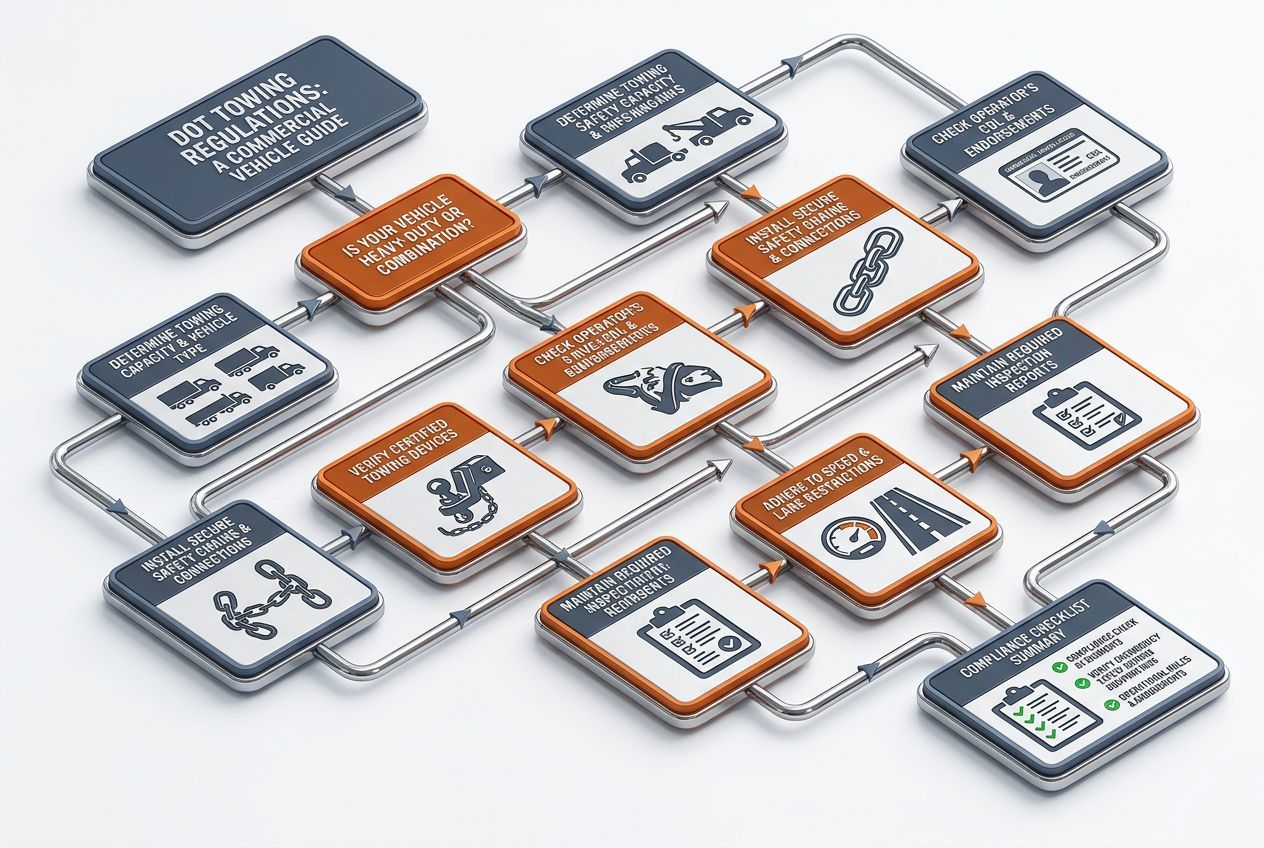
Key Takeaways
- Any tow truck over 10,001 lbs GVWR operating across state lines needs a USDOT number — registration is free through FMCSA.
- CDL thresholds kick in at 26,001 lbs GVWR; Class A is required for heavy wreckers towing large commercial vehicles.
- Hours of service rules apply to most commercial tow operators, but a 150-air-mile short-haul exemption covers many local dispatches.
- Annual DOT inspections under 49 CFR Part 396 are mandatory — a failed inspection means an immediate out-of-service order.
- Minimum liability insurance ranges from $300,000 (vehicles under 10,001 lbs) to $750,000 (vehicles over 10,001 lbs) under 49 CFR Part 387.
Compliance is Non-Negotiable: If you run a tow truck business — or you're thinking about starting one — federal compliance isn't optional. The FMCSA doesn't care if you're a solo operator with one light-duty wrecker or a fleet running heavy rotators across three states. The rules are tiered by weight, distance, and operation type, and the penalties for violations range from roadside out-of-service orders to five-figure fines. Here's exactly what applies to you.
💰
TOWING LAWS & REGULATIONS
What DOT Regulations Apply to Tow Trucks?
Understanding the Scope: DOT towing regulations under 49 CFR apply to any commercial tow truck exceeding 10,001 lbs GVWR operating in interstate commerce. These rules cover vehicle registration, driver qualifications, insurance minimums, markings, cargo securement, and record-keeping. Operators who haul disabled vehicles across state lines — even occasionally — fall under FMCSA jurisdiction the moment they cross a state line.
The Core Regulatory Framework: The core framework comes from Title 49 of the Code of Federal Regulations, specifically Parts 380–399. Think of it as a stack of compliance layers:
- Part 390: General applicability and definitions (including what counts as a "commercial motor vehicle")
- Part 391: Driver qualifications (medical certificates, driving history, drug testing)
- Part 395: Hours of service (HOS)
- Part 396: Vehicle inspection and maintenance
- Part 387: Insurance minimums
💡 Key Takeaway: Most states have adopted these federal thresholds for intrastate operations too. About 40 states mirror the FMCSA standards for in-state towing, but always check your specific state's motor carrier authority rules.
State-Specific Rules: The remaining 10-plus states set their own — sometimes lower — thresholds, so check your state's motor carrier authority rules separately. For a full breakdown by state, see our towing laws by state guide.
Do Tow Truck Companies Need a DOT Number?
USDOT Number Requirement: Yes — any tow truck company operating a vehicle with a GVWR of 10,001 lbs or more in interstate commerce must obtain a USDOT number from FMCSA. Registration is free through the FMCSA's Unified Registration System (URS) at fmcsa.dot.gov. The number must be displayed on both sides of the vehicle in letters at least 2 inches tall, along with your company name.
GVWR, Not Combined Weight: Here's where operators get tripped up: the GVWR threshold applies to the tow truck itself — not the weight of the vehicle being towed. A medium-duty wrecker rated at 19,500 lbs GVWR that only tows passenger cars still needs a DOT number if it crosses state lines, even if the total combined weight is well under 80,000 lbs.
✅ Pro Tip: If you operate strictly within one state, your DOT number requirement depends on that state's regulations. But if your drivers ever reposition a tow truck empty to a neighboring state for a pickup, that trip counts as interstate commerce under FMCSA's definition. When in doubt, register — it costs nothing and eliminates a compliance gap.
Nonconsensual Towing and DOT Numbers: For operators handling nonconsensual towing, your USDOT number and operating authority requirements don't disappear just because the vehicle owner didn't call you — if anything, FMCSA scrutinizes non-consent operators more closely, not less.
What FMCSA Regulations Apply to Commercial Towing?
Key Areas of Compliance: FMCSA towing regulations govern driver qualifications, hours of service, controlled substance testing, vehicle maintenance, and insurance for commercial tow operators. Under 49 CFR Parts 380–399, tow companies must maintain individual driver qualification files, enroll drivers in a DOT-compliant drug and alcohol testing program, and keep vehicle maintenance records on file for at least 12 months.
Out-of-Service Violations: According to FMCSA's Motor Carrier Management Information System (MCMIS) data, the industry average out-of-service violation rate sits around 20.7% — meaning roughly one in five commercial vehicles inspected gets pulled from service. Most violations involve brakes, tires, and lighting — not exotic compliance failures. The basics matter.
Mandatory File System Requirements: Here's what a compliant tow operator's file system looks like in practice:
- Driver Qualification File per driver:
- Commercial driver's license copy
- Medical examiner's certificate (DOT physical, renewed every 24 months)
- Motor vehicle record from every state where licensed in the past 3 years
- Pre-employment drug test result
- Annual review of driving record
- Drug & Alcohol Testing Program:
- Pre-employment testing required
- Random testing pool set at 50% of average driver count annually under 49 CFR Part 382
- Vehicle Maintenance Records:
- Every inspection, repair, and service entry
- Kept for 12 months active, 6 months after vehicle leaves your fleet
⚠️ Warning: California operators face an additional layer: the California Air Resources Board (CARB) requires tow trucks to meet stricter emissions standards, and the California Highway Patrol issues separate Motor Carrier Permits. Texas tow operators must hold a TDLR-issued tow truck license on top of federal requirements. Florida runs its towing licensing through DHSMV with separate tracks for consent and non-consent operations.
State-Level Licensing: For a deeper look at state-level tow truck license requirements, we cover those separately.
Do Tow Truck Drivers Need a CDL?
CDL Thresholds for Tow Trucks: Tow truck drivers need a CDL when operating a vehicle or combination with a GVWR exceeding 26,001 lbs, or when towing a unit over 10,001 lbs. A Class A CDL is required for heavy-duty wreckers towing large commercial vehicles like semi-trucks or buses. A Class B CDL covers single vehicles over 26,001 lbs not towing above the 10,001-lb threshold.
CDL Class Breakdown: Under 49 CFR §383.91, the thresholds break down like this:
- Class A CDL: Any combination of vehicles with a combined GVWR of 26,001 lbs or more, where the towed unit exceeds 10,001 lbs
- Class B CDL: Single vehicle over 26,001 lbs, or towing a unit at or under 10,001 lbs
- No CDL required: Vehicles under 26,001 lbs GVWR towing units under 10,001 lbs
Practical Example: You're running a 35,000-lb GVWR rotator wrecker. A disabled 18-wheeler calls — loaded, it weighs 72,000 lbs. The combination weight hits 107,000 lbs (requiring an overweight permit anyway), but the CDL requirement triggered the moment your truck hit 26,001 lbs GVWR. Class A, no exceptions.
⚠️ Warning: A driver holding a Class B CDL cannot legally operate that rotator in a towing combination where the towed unit exceeds 10,001 lbs, regardless of experience or employer approval. The FMCSA doesn't make exceptions for seasoned operators who "know what they're doing." The license class has to match the vehicle configuration.
State-Specific Endorsements: Some states require additional endorsements for specific towing setups — Illinois and New York, for example, have state-specific requirements layered on top of federal CDL classes. Always verify your state's motor carrier authority rules before putting a driver in a configuration they haven't been cleared for.
What Are the DOT Weight Limits for Towing?
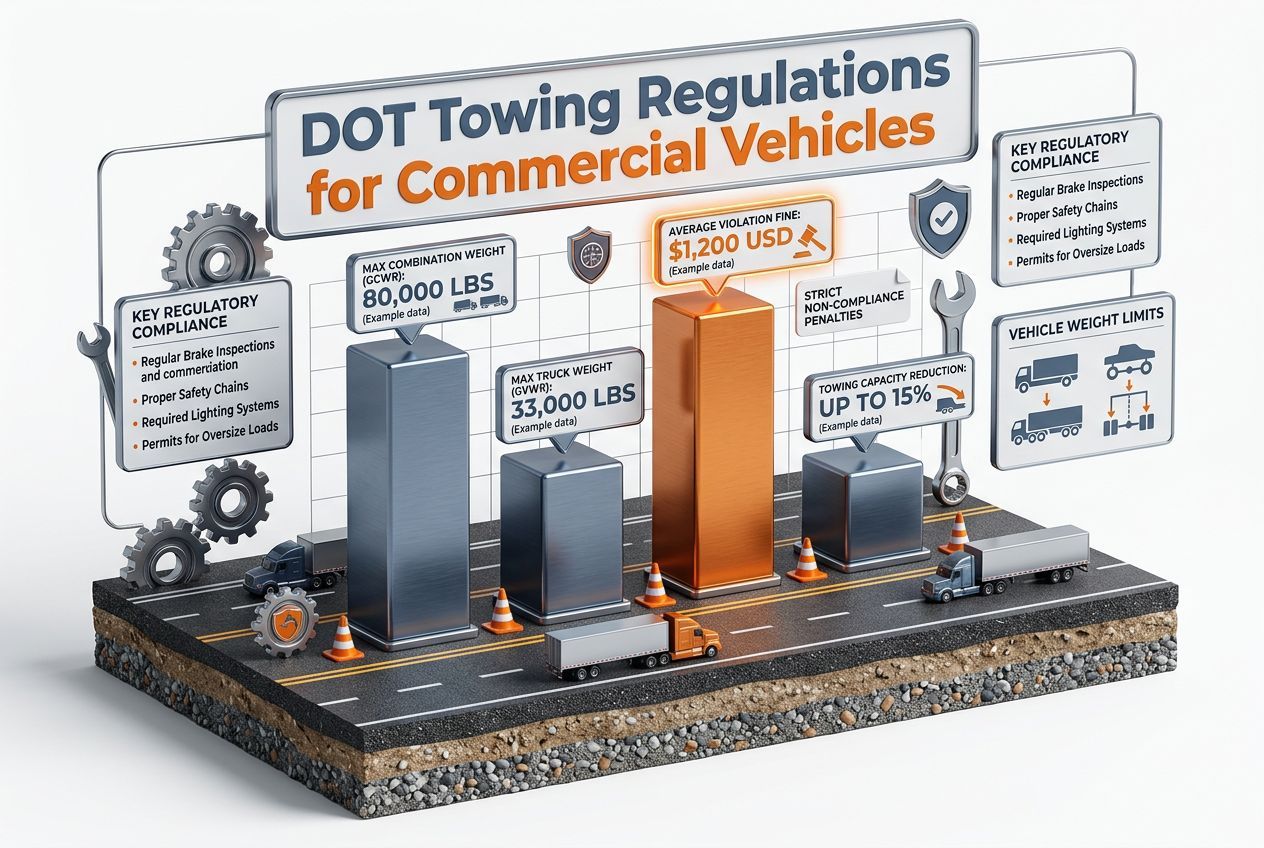
Federal Weight Maximums: The federal gross vehicle weight limit on interstate highways is 80,000 lbs, with single-axle limits of 20,000 lbs and tandem-axle limits of 34,000 lbs under 23 CFR 658.17 and the Federal Bridge Formula. The combined weight of the tow truck and towed vehicle must stay within these limits — or you'll need a state-issued overweight permit.
What Are the DOT Weight Limits for Towing? — data table
| Weight Category |
Federal Limit |
Regulatory Citation |
| Maximum gross vehicle weight |
80,000 lbs |
23 CFR 658.17 |
| Single axle |
20,000 lbs |
23 CFR 658.17 |
| Tandem axle |
34,000 lbs |
23 CFR 658.17 |
| GVWR threshold for DOT number |
10,001 lbs |
49 CFR 390.5 |
| CDL threshold (combination) |
26,001 lbs GVWR |
49 CFR 383.91 |
Source: FMCSA (fmcsa.dot.gov), Federal Highway Administration bridge formula tables
Overweight Permits for Recovery: The good news for heavy-wrecker operators: most states allow overweight permits specifically for disabled vehicle recovery. These permits let you move a combination that exceeds the standard 80,000-lb ceiling to get a broken-down rig off the road — but the permit has to be in the cab before you roll. Retroactive permits don't exist.
📊 Quick Fact: Most states allow overweight permits specifically for disabled vehicle recovery, but these permits must be obtained before the tow begins.
Utilizing Towing Tools: Use our towing capacity lookup tool to cross-reference vehicle GVWR data before configuring a new truck for your fleet. If you're matching tow vehicles to specific recovery scenarios, the tow vehicle matchmaker can help you identify configurations that stay within legal thresholds.
Are Tow Trucks Subject to Hours of Service Rules?
HOS Rules Apply: Yes — tow trucks operating as commercial motor vehicles in interstate commerce must follow FMCSA hours of service rules under 49 CFR Part 395. Drivers are limited to 11 hours of driving within a 14-hour on-duty window after 10 consecutive hours off duty. The 60/70-hour weekly limits also apply.
Short-Haul Exemption: But there's a meaningful exemption most local tow operators qualify for. Under 49 CFR 395.1(e), tow truck drivers operating within a 150 air-mile radius of their normal work reporting location and returning to that location at the end of each duty period qualify for the short-haul exemption. This eliminates the ELD (electronic logging device) requirement and relaxes some daily log requirements — but the 11/14-hour driving and on-duty limits still apply.
💡 Key Takeaway: The 150-air-mile short-haul exemption can relieve tow truck drivers from ELD requirements, but daily driving and on-duty limits still apply.
ELD Mandate: The ELD mandate has been in effect since December 2019 for most carriers. If you're outside the short-haul exemption — running interstate recovery jobs beyond 150 air miles — you need a compliant ELD installed and synced. Paper logs don't cut it anymore for non-exempt operators.
Emergency Waivers: Winter months complicate HOS compliance. During major storm events, FMCSA sometimes issues regional HOS waivers for tow operators assisting with emergency response. These are temporary and jurisdiction-specific — follow FMCSA's emergency relief announcements directly at fmcsa.dot.gov rather than assuming an exemption applies to your area.
HOS and Private Property Towing: For operators wondering how DOT rules interact with local private property towing rules, the answer is that federal HOS applies to the driver regardless of whether the tow was consent or non-consent.
What DOT Inspections Are Required for Tow Trucks?
Mandatory Inspections: DOT inspections for tow trucks require an annual vehicle inspection every 12 months per 49 CFR Part 396, plus driver-conducted pre-trip and post-trip inspections every operating day. Roadside inspections can happen at any weigh station or during targeted enforcement operations — including the annual CVSA International Roadcheck, a 72-hour blitz held every June.
Key Inspection Points for Tow Trucks: Inspectors check the following on tow trucks specifically:
- Braking systems: Service brakes, trailer brakes, emergency brake function
- Tires: Tread depth (minimum 4/32" on steer axles, 2/32" on others), sidewall condition, inflation
- Lighting: All required lamps operational, including work lights and warning beacons
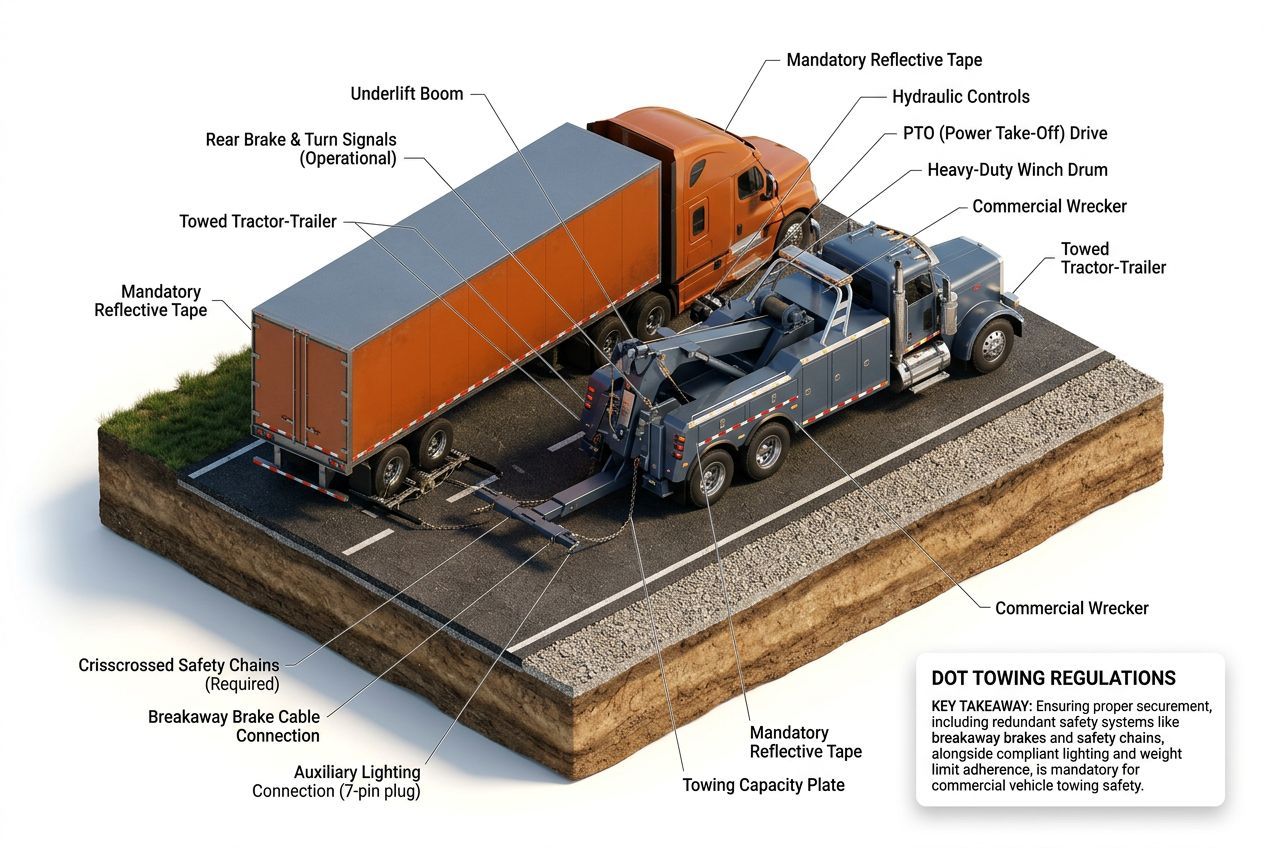
- Coupling devices: Hooks, underlift arms, wheel lift assemblies, fifth-wheel condition
- Winch and boom systems: Cable integrity, hydraulic line condition, safety latches
- Safety chains and load securement: Meets 49 CFR Part 393 cargo securement standards
⚠️ Warning: A failed roadside inspection triggers an out-of-service order — the truck stops moving until the deficiency is corrected and cleared. Brake-related violations are the single most common reason commercial vehicles get placed OOS. Don't skip the pre-trip.
Preparing for CVSA Roadcheck: For the CVSA Roadcheck in June, prep your fleet 30 days in advance. Pull every truck through a thorough third-party annual inspection, fix deferred maintenance, and audit your driver files. Inspectors during Roadcheck can also request driver qualification documents and HOS records — it's a full compliance review, not just a safety check.
Interstate Inspection Reciprocity: The DOT towing regulations cluster has additional detail on state-level inspection reciprocity — some states don't honor inspections performed in other states, which matters for operators running multi-state routes.
Impact on Consumers: Towing costs for consumers caught up in a DOT compliance stop — when their vehicle is towed because the carrier got placed OOS — can be significant. Our towing cost guide covers what those bills typically look like and who's responsible.