🔧
TOWING LAWS & REGULATIONS
How Do You Get Your Car Back After an Unauthorized Tow?
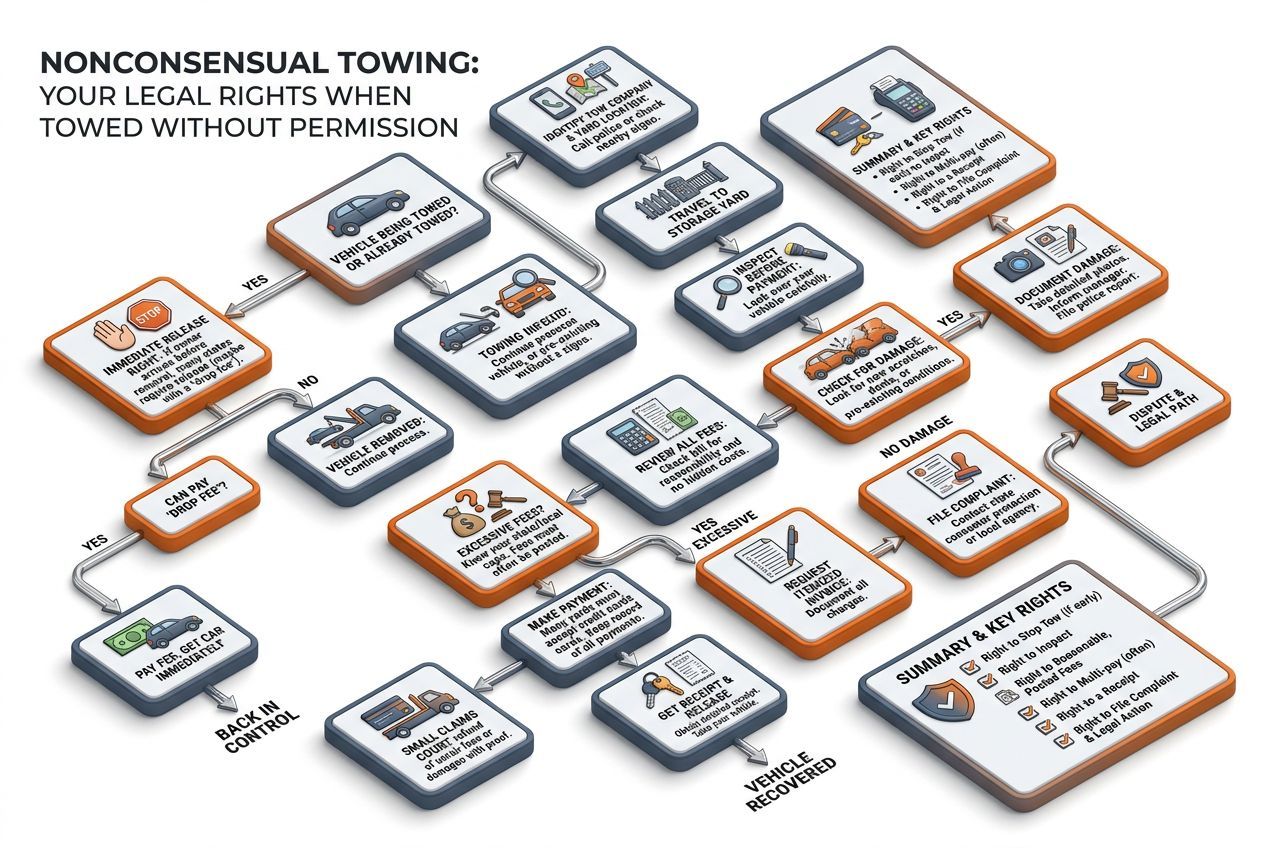
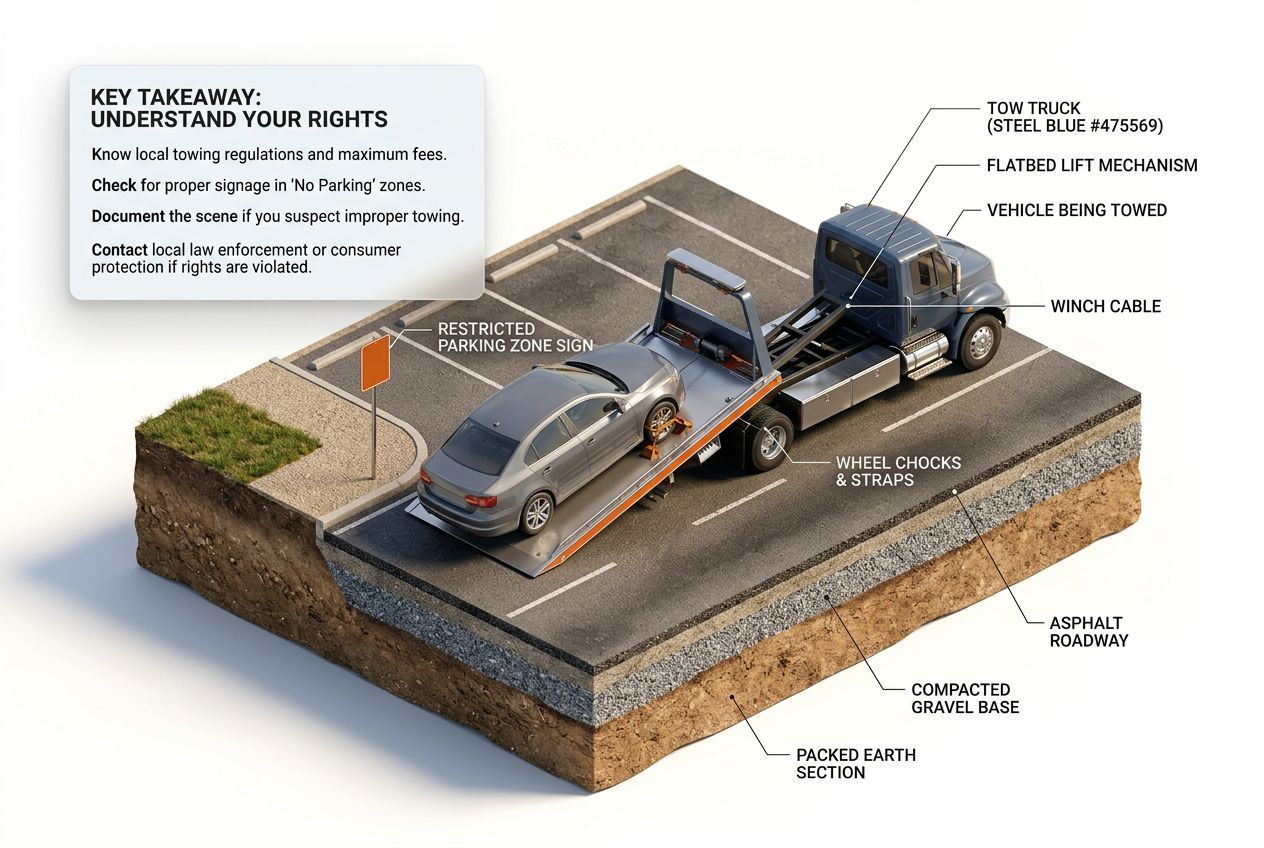
To retrieve a car after an unauthorized tow, call the non-emergency police line first, get the impound lot's name and address, then show up with your ID, vehicle registration, proof of insurance, and payment. Most states require release within one hour of your arrival.
Step-by-step process to retrieve your vehicle:
Here's the step-by-step that works in most states:
- Call 311 or your local police non-emergency line. Give them your license plate. They'll confirm if it was towed and to which lot. If it's not in the system, it may have been stolen — file a report immediately.
- Get to the lot quickly. Storage fees start accruing fast. Virginia bars storage charges for the first 24 hours after a non-consensual tow; in Texas, a storage facility can charge up to $22.85 per day from the start.
- Bring required documents. Valid government-issued ID, vehicle registration, and proof of ownership (title or loan documents if it's financed). Some states also require proof of insurance.
- Pay under protest if needed. If you believe the tow was illegal or the fees are inflated, pay to get your vehicle back, but write "paid under protest" on the receipt. This preserves your legal right to dispute the charges without waiving them.
✅ Pro Tip: Paying "under protest" ensures you get your vehicle back promptly while maintaining your right to legally challenge the tow charges later.
- Photograph everything. Before you leave the lot, photograph posted signage (or the lack of it), your vehicle's condition, and the itemized receipt. These photos are your evidence if you pursue a hearing or small claims case.
📊 Quick Fact: Storage fees are a major cost factor. Acting within 24 hours of a tow can significantly reduce your out-of-pocket expenses, as daily rates typically range from $20 to $75.
For a detailed look at how fees compound and what's reasonable to expect, see our full guide on how much towing costs.
🛡️
TOWING LAWS & REGULATIONS
Can You Sue a Towing Company for Towing Your Car Illegally?
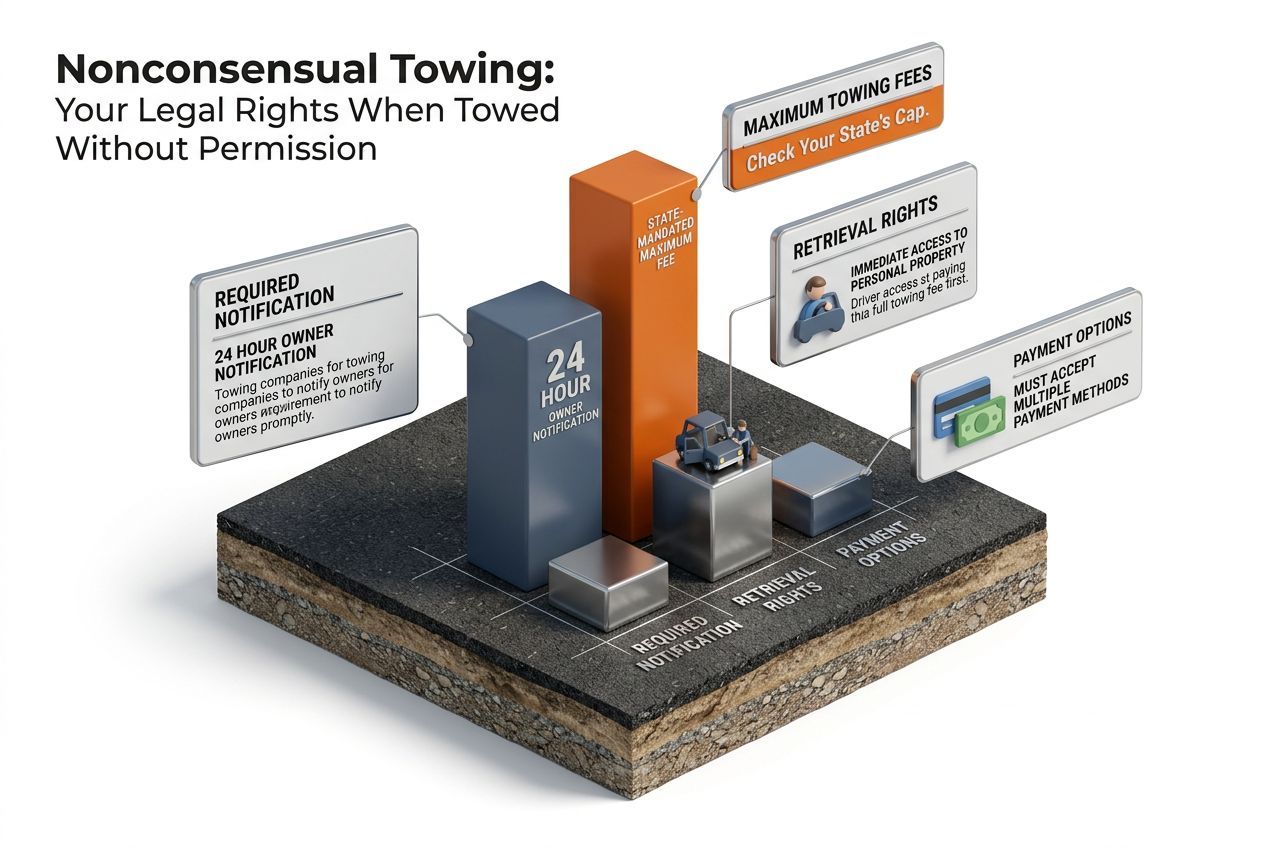
Yes — you can sue for an illegal nonconsensual tow. Many states let you recover actual damages (towing and storage fees paid), and some add statutory penalties — for example, four times the charges in California and $1,000 plus three times the fees in Texas. Small claims court is the most accessible venue.
Understanding statutory penalties:
Real numbers example: Say you were towed from a lot in Austin, TX with no posted signage. You paid $272 for the tow and $22.85 for one day of storage — a total of $294.85. Under Texas Occupations Code §2308.404, a company that violates the chapter is liable for your damages and the fees, and if the violation was intentional, knowing, or reckless, it is liable for $1,000 plus three times the fees — here, $1,000 + $884.55 = $1,884.55.
In California, an operator who charges excessive rates is liable for four times the amount charged under Vehicle Code §22658. If you paid a $250 tow and $65 in storage, that is $1,260.
When a lawsuit might not succeed: What won't work: Suing over a tow you legally deserved — even if the lot was poorly marked — is unlikely to succeed. If your vehicle genuinely violated a posted rule and the property owner followed authorization procedures, courts typically uphold the tow even if you disagree with the parking restriction. Your strongest cases involve missing signage, lack of written authorization, or fees that exceed the state cap.
💡 Key Takeaway: Your strongest legal cases for an illegal tow involve clear violations like missing signage, absence of written authorization, or charges exceeding state-mandated caps.
For more detail on the complaint and legal process, visit our illegal towing complaints guide.
📋
TOWING LAWS & REGULATIONS
What Are the State Laws on Nonconsensual Towing Fees?
State nonconsensual towing fee limits vary dramatically. California limits charges to local law enforcement or CHP-approved rates and requires after-hours release. Texas sets statewide caps through TDLR. Florida requires release for no more than half the posted rate if the owner arrives before the truck departs. Lightly regulated states leave fees largely to market forces.
Here's a comparison of key state rules, based on the statutes and regulator pages linked below:
What Are the State Laws on Nonconsensual Towing Fees? — data table
| State |
Max Base Tow Fee |
Daily Storage Cap |
Drop Fee Required? |
Statutory Penalty |
| California |
Local law enforcement agreement or CHP-approved rate |
Same rate limits |
Yes (half the regular towing charge) |
4× the amount charged (excessive rates) |
| Texas |
$272 (up to 10,000 lbs) |
$22.85/day (25 ft or less) |
Capped at $135 (up to 10,000 lbs) |
$1,000 + 3× fees (intentional, knowing, or reckless) |
| Florida |
Set by county or municipality |
Set locally |
Yes (up to half the posted rate) |
Removal and storage costs, damages, attorney's fees |
| Virginia |
$210 hookup and initial tow (passenger car), unless a locality sets its own limits |
No charge for first 24 hours |
Not set by statute |
10× the charges in Planning District 8 |
Sources: California Vehicle Code §22658; Texas Occupations Code ch. 2308 and TDLR; Florida Statutes §715.07; Virginia Code §46.2-1233.1 and §46.2-1233.3
⚠️ Warning: These fee caps typically apply only to light vehicles (under 10,000 lbs GVWR). For larger vehicles like dually trucks, RVs, or trailers, state fee caps often do not apply, and storage bills can quickly exceed $150/day.
Note that these caps often apply only to light vehicles (under 10,000 lbs GVWR). If you drive a large pickup, a dually, or an RV, many state fee caps don't apply — and storage bills can easily hit $150/day or more.
You can also use our towing laws by state tool to look up the specific rules and fee schedules for your state.
⚙️
TOWING LAWS & REGULATIONS
How Do You File a Complaint Against a Predatory Towing Company?
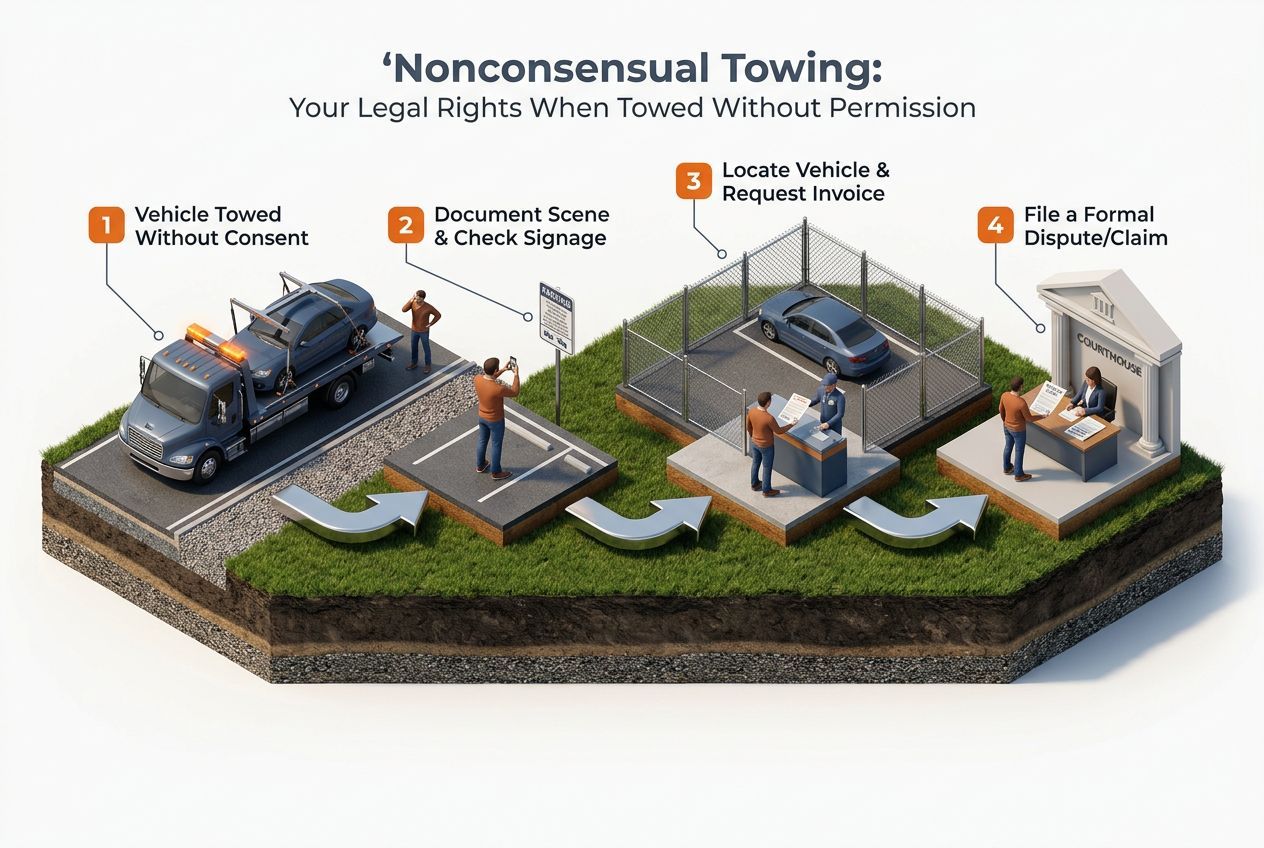
Filing a complaint against a predatory towing company starts with your state attorney general's consumer protection division, which has the authority to investigate, fine, and revoke tow company licenses. Document every detail first — photos of signage, your itemized receipt, timestamps, and any communication with the company.
Where to file a complaint and what to include:
Here's where to file and what to include:
- State Attorney General's Office — Most states have an online consumer complaint portal. Search "[your state] attorney general consumer complaint" to find it. This is the highest-leverage filing for repeat offenders.
- Local police or sheriff's department — Because towing companies must notify police of each nonconsensual tow, local law enforcement often tracks complaint patterns and can flag companies for audit.
- City vehicle-for-hire licensing office — In cities like Los Angeles, Chicago, and Houston, tow companies must hold a municipal license. License complaints can trigger inspections.
- FMCSA — If the towing company crosses state lines or is licensed as a commercial carrier, the Federal Motor Carrier Safety Administration accepts safety and consumer complaints.
- Better Business Bureau / FTC — Less enforcement authority, but complaint volume data from these bodies influences state-level regulatory attention.
✅ Pro Tip: Thorough documentation — including photos of signage (or its absence), your itemized receipt, and communication timestamps — is crucial for strengthening your complaint.
For the full complaint-filing process and what documentation you need, our predatory towing laws guide walks through it step by step.
🚛
TOWING LAWS & REGULATIONS
What Is the Difference Between a Police-Ordered Tow and a Private Property Tow?
A police-ordered tow is initiated by law enforcement for public safety reasons — accidents, DUIs, abandoned vehicles blocking roads — and follows a municipal fee schedule. A private property tow is authorized by a property owner to remove unauthorized vehicles from lots or driveways and is governed by stricter state consumer-protection statutes on signage, notice, and fee limits.
Key differences in towing scenarios:
The practical difference is significant.
- When police order the tow:
- Fees are set by the city or county under a rotation contract — typically lower and more predictable.
- You usually pay at a city-designated impound lot with standard redemption hours.
- Storage fees follow a published municipal schedule.
- When a private property tow company takes your car:
- Fees can be higher and vary by company (within any applicable state cap).
- Signage and authorization requirements must be strictly followed, or the tow is unlawful.
- You have more legal remedies if the rules weren't followed.
💡 Key Takeaway: Even if you're parked in a commercial lot, if the tow isn't police-ordered, it's a private property tow. This means the tow company must meet strict signage, written authorization, and police notification requirements for the tow to be legal.
One scenario that catches people off guard: you're parked at a strip mall after the restaurant closes. The property manager calls a tow company at 11 PM. This is a private property tow — not a police action — so the tow company needs posted signs, written authorization from the property, and police notification. If any of those steps are missing, you've got grounds to dispute the charge.
For police-authorized scenarios, our article on DOT towing regulations covers the federal framework that governs commercial towing operations on public roads.
Understanding private property towing rules in your state is the single best way to know whether a tow was legal before you pay a dime.