💡 Key Takeaway: GVWR and towing capacity are two different ratings — confusing them is the most common (and dangerous) mistake drivers make 💡 Key Takeaway: Recovery towing costs significantly more than a standard tow and requires specialized equipment like rotator cranes and air cushion systems ⚠️ Warning: Non-consent tows, storage fees, and administrative charges are the most common sources of billing surprises — know these terms before you need a tow 💡 Key Takeaway: Tow truck type matters: flatbeds handle AWD and luxury vehicles; wheel-lifts handle routine tows; rotators handle overturned commercial rigs up to 75 tons 📊 Quick Fact: Heavy commercial towing has its own regulatory vocabulary — FMCSA thresholds, overweight permits, and escort requirements apply to vehicles over 10,001 lbs GVWR
What Are the Basic Towing Terms Every Driver Should Know?
Understanding the essentials: A towing terms glossary starts with the foundational vocabulary every driver needs — tow bar, tow dolly, flatbed, wheel-lift, and hook-and-chain. These basic towing definitions help you communicate clearly with operators, compare service quotes, and make faster, smarter decisions during roadside emergencies. Here's the core list.
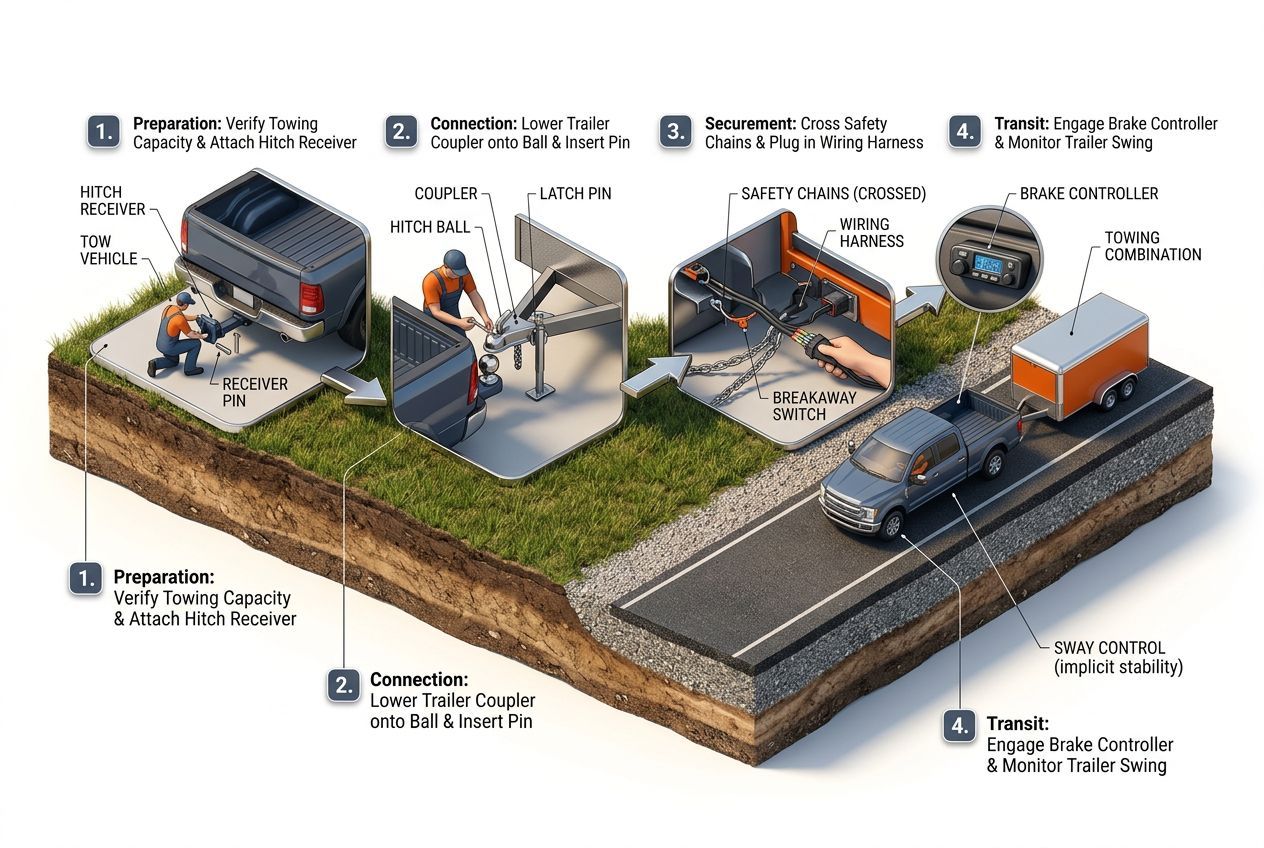
- Tow Bar — A rigid triangular frame that connects a disabled vehicle to the tow vehicle, allowing all four wheels to stay on the ground. Common in flat towing setups for RVs. For more on that method, see our flat towing guide.
- Tow Dolly — A two-wheeled trailer that lifts only the front axle of the disabled vehicle while the rear wheels roll freely. Works for front-wheel-drive cars. Doesn't work for AWD or 4WD vehicles without disconnecting the driveshaft.
- Flatbed / Rollback — A tow truck with a flat, hydraulic bed that tilts to ground level. The vehicle rides fully loaded on the bed. Best option for all-wheel-drive vehicles, low-clearance cars, and anything with drivetrain damage.
- Wheel-Lift — A tow truck that uses a metal yoke to lift either the front or rear axle off the ground while the other two wheels roll. Faster to deploy than a flatbed, commonly used for routine urban tows.
- Hook-and-Chain (Sling) — The old-school method: chains wrap under the vehicle's frame or axle and lift one end. Largely obsolete for passenger cars because it can damage bumpers, fairings, and unibody frames. You'll still see it on some older light-duty wreckers.
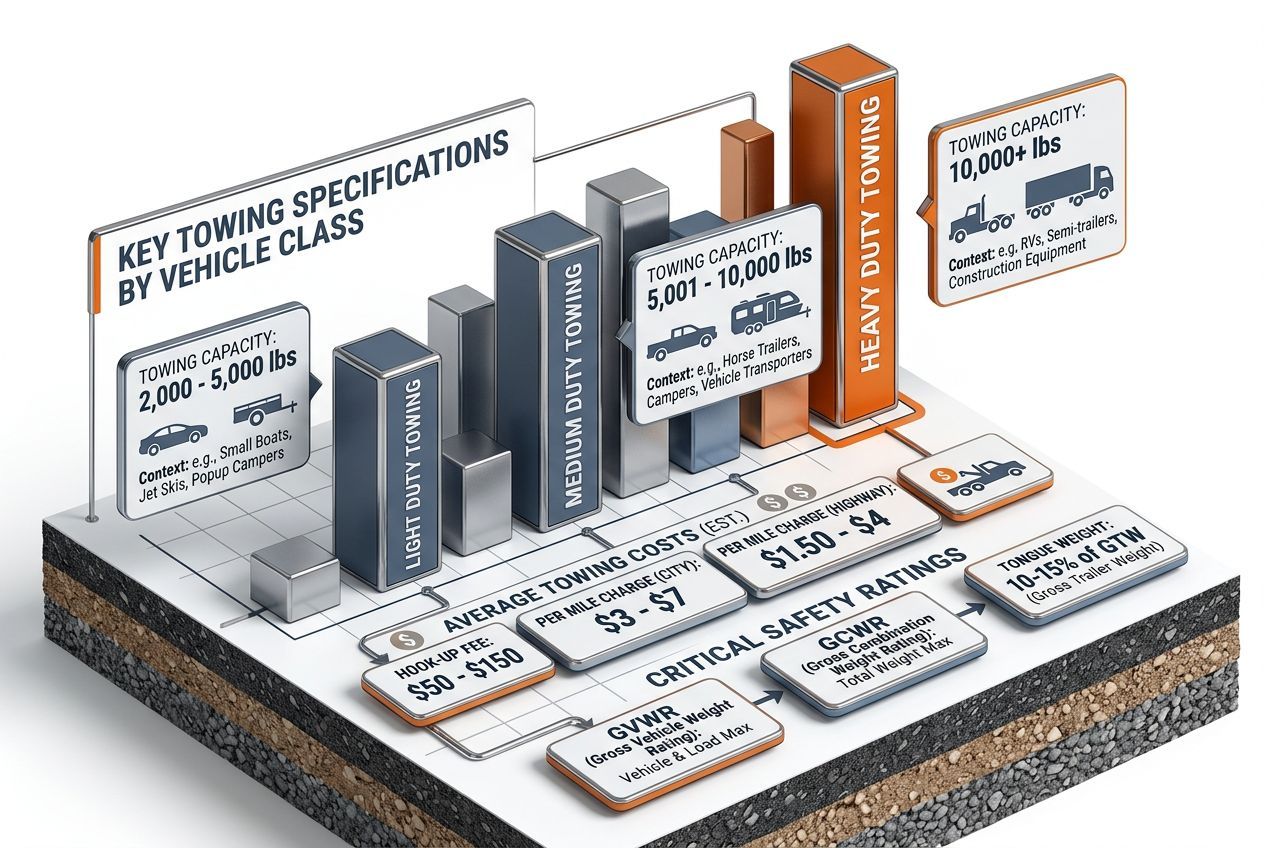
- Hookup Fee — The flat charge for attaching your vehicle to the tow truck, separate from the per-mile rate.
📊 Quick Fact: According to AAA, average hookup fees run $50–$100 before the per-mile charge starts.
- Per-Mile Rate — The charge applied after the hookup fee, typically $2–$7 per mile depending on truck type, geography, and time of day.
💡 Key Takeaway: Long-distance tows add up fast — a 50-mile flatbed tow can run $200–$450 total. See our full towing cost guide for regional breakdowns.
- Drop Fee — An additional charge applied when the tow truck is already en route and the call is cancelled. Usually $35–$75.
- Impound Tow — A tow authorized by law enforcement or property management, not the vehicle owner. Triggers storage fees immediately upon arrival at the impound lot.
- Winch-Out — A service where the tow truck's winch cable pulls a stuck or off-road vehicle back to a drivable surface without a full tow. Costs less than a full recovery but more than a standard hookup.

What Does GVWR Mean in Towing?
Defining Gross Vehicle Weight Rating (GVWR): GVWR is the maximum total weight a vehicle can safely carry, as set by the manufacturer. It includes the vehicle's curb weight, passengers, cargo, fuel, and tongue weight from any attached trailer. This critical rating is stamped on the driver's side door jamb placard and represents the legal safety ceiling you must never exceed.
⚠️ Warning: Here's where drivers get into trouble: GVWR is not the same as towing capacity. A truck rated at 7,500 lbs GVWR might tow 10,000 lbs — but that doesn't mean the truck itself can weigh 17,500 lbs total. They're measuring two different things. Violating GVWR can void your insurance and create liability in an accident.
Related Weight Terms to Know
The related terms you need to know for comprehensive weight understanding include:
- GAWR (Gross Axle Weight Rating) — The maximum load each individual axle can bear. Your truck might have a GVWR of 7,200 lbs, but if you load the rear axle beyond its 3,900 lb GAWR, the springs, brakes, and tires are operating outside spec.
- GCWR (Gross Combined Weight Rating) — The maximum allowable weight of the tow vehicle plus the fully loaded trailer combined. This is the master ceiling for the entire rig. If your truck's GCWR is 18,000 lbs and the truck weighs 6,200 lbs loaded, your max trailer weight is 11,800 lbs — regardless of what the hitch says.
- Curb Weight — The weight of the vehicle with a full tank of fuel and standard equipment, but no passengers or cargo.
- Tongue Weight — The downward force the trailer's coupler exerts on the hitch ball.
✅ Pro Tip: Ideal tongue weight is 10–15% of total trailer weight. Too little causes trailer sway; too much overloads the rear axle. Use our payload calculator to run the numbers before you hitch up.
- Payload Capacity — Covered in detail in the next section.
📊 Quick Fact: Per the FMCSA (fmcsa.dot.gov), commercial vehicles with a GVWR over 10,001 lbs are subject to federal safety regulations, including driver qualification rules and inspection requirements. That threshold matters when you're shopping for a truck to tow heavy.