Skip to content
🏗️ COMMERCIAL & HEAVY TOWING

How Much Does It Cost to Tow a Semi Truck?

Published · Updated · 12 min read
MarkUpdated May 10, 2026FHWA — Commercial Vehicle Size and Weight Program
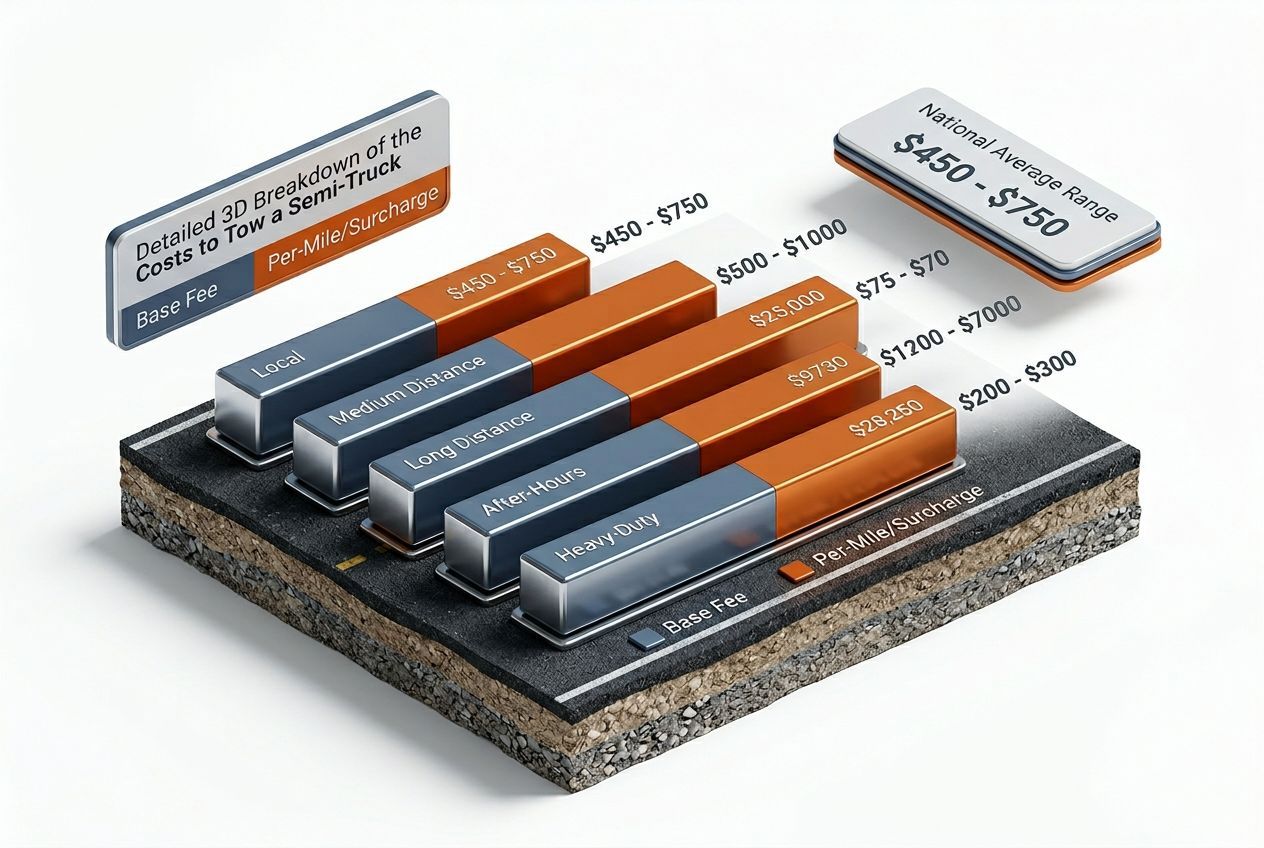
Semi-truck towing cost ranges by service type: hookup, mileage, and recovery
Key Takeaways
  • Per-mile rates for semi truck towing run $4–$15, with short-haul flat rates of $500–$1,000 for tows under 10 miles
  • A loaded 18 wheeler costs 30–60% more to tow than an empty one — cargo transfer alone adds $1,000–$5,000
  • Accident recovery with a rotator crane typically bills at $500–$800/hour, with total costs reaching $5,000–$50,000+
  • Most commercial insurance policies cap towing coverage at $2,500–$10,000 per incident — often well below actual cost
  • Owner-operators can cut towing expenses significantly with a $150–$400/year roadside assistance plan

Semi towing is a completely different animal from towing a passenger car — average towing costs for a sedan or SUV won't translate to a Class 8 rig. The equipment is heavier, the rigs are heavier, and when something goes sideways on a mountain pass or busy interstate, the costs stack up fast. Here's what you actually need to know before you're standing on the shoulder at 2 a.m. with a busted axle.


💰
COMMERCIAL & HEAVY TOWING

How Much Does It Cost to Tow a Semi Truck Per Mile?

Standard Towing Rates: Semi truck towing cost typically runs $4–$15 per mile, with a dispatch or hook-up fee of $250–$600 added on top. For shorter distances, tows under 10 miles often carry a flat rate of $500–$1,000. When facing longer hauls, such as 100+ miles, expect costs to reach $5,000–$17,000 or more. This estimate is for a straightforward tow on a flat highway with an empty trailer, meaning no complications.

Regional Rate Variations: Regional pricing matters more than most operators expect. On competitive interstate corridors — think I-40, I-10, or I-80 through metro areas — you'll find rates closer to $4–$8/mile with faster response times. Drive off that corridor into rural Wyoming or eastern Montana, and the same tow can hit $12–$15/mile. There are fewer rigs capable of handling a Class 8 truck out there, and the provider knows it.

Real-World Example: Consider a bobtail tractor that breaks down 40 miles outside of Amarillo on I-40. You're looking at a $400 hook-up fee plus 40 miles at $7/mile — that's $680 in mileage. The total bill would be roughly $1,080. Now, imagine adding a 53-foot loaded dry van to that scenario, and you're potentially doubling that figure before cargo transfer is even discussed.

For a broader look at how commercial towing rates are structured, our commercial towing rates guide breaks down per-mile vs. flat-rate pricing models in detail.


📊
COMMERCIAL & HEAVY TOWING

How Much Does It Cost to Tow a Loaded 18 Wheeler?

Increased Costs for Loaded Trailers: Towing a loaded 18-wheeler costs 30–60% more than an empty one, typically ranging from $1,500 to $6,000+ for a standard tow. When cargo must be off-loaded first — which happens any time the gross weight exceeds what the wrecker can safely move — add another $1,000–$5,000 in labor and equipment.

Specialized Cargo Premiums:

  • Temperature-sensitive reefer loads
  • Hazardous tanker cargo These types of loads push costs even higher due to the specialized handling and equipment required.

Physics of Heavy Loads: The reason for the premium is simple physics. A loaded tractor-trailer can tip the scales at 80,000 lbs — the federal maximum on the Interstate System under 23 CFR 658.17. That immense weight requires a heavy-duty wrecker rated for Class 8 recovery, not the standard Class 4–6 units used for box trucks and pickups (see the FHWA weight classes). These heavy-duty rigs are expensive to operate, and there are far fewer of them available.

⚠️ Warning: A standard 50-ton rotator cannot safely right an overturned tanker carrying a full hazmat load. Those recoveries require specialized contractors, environmental response teams, and sometimes state DOT involvement. At that point, you're no longer talking about a towing bill, you're talking about a comprehensive incident response.

You'll find a full breakdown of heavy equipment types and their use cases in our types of tow trucks guide.


🔧
COMMERCIAL & HEAVY TOWING

What Factors Affect Semi Truck Towing Cost?

Key Cost Drivers: The biggest cost drivers for commercial truck towing are distance, vehicle weight, time of day, road conditions, and whether recovery work is required. A daytime tow of an empty bobtail on a flat highway is the cheapest possible scenario. Everything else adds cost from there.

Here's a breakdown of the major variables:

What Factors Affect Semi Truck Towing Cost? — data table
Factor Cost Impact Notes
Distance (per mile) $4–$15/mile + $250–$600 hook-up Rural routes hit the high end
Vehicle configuration +30–60% for loaded trailer Cargo transfer billed separately
Time of day / night / weekend +15–30% after-hours surcharge Many providers charge holiday premiums
Recovery vs. simple tow $500–$800/hr for rotator 3–8 hrs typical for rollover scenes
Winter / ice conditions +20–50% in mountain states I-70 CO, I-80 WY, I-90 MT corridors

Data sourced from industry rate surveys, FMCSA incident data, and towing provider rate sheets. See Sources section.

Winter Towing Considerations: Winter towing deserves a specific call-out. According to state DOT incident data from Colorado and Wyoming, semi recovery events on mountain passes in January–February average 40% higher than summer rates. Wait times can also stretch to 4–6 hours when multiple rigs go down during the same storm. If you're running I-70 through the Eisenhower Tunnel corridor in February, this isn't a hypothetical risk.
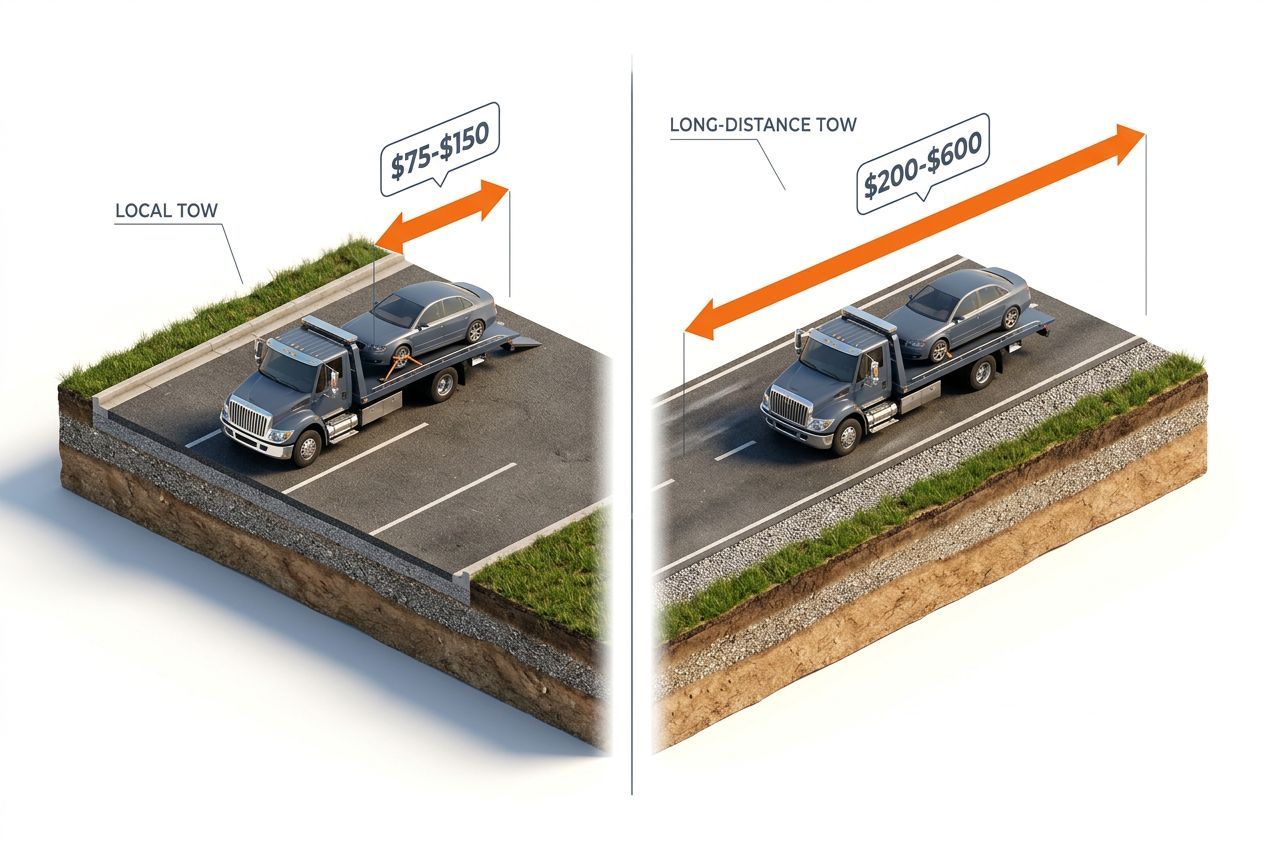

Local versus long-distance semi-truck towing cost comparison
🛡️
COMMERCIAL & HEAVY TOWING

How Much Does Semi Truck Recovery Cost After an Accident?

Accident Recovery Expenses: Post-accident semi truck recovery runs $5,000–$75,000 for most incidents. Catastrophic rollover scenes involving hazmat or cargo spills can push costs past $100,000. Insurance adjusters typically negotiate these charges after the fact, but the wrecker and recovery company are legally entitled to invoice for every hour and piece of equipment deployed.

A typical accident recovery bill breaks down like this:

  • Rotator crane deployment: $500–$800/hour × 4–6 hours = $2,000–$4,800
  • Traffic control / scene management: $500–$2,000
  • Cargo off-load and transfer: $1,000–$5,000
  • Environmental cleanup (if applicable): $5,000–$50,000+
  • Road damage assessment (some states): Billed separately by DOT

Our dedicated page on semi truck towing cost covers accident recovery invoicing in more detail, including how to dispute inflated charges.


📋
COMMERCIAL & HEAVY TOWING

How Much Does Semi Truck Towing Cost? Use the Calculator

Rates change by region, load status, and time of day — so your best move is to get a site-specific estimate before you call a provider. Use our free tool to get a ballpark figure for your exact situation.
Try Our Free Towing Cost Calculator


⚙️
COMMERCIAL & HEAVY TOWING

How Much Does a Heavy-Duty Rotator Tow Cost?

Rotator Tow Pricing: A heavy-duty rotator tow bills at $500–$800 per hour, and most on-scene jobs run 3–8 hours. This puts the total rotator recovery cost between $5,000 and $50,000 for most incidents. The hourly rate reflects the true cost of operating this specialized equipment: a 75-ton rotator crane costs $1,000,000–$1,500,000 to purchase, per pricing data from Miller Industries and Jerr-Dan.

When a Rotator is Needed: The rotator is used any time a standard push/pull or wheel-lift cannot safely right or extract the vehicle. Scenarios requiring a rotator include:

  • Rollovers on embankments
  • Trucks lodged in guardrails
  • Rigs that have gone over a median These all require the rotator's 360-degree boom and multi-point rigging capability for safe and effective recovery.

⚠️ Warning: Even a well-deployed rotator can't always save cargo. If a dry van has been compromised in a rollover, the structural integrity of the trailer box may be too damaged to right in place. In that case, the cargo comes out piece by piece before the trailer moves at all — and that labor clock runs the entire time.

For more on what equipment gets deployed at different recovery levels, see our commercial towing services overview.


🚛
COMMERCIAL & HEAVY TOWING

Does Insurance Cover Semi Truck Towing?

Understanding Commercial Policy Limits: Most commercial truck insurance policies include towing coverage, but the per-incident cap typically runs $2,500–$10,000. This amount often doesn't go far in a major recovery situation. Owner-operators should verify their policy's exact limit, their deductible, and whether loaded cargo transfer is a covered service before they need it.

⚠️ Warning: Standard commercial auto policies from carriers like Progressive or Great West often include basic roadside, but the fine print matters. If your policy caps towing at $5,000 and your accident recovery bill hits $40,000, you are personally liable for the substantial gap.

Supplemental Roadside Assistance: Supplemental roadside assistance plans through OOIDA (Owner-Operator Independent Drivers Association) or NationaLease run $150–$400/year and are designed specifically for truckers. These plans typically cover dispatch fees, per-mile towing up to a set distance, and some labor charges. The AAA roadside comparison on our site walks through how consumer plans compare, though commercial-specific plans from OOIDA are usually the better fit for owner-operators.

📊 Quick Fact: According to FMCSA data, there are over 500,000 large truck roadside events annually in the U.S. Coverage gaps cost operators real money, and most find out about them at the worst possible time.


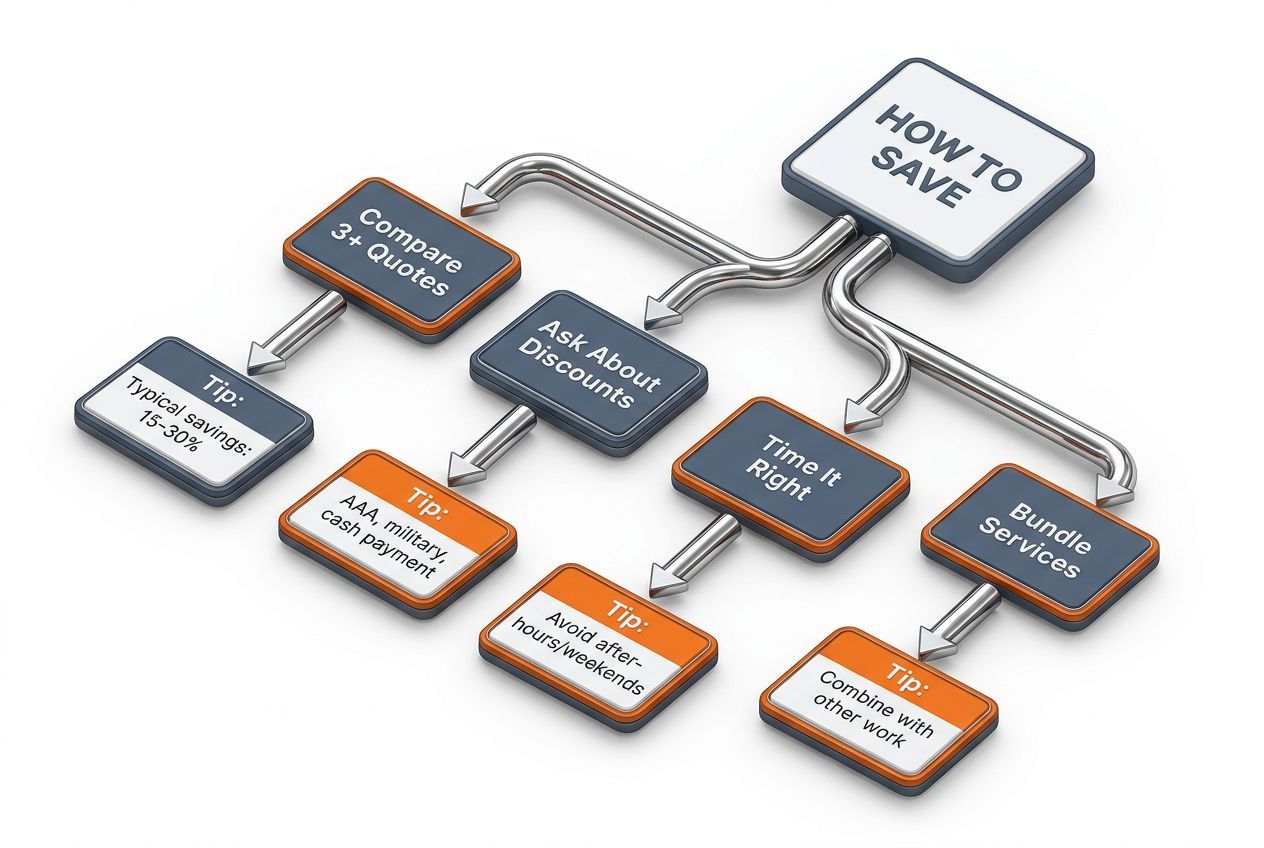
Ways to reduce semi-truck towing costs
📝
COMMERCIAL & HEAVY TOWING

How Can Owner-Operators Reduce Semi Truck Towing Costs?

Strategies for Cost Reduction: Owner-operators can meaningfully reduce semi towing expenses through three approaches: preventive maintenance, pre-vetted provider relationships, and the right assistance plan. According to ATA/TMC benchmarking data, a consistent preventive maintenance program can reduce breakdown frequency by up to 70%.

Actionable Tips to Lower Towing Expenses:

  • Lock in provider relationships before you break down. Call heavy towing companies along your regular routes, introduce yourself, and ask about pre-negotiated rates. Some providers offer fleet discounts or preferred response agreements for operators who commit to calling them first.
  • Request itemized invoices — always. Vague line items like "recovery labor" or "equipment fee" can hide double-billing. A legitimate invoice lists each charge separately, with the rate and quantity for each.
  • Carry the right assistance plan. A $250/year OOIDA plan covering your first 50 miles of towing and standard dispatch fees pays for itself after one breakdown. Compare that to a $600 hook-up fee paid out of pocket.
  • Know your route hazards in advance. If you're running mountain corridors in winter, check state DOT chain requirements before you go — getting stuck on a pass without chains isn't just dangerous, it's expensive. Our towing laws by state tool can help you check state-specific requirements.

Our medium-duty towing guide covers cost reduction strategies for operators running lighter commercial configurations, if your rig falls below the Class 8 threshold.


💰
COMMERCIAL & HEAVY TOWING

Semi Truck Towing Cost: Quick Reference

Semi Truck Towing Cost: Quick Reference — data table
Configuration Estimated Cost Range Key Variable
Bobtail tractor, short tow (<10 mi) $500–$2,000 Flat rate common
Empty tractor-trailer, highway $800–$4,000 Distance + hook-up fee
Loaded dry van, standard tow $1,500–$6,000+ Weight, cargo transfer
Loaded reefer (temp-sensitive cargo) $2,000–$8,000+ Perishable handling premium
Accident recovery, no rollover $5,000–$20,000 Equipment hours
Rollover with cargo spill $20,000–$100,000+ Rotator + cleanup

Sources: FMCSA incident data, industry rate surveys, towing provider rate sheets, TRAA/WreckMaster operator data.

For general towing cost context across vehicle types, see our how much does towing cost guide.

Sources & Methodology

  1. 1.
    FHWA — Commercial Vehicle Size and Weight Program: Federal 80,000-lb gross vehicle weight limit on the Interstate System. FHWA commercial vehicle size and weight overview
  2. 2.
    American Trucking Associations (ATA) / Technology & Maintenance Council (TMC) — Preventive maintenance benchmarking data, breakdown frequency statistics
  3. 3.
    Miller Industries / Jerr-Dan — Heavy recovery equipment specifications and purchase price data for rotator cranes (35- to 75-ton class). Miller heavy-duty wrecker and rotator buyer's guide
  4. 4.
    State DOT incident reports (Colorado, Wyoming, Montana) — Seasonal recovery cost data, mountain corridor towing surcharge documentation
  5. 5.
    FMCSA — Federal Motor Carrier Safety Regulations (49 CFR Parts 390–399): Commercial vehicle and cargo securement rules referenced in the recovery sections. 49 CFR Parts 390–399 (FMCSRs)
  6. 6.
    Vehicle weight classes (Class 4–8) — FHWA GVWR classes as charted by the U.S. Department of Energy's Alternative Fuels Data Center. AFDC vehicle weight classes chart

Rate ranges in this article reflect industry surveys, towing provider rate sheets, and owner-operator forum data aggregated as of early 2026. Actual costs vary by region, provider, and incident complexity.

TowingServiceHub is reader-supported: we may earn money from ads and from some links on this page. See our editorial policy.

Mark — Founder & Editor

Mark

Founder & Editor

Mark is the founder and editor of TowingServiceHub, which he launched in 2026 after struggling to find clearly sourced towing costs and truck specs. He works in enterprise technology and tows his own boats, trailers, and equipment, so he knows the questions drivers actually ask.

Read full bio →

Need a tow truck right now?

Browse vetted local providers in your area. Real Google ratings, verified business info, free to use.

Or browse all 50 states from our directory

Frequently Asked Questions

Semi truck towing cost averages $4–$15 per mile depending on region, load status, and equipment required. Urban corridors trend toward the lower end; rural and mountain routes hit $10–$15/mile. A dispatch or hook-up fee of $250–$600 is almost always charged on top.

A standard highway tow for an 18 wheeler runs $800–$6,000+ depending on distance and load. If cargo must be transferred to another truck first, add $1,000–$5,000. Night or weekend calls typically carry a 15–30% after-hours surcharge on top of base rates.

A tow moves a disabled vehicle to a shop or yard. Recovery involves uprighting, extracting, or stabilizing a vehicle that can't be directly towed — like a rollover or ditch extraction. Recovery costs significantly more due to rotator crane hours, rigging labor, and potential environmental cleanup.

Most commercial policies include towing coverage capped at $2,500–$10,000 per incident. That ceiling rarely covers major recovery events. Owner-operators should supplement with an OOIDA or similar commercial roadside plan and verify whether their policy covers loaded cargo transfer separately.

A bobtail tractor tow runs $500–$2,000 for most short-haul jobs — the lowest cost tier in semi towing. Add a loaded 53-foot trailer and you're looking at $1,500–$6,000+ before any recovery work. The trailer's gross weight determines which equipment class is required, which drives the rate.

Related Articles

Explore More Towing Guides

Browse all 157 expert guides and 10 free tools.