🔧
TOWING LAWS & REGULATIONS
How Does a Tow Company Lien Differ from a Mechanic's Lien?
Similarities and Differences: A tow company lien on a car and a mechanic lien towing claim are both possessory liens, but they arise from different services and are often governed by separate statutes. A towing lien covers removal and storage; a mechanic's lien covers repair labor and parts. In California, for example, Vehicle Code §3068 governs mechanic's liens while §22851 covers towing and storage liens — different rules, different timelines.
Practical Implications: The practical difference matters significantly:
- A mechanic's lien typically has a longer notice-to-sale timeline (up to 30 days for vehicles under $4,000 in some states).
- A towing lien sale can proceed faster because storage costs compound daily and vehicles are often left abandoned quickly.
- Some states — including Texas — bundle both under a single "garageman's lien" statute, which means a shop that both tows and repairs your car can consolidate claims under one lien.
✅ Pro Tip: If you're dealing with combined charges (e.g., tow + unauthorized repairs), consult a consumer protection attorney to clarify which fees fall under which lien category. Small claims court filing fees (typically $30–$75) can be a worthwhile investment.
🛡️
TOWING LAWS & REGULATIONS
How Do Towing Lien Laws Vary by State?
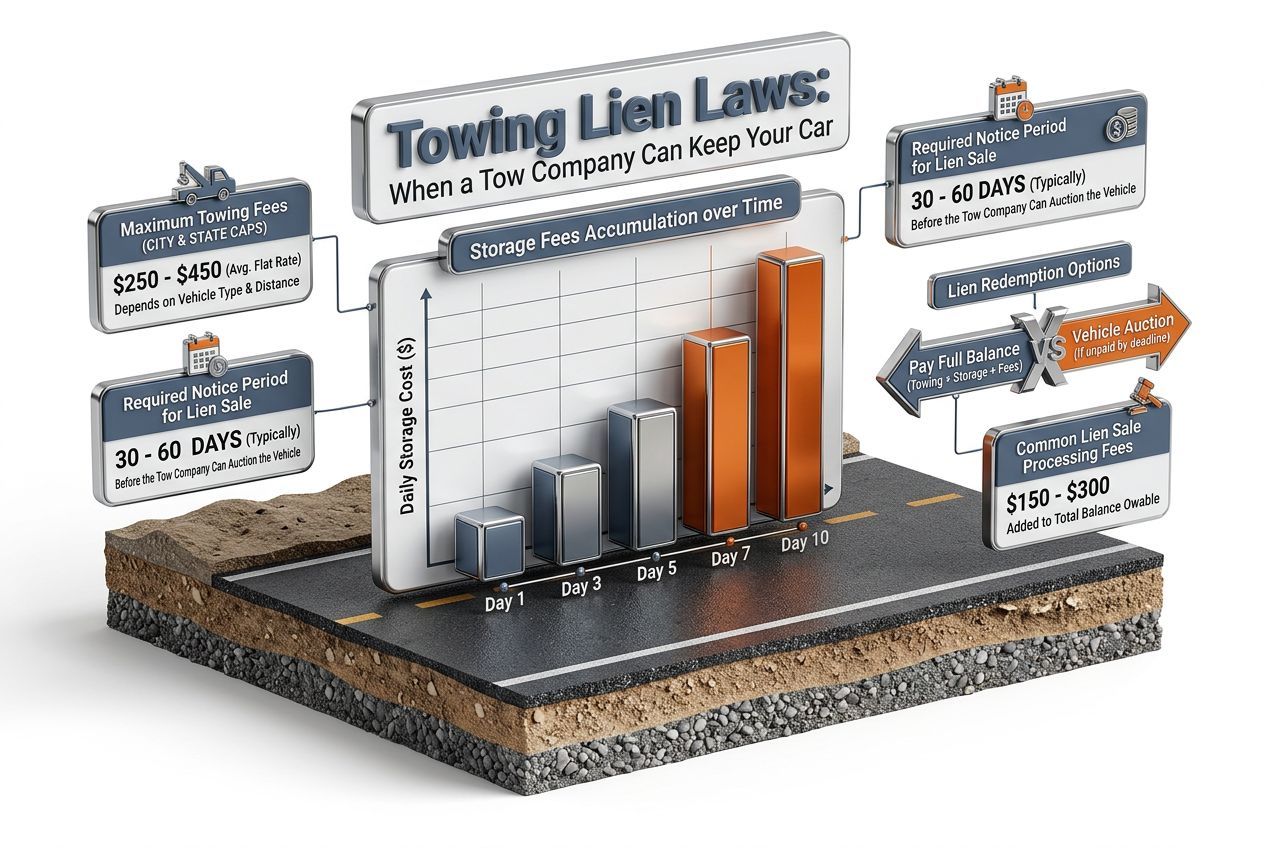
Key Differences Across States: Towing lien by state rules differ sharply on four dimensions: notification deadlines, maximum allowable fees, storage charge caps, and the timeline before a lien sale can occur. There's no federal floor here — the FMCSA (fmcsa.dot.gov) governs commercial vehicle towing, but private passenger vehicle towing lien rights are entirely state law.
State-Specific Regulations: Here's how five major states stack up:
How Do Towing Lien Laws Vary by State? — data table
| State |
Notification Deadline |
Max Basic Tow Fee |
Storage Cap |
Lien Sale Timeline |
| California |
Owner: 72 hrs; Lienholder: 72 hrs |
~$225 (light-duty, varies by county) |
Set by county ordinance |
15 days (DMV lien sale hearing) |
| Florida |
7 business days (owner & lienholder) |
$125–$250 depending on vehicle class |
$35–$55/day (regulated) |
35 days |
| Texas |
Varies by city ordinance |
$272 nonconsent (light-duty); cities may set lower |
$22.85/day (25 ft or less) |
~30 days with certified notice |
| Virginia |
5 business days |
$210 hookup and initial tow (passenger car), unless a locality sets its own limits |
No charge for first 24 hours; then per local ordinance |
30 days |
| New York |
5 days (NYC: separate framework) |
NYC regulated; upstate varies |
NYC: $20–$26/day |
30 days |
Sources: State vehicle codes, NHTSA.gov, state DMV publications. Fees current as of early 2026; verify local ordinances.
💡 Key Takeaway: California has a highly structured lien sale process through the DMV, while Texas pairs statewide fee caps with local ordinances.
California's process is the most structured — lien sales go through the DMV, and the owner has the right to request a hearing to contest the sale. Texas works differently: TDLR sets statewide maximums for nonconsent tows ($272 for a light-duty vehicle) and storage ($22.85 per day), and cities can regulate those fees further as long as they stay within the state maximums. For a full breakdown of towing laws by state, including which states have the strongest consumer protections, that resource covers all 50.
📋
TOWING LAWS & REGULATIONS
What Happens If You Don't Pay Towing and Storage Fees?
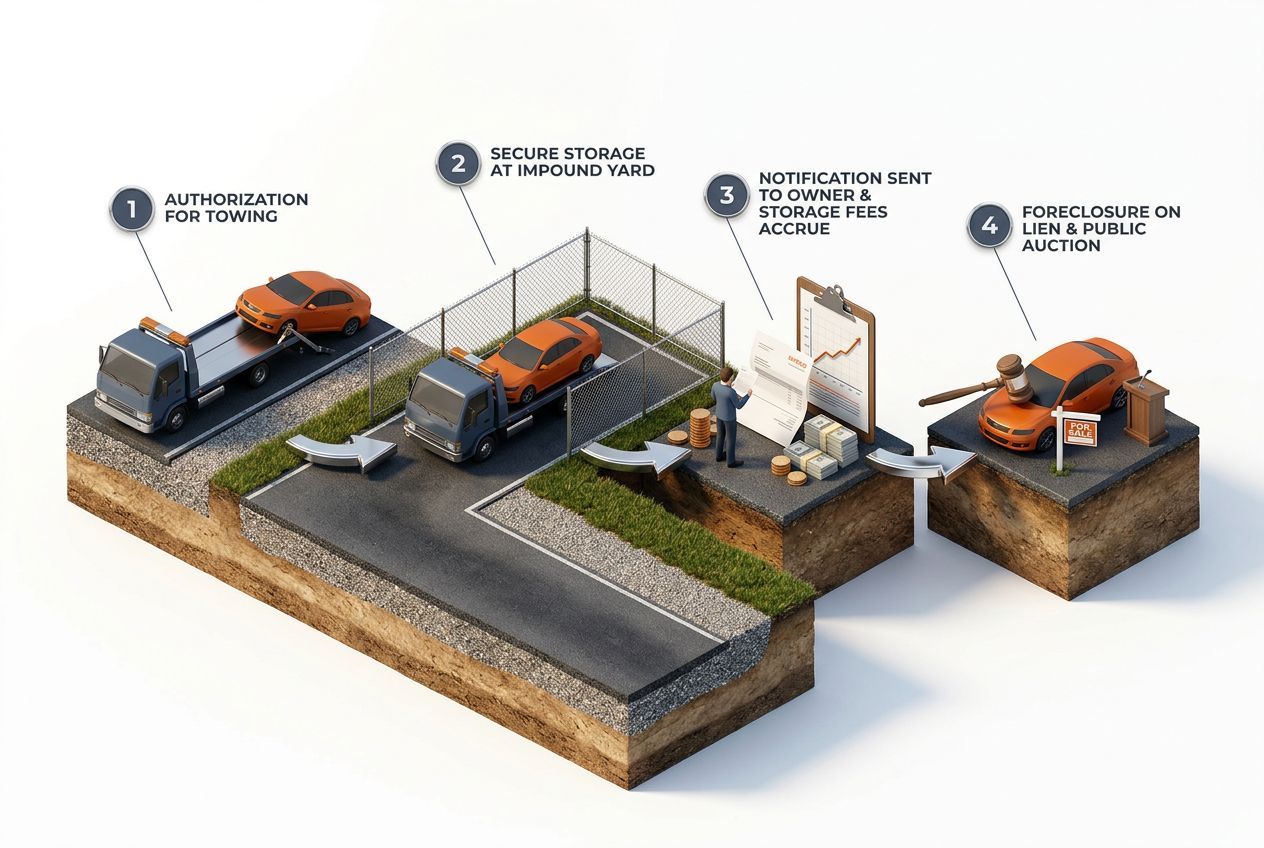
The Path to Lien Sale: If you don't pay, the tow company can pursue a lien sale — auctioning your vehicle to recover what you owe. Daily storage fees keep compounding the whole time. At $50/day, a 30-day delay turns a $250 tow into $1,750 owed before auction costs are even added.
📊 Quick Fact: Industry estimates suggest 10-15% of nonconsensual tows result in vehicles never being reclaimed by their owners.
A Real-World Scenario: Consider this example:
- Your car is towed on a Monday night from a shopping center in Florida.
- The base tow fee is $175, and storage runs $45/day.
- By Friday of the following week (just 11 days later), you owe $175 + (11 * $45) = $670.
- By day 35, when the lien sale can legally proceed, the bill has escalated to $175 + (35 * $45) = $1,750.
The tow company sends certified notice to your address on record with the DMV and to your lienholder (your lender). If neither party responds, the vehicle goes to public auction. Whatever the car sells for applies to the debt; if it sells for less, most states extinguish the remaining balance. If it sells for more, the surplus goes to the former owner.
⚠️ Warning: Lienholders (banks and finance companies) closely monitor tow notifications. They may opt to pay the towing and storage fees to prevent a significantly undervalued sale at auction and protect their collateral.
That auction outcome is one reason lienholders (banks and finance companies) watch for tow notifications — they'd rather pay the $670 and recover a $15,000 car than watch it sell for $8,000 at a salvage auction. If you want to understand what your rights during a nonconsensual tow look like before it reaches lien sale territory, that's the place to start.
⚙️
TOWING LAWS & REGULATIONS
How Can You Dispute a Towing Lien or Fight an Illegal Tow?
Grounds for Dispute: You can dispute a towing lien by requesting a post-tow hearing, filing a complaint with your state's consumer protection agency, or suing the tow company in small claims court. Common winning grounds include: no compliant signage at the tow location, fees exceeding state or local caps, missing or late owner/lienholder notification, or towing without proper property owner authorization.
Disputing a Tow: Key Steps
Documentation is Everything: The moment you learn your car was towed, take these four crucial steps before paying anything:
- Get the tow receipt: This document should clearly list the company name, license number, tow date/time, location of pickup, and an itemized breakdown of charges.
- Photograph the tow location: Return to where your car was towed from and take photos of the signage (or the absence of it). A sign that's too small, obscured, or lacks required contact info is strong grounds for dispute.
- Request the authorization paperwork: In most states, tow companies must retain written authorization from the property owner or a police/municipal impound order. You have the right to review this documentation.
- Check the math: Compare the itemized fees against your city or state's officially published rate schedule. Overcharges above capped rates are illegal and disputable.
✅ Pro Tip: If the tow company refuses to release your car while you dispute charges, some states (like California) require them to accept partial payment equal to undisputed charges and release the vehicle.
The illegal towing complaints resource has step-by-step guidance on filing with the right agency in your state.
🚛
TOWING LAWS & REGULATIONS
What Rights Does a Lienholder Have When a Car Is Towed?
Lienholder Notification: When a financed vehicle is towed, state law generally requires the tow company to notify the lienholder — your bank or auto finance company — within the same window as the registered owner. The lienholder's name and address appear on the vehicle title, which the tow company pulls from the DMV when it runs the plate. The lienholder can pay towing and storage charges to recover the vehicle and protect their collateral interest.
Consequences of Missed Notification: If the tow company skips lienholder notification or sends it too late, the lien sale can be legally voided after the fact — meaning the tow company may owe the lienholder the full market value of the vehicle it sold improperly. Courts have consistently upheld this in California and Florida, where the notification statutes are strictly construed.
💡 Key Takeaway: If your financed vehicle is towed, immediately contact your lender to prevent them from repossessing it directly from the tow yard, which could trigger a separate repossession process.
For the owner side, this cuts both ways. If your lender finds out first — which happens when banks run routine title checks — they may repossess the vehicle directly from the tow yard rather than pay storage and return it to you. That triggers a separate repossession process on top of the tow. If your car was towed and you have a loan on it, call your lender the same day you find out — before storage fees create a bigger problem. For questions about what towing speed limits and other state-level regulations apply when you're back on the road, that resource covers state-specific rules.


