🔧
VEHICLE SAFETY & RECOVERY
Can You Choose Your Own Tow Truck After an Accident?
Yes, in the majority of U.S. states, you have the legal right to select your own tow company after an accident. The police rotation list exists to ensure a licensed operator is always available when a driver can't or won't choose, not to override your preference.
Exercising Your Right to Choose
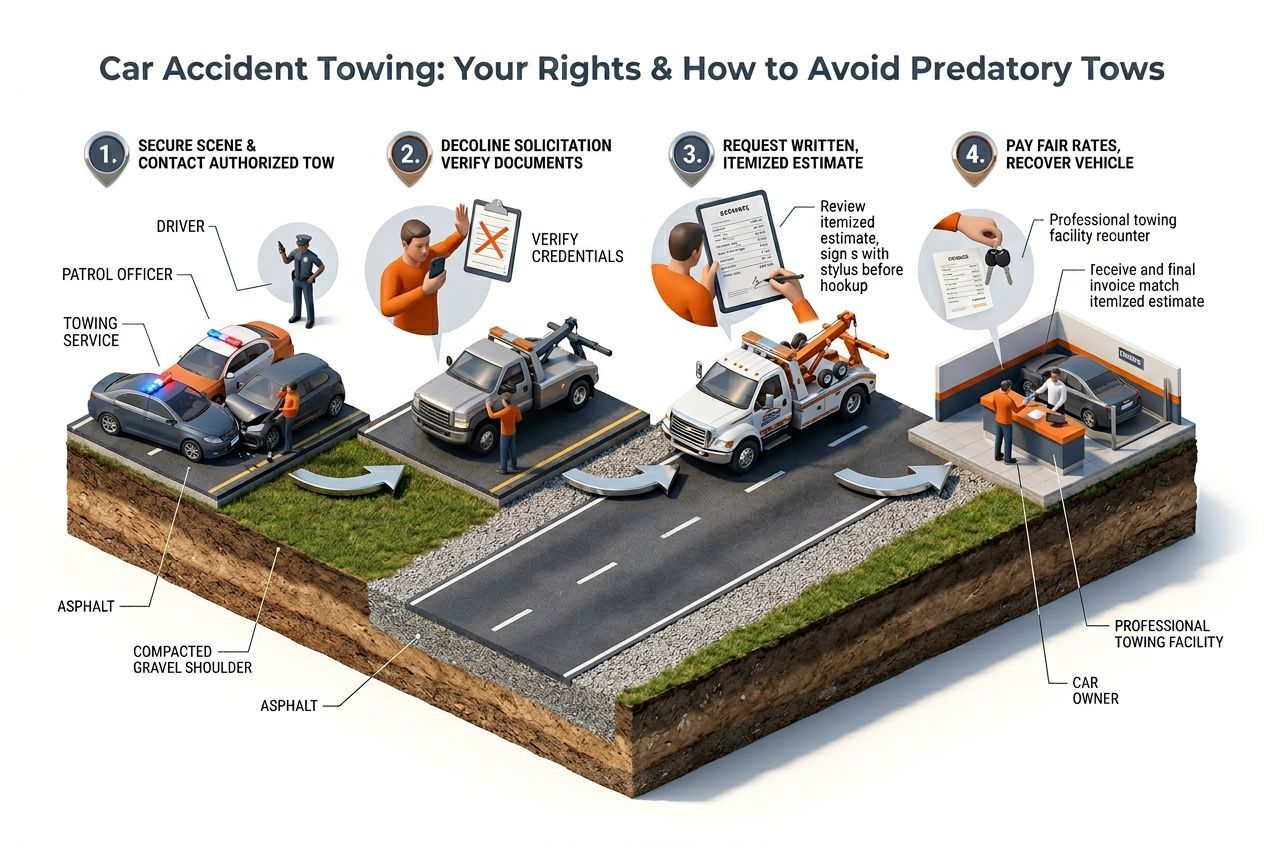
When an officer arrives on scene, clearly and calmly state your preference: "I'd like to call my own tow company." Most officers will give you 10–15 minutes. If your vehicle isn't blocking traffic, there's no urgency.
✅ Pro Tip: If your vehicle is blocking traffic and you must accept the rotation tow, you can still direct them to a specific repair shop rather than the tow company's affiliated yard, which often charges higher storage rates.
Special rules apply to highway corridors. Programs like Houston's SafeClear and Florida's Road Ranger/Motorist Assist use state-authorized operators to clear accidents from high-speed lanes as quickly as possible. Within those zones, your right to choose is limited for safety and traffic-flow reasons. Check your state's DOT website for specifics on managed-clearance corridors.
Our towing laws by state tool can show you the exact rules where you live.

🛡️
VEHICLE SAFETY & RECOVERY
What Is Predatory Towing and How Do You Spot It?
Predatory towing after an accident means operators exploit crash victims through inflated fees, unauthorized services, or excessive storage charges — often targeting people who are injured, shaken, or simply don't know their rights.
Common Warning Signs of Predatory Towing
The warning signs of predatory towing are consistent and easily identifiable. Watch for:
- Tow trucks arriving before police. Operators who monitor police scanners and race to accident scenes are called "chasers." Several states, including Florida and Texas, have laws banning solicitation within 24 hours or within a set distance of an accident scene.
- Pressure to sign vague paperwork. If a driver hands you a form before you've even called your insurance company, slow down. Read every line carefully. "Authorization to tow" can include buried consent to storage fees.
- Cash-only payment demands. No legitimate towing company refuses a credit card. Demanding cash is a scam tactic.
- Refusal to provide a rate sheet. Under state regulations in California, Texas, New York, and Illinois, tow operators must provide a written rate schedule on request. If they won't, walk away and call your insurance.
- "Helpful" advice to skip your insurance. Operators who tell you not to call your insurer are protecting their inflated bill, not you.
📊 Quick Fact: The Consumer Federation of America estimates more than 15,000 predatory towing complaints are filed with state attorneys general annually.
The FMCSA (fmcsa.dot.gov) regulates interstate towing operations and maintains complaint filing resources. For a deeper look at scam tactics, see our guide on tow truck scams.
📋
VEHICLE SAFETY & RECOVERY
How Much Does Accident Towing Cost on Average?
A standard accident tow costs $200–$500+ once you add up hookup fees, mileage, after-hours surcharges, and the first few days of storage.
📊 Quick Fact: The base hookup rate alone runs $75–$125 for the first 5–10 miles, with $2–$7 per mile beyond that, according to data compiled from state DOT rate filings and NHTSA consumer towing resources.
Accident Towing Cost Example
Consider this real-numbers example: You total your sedan on a Tuesday night at 11 p.m., 18 miles from the nearest body shop.
- Base hookup: $100
- After-hours surcharge: $50
- Mileage at $4/mile for 18 miles: $72
- If your car sits at the tow yard for three days before you can arrange pickup: 3 × $45/day = $135
💡 Key Takeaway: Your total bill for this scenario would be $357 — and that's without any winching or accident-scene cleanup fees.
Accident Towing Cost Example — data table
| Cost Component |
Low End |
High End |
Notes |
| Base hookup (first 5–10 mi) |
$75 |
$125 |
Standard sedan; source: state DOT rate filings |
| Per-mile charge (beyond base) |
$2/mi |
$7/mi |
Higher in urban markets; NHTSA consumer data |
| After-hours surcharge |
$25 |
$75 |
Nights, weekends, holidays |
| Accident scene winching |
$50 |
$200 |
Required if vehicle is off-road or overturned |
| Daily storage fee |
$20 |
$75 |
Starts after 24–72 hours; varies by state |
| EV/hybrid flatbed premium |
$50 |
$150 |
Dolly towing prohibited; specialized handling required |
Sources: State DOT rate filings; TowingServiceHub editorial estimates.
Note on vehicle type: These figures reflect standard passenger vehicles. If you're driving an SUV or pickup, expect a 10–25% surcharge. EVs require flatbed transport — no dolly towing allowed — which adds cost and limits which companies can even legally move your vehicle. See our article on towing electric cars for the specifics.
For a complete breakdown of towing costs by region, use our towing cost calculator or read the full towing cost guide.
⚙️
VEHICLE SAFETY & RECOVERY
What Should You Do If You're Overcharged by a Tow Company?
If a tow company overcharges you after an accident, your first move is to request a fully itemized invoice and compare each line item against your state's published maximum rate schedule. Don't pay a lump-sum "accident tow" figure without seeing exactly what you're being charged for.
💡 Key Takeaway: Twenty-nine states plus Washington D.C. cap towing rates by law, according to the National Conference of State Legislatures. If a company charges above those ceilings, they're violating state law.
Many states have specific regulations. In California, for example, non-consensual tow rates are set by each county, and operators must post their rates publicly. In Texas, the Texas Department of Licensing and Regulation enforces maximum rates for non-consent tows.
Your Dispute Path
Follow these steps if you believe you've been overcharged:
- Get the itemized bill in writing. Take photos of your vehicle before it leaves the scene as evidence.
- File a formal complaint with your state's Department of Transportation, consumer protection office, or state attorney general.
- Notify your insurer. They deal with tow disputes regularly and can often apply pressure the tow company will respond to.
- Contact your state's towing board. Many states have a formal hearing process where you can contest charges, and penalties for over-limit billing are real.
If your vehicle is already being held and you're afraid of mounting storage fees, our guide on how to get your car out of impound walks through the fastest retrieval process step by step.
🚛
VEHICLE SAFETY & RECOVERY
How Do Police Decide Which Tow Company Responds to an Accident?
Police departments use a pre-approved tow truck rotation list — a roster of licensed, insured companies that take turns responding to accident calls. Companies earn a spot by meeting the municipality's insurance minimums, equipment standards, and licensing requirements.
Rotation assignments exist to ensure fast, accountable response when a driver can't choose. But in most jurisdictions, the list is not binding on you. You can decline the assigned company and call your own, provided you do so before the rotation truck hooks up your vehicle.
💡 Key Takeaway: Once a tow truck has attached to your vehicle and started moving, fees typically begin, making it harder to refuse service without incurring costs.
Winter months often shift this dynamic. During ice storms and high-volume crash periods (November through February), rotation companies are often dispatched to multiple scenes simultaneously. Wait times can stretch significantly. Some jurisdictions temporarily waive the rotation requirement and allow any available licensed operator to respond.
⚠️ Warning: This is when predatory "chasers" are most active — and when having your pre-saved, preferred tow company number matters most.
Understanding the types of tow trucks that different scenarios require can also help you verify whether the responding company has the right equipment for your vehicle.


