Skip to content
🛡️ VEHICLE SAFETY & RECOVERY

Towing an AWD Vehicle: Why It's Different & What to Know

Published · Updated · 12 min read
MarkUpdated Nov 22, 2026NHTSA — Check for Recalls (recalls, investigations, and complaints search)
Key Takeaways
  • All four wheels on an an AWD vehicle link through the drivetrain — there's no "free" axle to lift like a 2WD car.
  • A tow dolly can destroy an AWD transmission in under a mile by spinning drivetrain components without lubrication.
  • Flatbed towing is the universally safe choice for any AWD car; request one by name when you call for help.
  • A handful of AWD vehicles — mainly Jeep Wrangler, Jeep Gladiator, and select Ford Broncos — are approved for four-wheels-down flat towing.
  • Fixing AWD drivetrain damage from improper towing typically runs $2,000–$8,000, versus $100–$300 for a flatbed tow.

A majority of vehicles on the road today are AWD. According to Edmunds market data, roughly 55% of new vehicles sold in the US now come with AWD. This represents a significant portion of breakdowns where the wrong tow method can lead to thousands of dollars in repairs. Before you call a tow truck or wait on the shoulder, understanding how your drivetrain works could protect you from a repair bill that far exceeds the cost of the tow itself.


💰
VEHICLE SAFETY & RECOVERY

Why Is Towing an AWD Vehicle Different from Towing a 2WD Car?

All four wheels are mechanically connected to the drivetrain through a center differential or transfer case in an AWD vehicle. On a 2WD car, you have the option to lift the driven axle or load the driven wheels on a dolly, effectively stopping the drivetrain from spinning. AWD systems, however, eliminate this option. Any wheel that remains on the ground will transmit rotation back through the entire system.

The Mechanical Problem: Lack of Lubrication

The core mechanical issue lies with lubrication. Your engine drives the oil pump responsible for circulating transmission fluid. If the engine is off and the vehicle is being towed with any wheels rolling, internal gears, clutch packs, and planetary sets spin in an oil bath that isn isn't actively moving or being circulated.

⚠️ Warning: According to technical service data from manufacturers like Toyota and Subaru, AWD drivetrain lubrication failure can begin in as little as 30–90 seconds without the engine-driven oil pump running.

Consider a common scenario: Your Toyota RAV4 AWD breaks down on the interstate. A tow truck arrives, uses a dolly to lift the front wheels, and proceeds to tow the vehicle with the rear wheels rolling down the highway for 12 miles. The center differential quickly runs dry. Within just two miles, unseen damage has likely already occurred, which you might only notice — or hear — a week later.

For a full breakdown of how improper towing damages vehicles across all drivetrain types, see our guide on does towing damage your car.
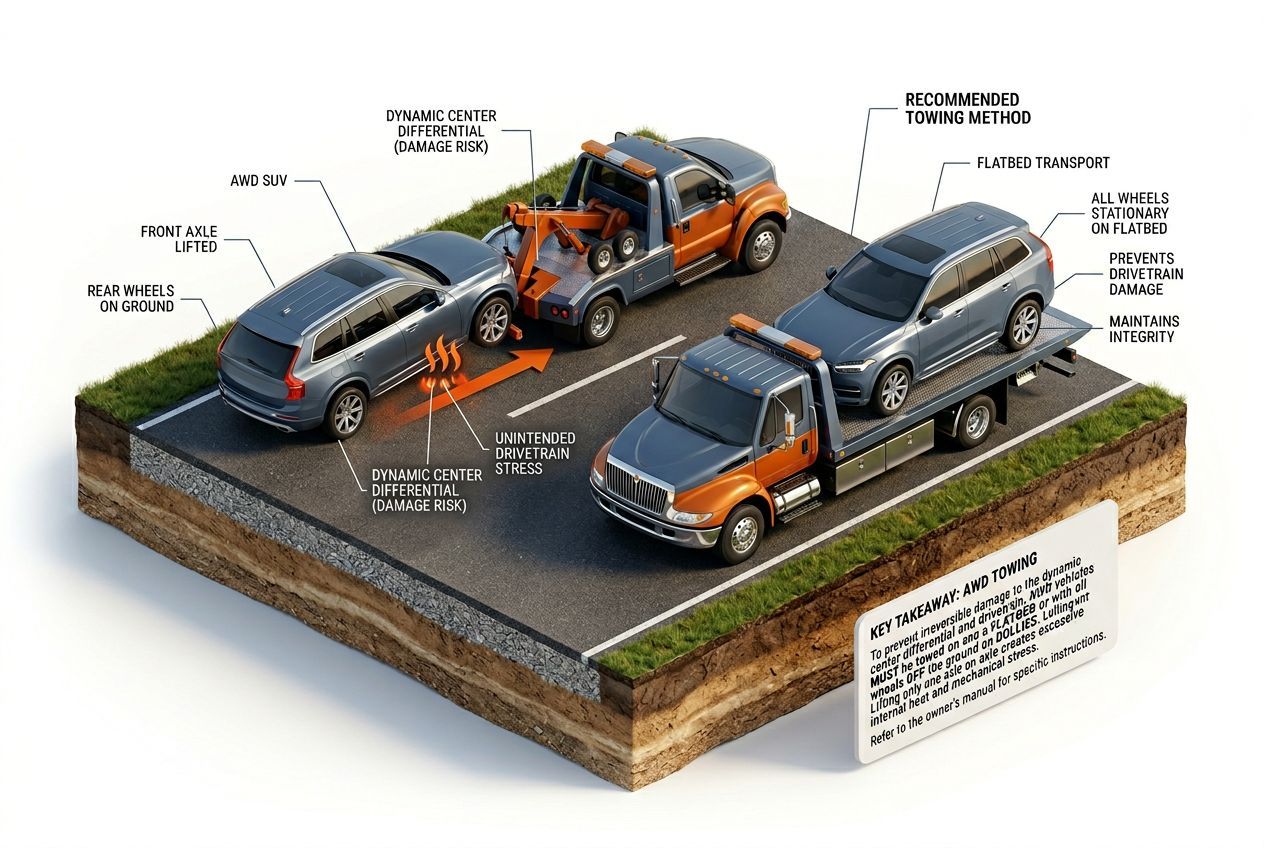

3D isometric overview diagram for towing an awd vehicle: why it's different & what to know
📊
VEHICLE SAFETY & RECOVERY

Can You Tow an AWD Car with a Tow Dolly?

No, most manufacturers explicitly prohibit towing an AWD car with a tow dolly. Lifting two wheels leaves the other two on the pavement, and those wheels continue to turn the driveshaft, transmission, and differentials without the engine-driven oil pump providing essential lubrication.

Manufacturer guidelines are clear. Subaru's owner's manuals, for example, state unequivocally that no Symmetrical AWD model should be towed with wheels on the ground under any circumstances. Documentation from Audi Quattro, BMW xDrive, and Mercedes 4MATIC systems echoes this strict position. These are not merely cautious recommendations; they represent engineering limits.

Rare Exceptions for Dolly Towing

There is one narrow exception: some vehicles permit dolly towing if the rear driveshaft is physically disconnected first.

  • Requires specialized knowledge: This is technically possible on certain trucks and body-on-frame SUVs.
  • Not a roadside job: It requires specific tools, jacking the vehicle, and knowing exactly which driveshaft bolts to remove. This is typically not a procedure for the average person at the side of the road.
  • When in doubt, don't: If you are unsure, absolutely do not allow anyone to load your AWD car on a dolly.

✅ Pro Tip: A standard tow dolly typically has a weight limit between 3,500 and 5,000 lbs, so larger AWD crossovers and SUVs may exceed those limits anyway. Always verify vehicle weight if considering a dolly for any vehicle.

Check our towing capacity lookup tool if you're also towing a trailer and need to verify weights.


🔧
VEHICLE SAFETY & RECOVERY

What Happens If You Tow an AWD Vehicle Wrong?

Improperly towing an AWD vehicle can lead to catastrophic damage to the center differential, transfer case, and transmission, often in less than a quarter mile. The mechanism of damage is straightforward: internal components spin without circulating fluid, leading to intense friction and heat. This heat can warp gears, burn clutch packs, and score critical bearing surfaces.

📊 Quick Fact: The NHTSA vehicle complaint database (searchable through NHTSA's recalls and complaints lookup) contains numerous filed complaints directly linking AWD drivetrain failures to improper towing events. Drivers often didn't discover the damage until days or weeks after the tow.

The Staggering Repair Costs

Repair costs for AWD drivetrain damage are substantial and unforgiving.

  • Center differential replacement: Typically runs $1,500–$3,500 on most mainstream AWD vehicles.
  • Full transmission rebuild (AWD platform): Can land between $3,000 and $6,500.
  • Luxury vehicle repairs: For systems like Audi Quattro or BMW xDrive, you can easily face $7,000 or more for parts and labor.

Compare these figures to the cost of a proper tow. Local flatbed tow rates average $100–$150 for a standard call, according to AAA towing data. Long-distance flatbed runs typically cost $2–$7 per mile. Even a 100-mile flatbed haul at the higher end — around $700 — is a mere fraction of the cheapest drivetrain repair.

AWD Towing Damage: Costs at a Glance

The Staggering Repair Costs — data table
Repair Type Estimated Cost Notes
Center differential replacement $1,500–$3,500 Most mainstream AWD vehicles
Transfer case rebuild or replacement $1,200–$2,800 Body-on-frame SUVs and trucks
AWD transmission rebuild $3,000–$6,500 Full internal rebuild
Luxury AWD drivetrain repair $5,000–$8,000+ Audi Quattro, BMW xDrive, 4MATIC
Flatbed tow (local) $100–$300 The cost to avoid all of the above

Sources: RepairPal industry repair estimates; AAA towing cost data; manufacturer service bulletins

The financial implications are clear: you are essentially gambling a $4,000+ repair to save on a $150 tow call. If you're concerned about what a tow actually costs, use our towing cost calculator before you call.

And if you think you've already been towed incorrectly, neutral drop towing risks covers what to watch for after the fact.
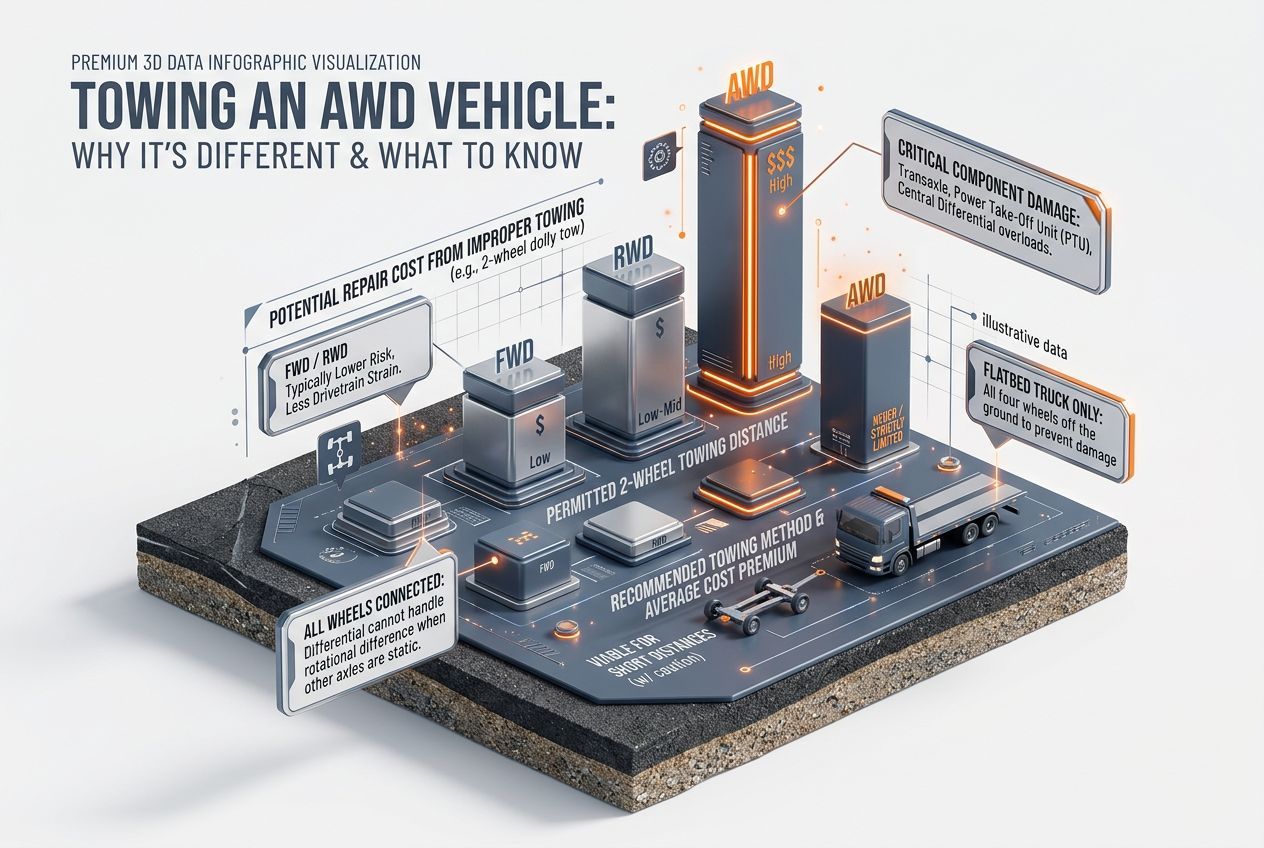
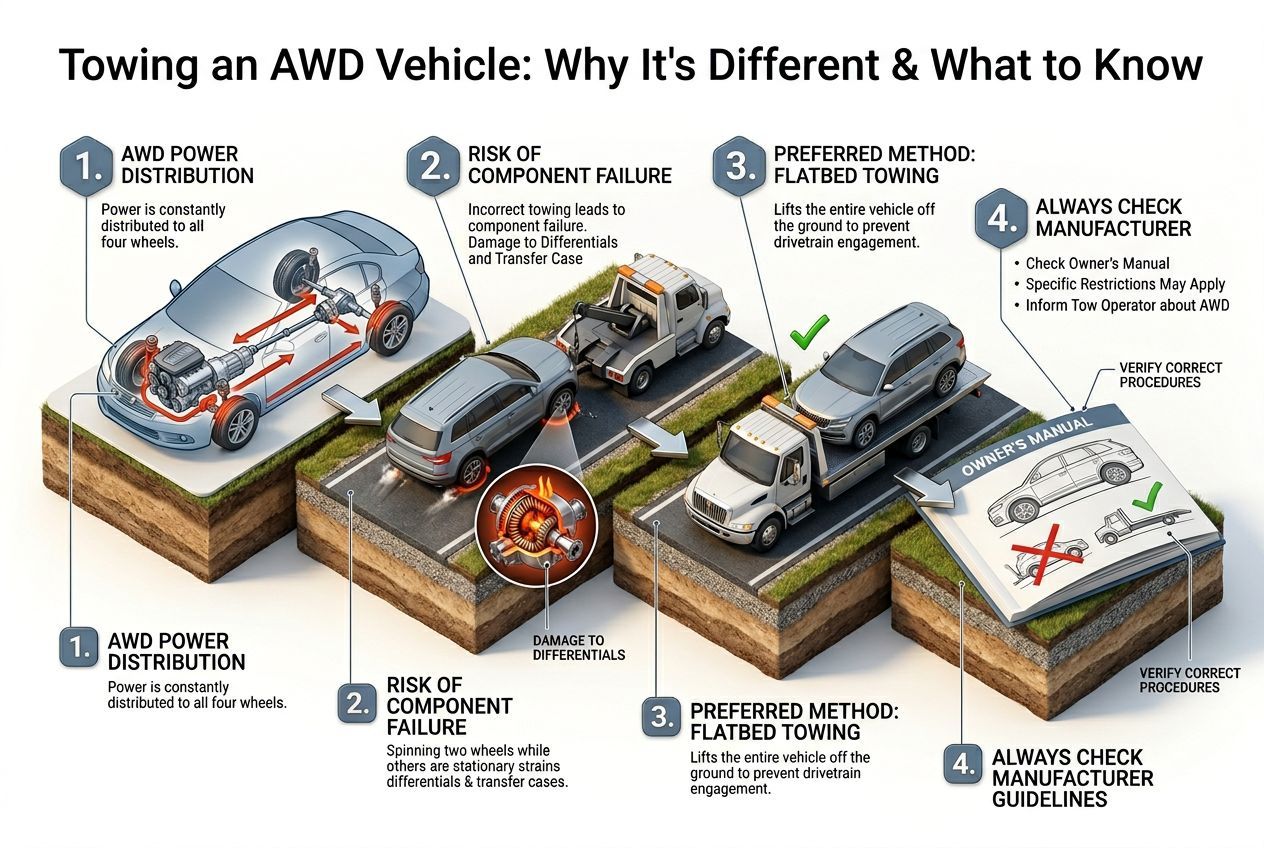
3D data visualization showing key figures for towing an awd vehicle: why it's different & what to know
🛡️
VEHICLE SAFETY & RECOVERY

Why Is Towing an AWD Vehicle Different When Done by a Flatbed vs. Dolly?

The fundamental difference between a flatbed tow and all other methods boils down to one critical factor: wheel contact with the ground.

  • Flatbed Towing: A flatbed truck lifts all four wheels of the vehicle completely off the ground. This means the entire drivetrain goes along for the ride without spinning a single internal component. This is precisely why flatbed towing is universally safe for AWD vehicles.
  • Wheel-Lift Towing: This method, where a tow truck cradles two wheels while the other two roll on the pavement, creates the exact same drivetrain risk as using a tow dolly. For AWD vehicles, it should be avoided just as strictly as a dolly.

💡 Key Takeaway: If any of an AWD vehicle's wheels are on the ground and rolling during a tow, there is a risk of severe drivetrain damage due to lack of lubrication.

This section pairs naturally with checking your own vehicle. Use our flat-tow checker below to see if your specific AWD model is approved for recreational flat towing or whether flatbed-only rules apply.

Try Our Free Flat Tow Compatibility Checker

Our flat-tow checker tool lets you enter your year, make, and model to see the manufacturer's recommended tow method in seconds. It's the fastest way to know before the tow truck arrives.


📋
VEHICLE SAFETY & RECOVERY

Do All AWD Vehicles Require a Flatbed Tow Truck?

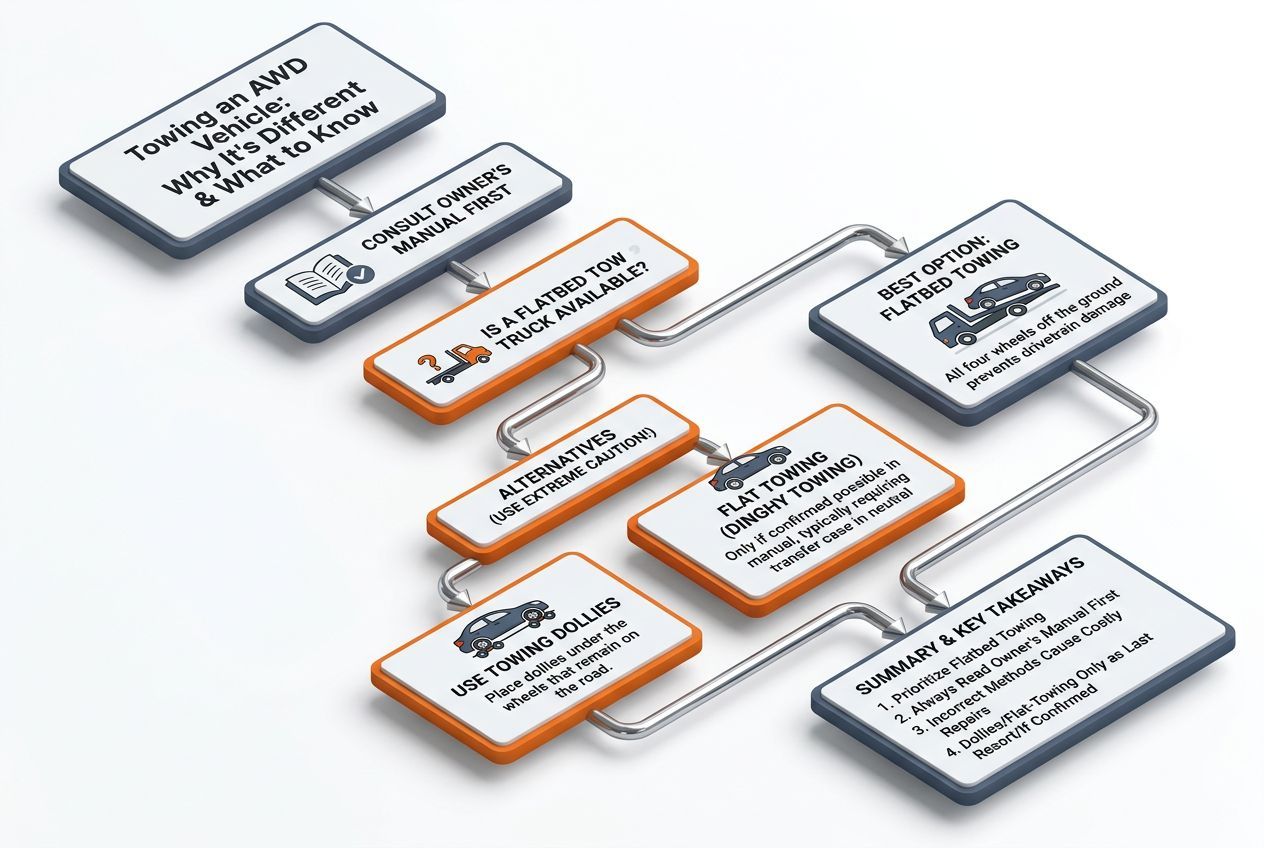
Almost all AWD vehicles require a flatbed as the only safe towing method. The blanket rule is simple: if you are unsure about your vehicle's specific manufacturer allowance, always request a flatbed. It is the safest choice every time.

Engineered Exceptions for 4WD/AWD Towing

A small number of AWD/4WD vehicles are engineered exceptions, primarily falling into two categories:

  1. Body-on-frame trucks and SUVs with a true neutral transfer case position. Examples include:

    • Jeep Wrangler
    • Jeep Gladiator
    • Older full-size pickup trucks with part-time 4WD Shifting into a true transfer case neutral position mechanically disconnects both the front and rear driveshafts, allowing all four wheels to roll freely without engaging the drivetrain.
  2. Vehicles that permit driveshaft removal for towing.

    • Ford publishes a Four-Wheel-Down Availability table in each model year's RV & Trailer Towing Guide (see Ford's flat-tow support page), which identifies specific models and procedures for certain trucks.
    • This process, however, requires removing two U-joint strap bolts and dropping the rear driveshaft before the tow begins, which is a specialized procedure not suitable for every roadside situation.

⚠️ Warning: Modern full-time AWD systems — found in virtually every AWD sedan, crossover, and EV sold today — typically do not have a true neutral position in their transfer case. This includes popular models like the Honda CR-V AWD, Subaru Forester, Audi A4 Quattro, and Tesla Model Y. For these vehicles, a flatbed is the only safe towing option.

The Unique Case of AWD Electric Vehicles

Tesla and other dual-motor AWD electric vehicles introduce additional complications. When an AWD EV's wheels spin, the motors generate power, which can cause significant damage and overheating. Tesla's Model Y Instructions for Transporters require all four tires to be off the ground: a flatbed is the recommended method, and wheel lifts with dollies are allowed only if all four wheels are lifted, for a maximum of 35 miles. For more on this, see our full guide on towing electric cars.


3D step-by-step process visualization for towing an awd vehicle: why it's different & what to know
⚙️
VEHICLE SAFETY & RECOVERY

How Do You Put an AWD Vehicle in Neutral for Towing?

Putting an AWD vehicle into neutral for towing is only possible on vehicles equipped with a two-speed transfer case that features a true neutral (N) position. Even then, the precise procedure will vary significantly by model.

Example: Jeep Wrangler

On a Jeep Wrangler, for instance, the 2024 Wrangler owner's manual (Recreational Towing section) lays out these key steps:

  1. Stop on level ground, hold the brake, and shift the automatic transmission into neutral (or press the clutch on a manual).
  2. Turn the engine off, then move the transfer case lever to "N" (neutral).
  3. Restart the engine and check that the vehicle doesn't move in reverse or drive, which confirms the transfer case is fully in neutral.
  4. Turn the engine off, set the parking brake, and shift an automatic into PARK (a manual goes in gear, not neutral) before attaching the tow bar.
  5. Tow only in the forward direction. Jeep's manual also prohibits dolly towing any 4WD Wrangler.

For a part-time 4WD pickup truck from manufacturers like Ford, Chevrolet, or RAM with a floor-mounted transfer case lever, the procedure is similar. However, it is crucial to confirm the exact steps in your vehicle's Trailer Towing Supplement (often a separate document from the main owner's manual) to ensure it applies to your specific configuration.

💡 Key Takeaway: Simply putting a full-time AWD car's automatic transmission into "N" (neutral gear) does not disconnect the transfer case. This action only disengages the transmission's internal clutch packs; the center differential and all four driveshafts remain mechanically linked. Rolling those wheels will still spin drivetrain components without lubrication.

This is one of the most common misunderstandings that leads to AWD towing damage. If you want to understand exactly how this risk plays out, our article on AWD towing risks goes deeper into the drivetrain mechanics.


🚛
VEHICLE SAFETY & RECOVERY

Which AWD Vehicles Can Be Flat Towed Behind an RV?

Only a very narrow list of AWD vehicles qualifies for four-wheels-down flat towing behind an RV, and this list is updated annually by manufacturers.

For 2024 and 2025 model years, the primary approved AWD options typically include:

  • Jeep Wrangler (specifically models with a manual transfer case offering a true neutral)
  • Jeep Gladiator
  • Ford Bronco (select trims also with a manual transfer case)
  • Certain full-size pickup trucks equipped with part-time 4WD systems

Reliable sources for flat-tow compatibility: Motor home and RV publications, such as MotorHome Magazine, publish annual "dinghy towing guides" that list every approved flat-tow vehicle by year, make, model, and specific configuration. These guides are the most reliable current sources. Always cross-reference this information with the manufacturer's own website or owner's manual for your specific tow year.

✅ Pro Tip: If you're planning recreational flat towing, remember that you'll also need to account for tow bar weight ratings, supplemental braking systems (which are legally required in many states for towed vehicles over a certain weight), and the proper base plate installation specific to your vehicle.

Our flat-towing guide covers the full equipment setup. For a quick estimate on what flat towing an AWD vehicle long-distance might cost in total, our RV and boat tow estimator can help you plan.


3D flowchart of practical tips and decisions for towing an awd vehicle: why it's different & what to know
📝
VEHICLE SAFETY & RECOVERY

How Much Does It Cost to Repair AWD Drivetrain Damage?

Repairing AWD drivetrain damage caused by improper towing typically costs between $2,000 and $8,000 on average. Luxury vehicles frequently exceed this ceiling, as detailed in the "What Happens If You Tow an AWD Vehicle Wrong?" section above.

To recap the core costs:

  • Center differentials: Generally range from $1,500–$3,500.
  • Transmission rebuilds (AWD platforms): Typically run $3,000–$6,500.
  • Luxury vehicle repairs: For high-end systems like BMW xDrive or Audi Quattro, parts alone can push labor-plus-parts costs past $8,000 at a dealership.

Beyond Direct Repair Costs

Beyond the immediate repair bill, consider the ripple effect of expenses:

  • Rental car: You'll likely need a rental vehicle while your car is in the shop, often for 1–2 weeks for a drivetrain rebuild.
  • Additional towing: You might incur costs for towing the vehicle from the repair shop back to your home.
  • Depreciation: A repaired drivetrain, even if perfectly executed, can affect the vehicle's resale value.

⚠️ Warning: If you find yourself in a breakdown situation and an unscrupulous tow operator loads your AWD vehicle onto a dolly without your clear agreement or against your wishes, you may have legal recourse. Knowing your rights before you make the call is essential. Read our guide on car accident towing rights and how to avoid tow truck scams to protect yourself from unnecessary damage and exorbitant bills.

Sources & Methodology

Research for this article draws on the following sources:

  1. 1.
    NHTSA — Check for Recalls (recalls, investigations, and complaints search): used to point readers to federal complaint and recall records for AWD drivetrain failures. NHTSA recalls and complaints search
  2. 2.
    Tesla — Model Y Owner's Manual, Instructions for Transporters: used for Tesla's requirement that all four tires stay off the ground during transport, the flatbed recommendation, and the 35-mile limit for wheel-lift-plus-dolly moves. Tesla Model Y Instructions for Transporters
  3. 3.
    Jeep — 2024 Wrangler Owner's Manual, Recreational Towing (Behind Motorhome): used for the transfer-case neutral flat-tow procedure, the forward-only towing rule, and the prohibition on dolly towing 4WD models. 2024 Jeep Wrangler Owner's Manual (PDF)
  4. 4.
    Ford Motor Company — Can I flat tow my Ford?: used for where Ford publishes the Four-Wheel-Down Availability table in its RV & Trailer Towing Guides. Ford flat-tow support page
  5. 5.
    Edmunds, AAA, and RepairPal: Edmunds new-vehicle sales data for AWD market share (about 55%); AAA towing data for call volume (~32 million per year) and flatbed tow costs; RepairPal repair estimates for center differential, transfer case, and AWD transmission repair ranges.

TowingServiceHub is reader-supported: we may earn money from ads and from some links on this page. See our editorial policy.

Mark — Founder & Editor

Mark

Founder & Editor

Mark is the founder and editor of TowingServiceHub, which he launched in 2026 after struggling to find clearly sourced towing costs and truck specs. He works in enterprise technology and tows his own boats, trailers, and equipment, so he knows the questions drivers actually ask.

Read full bio →

Need a tow truck right now?

Browse vetted local providers in your area. Real Google ratings, verified business info, free to use.

Or browse all 50 states from our directory

Frequently Asked Questions

No, a wheel-lift tow is not safe for AWD vehicles. A wheel-lift tow keeps two driven wheels on the ground, which creates the same drivetrain damage risk as using a tow dolly. For an AWD vehicle, wheel-lift towing will spin unlubricated drivetrain components, leading to potential failure. Always request a flatbed for any all-wheel-drive car or crossover.

No, simply shifting the automatic transmission into "neutral" does not protect an AWD car during towing. While it disengages the transmission's internal clutch packs, the center differential and transfer case remain mechanically linked. This means that rolling wheels will still spin drivetrain components without proper lubrication. Only a true transfer case neutral setting — found on select 4WD trucks and Jeeps — physically breaks this mechanical connection.

Even very short distances can cause significant damage. Without engine-driven lubrication, AWD drivetrain components can begin to suffer damage from friction and heat in as little as 30-90 seconds, or within a quarter mile. This rapid onset of damage is why improper towing of AWD vehicles is so risky and why a flatbed is the only consistently safe option.

Related Articles

Explore More Towing Guides

Browse all 157 expert guides and 10 free tools.