🔧
VEHICLE SAFETY & RECOVERY
Can Towing Cause Transmission Damage?
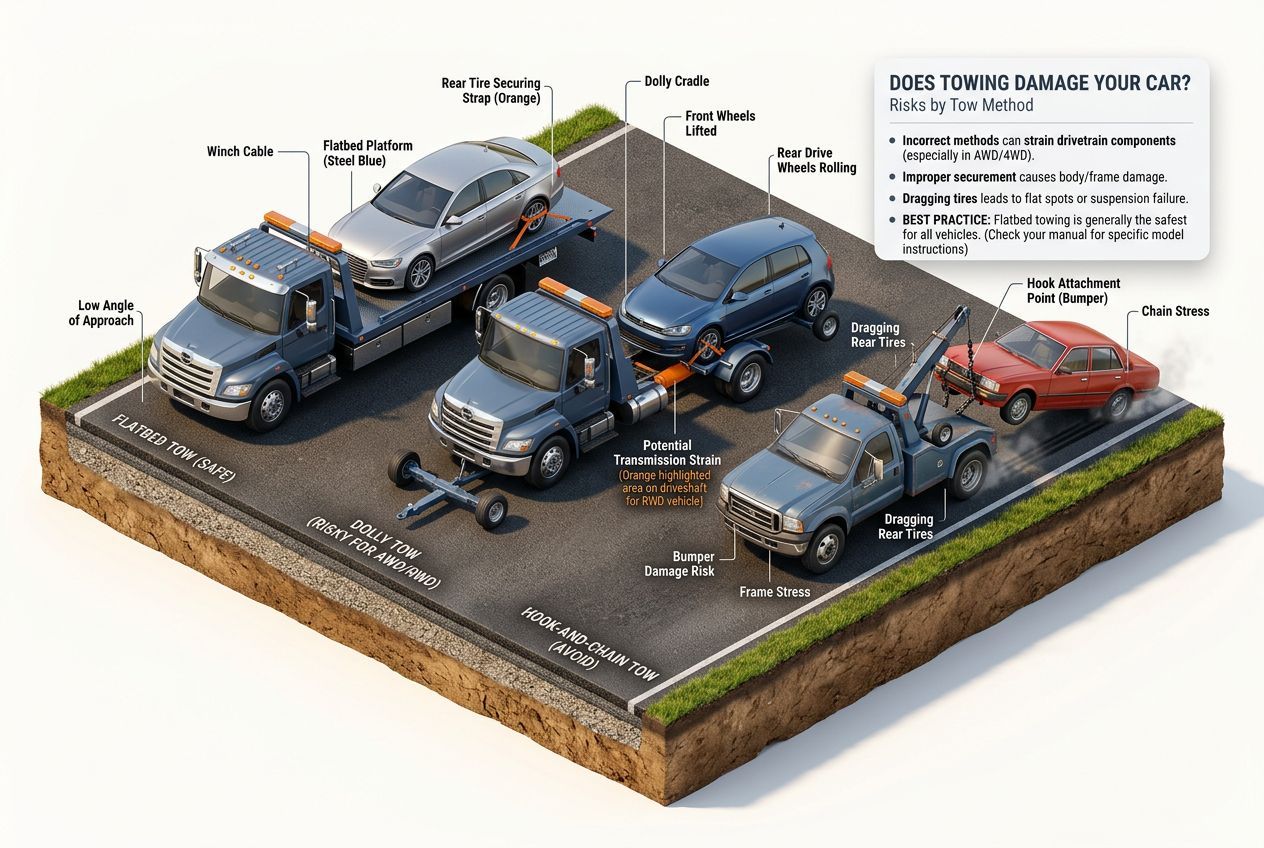
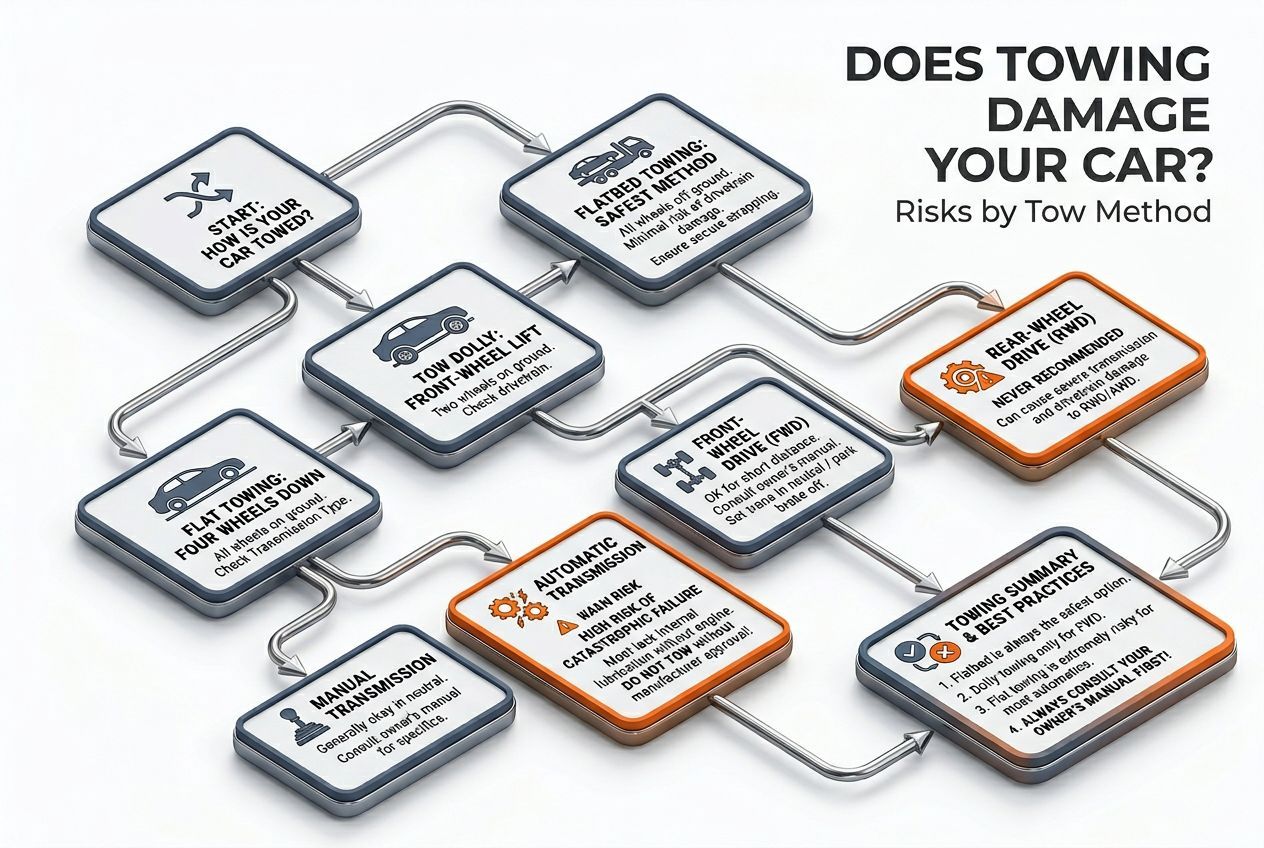
Yes, towing can absolutely cause severe and expensive transmission damage. This risk is particularly high when a vehicle with an automatic transmission is towed with its drive wheels on the pavement while the engine is off.
The Mechanical Reason: The core issue lies in how an automatic transmission operates. Its fluid pump, which is vital for lubrication and cooling, is driven by the engine's torque converter. When the engine is not running, this pump ceases to circulate fluid. Consequently, the transmission fluid remains static while the internal components—gears, clutch packs, and planetary sets—continue to spin due to road contact. At temperatures exceeding 270°F—a threshold easily reached during a 15-mile tow at highway speed—these internal components will begin to fail, leading to significant damage.
⚠️ Warning: Dragging an automatic transmission's drive wheels on the ground without the engine running is a recipe for catastrophic failure. The lack of fluid circulation leads to rapid overheating and component damage.
Worked Example: Imagine your front-wheel-drive Honda Accord breaks down on the highway. A wheel-lift truck arrives and, incorrectly, lifts the rear axle, leaving the front drive wheels on the ground. As you are towed at 45 mph, the transmission output shaft continuously rotates. By mile 10, fluid temperatures are dangerously high. By mile 20, you could be facing a transmission replacement bill of $3,000–$5,000 or more.
Correct Procedure by Drivetrain:
- Front-Wheel Drive (FWD) vehicles: The correct procedure is to lift the front (drive) wheels.
- Rear-Wheel Drive (RWD) vehicles: The rear (drive) wheels should be lifted.
- All-Wheel Drive (AWD) vehicles: Flatbed only, with no exceptions, regardless of distance or speed.
Owner's Manual Guidelines: Most Original Equipment Manufacturers (OEMs) specify a maximum "wheels-down" tow distance and speed, even if the vehicle is in neutral. This is often limited to about 15 miles at no more than 15–35 mph. Always check your owner's manual before agreeing to any non-flatbed tow. For a deeper dive into neutral towing mechanics, consult our guide on neutral drop towing risks.
🛡️
VEHICLE SAFETY & RECOVERY
Does Flatbed Towing Damage a Car?
Flatbed towing rarely causes damage when performed by a skilled operator who adheres to proper tie-down procedures. Any issues typically encountered with flatbed towing are minor and primarily cosmetic.
Common Flatbed-Related Issues (when they occur):
- A slight scratch from a loading ramp if not approached carefully.
- Paint marks on a rocker panel if a strap isn't properly padded.
- A bumper scuff during the winch-on process for a vehicle that cannot roll.
Operator Error is the Key Factor: Statistically, these incidents are uncommon. The more significant risk stems from a negligent or hurried operator who fails to use appropriate wheel nets or axle straps, instead opting to wrap chains directly around suspension components or brake lines. This is a clear case of operator error and not an inherent flaw in the flatbed towing method itself.
✅ Pro Tip: If your non-running car is being winched onto a flatbed, observe where the cable hooks. It should always attach to a dedicated tow hook or D-ring mount, never to a bumper cover, exhaust tip, or plastic undertray, as these are not structural and can easily fail or deform under load.
The Bottom Line: While flatbed towing damage is possible, it is highly preventable. Always watch the operator during the loading process and speak up immediately if anything appears incorrect before your car is moved.
📋
VEHICLE SAFETY & RECOVERY
Is Wheel-Lift Towing Bad for Your Car?
Wheel-lift towing is not inherently detrimental and is a legitimate, widely utilized method that causes no damage when executed correctly. This method involves cradling two wheels with a yoke, lifting that axle off the ground, while the remaining two wheels roll freely. For short-distance tows, and as long as the correct axle is lifted, this method is perfectly safe.
When Problems Arise: Damage risks primarily emerge in specific scenarios:
- Incorrect Axle Lifted: If a front-wheel-drive automatic vehicle has its rear axle lifted, the front drive wheels will spin on the pavement. This directly leads to the transmission damage scenario detailed earlier.
- Yoke Contact Issues: A misaligned yoke can inadvertently contact and crack a dust shield or gouge a brake rotor. While not catastrophic, these are certainly unwelcome repairs.
- Excessive Tow Distance: Pushing wheel-lift towing beyond 50 miles, especially for an automatic transmission, significantly increases the risk of damage, even when in neutral.
- Vehicle Specifics: Vehicles with lowered suspensions or wide aftermarket wheels may not fit correctly within the yoke's geometry, potentially causing contact with components that should remain untouched.
Your Right to Ask: If wheel-lift is the only available option—often the case in confined urban parking structures where flatbeds cannot maneuver—insist that the operator confirm the correct axle selection with you before lifting. You have every right to ask and ensure proper procedure. For more information on your rights when your car is towed without your consent, refer to our guide on car accident towing rights.
⚙️
VEHICLE SAFETY & RECOVERY
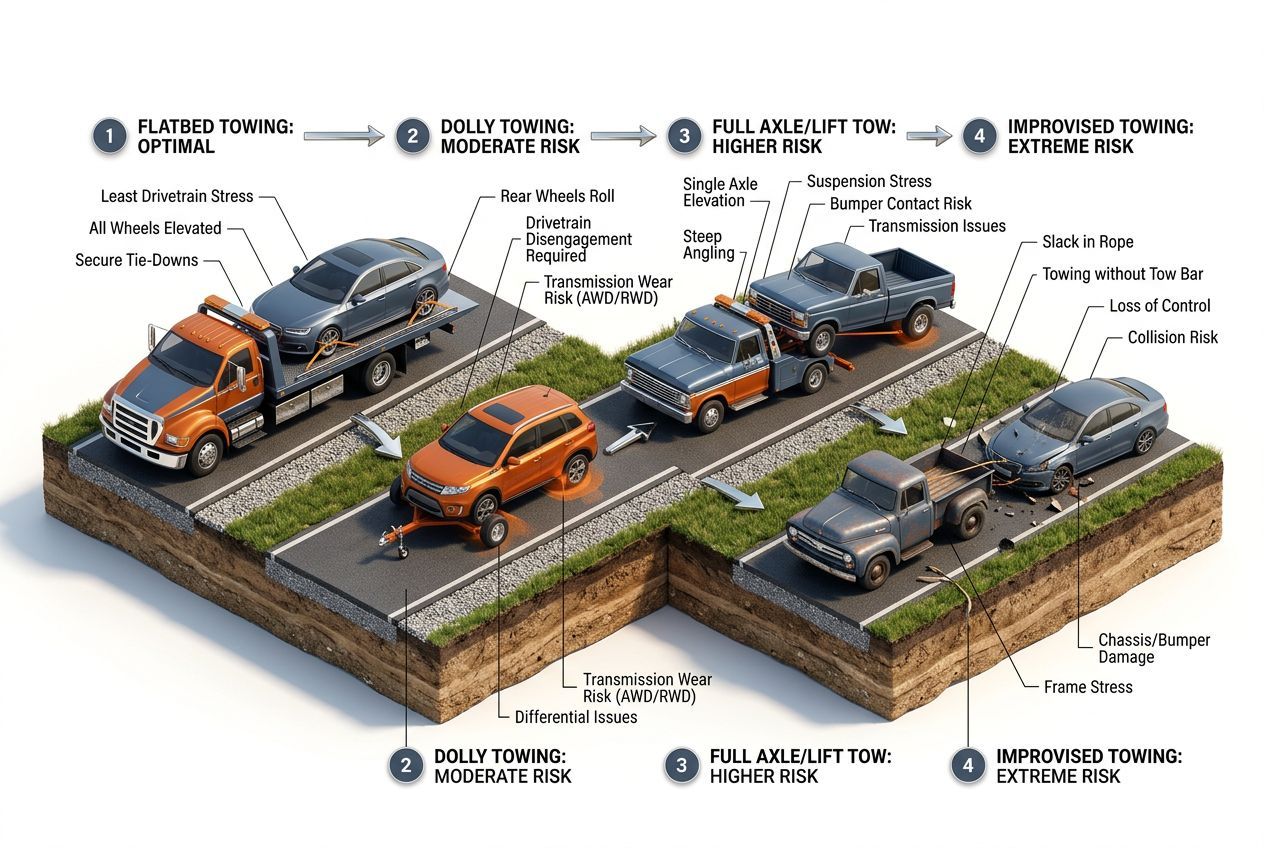
Towing Damage Risk by Method — Comparison
Towing Damage Risk by Method — Comparison — data table
| Tow Method |
Drivetrain Risk |
Body/Cosmetic Risk |
AWD Safe? |
Best For |
| Flatbed |
Very Low |
Low (ramp scrape possible) |
Yes |
All vehicles |
| Wheel-Lift (correct axle) |
Low–Medium |
Low–Medium |
No |
FWD/RWD short tows |
| Wheel-Lift (wrong axle) |
High |
Medium |
No |
Should not be used |
| Hook-and-Chain |
High |
Very High |
No |
Largely discontinued |
| Dolly (2-wheel trailer) |
Medium |
Low |
No |
FWD short-haul |
Source: Method risk profiles based on OEM owner's manual guidance (Ford, Toyota, Subaru) and NHTSA vehicle safety data at nhtsa.gov.
🚛
VEHICLE SAFETY & RECOVERY
Can Towing an AWD or 4WD Vehicle Cause Damage?
Yes, towing an AWD or 4WD vehicle with any wheels touching the ground can cause catastrophic and extremely expensive damage. This is arguably the most financially devastating towing damage risk, with repair bills frequently ranging from $2,000 to $5,000+, and it is entirely avoidable.
Why It Happens: All-Wheel Drive (AWD) systems are engineered to distribute torque across all four wheels simultaneously. When a tow truck lifts only one axle, allowing the other two wheels to roll on the pavement, those rolling wheels attempt to drive the transfer case and center differential. Without the engine running to provide power or circulate crucial lubrication fluid, this process essentially results in dry metal grinding against dry metal at highway speeds, even for a short duration.
⚠️ Warning: Never allow an AWD or 4WD vehicle to be towed with any wheels on the ground. Even a short distance in neutral can cause irreparable damage to the transfer case and differentials. Flatbed towing is the ONLY safe method.
Manufacturer Mandates: Brands such as Subaru, Audi, Toyota (for Lexus AWD models), and Jeep (for full-time 4WD trims) explicitly state flatbed-only towing requirements in their owner's manuals. For instance, Toyota's owner's manual guidelines clearly indicate that towing an AWD Rav4 with wheels on the ground—even in neutral—can lead to drivetrain damage that will not be covered under warranty.
Further Resources: Our AWD towing risks guide provides specific model information and essential questions to ask the dispatcher when arranging a tow. If you own an EV with AWD (e.g., Tesla Model Y, Rivian R1T), flatbed towing is doubly mandatory. Consult towing an electric car for a complete understanding of these specific requirements.
📝
VEHICLE SAFETY & RECOVERY
Who Pays for Damage Caused by a Tow Truck?
The tow company is legally responsible for any damage directly caused by their operator's negligence. Most reputable professional towing companies maintain garage keeper's liability insurance, which specifically covers physical damage to your vehicle while it is under their care—including during loading, transit, and unloading.
📊 Quick Fact: Average tow truck damage claims typically range from $1,500–$3,000 for moderate damage, reflecting common repair costs for such incidents.
Steps to File a Successful Claim: To maximize your chances of a successful tow truck damage claim, it's critical to take these four immediate actions:
- Document Immediately: Before your vehicle leaves the scene, use your phone to take timestamped photos as your primary evidence. Capture every angle, including bumper corners, rocker panels, wheels, and the undercarriage.
- Obtain a Written Report: Request that the operator or dispatcher document the damage on the work order or provide a separate incident report. If they decline, this refusal itself can serve as supporting evidence.
- Contact Insurer Promptly: Reach out to the towing company's insurance provider within 48 hours. Delays can weaken your claim, as insurers often use late reporting as grounds for denial.
- File a Regulatory Complaint: If the company is uncooperative, file a complaint with your state's towing regulator. States like California, Florida, and Texas, for example, have dedicated towing enforcement divisions with established complaint intake processes.
Insurance Options: If the towing company stonewalls your efforts, your own comprehensive auto insurance policy may cover the damage (after your deductible) while they pursue subrogation against the towing company on your behalf. Learn more about your options in situations where your car is towed and how to identify and handle tow truck scams if the company disputes legitimate damage.