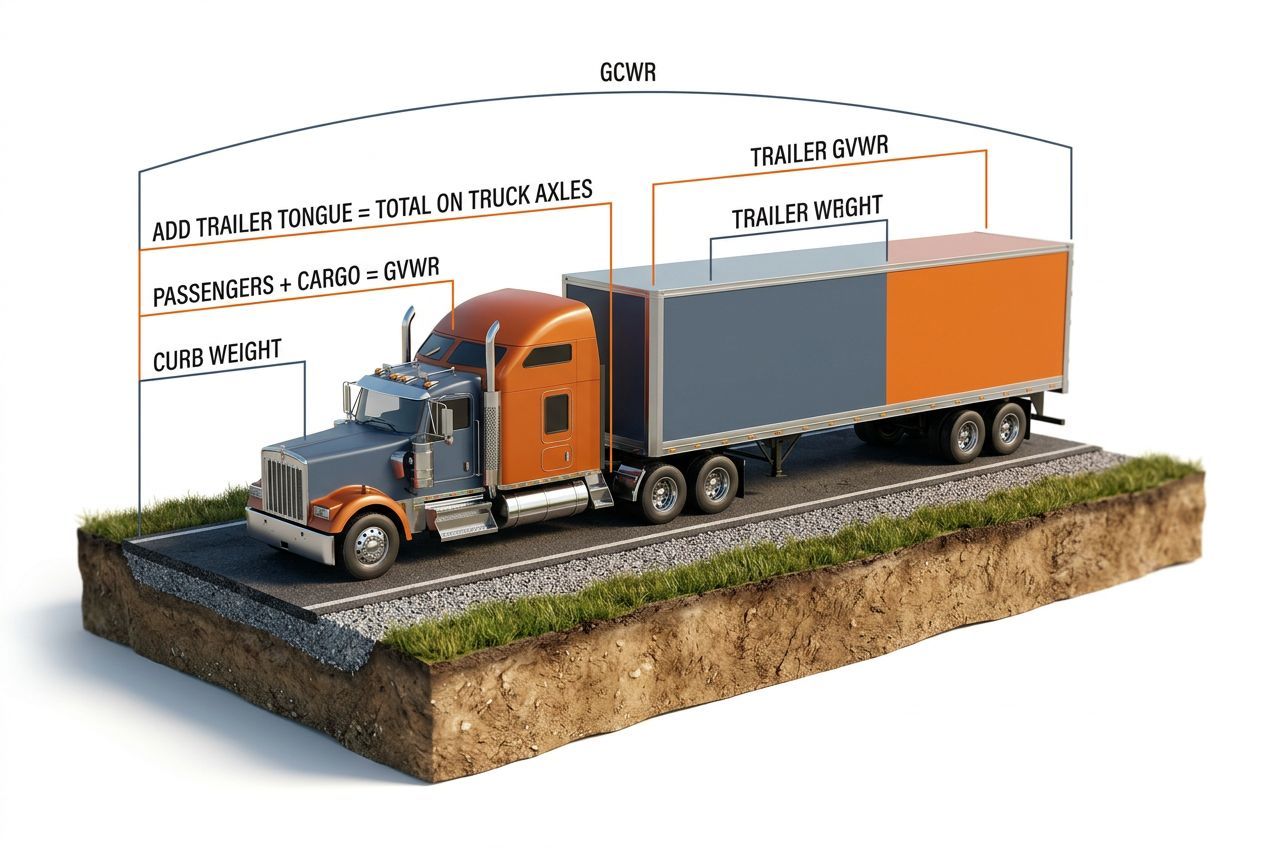
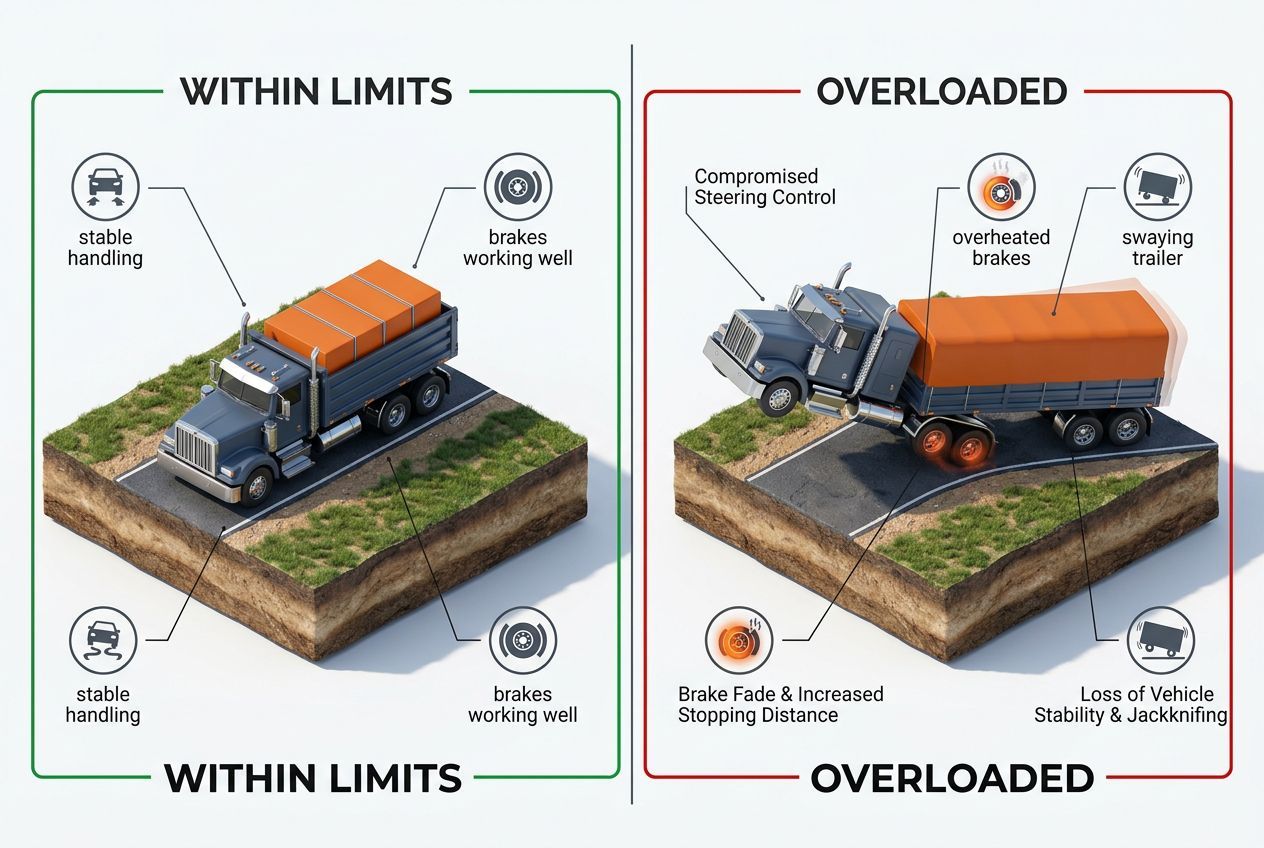
- GCWR caps the combined weight of truck + trailer. GVWR caps the truck alone. They work together — you need both to plan a safe tow setup.
- GAWR applies to each axle individually. You can stay under GVWR and still exceed GAWR by loading weight unevenly — and that's just as dangerous.
- All three ratings are printed on the driver-side door jamb or in the manufacturer's towing supplement. They're free to find; ignoring them isn't free.
- SAE J2807 — the voluntary towing standard adopted by all major OEMs since 2013 — governs how manufacturers test and publish these ratings.
- A single overloaded axle, not just a total weight violation, can trigger a DOT fine up to $16,000 per violation, according to the FMCSA.
Towing Ratings Demystified: Towing ratings look like alphabet soup at first — GCWR, GVWR, GAWR, GTW, CW. But once you know what each one controls, they're actually logical. Think of them as guardrails at different levels of your rig: one for each axle, one for the whole truck, and one for the truck-plus-trailer combo. Miss any one of them, and the system fails. For the foundation — what your truck weighs empty vs loaded — our curb weight vs gross weight guide covers the difference between curb weight, GVW, and GVWR.
This guide breaks each rating down, shows you where to find the numbers on your actual vehicle, and walks through a real-world example so you can see how they interact before you hook up and pull away.
What Does GCWR Mean and Why Does It Matter?
Defining GCWR: GCWR — gross combined weight rating — is the maximum weight the entire combination of tow vehicle and trailer can reach, including every pound of passengers, fuel, gear, and cargo in both the truck and the trailer. Manufacturers set GCWR based on engine output, transmission cooling capacity, frame strength, and — critically — braking system capability. It's the hardest ceiling in towing.
💡 Key Takeaway: The "max tow rating" on window stickers assumes an optimally configured, lightly loaded truck. GCWR is the actual, honest number. For example, a 2024 F-150 with the 3.5L EcoBoost has a GCWR of 17,100 lbs. If your loaded truck weighs 6,200 lbs, your fully loaded trailer cannot exceed 10,900 lbs, regardless of a higher advertised max tow rating.
⚠️ Warning: At altitude, your vehicle's performance decreases. A naturally aspirated engine loses roughly 15% of its rated output at 7,000 feet. While your GCWR doesn't change, your ability to operate safely near it is significantly reduced.
For a full breakdown of how GCWR fits into the broader towing capacity picture, see our towing capacity guide.

What Is GVWR and How Is It Different From GCWR?
Understanding GVWR: GVWR, or gross vehicle weight rating, is the maximum total weight a single vehicle can safely carry — its own curb weight plus every passenger, tank of fuel, and piece of cargo you add. It applies only to the truck itself, not the trailer. For instance, a 2024 Chevrolet Silverado 1500's max GVWR reaches 7,400 lbs, according to Chevrolet's published specs.
💡 Key Takeaway: The simplest way to think about it is that GVWR governs what's on the truck, while GCWR governs what's attached to it.
Finding Your GVWR: You'll find GVWR on the federal certification label located on the driver-side B-pillar door jamb. This sticker also lists tire pressure, tire size, and load ratings, and is a federally mandated label present on every passenger vehicle sold in the United States.
Calculating Payload Capacity: Payload capacity is derived directly from GVWR using a simple formula:
Payload = GVWR − Curb Weight
For example, if your Silverado 1500 has a GVWR of 7,400 lbs and a curb weight of 4,860 lbs, your payload is 1,540 lbs. This is your total budget for the driver, passengers, gear in the cab, and anything in the bed.
⚠️ Warning: Many people don't realize that a significant portion of the trailer's tongue weight directly eats into your truck's available payload capacity.
For a deeper look at how GVWR interacts with payload, our towing capacity vs. payload guide has the full breakdown.