Transmission Considerations: The 2007 F-150 V8s use a 4-speed automatic transmission (Ford's 4R75E unit). Ford's 2007 towing guide also lists a manual transmission for the 4.2L V6, rated at just 2,300–3,700 lbs.
⚠️ Warning: The 4R75E is a proven unit, but Ford requires the Trailer Tow Package, which upgrades the auxiliary transmission oil cooler, for any trailer over 5,000 lbs. Skipping that cooler and towing at max capacity is the fastest way to shorten the life of this transmission.
📊
TRUCK TOWING CAPACITY
2007 F-150 4.6L V8 Towing Capacity
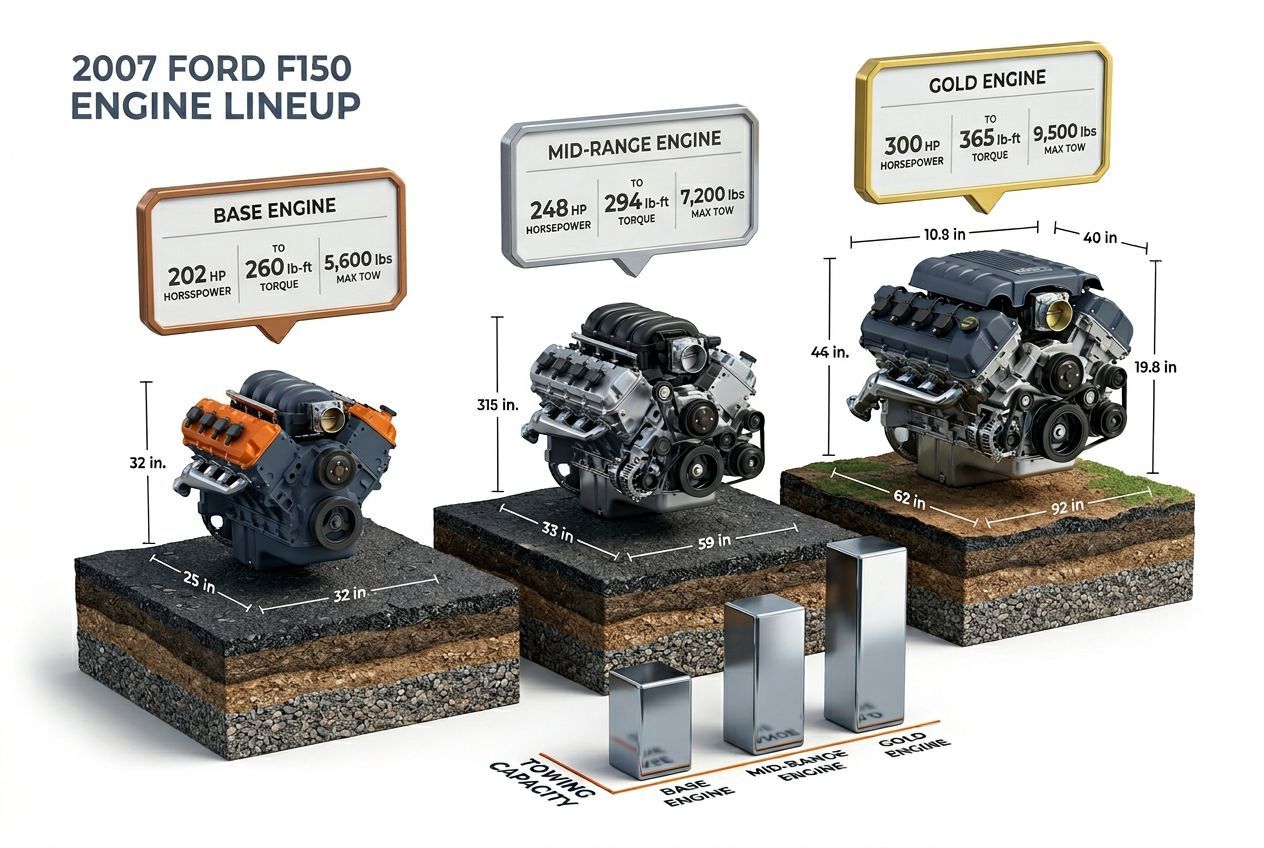
Maximum Towing Capacity: A 2007 F-150 equipped with the 5.4L 3-valve Triton V8 can tow up to 9,800 lbs when paired with the 3.73 rear axle and factory Trailer Tow Package, and up to 11,000 lbs with the 4.10 axle and Heavy Duty Payload Package. This engine produces 300 hp and 365 lb-ft of torque. Stepping down to the 3.55 axle drops the top rating to 8,800 lbs. The 5.4L is also the only engine eligible for the maximum GCWR of 16,400 lbs.
Understanding Payload in a Real-World Scenario: Let's consider a practical example.
Say you're towing a 28-ft travel trailer with a loaded GVWR of 8,500 lbs.
- Tongue weight at 12% is 1,020 lbs.
- Add the driver (200 lbs), a passenger (160 lbs), and 100 lbs of gear in the cab — that's 1,480 lbs against the truck's payload.
- A Regular Cab 5.4L F-150 might carry 2,800+ lbs of payload, so you'd have plenty of room.
- However, a SuperCrew Lariat with heavy options might be sitting at a 1,650-lb payload limit — leaving you just 170 lbs of margin with a full fuel tank.
✅ Pro Tip: Always run the numbers for your specific truck's payload and anticipated load before you hitch up. Payload limits are often reached before towing limits.
For a broader look at how the F-150 platform handles high tow ratings across model years, see our F-150 towing capacity hub.
🔧
TRUCK TOWING CAPACITY
What Is the Towing Capacity of a 2007 F-150 With the 4.6L V8?
4.6L V8 Towing Performance: The 2007 F-150's 4.6L 2-valve Triton V8 tops out at 7,200 lbs when configured with the 3.73 rear axle and tow package. This engine makes 248 hp and 294 lb-ft of torque — solid for most everyday towing tasks. With the 3.55 axle, the top rating drops to 6,700 lbs. It's a capable mid-range option, but the gap between it and the 5.4L is meaningful if you're near the top of your trailer's GVWR.
Ideal Uses for the 4.6L V8:
- Loaded car haulers in the 5,000–6,500-lb range
- Mid-size travel trailers (24–26 ft, depending on weight)
- Utility and landscape trailers under 7,000 lbs loaded
Limitations of the 4.6L V8:
- Fifth-wheel trailers — most fifth-wheels exceed 7,200 lbs loaded, and GCWR constraints leave no margin
- Back-to-back heavy towing days without close attention to transmission temps
🛡️
TRUCK TOWING CAPACITY
Can a 2007 F-150 V6 Tow a Travel Trailer?
4.2L V6 Towing Capacity: The 4.2L Essex V6 in the 2007 F-150 can tow up to 5,600 lbs with the automatic transmission and 3.73 axle — enough for pop-up campers, light utility trailers, and small travel trailers under 4,500 lbs loaded. It produces 202 hp and 260 lb-ft of torque, making it the weakest powertrain in the lineup. Before hitching any trailer, subtract tongue weight from your payload rating — on a V6 Regular Cab, that limit is around 1,800–2,000 lbs.
Realistic Limitations for Travel Trailers: The 4.2L V6 is not a travel trailer engine in any practical sense. A 22-ft trailer might come in at 4,800 lbs loaded — right at the ceiling. Add two adults, luggage, and a full water tank, and you're likely over.
⚠️ Warning: Ford rates the V6 at up to 5,600 lbs under ideal conditions (flat terrain, sea level, correct equipment). At 5,000+ feet elevation, naturally aspirated engines lose roughly 3% power per 1,000 feet — so that rating effectively shrinks to around 4,750 lbs in the Colorado Rockies.
💡 Key Takeaway: If travel trailer towing is your goal, the 4.6L V8 is the minimum engine you should consider for a 2007 F-150. Our towing capacity vs. payload explainer breaks down why both numbers matter equally.
📋
TRUCK TOWING CAPACITY
2007 F-150 Towing Capacity Chart by Engine and Axle Ratio
Importance of Axle Ratio: The 3.73 rear axle delivers the top rating for the V6 and 4.6L V8, and the 4.10 axle (5.4L only) unlocks the 11,000-lb maximum. Drop from the 3.73 to the 3.55 and you lose 500–1,000 lbs of capacity. The 3.31 axle drops ratings further and is really just for fuel economy on light-duty use. Axle ratio is stamped on the axle tag near the differential and also listed on the door-jamb sticker.
Axle Ratio Breakdown by Engine: Here's how the numbers break down by engine and axle combination, per the F-150 conventional towing table in Ford's 2007 RV & Trailer Towing Guide:
2007 F-150 Towing Capacity Chart by Engine and Axle Ratio — data table
| Engine |
Axle Ratio |
Max Conventional Tow |
Max GCWR |
| 4.2L V6 (202 hp) |
3.55 |
5,000–5,100 lbs |
10,000 lbs |
| 4.2L V6 (202 hp) |
3.73 |
5,500–5,600 lbs |
10,500 lbs |
| 4.6L V8 (248 hp) |
3.55 |
6,000–6,700 lbs |
11,500–11,700 lbs |
| 4.6L V8 (248 hp) |
3.73 |
6,500–7,200 lbs |
12,000–12,200 lbs |
| 5.4L V8 (300 hp) |
3.55 |
7,300–8,800 lbs |
13,000–14,000 lbs |
| 5.4L V8 (300 hp) |
3.73 |
7,800–9,800 lbs |
13,500–15,000 lbs |
| 5.4L V8 (300 hp) |
4.10 |
9,300–11,000 lbs |
15,300–16,400 lbs |
Source: Ford Motor Company 2007 RV & Trailer Towing Guide, automatic transmission. Higher figures are Regular Cab 4x2 long bed; SuperCab, SuperCrew, and 4x4 ratings fall within each range. The 11,000-lb rating requires the Heavy Duty Payload Package, and Ford cuts 500 lbs from ratings on trucks with 18- or 20-inch wheels.
If you're shopping for a used 2007 F-150 and want to confirm how these specs compare to other half-ton options from the same era, our half-ton truck towing capacity comparison puts the numbers side by side.
⚙️
TRUCK TOWING CAPACITY
Does the 2007 F-150 Need a Tow Package to Reach Its Max Rating?
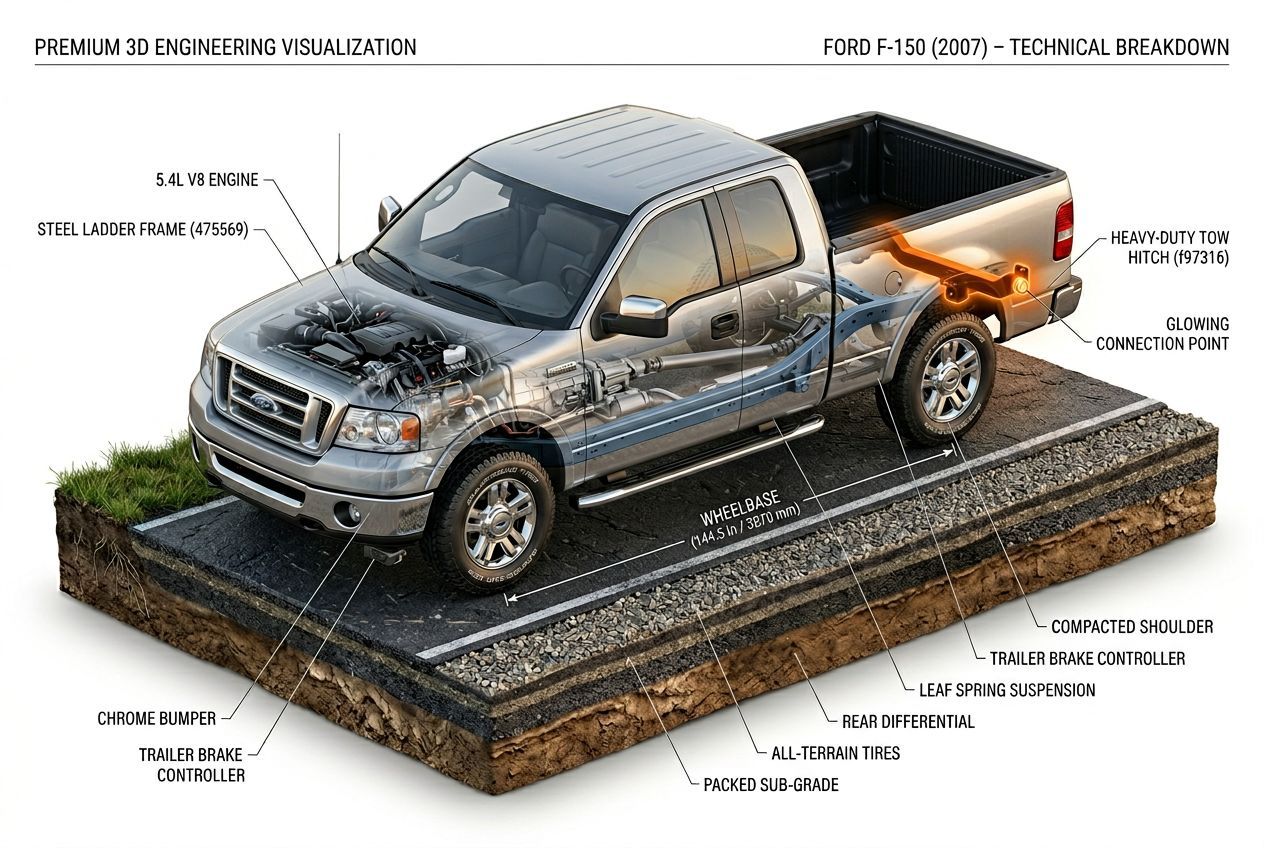
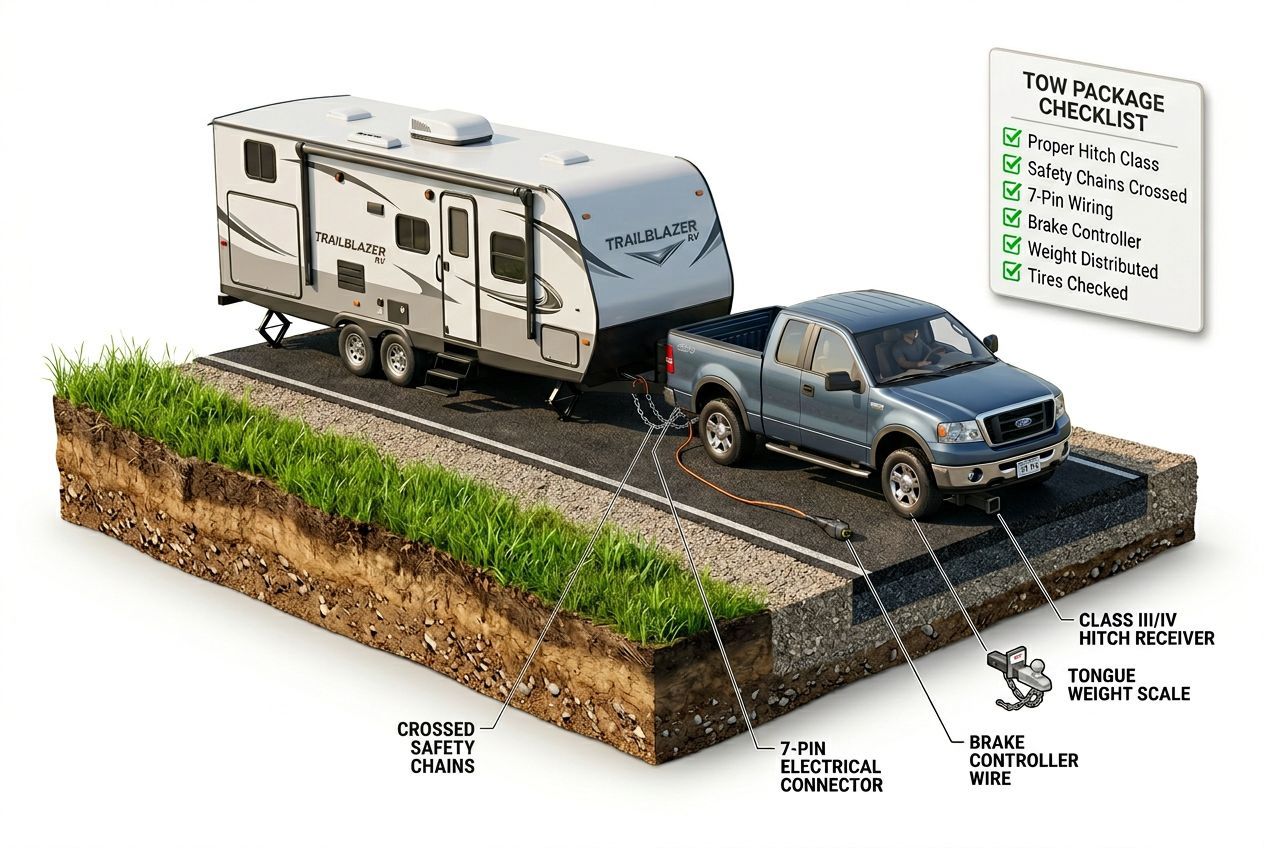
The Essential Trailer Tow Package: Yes — the factory Trailer Tow Package is mandatory to reach Ford's published max tow ratings on the 2007 F-150. Without it (or the Heavy Duty Payload Package), Ford's 2007 towing guide limits the truck to trailers of 5,000 lbs or less. The package (option code 535) includes a hitch receiver, 7-wire harness with 4/7-pin connector, a larger auxiliary transmission oil cooler, upgraded radiator (V8s only), and a 72 amp-hr heavy-duty battery.
Aftermarket vs. Factory Tow Package: An aftermarket hitch alone does not restore the full rating. The receiver is just one component. Without the factory cooling upgrades and wiring, you're operating outside Ford's engineered parameters.
⚠️ Warning: Operating outside Ford's engineered parameters by towing at max capacity without the factory tow package can potentially void any remaining drivetrain warranty claims. Vehicle towing ratings are established under specific equipment configurations; deviating from them shifts liability to the operator.
How to Verify Tow Package Presence on a Used Truck:
- Check for the 7-pin trailer connector at the rear bumper (4-pin only = no tow package).
- Look for the transmission cooler lines running to the front of the radiator.
- Check the window sticker or factory build sheet (from a Ford dealer, by VIN) for the Trailer Tow Package.
- Pull the window sticker or build data via Ford's VIN decoder at ford.com.
If the tow package is missing, budget $800–$1,500 for a proper aftermarket cooling and wiring upgrade — but understand that Ford's published max rating still won't officially apply.
🚛
TRUCK TOWING CAPACITY
What Is the Payload Capacity of a 2007 Ford F-150?
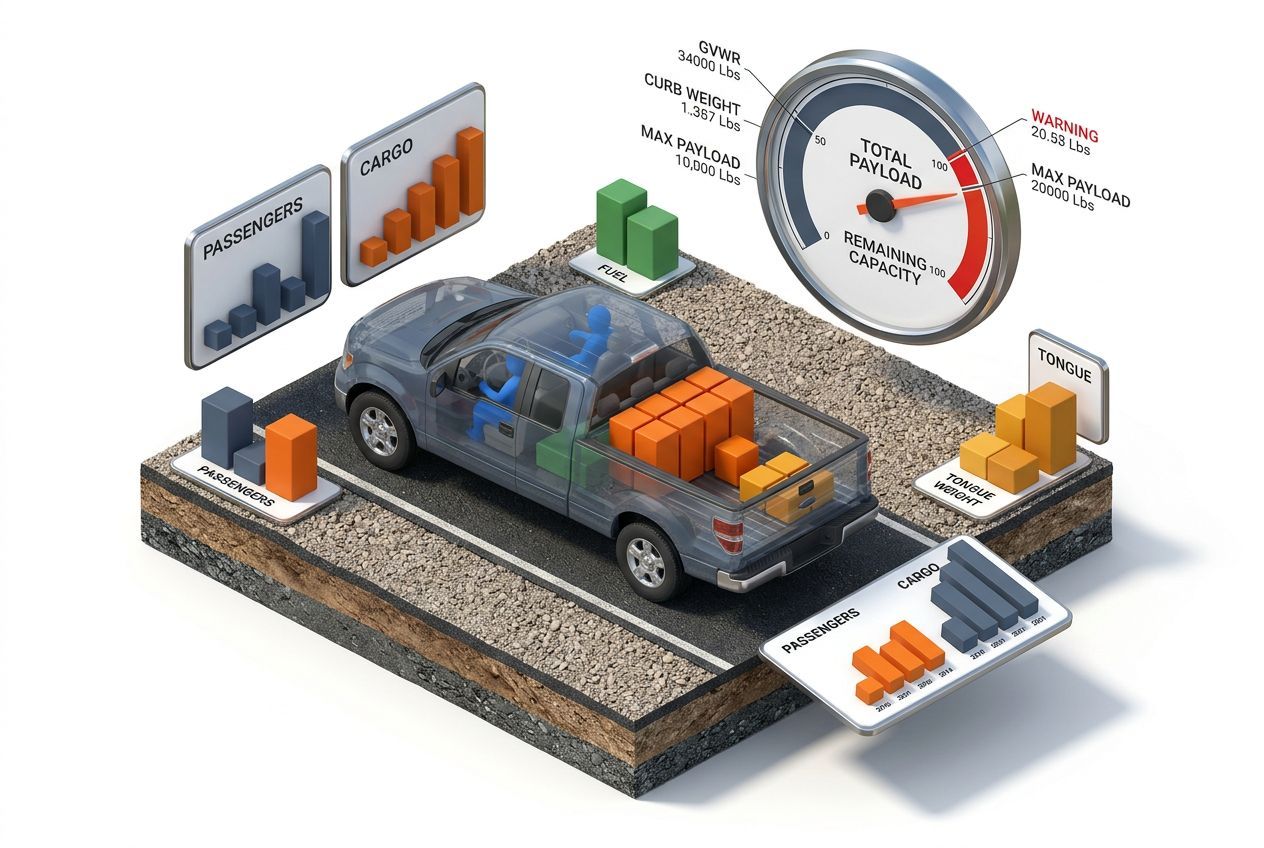
Payload Capacity Range: The 2007 F-150 payload capacity runs from approximately 1,450 lbs to 3,030 lbs depending on cab style, bed length, engine, and installed options. Regular Cab, long-bed XL models with minimal options rate highest. SuperCrew models with heavy packages — moonroof, power running boards, leather — rate lowest because those options eat directly into GVWR-minus-curb-weight math. Payload is printed on the yellow Tire and Loading Information label inside the driver's door jamb (NHTSA's tire safety page shows where it sits).
Payload and Towing: Payload matters during towing because tongue weight — typically 10–15% of trailer GVWR — counts against the truck's payload, not its tow rating. These are separate limits that must both be respected simultaneously. Our towing capacity guide pillar explains the relationship between GVWR, GCWR, and payload in detail.
Quick Payload Check:
- Tongue weight
-
-
-
- = Total payload demand.
Keep this number under the yellow sticker's figure. If you're close to that ceiling, use our payload calculator to run the exact numbers before you load up.
For a side-by-side look at how the 2007 F-150's numbers compare to the competition, our RAM 1500 towing capacity guide and Silverado towing capacity guide cover the same generation of rivals.
📝
TRUCK TOWING CAPACITY
Towing Safety Tips for the 2007 F-150
The 2007 F-150 shares the 11th-generation platform with proven towing capability, but these tips will keep you safe:
- Stay 10–15% below your max tow rating. This accounts for fuel, passengers, and gear not included in dry trailer weight.
- Verify tongue weight is 10–15% of trailer weight. Use a tongue weight scale at home or at a truck stop scale.
- Use a weight distribution hitch above 5,000 lbs. The 2007 F-150's rear leaf springs sag noticeably under heavy tongue loads.
- Downshift on long descents. The 4R75E transmission generates heat quickly under sustained braking. Use engine braking in 3rd or 2nd gear.
- Monitor transmission temperature. The 2007 F-150 lacks a factory trans temp gauge. An aftermarket gauge ($30–$60) is essential for frequent towers.
- Check tire pressure before every tow. The recommended towing pressure is on the driver's door jamb. Under-inflation causes heat buildup and sway.
💰
TRUCK TOWING CAPACITY
Maintenance Schedule for Heavy Towing
Maintenance Schedule for Heavy Towing — data table
| Service |
Normal Interval |
Heavy Towing Interval |
| Engine oil and filter |
7,500 miles |
5,000 miles |
| Transmission fluid |
60,000 miles |
30,000 miles |
| Transfer case fluid (4WD) |
60,000 miles |
30,000 miles |
| Coolant flush |
100,000 miles |
50,000 miles |
| Brake inspection |
30,000 miles |
15,000 miles |
| Rear differential fluid |
60,000 miles |
30,000 miles |
Source: Ford Motor Company 2007 F-150 Owner's Manual.

