📊
TRUCK TOWING CAPACITY
2005 F-150 Towing Capacity by Engine and Configuration
Here's the full breakdown across engine, axle ratio, and general configuration. These figures come from the F-150 Pickup Conventional Towing table in Ford's 2005 RV & Trailer Towing Guide.
2005 F-150 Towing Capacity by Engine and Configuration — data table
| Engine |
Axle Ratio |
Transmission |
Max Towing Capacity |
| 4.2L V6 (202 hp) |
3.31 / 3.55 |
Manual |
2,200–3,700 lbs |
| 4.2L V6 (202 hp) |
3.55 / 3.73 |
Automatic |
5,000–5,600 lbs |
| 4.6L V8 (231 hp) |
3.55 |
Automatic |
6,000–6,600 lbs |
| 4.6L V8 (231 hp) |
3.73 |
Automatic |
6,500–7,100 lbs |
| 5.4L V8 (300 hp) |
3.31 / 3.55 |
Automatic |
6,900–8,800 lbs |
| 5.4L V8 (300 hp) |
3.73 / 4.10 |
Automatic |
7,800–9,900 lbs |
Source: Ford Motor Company 2005 RV & Trailer Towing Guide, F-150 conventional towing selector. Ford requires the Trailer Tow Package or Heavy Duty Payload Package for trailers over 5,000 lbs; the V6 was rated only in Regular Cab 4x2 form.
💡 Key Takeaway: Cab style also influences towing capacity. Regular cab, short-bed, rear-wheel-drive trucks generally achieve the highest ratings within each engine's range. SuperCrew 4x4 models with the same engine typically have ratings that are 300–600 lbs lower due to their increased curb weight and drivetrain losses.
The Gross Combined Weight Rating (GCWR) for the best-equipped 5.4L V8 configurations can reach up to 15,300 lbs. Across the entire lineup, curb weights for the 2005 F-150 span from 4,196 to 5,296 lbs.
🔧
TRUCK TOWING CAPACITY
2005 F-150 5.4L V8 Towing Capacity
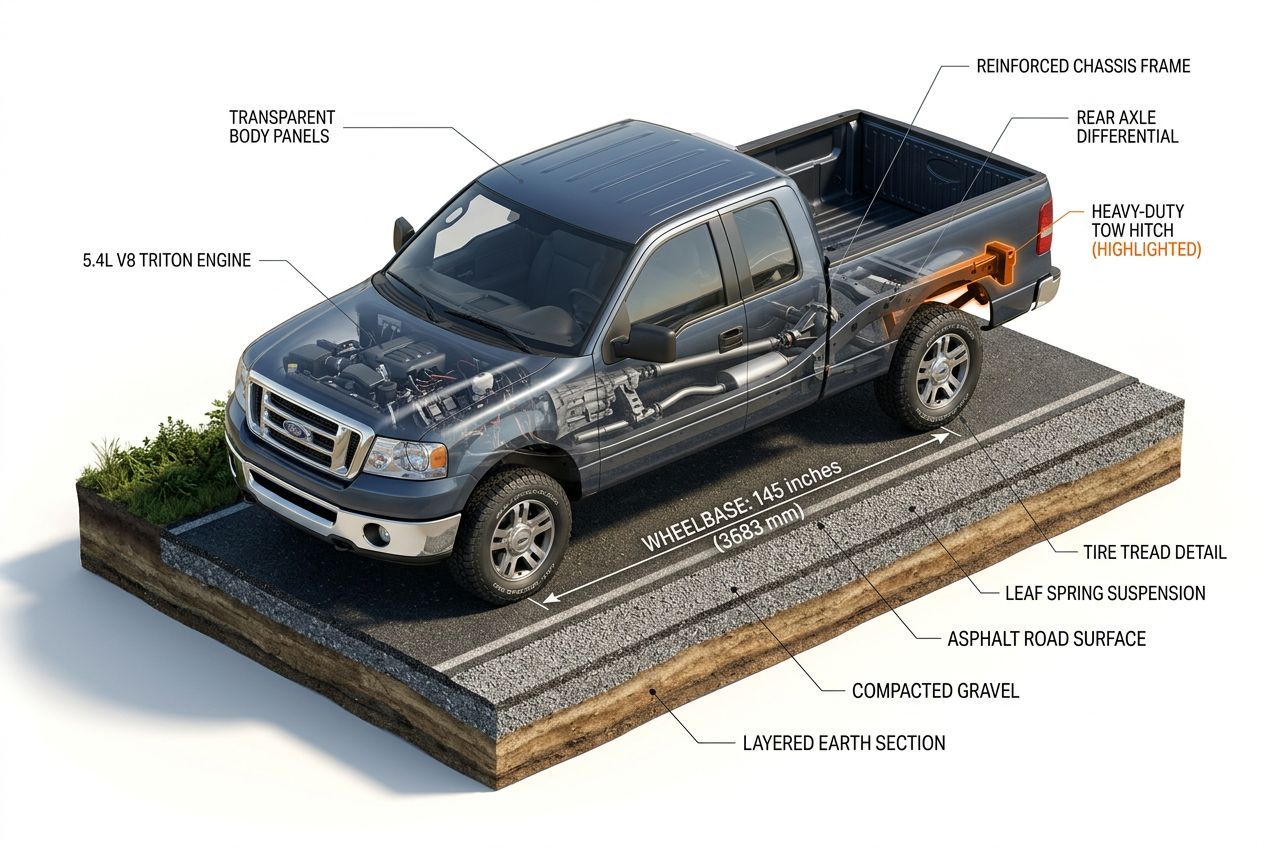
The 5.4L Triton V8 is the top towing engine in the 2005 F-150 lineup, reaching a maximum of 9,900 lbs when equipped with the 4.10 rear axle and factory Trailer Tow Package (9,800 lbs with the 3.73). This engine produces 300 hp and 365 lb-ft of torque, providing the pulling power needed for heavy conventional trailers, large boats, and loaded car haulers.
2005 F-150 5.4L towing capacity by axle ratio:
2005 F-150 5.4L V8 Towing Capacity — data table
| Axle Ratio |
Cab Style |
Max Tow Rating |
GCWR |
| 3.55 |
Regular Cab |
7,600–8,800 lbs |
13,000–14,000 lbs |
| 3.73 |
Regular Cab |
8,100–9,800 lbs |
13,500–15,000 lbs |
| 4.10 |
Regular Cab |
9,500–9,900 lbs |
15,300 lbs |
| 3.55 |
SuperCrew |
8,200–8,500 lbs |
14,000 lbs |
| 3.73 |
SuperCrew |
9,200–9,500 lbs |
15,000 lbs |
Source: Ford Motor Company 2005 RV & Trailer Towing Guide (automatic transmission). Lower figure in each range is 4x4; Ford reduces GCWR and trailer weight by 500 lbs on 5.4L trucks with 18-inch wheels.
The 05 F-150 5.4L V8 is capable of towing most mid-size travel trailers, loaded car haulers, and recreational boats with room to spare. For heavier loads approaching the 9,900-lb ceiling, verify your specific truck's payload capacity using the door-jamb sticker — tongue weight at 12-15% of trailer GVWR eats directly into that number.
🛡️
TRUCK TOWING CAPACITY
What Is the Towing Capacity of a 2005 F-150 V6?
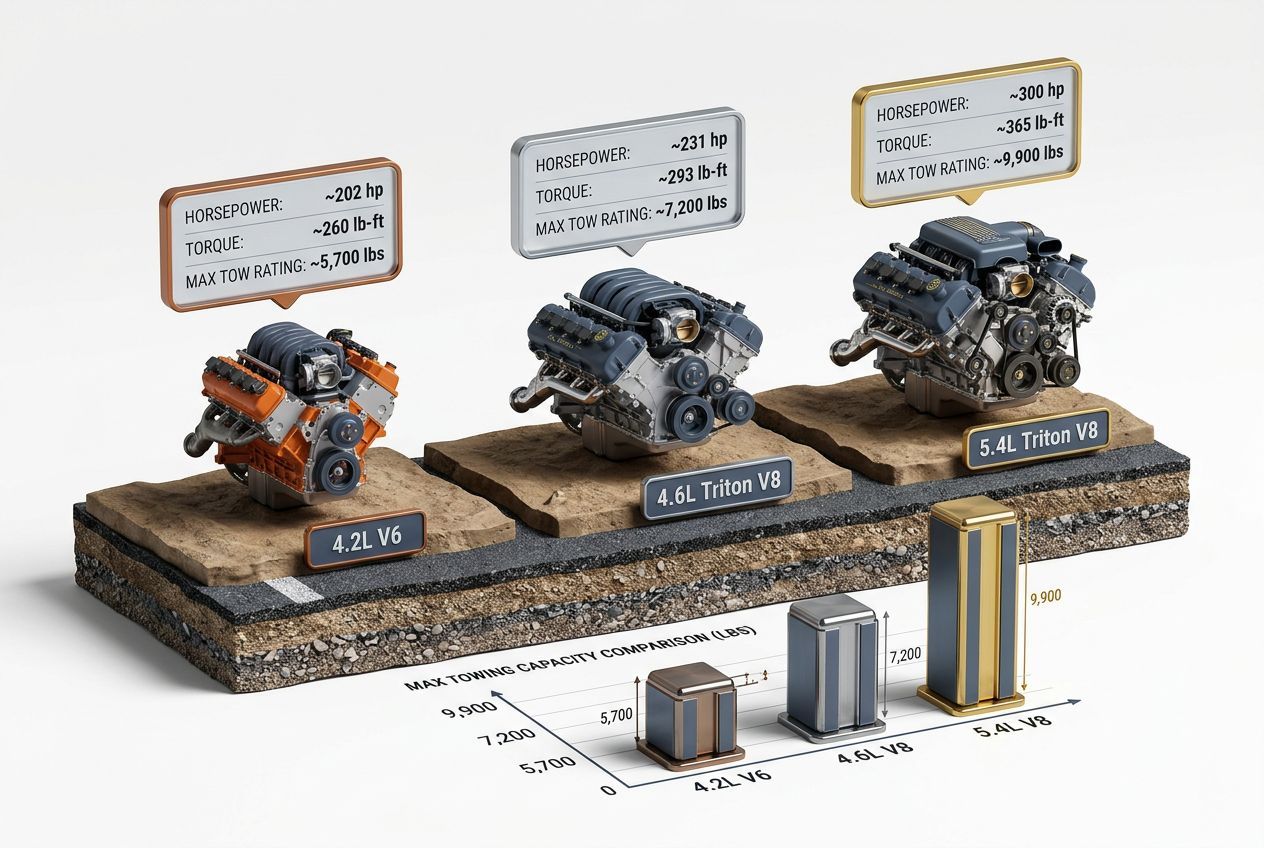
V6 Limitations: The 2005 F-150's 4.2L Essex V6 engine has a maximum towing capacity of 5,600 lbs with the automatic transmission and 3.73 axle (5,100 lbs with the 3.55). Manual-transmission V6 trucks are rated far lower: 2,200–2,400 lbs with the 3.31 axle and 3,500–3,700 lbs with the 3.55.
Suitable Applications: With 202 hp and 260 lb-ft of torque, the 2005 F-150 4.2L V6 towing capacity is generally suitable for:
- Lightweight utility trailers
- Small fishing boats
- Pop-up campers
Transmission Note: This V6 engine was paired with either a 5-speed manual or a 4-speed automatic. If you encounter a 2005 F-150 with a manual transmission, it almost certainly has the V6. Manual-equipped trucks generally cannot achieve the same maximum tow ratings as automatics, primarily because the factory tow package's transmission oil cooler is designed specifically for automatic transmissions.
⚠️ Warning: The V6 is inherently not a heavy-duty towing engine. If your loaded trailer approaches or exceeds 5,500 lbs (including all gear, water, and tongue weight), this truck will likely struggle. Sustained climbs on grades above 6% can lead to rapid engine coolant overheating, especially without a supplemental transmission cooler. For any towing requirement over 5,000 lbs, upgrading to the 4.6L or 5.4L V8 is highly recommended for safety and performance. Consult our towing capacity vs. payload guide for help matching the right engine to your trailer weight.
📋
TRUCK TOWING CAPACITY
Does a 2005 F-150 Need a Tow Package?
Essential for Max Capacity: Yes, a 2005 F-150 absolutely needs the factory tow package to achieve its published maximum towing capacities. The difference in ratings is substantial. Without this package, published maximum towing capacities drop by 2,000 lbs or more across all engine options.
What the Factory Tow Package Includes:
- Class IV trailer hitch receiver
- Engine oil cooler
- Transmission oil cooler
- Heavy-duty trailer wiring relay
- 7-pin connector harness
- Upgraded radiator
✅ Pro Tip: To verify if a used truck has the factory tow package, look for the 7-pin connector behind the rear bumper (a 4-pin connector alone indicates it's not fully equipped). You can also check the door-jamb sticker for option codes or pull the original window sticker through a Ford dealer using your VIN. Visually, inspect the transmission pan area for external cooler lines running to a separate cooler near the front radiator.
Aftermarket Considerations: Aftermarket alternatives exist, but they must be matched carefully to your towing needs. While a standalone transmission cooler (brands like B&M SuperCooler or Hayden Rapid-Cool are popular) can provide similar cooling capacity to the factory unit, you'll still need a proper Class IV receiver rated for your target Gross Trailer Weight (GTW). Always verify the GTW rating stamped directly on the receiver tube itself, looking for "GTW 10,000" or "Class IV" near the pin hole.

⚙️
TRUCK TOWING CAPACITY
What Is the Payload Capacity of a 2005 Ford F-150?
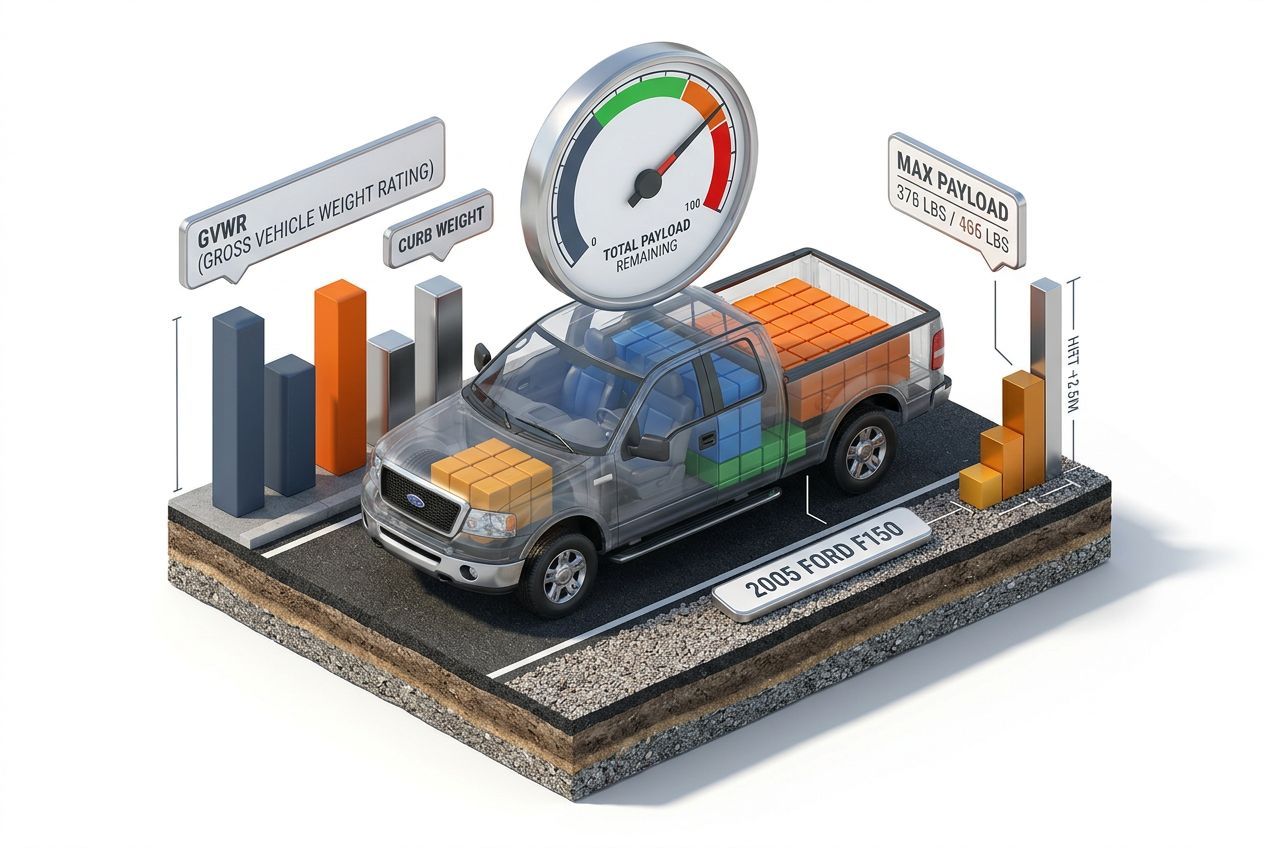
Understanding Payload: The 2005 Ford F-150 payload capacity typically ranges from approximately 1,300 to 2,050 lbs. This figure varies depending on numerous factors including cab style, bed length, engine, and drivetrain. Your specific truck's exact payload capacity is listed on its door-jamb sticker, and that is the only number you should rely on.
Payload vs. Tongue Weight: Payload is the combined weight of everything you put in or on the truck:
- Passengers
- Cargo in the bed or cab
- The tongue weight from your trailer
This last point is crucial and often trips up even experienced towers: trailer tongue weight counts directly against your truck's payload capacity. Ford's 2005 towing guide puts trailer tongue load at 10–15% of total loaded trailer weight and states that tongue load, passengers, and cargo cannot push the truck past its rear GAWR or GVWR.
💡 Key Takeaway: Your payload capacity is often reached before your towing capacity, especially with dense cargo or heavy trailer tongue weights. Always verify your available payload before loading up.
Worked Example:
Let's illustrate with an example:
- You're towing a 7,000-lb travel trailer with a properly equipped 5.4L V8.
- Assuming a 12% tongue weight, that's 840 lbs.
- Add the driver (190 lbs), one passenger (160 lbs), and 100 lbs of miscellaneous gear in the cab.
- Your total payload consumption is 840 lbs (tongue) + 190 lbs (driver) + 160 lbs (passenger) + 100 lbs (gear) = 1,290 lbs.
- If your truck has a payload rating of, say, 1,500 lbs, you only have 210 lbs remaining.
- Consider a full 30-gallon tank of fuel, which weighs approximately 180 lbs. This means you're functionally at maximum payload with just a driver, one passenger, and a light cab load, leaving little to no room for a loaded toolbox or an ice chest in the truck bed.
Our payload calculator can help you run this math for your specific configuration before you hitch up.
🚛
TRUCK TOWING CAPACITY
What Axle Ratio Is Best for Towing with a 2005 F-150?
Optimal Ratios: The 4.10 axle ratio (5.4L V8 only) delivers the peak 9,900-lb rating for the 2005 F-150, and the 3.73 is the best choice across both V8s if regular trailer use is your primary concern.
Ratio Comparison:
- 4.10 Ratio: Highest ratings (9,300–9,900 lbs), offered only on 5.4L long-wheelbase Regular Cab and SuperCab trucks.
- 3.73 Ratio: Best widely available ratio for towing power.
- 3.55 Ratio: This ratio offers a compromise between towing performance and fuel economy. It typically reduces maximum tow ratings by 500–1,000 lbs compared to the 3.73, but it can recover 1–2 mpg during unladen driving.
- 3.31 Ratio: The base 3.31 axle significantly reduces tow ratings by 1,500–2,500 lbs versus the 3.73 on the 5.4L. This ratio should be avoided if heavy towing is a priority.
✅ Pro Tip: To identify your rear axle ratio, check the door-jamb sticker on the driver's side B-pillar; it will list an axle code. You can then decode this using a Ford axle code chart. Another method, if practical, is to manually count the rear driveshaft rotations per wheel revolution with the truck safely elevated in neutral – approximately 3.73 driveshaft turns for one wheel turn confirms a 3.73 ratio.
4x4 Considerations: For 4x4 trucks, both the front and rear axle ratios must match, and Ford equipped them identically from the factory. A 4x4 with the 3.73 ratio will experience a slightly greater fuel economy penalty compared to a 2WD with the same gearing due to additional drivetrain weight and friction. If you tow heavily but also daily drive, carefully weigh this tradeoff. Our F-150 towing capacity page covers axle ratio considerations across every generation for a wider comparison.
📝
TRUCK TOWING CAPACITY
Can a 2005 F-150 Tow a Travel Trailer?
Matching Trailer to Truck: A well-equipped 2005 F-150 can indeed tow many travel trailers, but careful matching of the trailer's loaded weight to your truck's rated capacity is absolutely essential. With the 5.4L V8, a 3.73 or 4.10 axle, and factory tow package, you can safely handle most travel trailers up to 7,500 lbs loaded. This leaves a buffer of approximately 2,400 lbs below the 9,900-lb maximum, which is an appropriate working margin for sustained highway towing, aligning with guidelines from the Federal Motor Carrier Safety Administration.
✅ Pro Tip: The 2005 F-150 does not come with integrated trailer brake controller wiring from the factory. However, the tow package's wiring harness makes it straightforward to add an aftermarket controller (like a Tekonsha Prodigy P3 or Cequent) without needing to cut into factory wiring. Electric trailer brakes are a legal requirement for trailers over 3,000 lbs in most states. Check our towing laws tool for your state's specific threshold.
Limitations and Warnings:
- Light Trailers: Pop-up campers and teardrop trailers are generally well within the capabilities of even V6 models.
- Heavy Trailers: If your travel trailer's loaded weight consistently hits 8,500 lbs or more, the 2005 F-150 is not the appropriate vehicle, regardless of engine. The 9,900-lb ceiling represents the absolute maximum under ideal conditions and doesn't fully account for factors like mountain grades, strong headwinds, or a heavy tongue weight.
- Upgrade Required: For trailers in the 8,500+ lb range, you should consider a 3/4-ton platform, such as a Ford F-250 or a Chevrolet Silverado 2500HD, for adequate safety and performance. Refer to our half-ton truck towing capacity guide for a direct comparison of what this class of truck can and cannot handle.
For other 11th-generation F-150 years within a similar towing capability window, the 2008 F-150 towing capacity and 2009 F-150 towing capacity pages are worth a look if your model year flexibility.
💰
TRUCK TOWING CAPACITY
Towing Safety Tips for the 2005 F-150
The 2005 F-150 is a capable tow vehicle, but staying safe requires more than just staying under the max rating:
- Stay 10–15% below max tow rating. This provides a safety margin for fuel, passengers, and cargo you add after weighing.
- Check tongue weight before every trip. Target 10–15% of total trailer weight. Too little causes trailer sway; too much overloads the rear axle.
- Use a weight distribution hitch above 5,000 lbs. The 2005 F-150's rear leaf springs compress noticeably with heavy tongue loads.
- Downshift on long descents. The 4R75E automatic transmission can overheat relying solely on brakes during mountain descents.
- Monitor transmission temperature. Install an aftermarket gauge ($30–$60) if you tow frequently. Keep fluid below 250°F.
- Increase following distance to 6–8 seconds. A loaded F-150 towing 8,000 lbs takes roughly 40% longer to stop than unloaded.
📊
TRUCK TOWING CAPACITY
Maintenance Schedule for Heavy Towing
Maintenance Schedule for Heavy Towing — data table
| Service |
Normal Interval |
Heavy Towing Interval |
| Engine oil and filter |
7,500 miles |
5,000 miles |
| Transmission fluid |
60,000 miles |
30,000 miles |
| Transfer case fluid (4WD) |
60,000 miles |
30,000 miles |
| Coolant flush |
100,000 miles |
50,000 miles |
| Brake inspection |
30,000 miles |
15,000 miles |
| Rear differential fluid |
60,000 miles |
30,000 miles |
Source: Ford Motor Company 2005 F-150 Owner's Manual.

