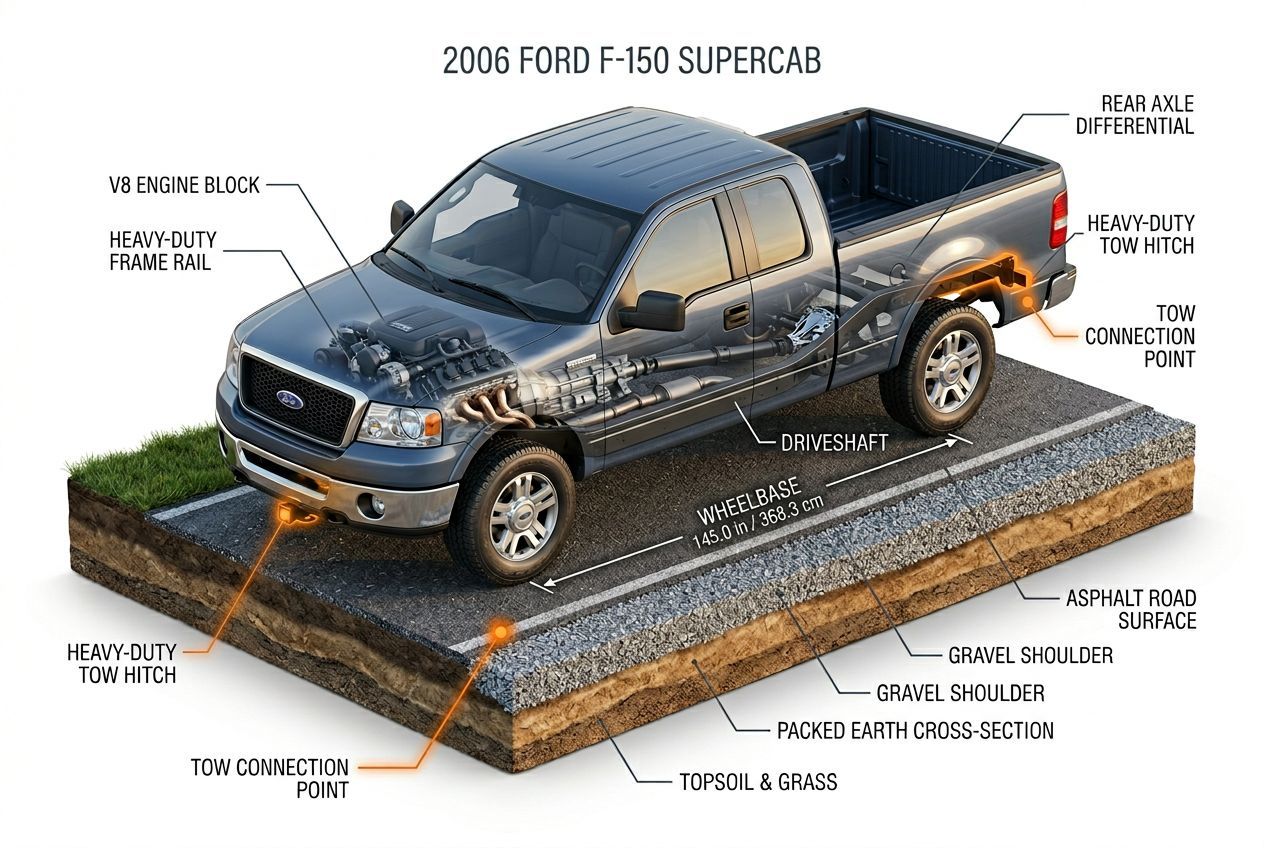
The 2006 F-150 sits in the 11th generation body style (2004–2008), sharing its fully boxed steel frame with the 2005 F-150 and 2007 F-150. Ford introduced this boxed frame design in 2004, replacing the old C-channel rails and improving torsional rigidity by roughly 30% — a meaningful structural upgrade that supported higher tow ratings across the lineup.
📊
TRUCK TOWING CAPACITY
How Much Can a 2006 F-150 With the 5.4L V8 Tow?
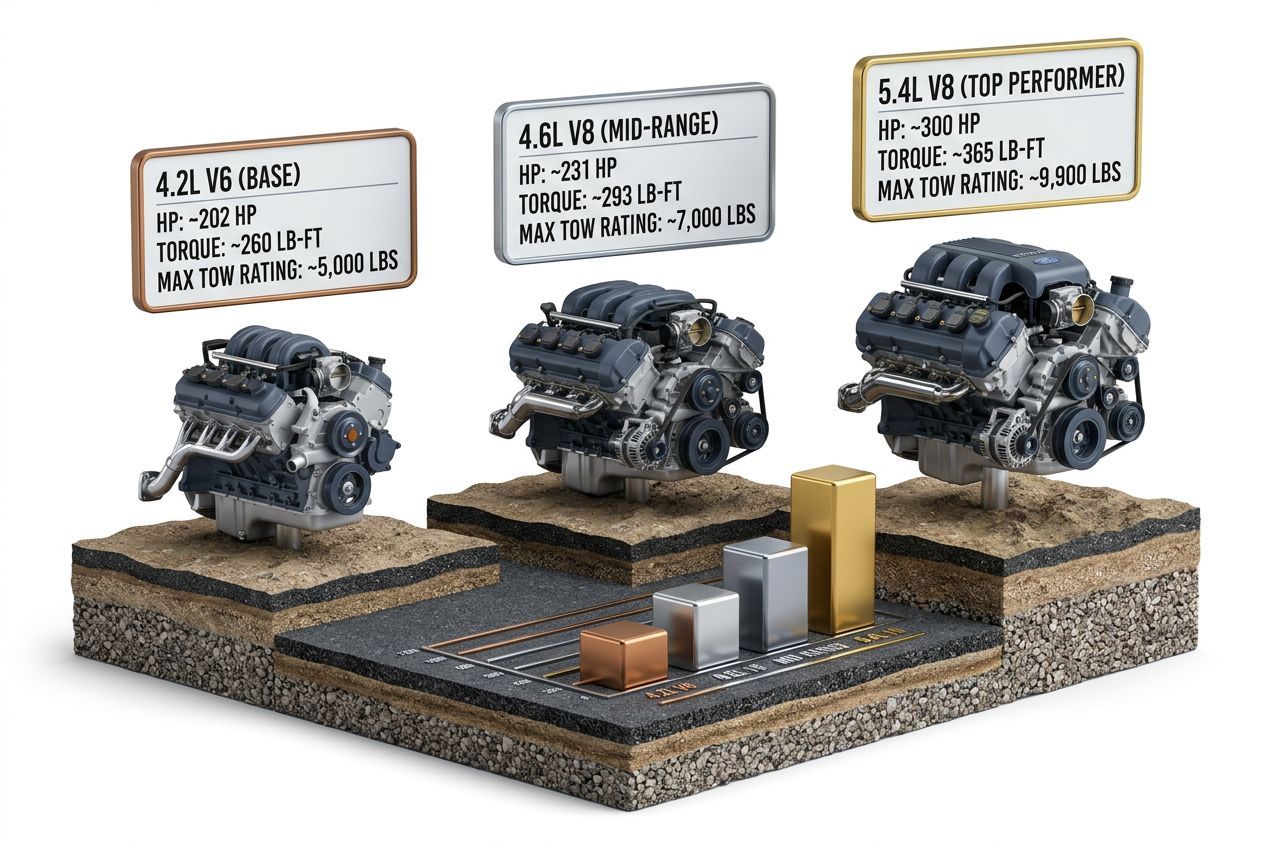
Engine Performance for Towing: The 2006 F-150, when equipped with the 5.4L 3-valve Triton V8, offers a towing range of 7,400 to 9,900 lbs. This range is influenced by factors such as the axle ratio, cab configuration, and whether the Max Trailer Tow Package is installed. With 300 hp and 365 lb-ft of torque, the 5.4L V8 is the optimal choice for owners who plan to tow frequently or heavy loads. In comparison, the 4.6L two-valve V8 (231 hp, 293 lb-ft) has a lower peak, topping out at 7,200 lbs even in its best configuration.
Here's how the three available engines stack up across key towing configurations:
How Much Can a 2006 F-150 With the 5.4L V8 Tow? — data table
| Engine |
Power Output |
Axle Ratio |
Cab Style |
Max Tow Rating |
| 4.2L V6 (202 hp / 260 lb-ft) |
Base |
3.55 / 3.73 |
Regular Cab |
5,100–5,700 lbs |
| 4.6L V8 (231 hp / 293 lb-ft) |
Mid |
3.55 |
SuperCab |
6,000–6,400 lbs |
| 4.6L V8 (231 hp / 293 lb-ft) |
Mid |
3.73 |
Regular Cab |
6,800–7,200 lbs |
| 5.4L V8 (300 hp / 365 lb-ft) |
Top |
3.55 |
SuperCrew |
8,100–8,500 lbs |
| 5.4L V8 (300 hp / 365 lb-ft) |
Top |
3.73 |
Regular Cab |
8,200–9,800 lbs |
| 5.4L V8 (300 hp / 365 lb-ft) |
Top |
4.10 |
Regular Cab |
9,500–9,900 lbs |
Source: Ford's 2006 RV & Trailer Towing Guide, F-150 conventional towing table (automatic transmission; lower figure in each range is 4x4 or shorter wheelbase). Ford requires the Trailer Tow Package or Heavy Duty Payload Package for trailers over 5,000 lbs and cuts 500 lbs from ratings on trucks with 18- or 20-inch wheels. Verify against your truck's door-jamb label.
If you're shopping a used 2006 with the 5.4L, confirm the 3.73 (or 4.10) axle code is on the door-jamb sticker — not every 5.4L truck left the factory with it. The axle code is listed alongside GVWR and GAWR on the B-pillar sticker on the driver's side.
🔧
TRUCK TOWING CAPACITY
Can a 2006 Ford F-150 Tow a Travel Trailer or Camper?
A properly equipped 2006 F-150 can tow most mid-size travel trailers and boat trailers, but owners must account for loaded weight — not just the manufacturer's dry figure. Travel trailers rated at 5,000–7,000 lbs loaded fall within reach of the 5.4L V8 with the tow package, but the math gets tight fast when you factor in tongue weight and payload.
Real-World Towing Example: Let's consider a scenario where you're pulling a 7,000-lb loaded travel trailer.
- Tongue weight at 12% is 840 lbs.
- Add the driver (200 lbs), a passenger (160 lbs), and 100 lbs of gear in the bed.
- This sums up to 1,300 lbs which counts against a payload rating that might be as low as 1,400–1,500 lbs on a SuperCrew Lariat.
- A full tank of fuel adds another 130 lbs.
- You're now within 30 lbs of your payload ceiling before you've added a weight-distribution hitch head or a sway bar.
⚠️ Warning: Always perform a detailed payload calculation before towing. Many drivers unknowingly exceed their truck's payload capacity, even if they're within the published tow rating, especially with passengers and gear.
The same trailer behind a Regular Cab XL with the Heavy-Duty Payload Package — which can push payload near 2,900 lbs — gives you far more buffer. That's why trim and configuration matter as much as the engine.
One honest limitation: the 2006 F-150 tops out at 9,900 lbs, and that's the absolute ceiling with the best possible configuration. If your fifth-wheel hits 11,000 lbs loaded, this truck isn't rated for it — full stop. You'd need to step up to an F-250 or F-350. Our towing capacity vs. payload guide walks through exactly how to do that math for any trailer type.
For pop-up campers (typically 1,500–3,500 lbs), pontoon boats (3,000–6,000 lbs), or enclosed car haulers under 7,000 lbs, the 2006 F-150 with a 5.4L is a capable hauler — provided the equipment is right.
🛡️
TRUCK TOWING CAPACITY
What Is the Payload Capacity of a 2006 Ford F-150?
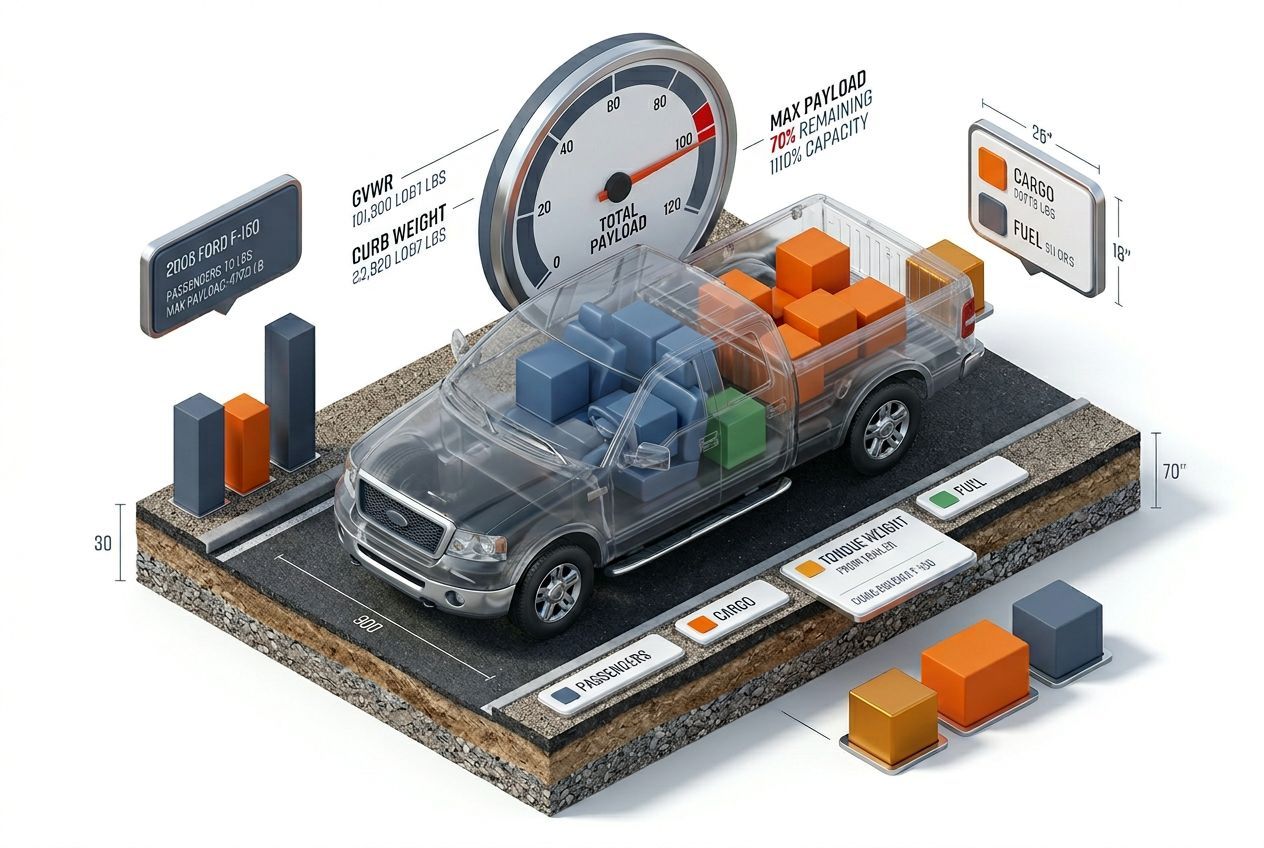
The 2006 F-150 payload capacity ranges from roughly 1,300 lbs on a fully optioned SuperCrew Lariat to about 3,050 lbs on a Regular Cab XL equipped with the Heavy-Duty Payload Package. Payload is the number that actually limits real-world towing — it's not just about what you stack in the bed.
Finding Your Truck's Specific Payload: Your exact payload capacity is printed on the yellow Tire and Loading Information label found inside the driver's door jamb (NHTSA's tire safety page shows where it sits). This number is unique to your specific truck, not just an average for the trim. For example, two identical-looking 2006 F-150 XLTs from the same production run can have different payload ratings if one has the Tow Package and the other has the sunroof and heated seats.
✅ Pro Tip: Always consult your door-jamb sticker. Relying on general figures can lead to unintentional overloading, which is unsafe and potentially illegal.
Calculating Your Real Payload Budget for Towing: To determine your actual payload capacity available for towing:
- Start with the "Occupant and Cargo Capacity" number from your door-jamb label.
- Subtract the tongue weight of your trailer (typically 10–15% of the loaded trailer weight).
- Subtract the combined weight of the driver and all passengers.
- Subtract the weight of any cargo currently in the cab or bed of the truck.
- The remaining figure is your margin. If this margin is zero or negative, you are overloaded, even if you are under the truck's published maximum tow rating.
You can check your numbers quickly with our payload calculator before you commit to a trailer purchase.
📋
TRUCK TOWING CAPACITY
Does the 2006 F-150 Have a Factory Tow Package?
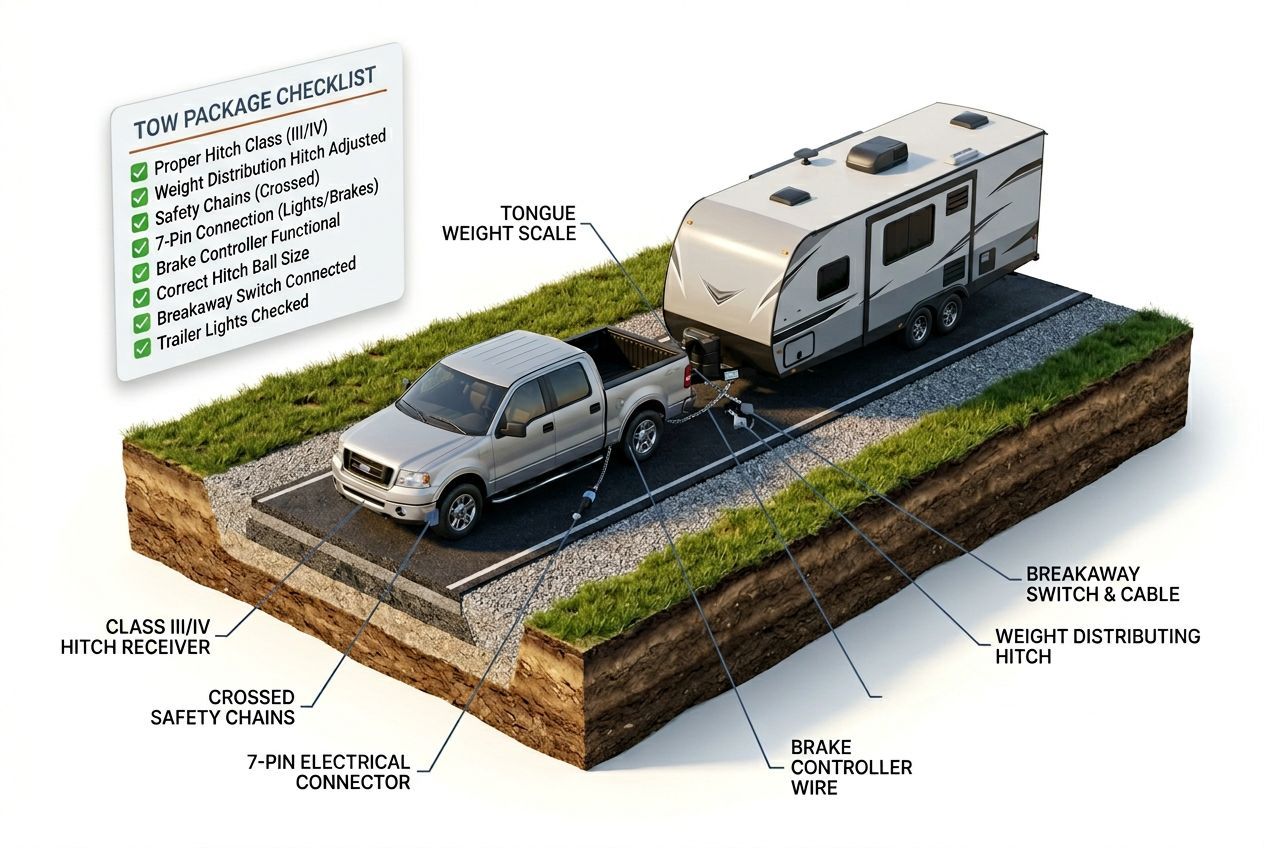
Ford offered two distinct tow packages for the 2006 F-150, and the difference between them matters significantly for what you can safely haul. The standard Trailer Tow Package covers basic wiring and a Class III receiver. The Max Trailer Tow Package — the one you want for heavy loads — is a more comprehensive upgrade.
Max Trailer Tow Package Components
The Max Trailer Tow Package includes several critical upgrades:
- Class IV hitch receiver: Rated to 10,000 lbs GTW (stamped on the receiver tube near the pin hole).
- 7-pin wiring harness: Essential for trailer brakes and lighting.
- Transmission oil cooler: Critical for preserving the 4R75E transmission; towing without one significantly accelerates ATF breakdown.
- Engine oil cooler
- Upgraded radiator: Features a larger core for enhanced cooling.
- Heavy-duty turn signal flasher relay
- Trailer sway control: Integrated with the anti-lock braking system (ABS).
Without the Max Tow Package, the published 9,900-lb rating doesn't apply to your truck. Period. Ford's 2006 RV & Trailer Towing Guide, published separately from the owner's manual, requires the Trailer Tow Package (or Heavy Duty Payload Package) for any trailer over 5,000 lbs.
✅ Pro Tip: When buying a used 2006 F-150 and the seller claims it has the tow package, verify by checking for a 7-pin connector (not just a 4-pin) and look for the transmission cooler lines running to the front of the radiator. No lines, no cooler.
💡 Key Takeaway: The 4R75E 4-speed automatic transmission used in 2006 F-150s is generally robust, but it's crucial to change the fluid and filter (using Ford Mercon V) before extended towing. Degraded ATF is the leading cause of transmission failure in half-ton trucks used for towing.
⚙️
TRUCK TOWING CAPACITY
What Rear Axle Ratio Is Best for Towing With a 2006 F-150?
The 3.73 rear axle ratio gives the best towing performance across both 2006 F-150 V8s, and the 4.10 ratio (5.4L only, long-wheelbase Regular Cab and SuperCab) unlocks the 9,900-lb peak. For towing purposes, this is the only axle ratio worth having if you plan to use the truck near its limits.
Understanding Axle Ratio Impact
Here's the practical breakdown of the available axle ratios:
- 3.31 axle: This ratio is standard on base trucks without a tow package, prioritizing fuel economy. However, it significantly reduces towing capacity, often by 2,000–3,000 lbs, compared to a 3.73 axle on the same engine configuration.
- 3.55 axle: A good middle-ground option that offers better fuel economy than the 3.73 while incurring only a modest towing penalty. It works well for occasional towing under 7,000 lbs.
- 3.73 axle: This ratio delivers the best tow rating. While it results in slightly higher engine revs at highway speed (and a minor fuel economy penalty), it provides far superior performance for sustained grades, starting heavy loads, and max-capacity pulls.
Towing at Higher Elevations: One seasonal note worth knowing is that at 5,000+ feet of elevation, naturally aspirated engines like the 4.6L and 5.4L lose roughly 3% of their power per 1,000 feet. The 9,900-lb rating was tested at sea level. If you're pulling through Colorado mountain passes at 7,000 feet, you're effectively working with about 15% less power.
⚠️ Warning: When towing at high altitudes, always plan your load accordingly and gear down early on grades to compensate for reduced engine performance.
Understanding how axle ratio, engine, and configuration interact is also covered in depth in our towing capacity guide if you want the full methodology.
🚛
TRUCK TOWING CAPACITY
How Does the 2006 F-150 Compare to Competitors for Towing?
The 2006 F-150's 9,900-lb maximum is competitive for the era, landing between the Silverado 1500's ~10,000-lb ceiling and the Dodge Ram 1500's ~9,100-lb max with the 5.7L Hemi. All three trucks were capable in the half-ton class, but each had trade-offs.
The 2006 Chevrolet Silverado 1500 edged the F-150 by about 100 lbs at the top end — not a meaningful real-world difference. The Ram 1500's 5.7L Hemi made more low-end grunt (375 lb-ft vs. 365 lb-ft for the 5.4L) but the Ram's payload capacity was slightly lower in most configurations. The F-150's 4R75E automatic was generally smoother for trailer starts than the Ram's 545RFE in this era.
For a direct comparison against current-generation trucks and to see how much towing technology has advanced, check our F-150 towing capacity overview. If you're cross-shopping against the Silverado or RAM 1500, those pages break out the modern ratings in detail.
The 2006 F-150 was also the last full model year before Ford introduced the 3-valve 5.4L's updates that carried into the 2007 and 2008 F-150 cycles, so the specs between these years are nearly identical — helpful if you're comparing used trucks across model years.
Modern vs. Classic Towing Features: One area where the 2006 F-150 genuinely lags behind modern trucks is the absence of an integrated trailer brake controller from the factory, and no trailer profile memory. This means you'll need to add an aftermarket brake controller (such as a Tekonsha Prodigy P3 or equivalent) if your trailer has electric brakes.
⚠️ Warning: Most states require trailer brakes on trailers over 3,000 lbs. Always check the specific rules for your state with our towing laws by state tool to ensure compliance and safety.
For used truck buyers trying to decide between a 2006 and a newer model, our half-ton truck towing capacity comparison puts the numbers side by side across generations.