
📊
TRUCK TOWING CAPACITY
What Is the Maximum Towing Capacity of a 2018 Ford F-150?
Class-Leading Towing Prowess. The maximum 2018 F-150 towing capacity is 13,200 pounds, achieved with the 3.5L EcoBoost V6, Max Trailer Tow Package, 3.55 axle ratio, and a Regular Cab/8-foot bed configuration. This rating made the 2018 F-150 the highest-rated half-ton pickup of its model year, edging out the Ram 1500 (11,610 lbs) and Silverado 1500 (12,500 lbs with the 6.2L V8).
📊 Quick Fact: In 2018, the F-150's 13,200 lb max towing capacity surpassed competitors like the Ram 1500 (11,610 lbs) and Silverado 1500 (12,500 lbs), making it the half-ton segment leader.
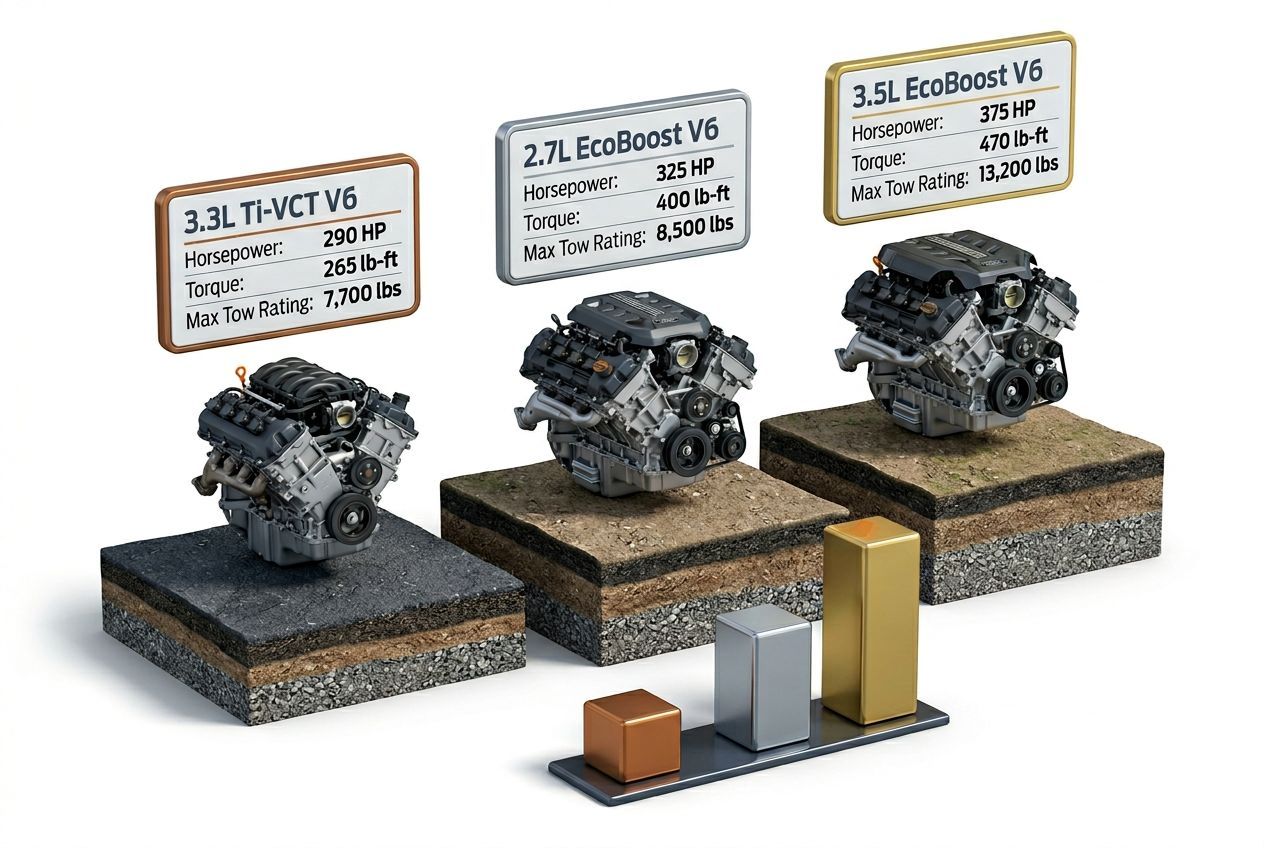
Engine-Specific Maximums: Here's the full breakdown by engine:
What Is the Maximum Towing Capacity of a 2018 Ford F-150? — data table
| Engine |
Max Output |
Max Towing Capacity |
Notes |
| 3.5L EcoBoost V6 |
375 hp / 470 lb-ft |
13,200 lbs |
Requires Max Tow Package + 3.55 axle |
| 5.0L Coyote V8 |
395 hp / 400 lb-ft |
11,600 lbs |
Requires Max Tow Package + 3.55 axle |
| 2.7L EcoBoost V6 |
325 hp / 400 lb-ft |
8,500 lbs |
Strong mid-range option |
| 3.3L Ti-VCT V6 (base) |
290 hp / 265 lb-ft |
7,700 lbs |
Entry-level; lowest tow rating |
| 3.5L EcoBoost H.O. (Raptor) |
450 hp / 510 lb-ft |
~8,000 lbs |
Off-road tuned; not a max-tow config |
Source: Ford Motor Company 2018 F-150 Towing and Payload Guide (ford.com); NHTSA vehicle specifications (nhtsa.gov)
Understanding Gross Combined Weight Rating (GCWR). One number that rarely gets mentioned: the GCWR. The 2018 F-150's Gross Combined Weight Rating runs from roughly 15,000 lbs to 17,600 lbs depending on configuration. That ceiling covers the truck itself, occupants, cargo, fuel, and trailer together — not just the trailer alone.
✅ Pro Tip: Don't just focus on trailer weight. Your GCWR is the total allowable weight of your fully loaded truck and trailer combined. Always ensure your total setup stays under this critical limit. If you want to understand how GCWR affects your real-world load math, our GCWR explainer walks through the full calculation.
🔧
TRUCK TOWING CAPACITY
How Much Can a 2018 F-150 3.5 EcoBoost Tow?
The Go-To Engine for Heavy Loads. The 2018 F-150 3.5L EcoBoost tows between 8,500 and 13,200 pounds depending on configuration. With 375 horsepower and 470 lb-ft of torque — the most torque of any engine in the 2018 F-150 lineup — this twin-turbo V6 is the default choice for serious towing. Paired with the 10-speed SelectShift automatic (a new addition for 2017 that carried into 2018), it delivers smoother power management under trailer load than the outgoing 6-speed unit.
Achieving Maximum Capacity: To hit that 13,200-lb ceiling, you need a very specific setup:
- Max Trailer Tow Package (option code 53C)
- 3.55:1 rear axle ratio (not the standard 3.15 or 3.31)
- Regular Cab / 8-foot bed body configuration
Impact of Configuration on Towing. Move to a SuperCrew with a 5.5-foot bed — by far the most popular configuration — and the 3.5 EcoBoost's max rating drops to approximately 11,100 lbs. That's still class-competitive, but it's a meaningful gap from the advertised headline number.
⚠️ Warning: The "headline" 13,200-lb capacity is highly configuration-dependent. Most common SuperCrew setups will have a significantly lower (1,000-2,000 lb) actual maximum towing capacity.
For a year-over-year comparison on this platform, see our 2016 F-150 towing capacity and 2017 F-150 towing capacity articles — the 3.5 EcoBoost received measurable updates each year.
🛡️
TRUCK TOWING CAPACITY
What Is the Towing Capacity of a 2018 F-150 With the 5.0 V8?
Power and Predictability. The 2018 F-150 5.0L V8 tows between 7,000 and 11,600 pounds. At 395 hp and 400 lb-ft of torque, the naturally aspirated Coyote V8 makes slightly more peak horsepower than the 3.5 EcoBoost but produces less torque — and torque is what moves heavy trailers from a stop. Still, many experienced towers prefer the 5.0 for its linear, predictable power delivery without the throttle lag that sometimes appears in turbocharged setups at low RPM.
Improved Transmission for V8 Towing. The 5.0L V8 also benefits from the same 10-speed automatic introduced in 2017. According to Ford, the 10-speed's wider ratio spread keeps the engine in its torque band more efficiently during grade changes — an upgrade that matters when you're pulling 10,000 lbs up a mountain highway.
Altitude Considerations. At altitude, though, naturally aspirated engines lose roughly 3% of their power for every 1,000 feet of elevation gain. If you're hauling a horse trailer in Colorado at 7,000 feet, you're effectively towing with about 15% less power than the sea-level spec suggests.
⚠️ Warning: If you frequently tow at high altitudes (e.g., in mountainous regions), a naturally aspirated engine like the 5.0L V8 will experience a noticeable power loss. The turbocharged 3.5 EcoBoost maintains boost pressure more effectively at altitude, giving it a practical edge in mountain terrain.
📋
TRUCK TOWING CAPACITY
Does the 2018 F-150 2.7 EcoBoost Tow Well?
The Efficient Towing Option. The 2018 F-150 2.7L EcoBoost tows between 7,000 and 8,500 pounds — more than enough for most boat trailers, pop-up campers, car haulers, and utility trailers. With 325 hp and 400 lb-ft of torque, this smaller twin-turbo V6 delivers full torque early in the RPM range, which translates to confident acceleration from stops with a loaded trailer behind you.
💡 Key Takeaway: The 2.7L EcoBoost offers excellent fuel efficiency for daily driving and provides ample power for common recreational towing needs up to 8,500 lbs.
Know Your Limits. The 2.7 EcoBoost's real advantage is daily-driver efficiency. EPA-estimated fuel economy runs about 2–4 mpg better than the 3.5 EcoBoost under non-towing conditions. If you're towing occasionally but driving the truck every day, the 2.7 makes a strong case for itself.
⚠️ Warning: Do not exceed the 2.7L EcoBoost's firm 8,500-lb towing ceiling. If your loaded trailer weighs more than this, you absolutely need to step up to the 3.5L EcoBoost or 5.0L V8 for safety and compliance.
For a broader look at how the F-150 platform handles varied loads, our F-150 towing capacity hub covers all model years.
⚙️
TRUCK TOWING CAPACITY
What Towing Package Options Were Available on the 2018 F-150?
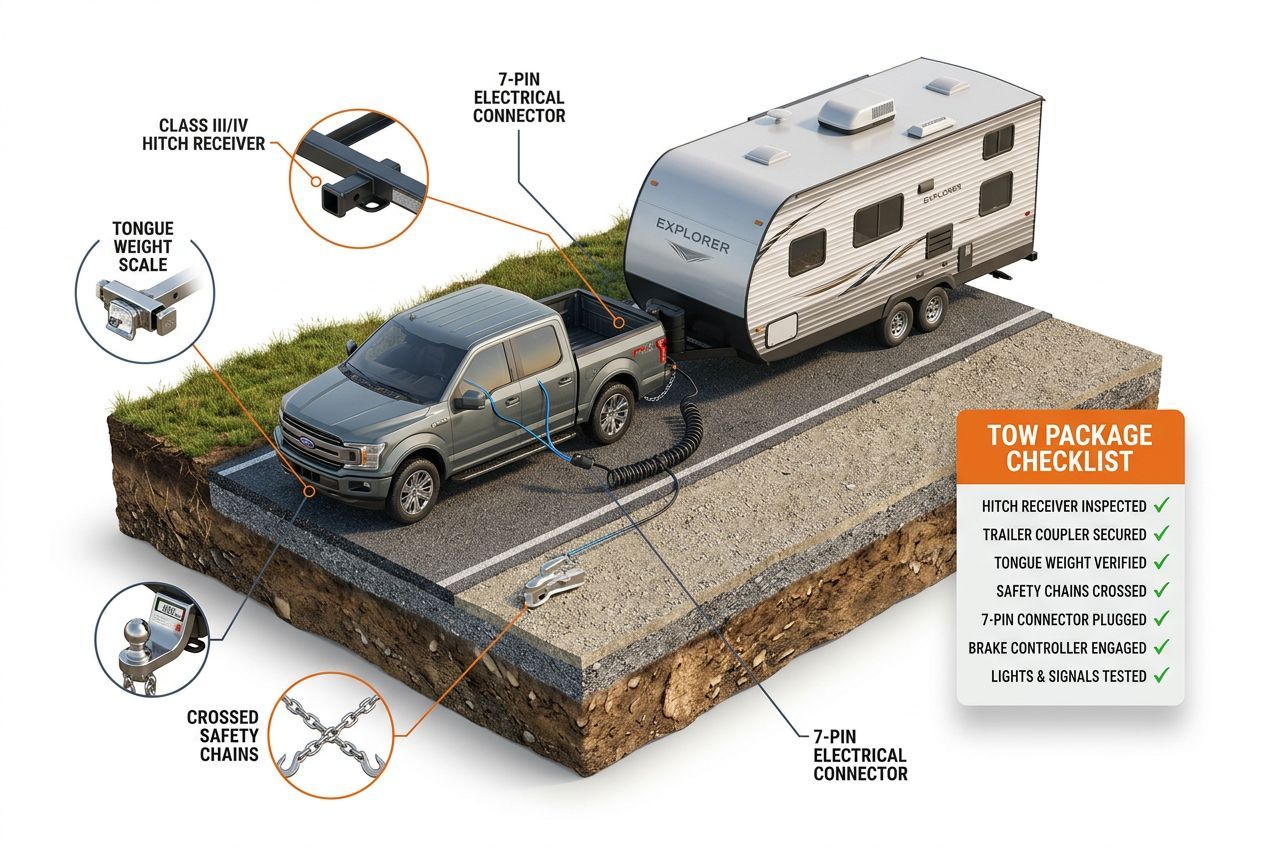
Ford offered two primary towing packages for the 2018 F-150: the standard Trailer Tow Package and the Max Trailer Tow Package.
Standard Trailer Tow Package
The standard package includes:
- A Class IV hitch receiver (GTW rating of 10,000 lbs stamped on the receiver tube near the pin hole)
- A 7-pin wiring harness
- An upgraded radiator
This package gets you above the base rating but doesn't unlock the truck's highest numbers.
Max Trailer Tow Package Features
The Max Trailer Tow Package (option code 53C; the standard Trailer Tow Package is 53A) is where the real capability lives and is essential for achieving the highest tow ratings. It adds:
- A larger, high-capacity transmission oil cooler
- Integrated Trailer Brake Controller (IBC) — built into the dash, no aftermarket unit needed
- Pro Trailer Backup Assist (on select trims)
- Upgraded 3.55 rear axle ratio
- Heavy-duty front and rear suspension calibration
- Larger engine cooling system
Verifying Your Package. Without the Max Trailer Tow Package, the published maximum tow ratings do not apply. That 13,200-lb number assumes the package is installed.
✅ Pro Tip: Always check your specific truck's door-jamb sticker on the driver's side B-pillar for GVWR, GAWR, and payload. Then cross-reference with the Trailer Towing Supplement, which Ford publishes separately from the owner's manual and is available through ford.com, to confirm your exact tow ratings and package details.
The Importance of an Integrated Brake Controller. The integrated trailer brake controller is worth calling out specifically. Per FMCSA regulations (fmcsa.dot.gov), trailers with a gross weight over 3,000 lbs require a functioning brake controller in most states. Having it factory-integrated means one less aftermarket device to wire in and calibrate, offering seamless and reliable trailer braking.
📊 Quick Fact: Most states require a functioning brake controller for trailers weighing over 3,000 lbs, making the factory-integrated unit in the Max Trailer Tow Package a significant safety and convenience feature.
If you're deciding between the 2018 F-150 and the competition, our 2018 Chevy Silverado 1500 towing capacity and 2018 Ram 1500 towing capacity articles give you a direct head-to-head comparison.
🚛
TRUCK TOWING CAPACITY
How Does Cab Size and Bed Length Affect 2018 F-150 Towing Capacity?
The Weight of Comfort. Cab configuration directly impacts 2018 F-150 towing capacity because heavier cabs increase curb weight, which eats into the truck's GCWR headroom. The Regular Cab with an 8-foot bed achieves the highest ratings across all engine options due to its lighter weight. SuperCab configurations fall in the middle.
💡 Key Takeaway: Heavier cab configurations and longer beds reduce your available towing capacity because the added weight of the truck itself consumes part of the Gross Combined Weight Rating (GCWR).
Real-World Capacity Reduction. The SuperCrew with a 5.5-foot bed — the most common retail configuration — typically loses 1,000–2,000 lbs of towing capacity compared to the Regular Cab baseline with the same engine and axle. This difference is critical for safely matching your truck to your trailer.
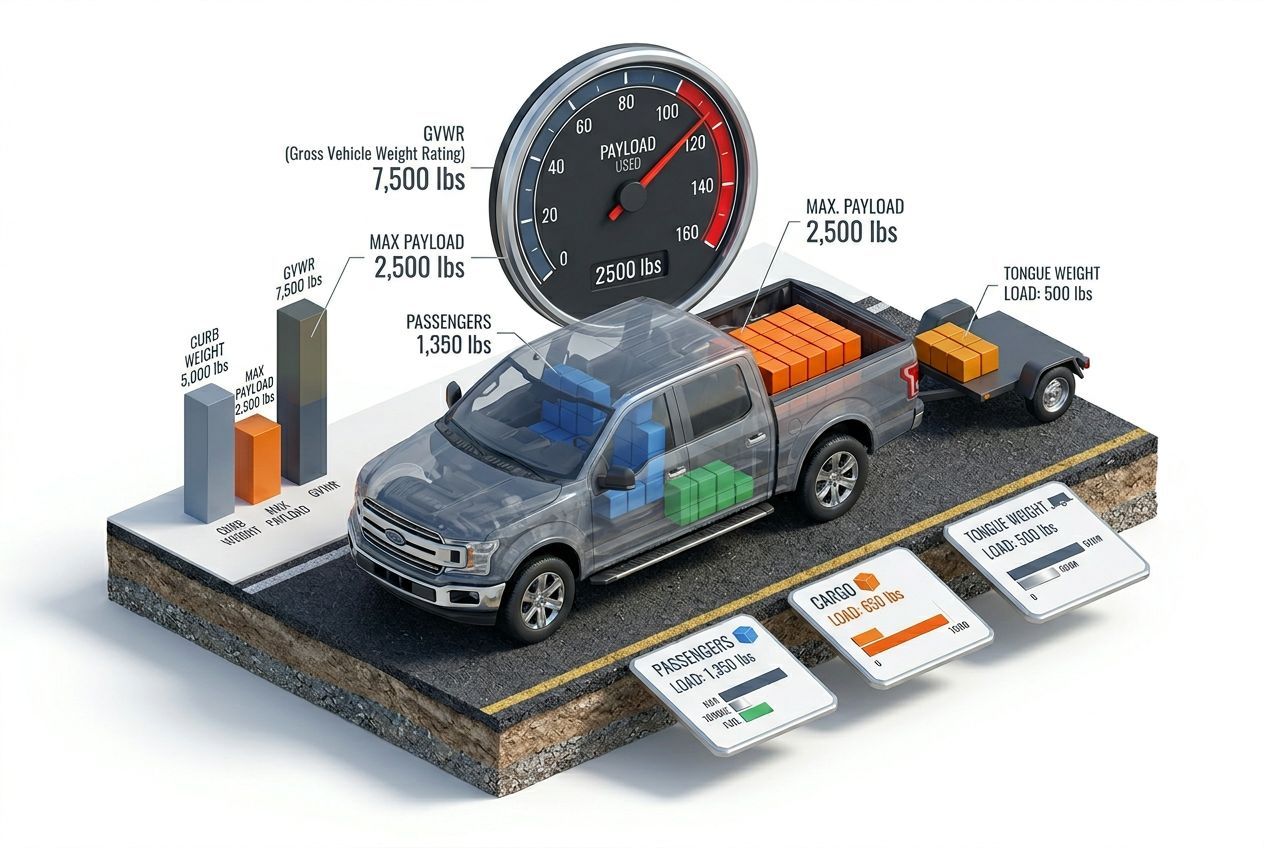
A Crucial Payload Example. Here's a worked example with real numbers. Say you're towing a 10,500-lb fifth-wheel with a 2018 F-150 SuperCrew 3.5 EcoBoost rated at 11,100 lbs max. Tongue weight at 15% of trailer weight is 1,575 lbs. Add the driver (200 lbs), a passenger (165 lbs), and 100 lbs of gear in the cab. That's 2,040 lbs against a payload rating that might be as low as 2,000 lbs on a fully optioned SuperCrew.
⚠️ Warning: In the example above, you're already at or over payload capacity before you add fuel or anything in the truck bed. This illustrates why understanding towing capacity vs. payload matters immensely before you hitch up. Overloading your payload is a common and dangerous towing mistake.
📝
TRUCK TOWING CAPACITY
What Is the Payload Capacity of a 2018 Ford F-150?
Payload Varies Widely. The 2018 F-150 payload capacity ranges from approximately 1,660 to 3,270 pounds depending on trim, engine, and configuration. The maximum payload figure comes from the 5.0L V8 in a Regular Cab with the Heavy-Duty Payload Package — a specialized configuration that most retail buyers don't order. A typical SuperCrew Limited or Platinum trim with the 3.5 EcoBoost will have a payload rating closer to 1,800–2,100 lbs.
✅ Pro Tip: Your actual payload rating is printed on the Tire and Loading Information label on the driver's door jamb — not in any brochure or spec sheet. This number is specific to your truck's build, not the average for its configuration. Use our payload calculator tool to work out how your tongue weight, passengers, and cargo stack against your truck's specific limit.
The Critical Connection Between Payload and Towing. Payload and towing capacity are intrinsically connected: every pound of tongue weight you accept from the trailer comes out of your available payload. Most trailers run tongue weight at 10–15% of gross trailer weight. A 10,000-lb trailer puts 1,000–1,500 lbs of tongue weight onto your truck's hitch — reducing your available payload by that amount before you account for people and cargo.
💡 Key Takeaway: Your trailer's tongue weight directly reduces your truck's available payload. Always factor in tongue weight, passengers, and cargo when calculating your usable payload capacity. For a deeper look at how these specs interact, our towing vs. payload guide covers the math in plain terms.
To see how the 2018 model compares to the year before it, check our 2017 F-150 towing and payload breakdown, or look back further with the 2015 F-150 towing capacity from the same generation's launch year.
If you're still sizing up whether your specific 2018 F-150 can handle a particular trailer, our Can My Truck Tow This tool walks you through the complete calculation in under two minutes.

