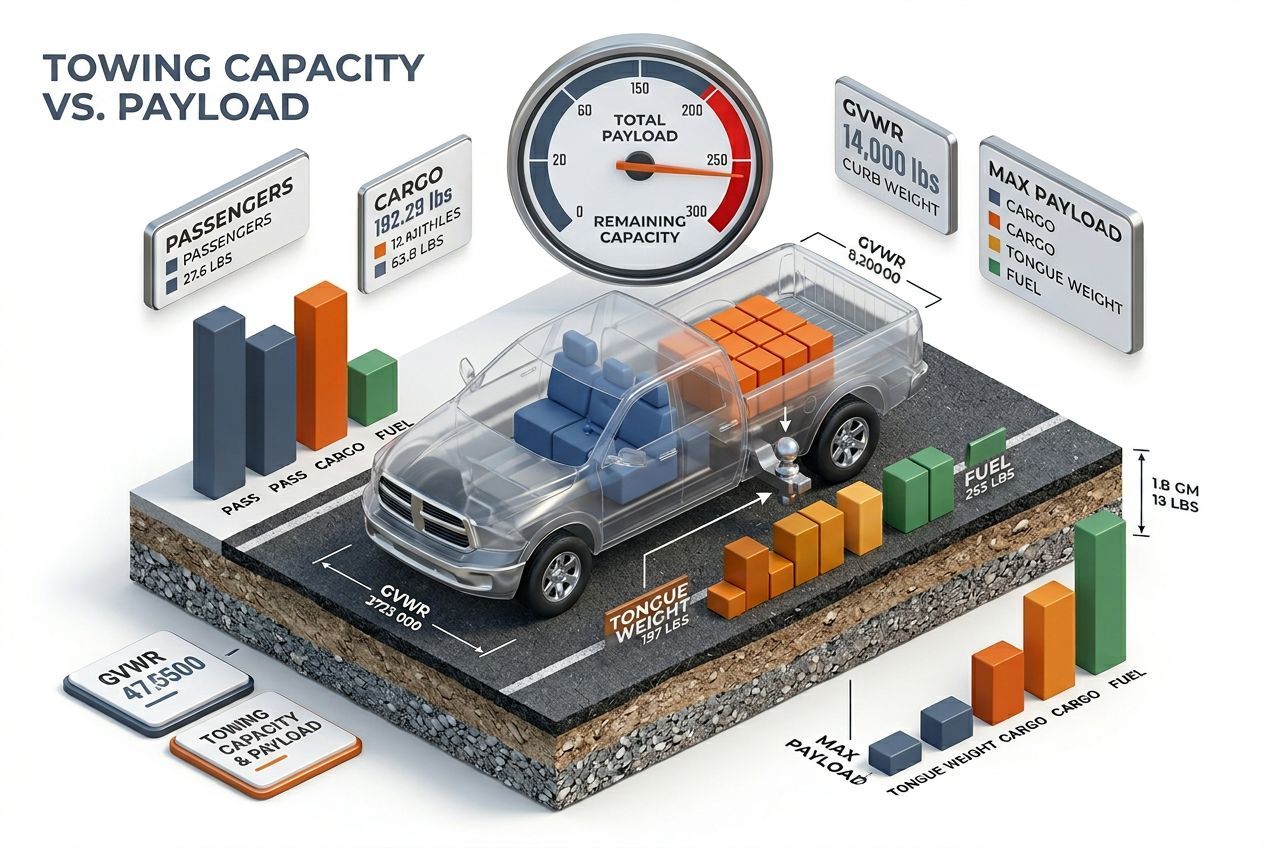
- Payload = weight on the truck (passengers, cargo, tongue weight). Towing capacity = weight behind the truck on a trailer.
- Tongue weight (10–15% of trailer weight on conventional hitches) eats into your payload rating every time you hook up.
- Both limits must be respected simultaneously — exceeding either one puts you, your load, and other drivers at risk.
- Your exact payload rating is on the yellow sticker inside the driver's-side door jamb. Your tow rating is VIN-specific — not the number in the ad.
- Half-ton trucks typically carry 1,500–2,300 lbs of payload and tow up to 9,000–14,000 lbs depending on configuration.
What Is Towing Capacity and How Is It Measured?
Defining Towing Capacity: Towing capacity is the maximum weight a vehicle can safely pull behind it using a hitch or coupler. Manufacturers calculate it using the gross combined weight rating (GCWR) — the maximum allowable weight of the fully loaded truck plus the fully loaded trailer — minus the truck's curb weight and any cargo on board. Engine choice, transmission, axle ratio, and hitch class all move that number. For a deeper look at how GCWR fits into the picture, see our full breakdown at what is GCWR.
💡 Key Takeaway: The towing capacity advertised by manufacturers often assumes the lightest possible vehicle configuration. Your truck's actual, VIN-specific rating may be significantly lower.
Understanding Advertised vs. Real Ratings: Here's the part that surprises most buyers: the number in the truck advertisement assumes the lightest possible configuration. For example, the 2024 Ford F-150 with the 3.5L PowerBoost V6 hybrid, Max Trailer Tow Package (option 52B), and Super Crew cab on a 5.5-ft bed is rated at 12,700 lbs. Swap to a longer bed, different cab, or base engine, and that number drops — sometimes by over 2,000 lbs. You can look up your exact VIN configuration using our towing capacity lookup tool.
Finding Your Truck's Specific Rating: One more thing: Ford publishes a Trailer Towing Supplement separate from the main owner's manual. That supplement — not the window sticker — is where you'll find the definitive number for your build.

What Is Payload Capacity and How Is It Calculated?
Understanding Payload: Payload capacity is the maximum combined weight of everything loaded onto the vehicle — passengers, gear in the cab, cargo in the bed, and tongue weight transferred from any trailer. It's calculated by subtracting the truck's curb weight from its gross vehicle weight rating (GVWR):
Payload = GVWR − Curb Weight
Practical Payload Example: A truck with a 7,000-lb GVWR and a 5,400-lb curb weight has 1,600 lbs of payload. Every single pound matters — a full tank of diesel, four passengers, and a toolbox can easily consume 900 lbs before you've loaded a single thing in the bed.
Locating Your Payload Rating: Your exact payload rating is printed on the yellow tire-and-loading information sticker on the driver's-side B-pillar door jamb. Per NHTSA regulation 49 CFR Part 567, that label has been federally mandated since the TREAD Act update — if the number isn't there, the truck's been modified and you should be skeptical of any rating claimed.
📊 Quick Fact: The Toyota Tacoma (2016–2023 generation with the 3.5L 2GR-FKS V6) has a payload capacity of just 1,120–1,440 lbs depending on trim. Many owners underestimate this, especially after adding passengers and gear.
This is where mid-size trucks trip people up most often. Many owners discover this only after adding passengers and a full bed of gear. For specifics, check out our 2016 Tacoma towing and payload page.
What Is the Difference Between Towing Capacity and Payload?
The Core Distinction: The core difference between towing capacity and payload is simple: payload is weight carried on the vehicle, towing capacity is weight pulled behind it. But they're not independent. They share a boundary through tongue weight.
Two Simultaneous Weight Budgets: Think of it this way. Your truck has two weight budgets running at the same time:
- GVWR budget: Governs how heavy the truck itself can get (payload).
- GCWR budget: Governs how heavy the truck-plus-trailer system can get (towing capacity).
Tongue weight — the downward force the trailer hitch puts on the truck's receiver — lives in both budgets. It's part of what makes the trailer stop swaying, but it's also cargo weight pressing on your rear axle. So you can't manage towing capacity vs payload as two separate problems. They're the same problem viewed from two angles.
For a broader comparison of how these numbers rank across popular trucks, our half-ton truck towing capacity guide breaks it down by model.
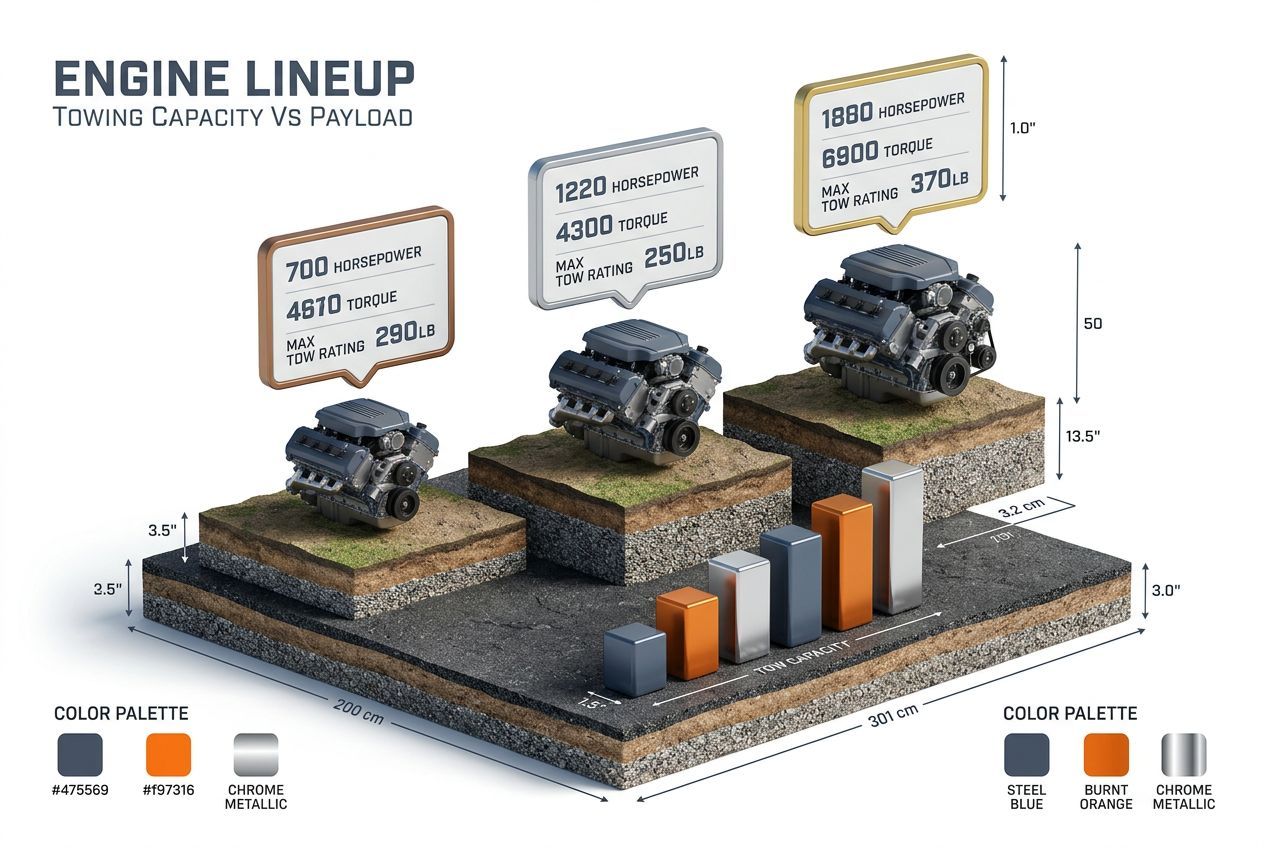
How Do Towing Capacity and Payload Work Together?
Use this payload calculator to check whether your planned load stays within limits before you pull out of the driveway.