- Every tow starts with a hook-up fee ($50–$125 for light-duty), before mileage even enters the equation
- After-hours, weekend, and holiday surcharges add $50–$150 to the base bill — sometimes doubling the rate
- Heavy-duty and commercial towing rates ($8–$15+/mile) reflect equipment that costs $500,000+ to operate
- About 29 states regulate rates for non-consensual (police-ordered) tows; consensual tows are largely a free market
- Always request an itemized estimate before you authorize a tow — it's your legal right in most states
Understanding the towing company rate structure before your car breaks down is far better than learning it on the side of a highway at midnight. This breakdown pulls back the curtain on how the industry prices its services — and where you have room to push back.
What Is the Typical Rate Structure for a Towing Company?
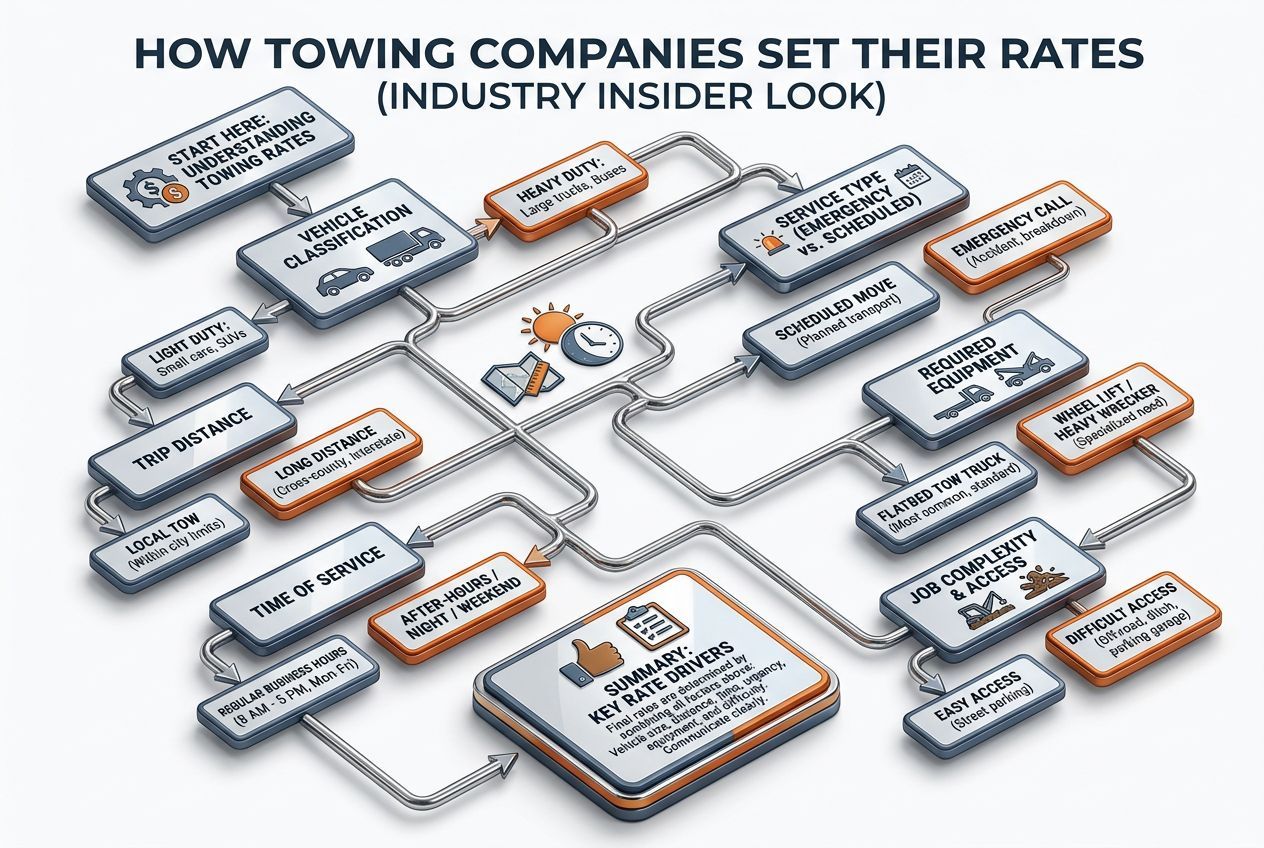
Most towing companies utilize a core pricing foundation built on a base hook-up fee combined with a per-mile charge. The hook-up fee, often referred to as a dispatch or service initiation fee, covers the essential costs of the truck being dispatched, arriving at your location, and securely loading your vehicle. For light-duty tows, this fee typically ranges from $50–$125. Following this, per-mile charges, usually $2.50–$7.00, are applied, with additional surcharges for special circumstances layered on top.
Consider it similar to a rideshare application: you incur a booking fee the moment you request the service, followed by a per-mile rate as the driver proceeds to your destination. The critical distinction for tow trucks lies in their dramatically higher operational costs and the absence of a dynamic surge pricing algorithm to inform your call.
Common Towing Bill Components
Here's a detailed look at what a typical light-duty tow bill might include:
| Line Item | Typical Range | Notes |
|---|---|---|
| Hook-up / base fee | $50–$125 | Covers dispatch, arrival, loading |
| Per-mile charge (loaded) | $2.50–$5.00/mi | Charged from pickup to drop-off |
| Dead-mile charge | $1.00–$4.00/mi | Truck's drive to your location |
| After-hours surcharge | $50–$150 | Evenings, weekends, holidays |
| Winching / recovery fee | $50–$200+ | Off-road, mud, ditch extractions |
| Daily storage fee | $20–$75/day | If vehicle sits at the yard |
Sources: AAA towing data, municipal rate schedules
For a comprehensive breakdown of what you'll pay in your specific region, the towing cost by state tool allows you to compare average rates side by side.
How Much Do Tow Companies Charge per Mile?
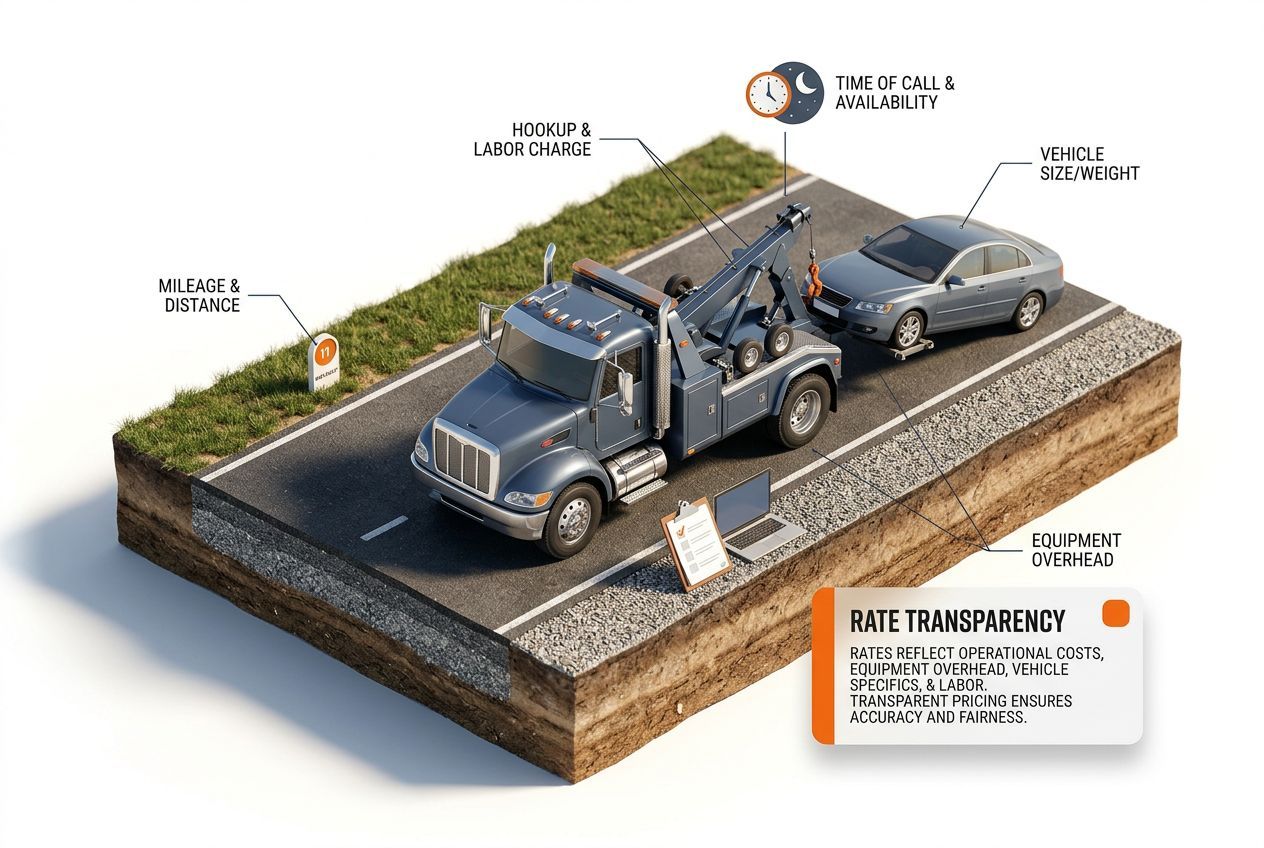
Light-duty towing typically incurs per-mile rates ranging from $2.50–$5.00 per loaded mile. This rate applies to the distance your vehicle is transported from its breakdown location to the designated drop-off point. However, a frequently overlooked charge is for "dead miles" — the distance the tow truck travels to reach you before loading. Many companies impose an additional $1–$4 per dead mile on top of the loaded rate.
Consider this scenario: if your vehicle breaks down 8 miles from the nearest tow company, and your chosen mechanic is 12 miles away, your bill won't just cover the 12 loaded miles. You could be charged for a total of 20 miles (8 dead + 12 loaded). On a $3.50/mile structure, this translates to $70 in mileage charges alone, before factoring in the hook-up fee, storage, or any other potential costs.
📊 Quick Fact: The equipment for heavy-duty towing, such as a Jerr-Dan or Miller Industries rotator wrecker, can cost between $500,000 and $900,000 new, directly contributing to their $8–$15+ per mile rates.
You can plug your specific scenario into our towing cost calculator to get a real-world estimate before you make any calls.
How Do Towing Companies Calculate Their Rates?
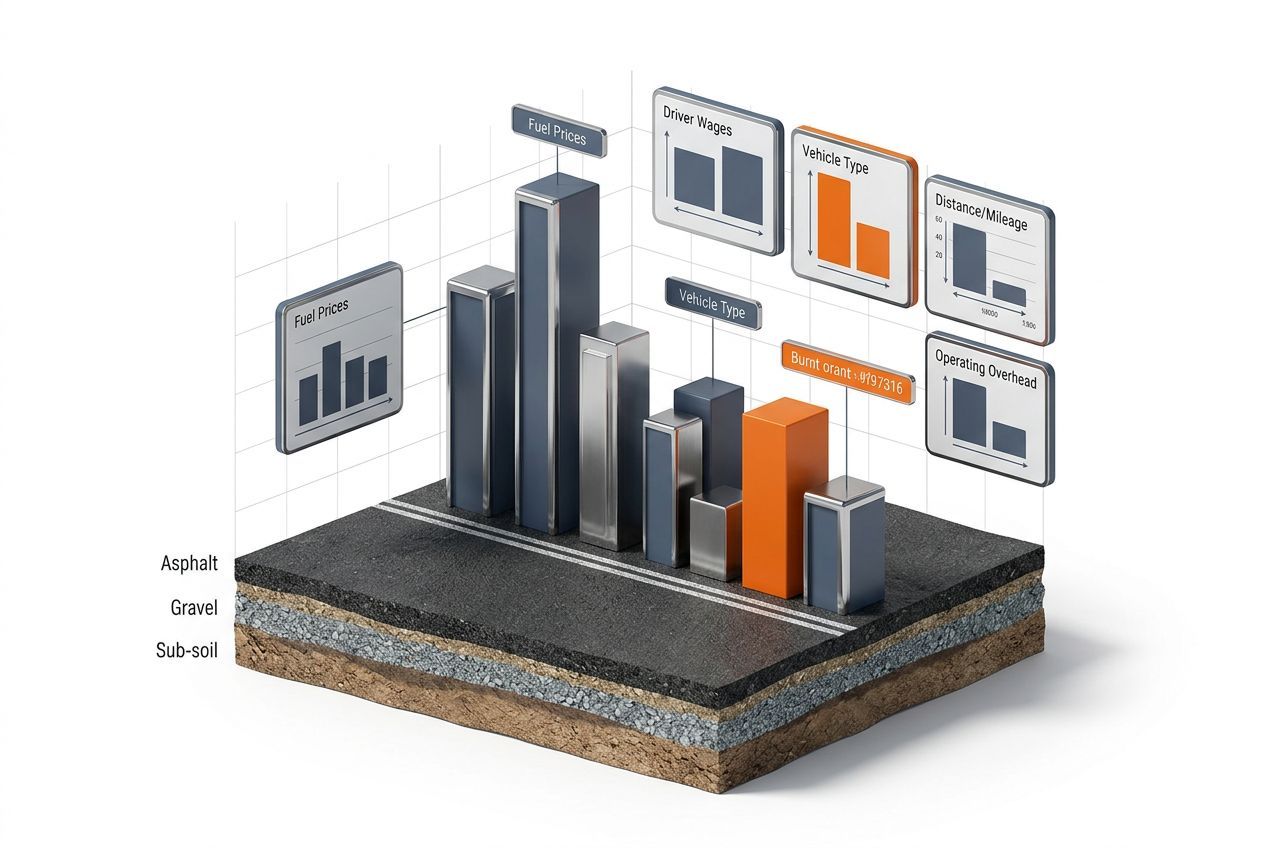
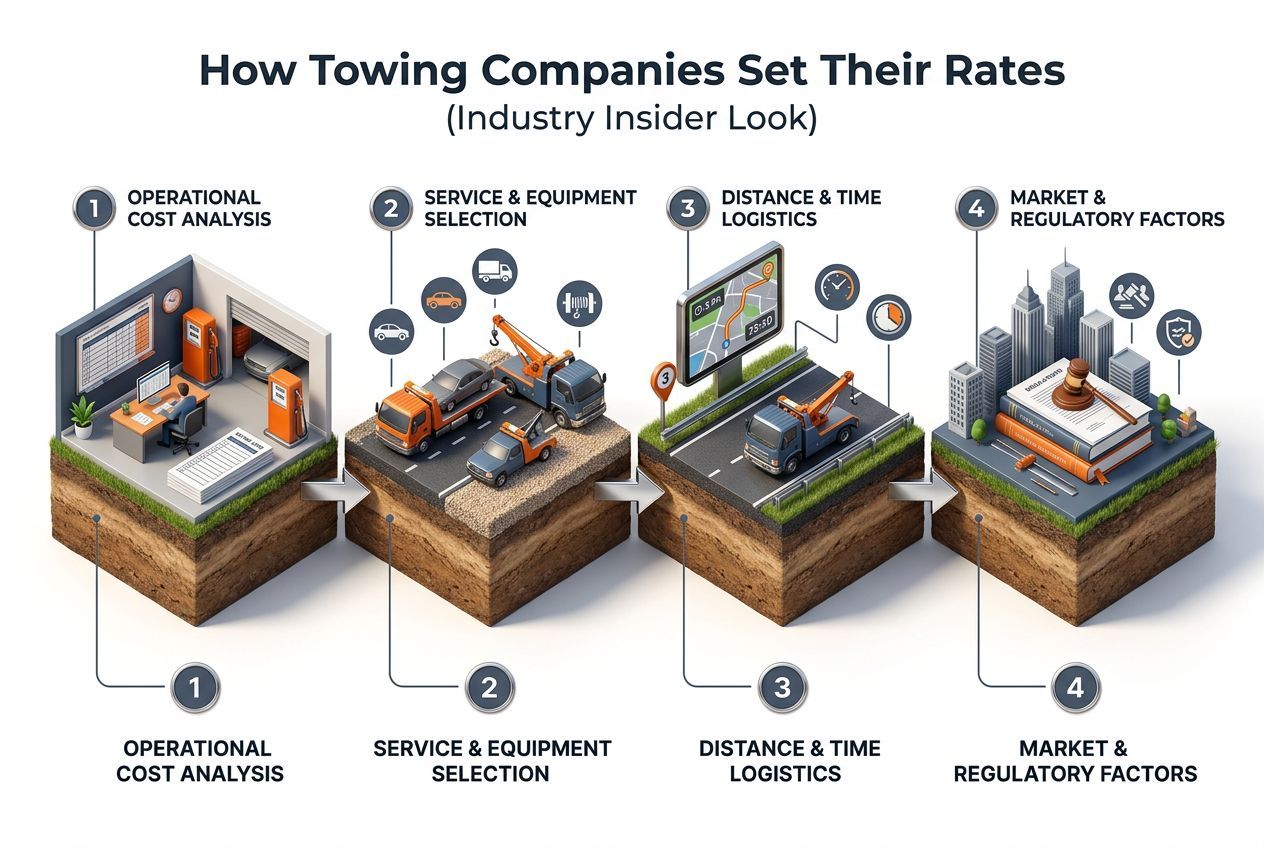
Towing company rate structures are not arbitrary; they are meticulously reverse-engineered from operational costs. Most owner-operators assess their monthly expenses, which include truck payments, insurance, fuel, driver wages, and yard overhead, to determine their pricing.
Understanding the Overhead
Here’s a practical example with real numbers. A new single flatbed tow truck, such as a Jerr-Dan MPL-NGS on a Ram 5500 chassis, costs approximately $80,000–$120,000. Financing this over 60 months at a 7% interest rate results in roughly $1,500–$2,400 per month just for truck payments. To this, add:
- Insurance: $8,000–$15,000 per year per truck (based on industry benchmarks), translating to $670–$1,250 per month.
- Diesel fuel: A flatbed averaging 8 mpg, operating 200 miles per day at $4.00 per gallon, consumes approximately $100 daily, summing up to around $2,500–$3,000 per month.
- Driver wages: A certified light-duty operator typically earns $20–$35 per hour.
- Yard/dispatch overhead: Costs for leasing, software, phone services, and licensing.
Before even completing a single tow, that truck incurs monthly costs of $6,000–$10,000+. With an average of 3–5 tows per day per truck, each call must contribute a significant share to cover this overhead. The $75 hook-up fee, which may seem steep to a customer, often represents the crucial margin between the company breaking even and operating at a loss.
💡 Key Takeaway: The seemingly high hook-up fee is often a critical component for towing companies to cover their substantial fixed monthly operating costs.
This context is crucial when you delve deeper into our explanation of towing company rates.
Use the estimate tool below to see how these variables interact for your location and vehicle type.