📊
TOWING COSTS
What Does a Full Tow Truck Price List Look Like?
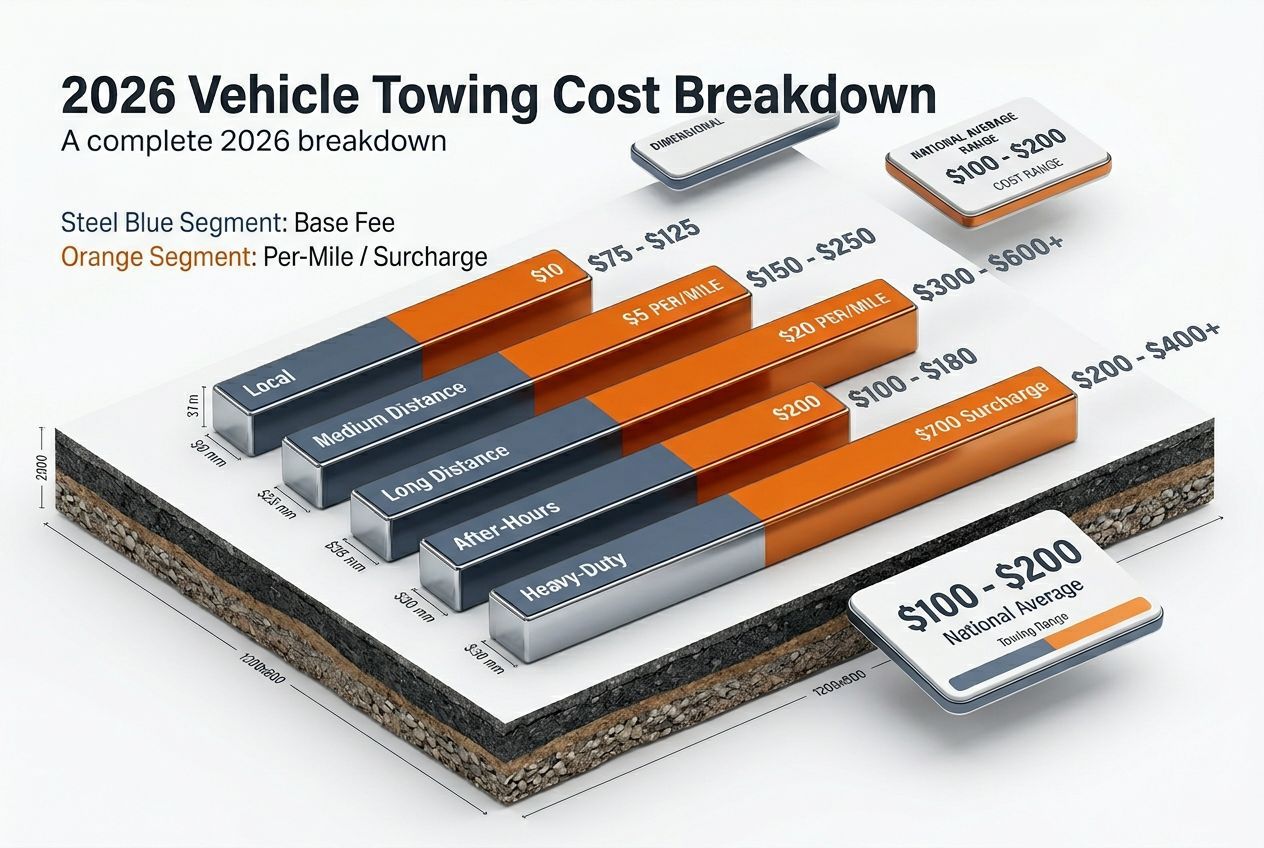
Service Type Costs: A complete tow truck price list in 2026 puts flatbed towing at $95–$350, wheel-lift at $75–$250, motorcycle towing at $75–$200, and heavy-duty service at $200–$1,000+. The type of tow truck dispatched — not just distance — is often the biggest cost variable, especially for specialty vehicles.
Here's what drives the difference between service types:
Wheel-Lift Towing
Understanding Wheel-Lift: Wheel-lift towing uses a metal yoke that cradles the front or rear axle. It's fast and costs less, but it leaves two wheels rolling on the pavement. That's fine for most front-wheel-drive cars.
⚠️ Warning: Using a wheel-lift for an AWD vehicle is the wrong call. Running an AWD car on a wheel-lift can damage the center differential and transfer case because the drivetrain isn't designed to have two wheels stationary and two rolling at speed. NHTSA (nhtsa.gov) flags drivetrain damage as one of the most common post-tow vehicle complaints.
Flatbed Towing
Why Flatbed is Preferred: Flatbed towing loads the entire vehicle onto a tilting platform. All four wheels are off the ground, making it the required method for AWDs, rear-wheel-drive cars with automatics, lowered vehicles, luxury cars, and anything with front-end damage.
💡 Key Takeaway: The trade-off is cost. Flatbed service typically runs $20–$60 more than wheel-lift for the same distance, but it's essential for preventing potential damage to specific vehicle types. Our flatbed towing cost guide breaks this down further.
Winch-Out Services
Extraction Fees: Winch-out services are a separate charge — not a tow. If you've gone into a ditch, gotten stuck in mud, or backed off an embankment, the operator first extracts your vehicle before any towing begins.
Winch-out fees range from $50 to $250 depending on terrain difficulty and time on-site:
- A straightforward ditch pull on flat ground is usually $50–$100.
- A vehicle buried to the axles in soft ground, or one that requires a second truck, can hit $200–$300 before the tow even starts.
✅ Pro Tip: For motorcycles specifically, the pricing and logistics differ enough that we've written a separate motorcycle towing cost guide. Always be clear about the nature of the recovery when you call for service.
🔧
TOWING COSTS
How Much Does Long-Distance Towing Cost?
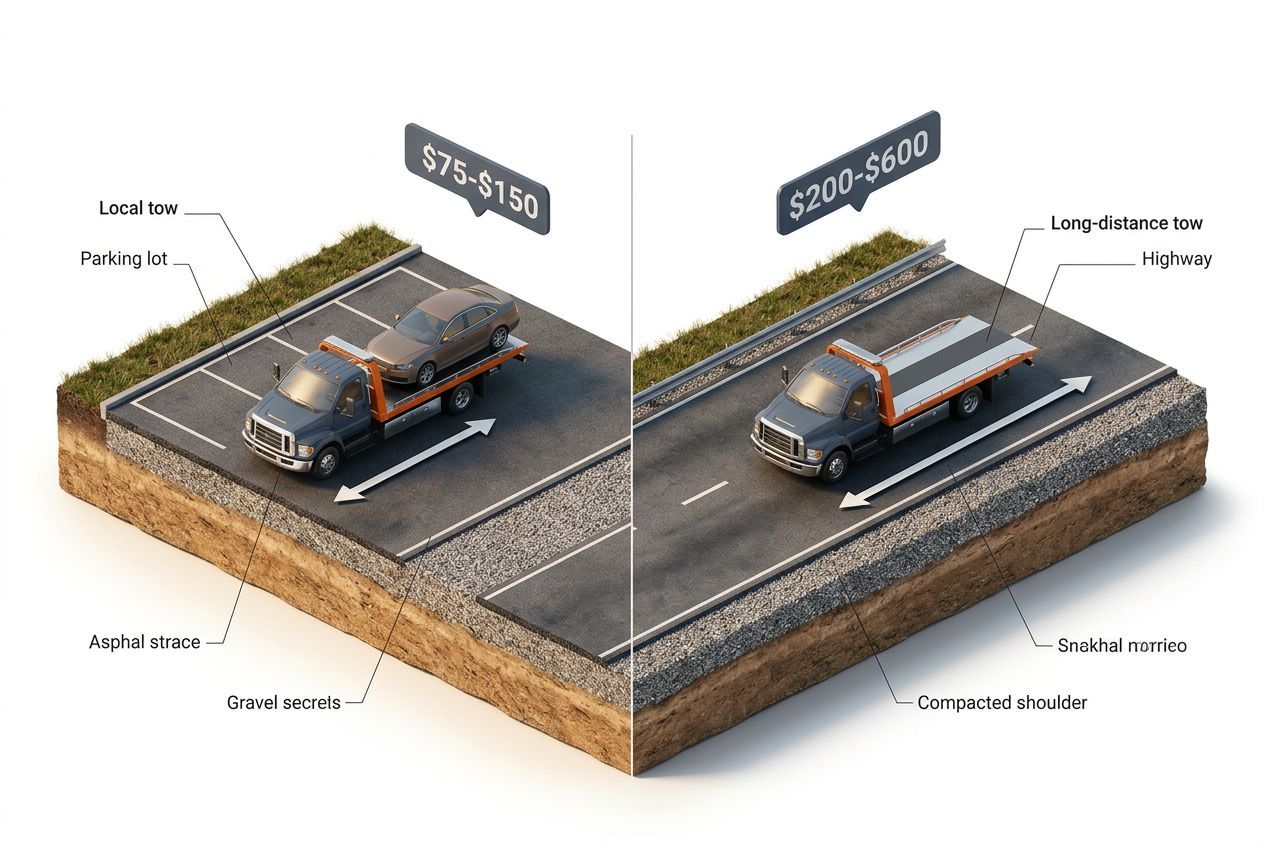
Long-Haul Expenses: Long-distance towing runs $2–$5 per mile for hauls over 50 miles, with a 100-mile tow averaging $450–$700 and a 500-mile cross-state move running $1,200–$3,000 or more. Per-mile rates typically drop on longer hauls — operators discount volume since the truck is already committed to the route.
That said, long-distance towing carries costs that local tows don't:
Additional Costs for Long-Distance Tows
- Fuel Surcharges: Many operators add a fuel surcharge on hauls over 100 miles, especially with diesel prices fluctuating. Expect $25–$75 extra.
- Driver Layover Fees: On very long hauls (500+ miles), the driver may need an overnight stop. Some operators pass that cost on as a flat fee ($100–$200).
- State-to-State Licensing: Interstate towing requires compliance with FMCSA regulations (fmcsa.dot.gov). Most professional operators handle this automatically, but confirm they're licensed for interstate transport before authorizing a state-line haul.
A practical example: you bought a used car in Nashville and need it delivered to Dallas — roughly 660 miles. At $3.50/mile with a $150 hookup fee, you're looking at $2,460 plus any fuel surcharges.
✅ Pro Tip: That same route on an auto transport carrier (enclosed or open) might run $800–$1,100 — so for very long hauls, compare towing against transport carriers before you commit.
Our long-distance towing cost guide covers how to structure that comparison, and our 100-mile towing cost breakdown goes deep on the mid-range haul most people actually deal with.
🛡️
TOWING COSTS
Why Is Towing So Expensive?
Understanding Operator Costs: Towing is expensive because operators carry massive fixed costs — specialized trucks, commercial insurance, fuel, and 24/7 staffing — that must be recovered on every service call. A light-duty flatbed tow truck costs $60,000–$100,000 new. A heavy-duty wrecker or rotator runs $200,000–$600,000.
Deconstructing the Costs of a Single Tow
Here's a breakdown of the cost structure for a single tow:
- Equipment Depreciation and Financing: A $80,000 truck financed over 5 years at 7% costs roughly $1,584/month before insurance.
- Commercial Insurance: $8,000–$15,000 per truck, per year. That's $22–$41 per day just to keep one truck insured.
- Fuel: A medium-duty tow truck averages 8–12 MPG. At current diesel prices, a 30-mile round trip costs $12–$20 in fuel alone.
- Labor: Tow operators in most states earn $18–$28/hour for regular shifts, with overtime and on-call premiums adding to nighttime and weekend dispatches.
- Licensing and Compliance: FMCSA compliance, state towing licenses, and mandatory training add recurring costs most consumers never see.
Add it up and a company with three trucks running 8 calls per day needs to average $130+ per call just to break even — before paying the owner or reinvesting in equipment. Emergency towing cost reflects that reality, not price gouging. For an industry-insider look at how towing companies set their rates — including overhead breakdowns, surcharge structures, and what's negotiable — see our pricing fundamentals guide.
📋
TOWING COSTS
What Does Emergency Towing Cost After Hours?
After-Hours Premiums: Emergency towing after hours costs 20–50% more than standard daytime rates, with after-hours calls averaging $150–$450 versus $110–$300 during business hours. Most towing companies define "after hours" as 8 PM to 8 AM on weekdays, with a separate weekend premium (15–25%) and holiday premium (25–50%) on top. For the full breakdown of after-hours towing cost — including time-window-by-time-window surcharge tables and six tactics to avoid them — see our after-hours pricing guide.
Real-World Emergency Towing Scenarios
Here's what "emergency" actually costs in practice:
- Friday night at 10 PM: $175–$250 for a standard local tow
- Saturday at 3 AM: $200–$300 (after-hours + weekend premium stacked)
- Christmas Day, any hour: $250–$400 (holiday rate applies even during normal business hours)
- Snowstorm, high-demand surge: Some markets apply surge pricing, similar to rideshare apps. During a major winter storm, rates can double in areas without state-regulated rate caps.
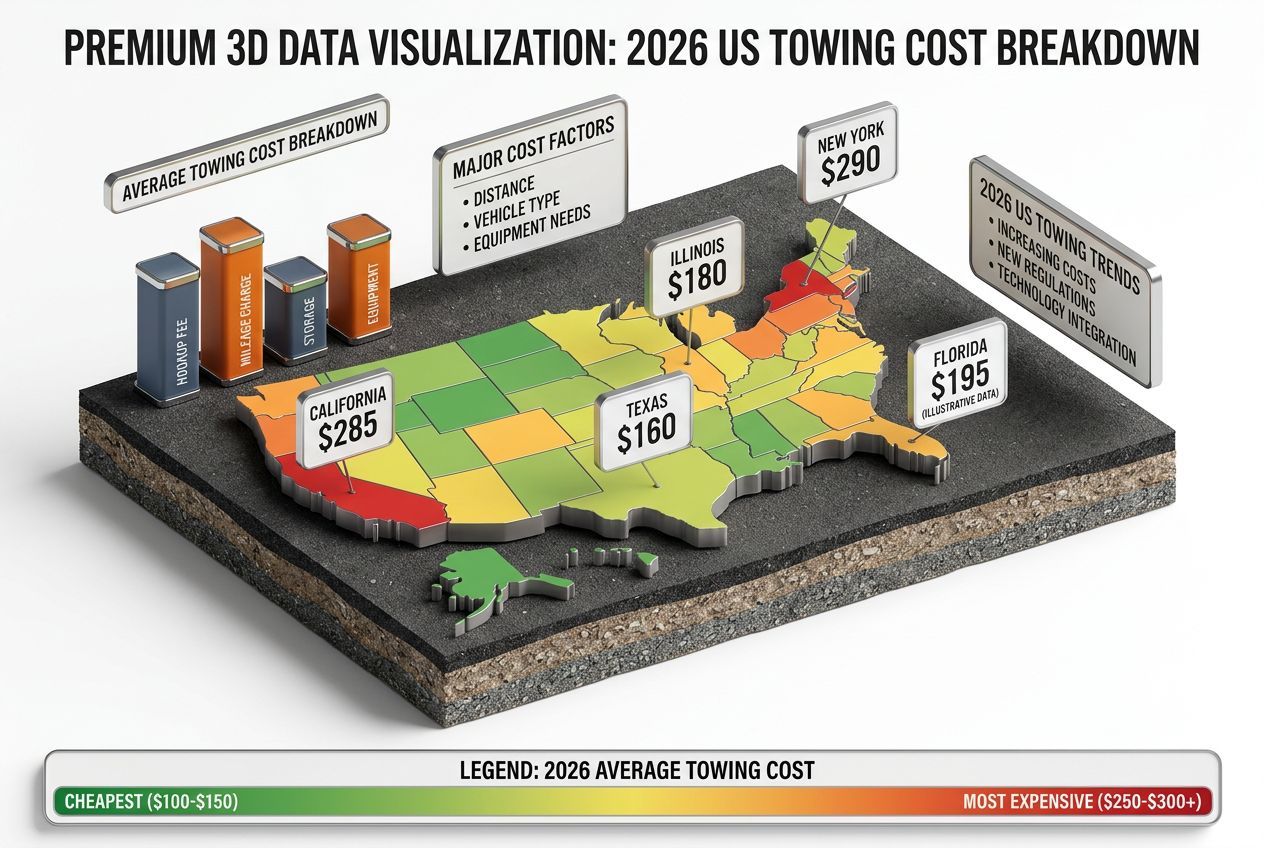
⚠️ Warning: Florida, Texas, and Virginia all have regulations limiting what towing companies can charge for non-consensual tows (when your car is towed without your permission, like from private property). For voluntary tows — when you call the truck yourself — most states don't cap rates. Always ask for the full towing price before authorizing service, and get a written estimate if the situation allows. See our towing cost by state guide for state-specific rules. If your vehicle ends up at an impound lot, impound lot fees — daily storage charges of $20–$75 plus administrative release fees — can stack quickly on top of the original tow bill.
⚙️
TOWING COSTS
Does Insurance Actually Cover Towing Costs?
Standard Coverage Limitations: Most standard auto insurance policies don't include towing coverage automatically — it's an optional add-on, typically called "roadside assistance" or "emergency road service," that costs $5–$25 per year. When active, coverage usually caps at $50–$100 per incident or limits towing to the nearest qualified repair facility, not the shop of your choosing. For carrier-specific insurance towing coverage cost breakdowns across GEICO, State Farm, Progressive, USAA, and Allstate, see our add-on pricing guide.
💡 Key Takeaway: That $50–$100 cap matters. If your tow runs $175, you're still out $75–$125 out of pocket after the insurance payment. And filing a claim, even a small one, can affect your rates at renewal with some carriers — so weigh whether submitting a $150 tow claim is worth the potential rate impact.
AAA Membership: A Different Approach
AAA Benefits: AAA is a different model. Membership costs $50–$170 per year depending on tier:
- AAA Classic: Up to 3–7 miles of free towing per call, depending on the club (4 calls/year)
- AAA Plus: Up to 100 miles of free towing per call
- AAA Premier: One tow of up to 200 miles per membership year (other tows up to 100 miles), plus one day of free car rental
Per AAA's published membership benefits (aaa.com), Premier members in high-mileage states like Texas or Montana can easily recoup membership costs on a single long-distance breakdown. If you tow frequently or drive a high-mileage vehicle, our breakdown of whether AAA roadside is worth it walks through the math in detail. For a full plans-compared overview of roadside assistance cost across AAA, insurance add-ons, credit-card perks, and pay-per-use options, see our roadside cost guide. For a tier-by-tier breakdown of AAA towing cost — including overage fees and the AAA Plus vs Premier breakeven math — see our dedicated AAA pricing guide.
For a side-by-side comparison of roadside assistance plans across providers, the roadside assistance comparison tool pulls current pricing and coverage limits.
🚛
TOWING COSTS
How Does Towing Cost Change by Vehicle Type?
Vehicle-Specific Pricing: Towing cost rises with vehicle weight and drivetrain complexity — sedans average $95–$250, SUVs and full-size trucks $150–$350, and heavy-duty vehicles like RVs or commercial equipment $350–$1,500+. The tow truck cost isn't just about the labor; heavier vehicles require more capable (and more expensive) equipment.
Cost Breakdown by Vehicle Category
Here's what that looks like by category:
- Sedans and Compact Cars ($95–$250): Most can use wheel-lift. If the car is AWD or has front-end damage, expect the operator to call for a flatbed instead — which adds $20–$60 to the invoice.
- Full-Size SUVs and Trucks ($150–$350): Heavier than they look. A loaded Ford Expedition or Ram 1500 can weigh 6,000+ lbs. Some light-duty flatbeds are rated for this; others aren't. A dispatch that sends a truck not rated for your vehicle weight wastes time and may require a second dispatch.
- RVs and Motorhomes ($350–$1,500+): These need heavy-duty wreckers or specialized RV transport. The heavy duty towing cost guide goes deep on this category.
- Semi Trucks and Class 8 Commercial ($500–$75,000+): Class 8 truck towing operates on a separate rate scale entirely — $4–$15 per mile plus a $250–$600 hook-up fee, with rotator recovery billed hourly at $500–$800/hour. See our semi truck towing cost guide for the full commercial breakdown.
⚠️ Warning: What towing can't fix: If your vehicle has major frame damage, flood damage, or fire damage, a standard tow gets it to a shop — but be clear with the dispatcher about the vehicle's condition. Some operators won't tow a severely damaged vehicle with a wheel-lift at any price due to liability. And if the vehicle can't roll (locked brakes, missing wheels), you'll need a flatbed with a winch regardless of what you'd prefer to pay.
For help matching your vehicle to the right equipment before you call, use the towing capacity lookup tool.
📝
TOWING COSTS
How Can I Actually Reduce My Towing Costs?
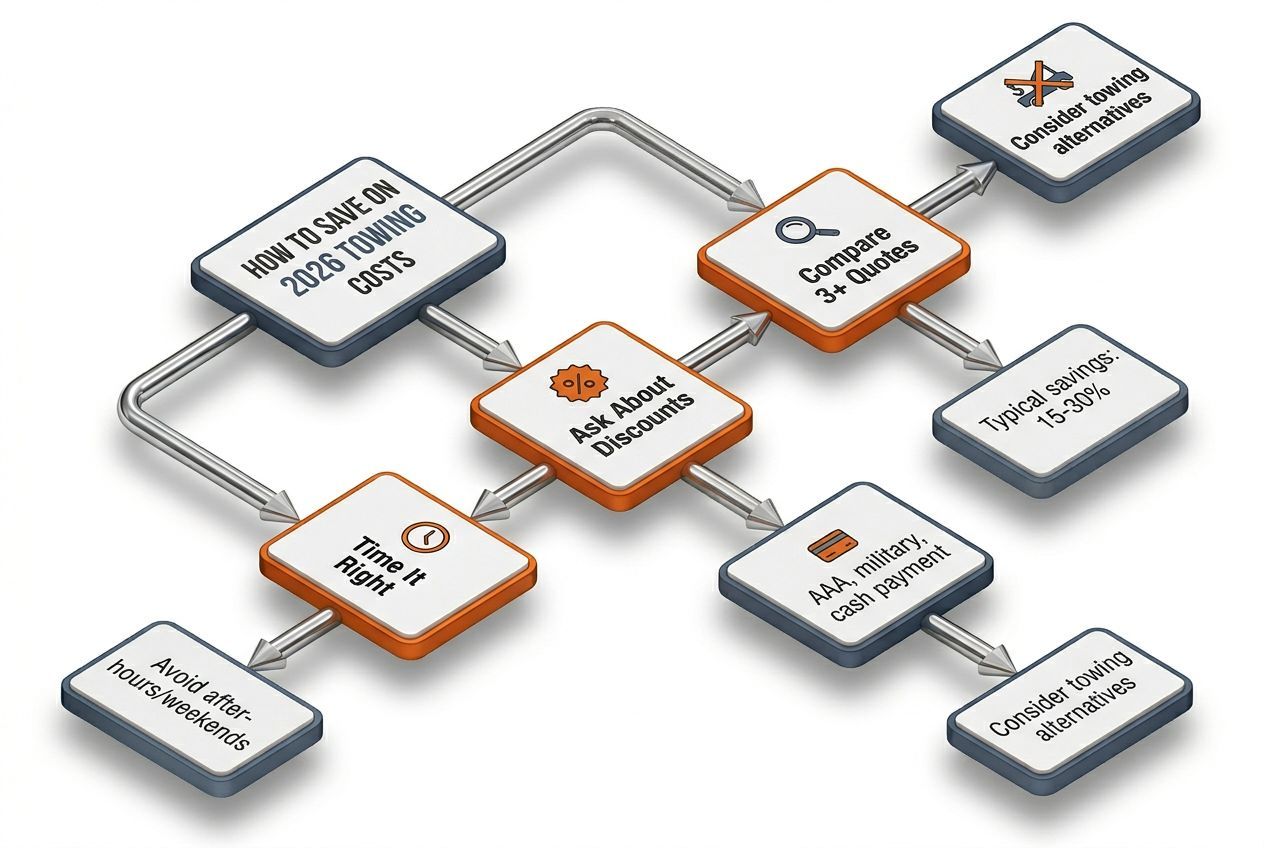
Strategies for Savings: You can cut towing costs by carrying an active roadside assistance plan, adding towing coverage to your auto policy, getting multiple quotes before authorizing a tow, and asking about cash discounts. The biggest savings come from preparation before a breakdown happens — not negotiating at the side of the road at midnight.
Your Cost-Reduction Playbook
Here's a practical cost-reduction playbook:
- Pre-purchase a roadside plan. AAA Plus at $100/year gives you up to 100 miles of free towing per call — potentially saving $300–$600 on a single mid-distance breakdown. Motor clubs, credit card travel benefits (many Visa Signature and Amex cards include roadside), and some manufacturer programs (GM's OnStar, Ford's Roadside Assistance) all offer coverage at low or no cost.
- Add towing to your auto policy. At $5–$25/year, it's cheap. Just know the per-incident cap. Call your insurer and ask: "What's my towing benefit, and does filing affect my rate?"
- Call multiple tow companies before committing. If your vehicle is safely off the road and you're not in immediate danger, spending 5 minutes calling two or three local operators can save $50–$150. Prices genuinely vary between companies in the same city.
- Avoid the "default dispatch." If you call 911 for a non-emergency breakdown or go through an insurance dispatch, you often get whoever is on a rotation list — not the cheapest option. Requesting a specific company by name is your right in most states.
- Ask about cash discounts. Some operators discount 5–10% for cash payment, which avoids credit card processing fees on their end. It's worth asking.
For more strategies including how to find cheap local service, see our cheap towing near me guide.