📊
ROADSIDE ASSISTANCE
Does Roadside Assistance Cover Towing and How Far?
Yes, roadside assistance covers towing, but the mileage cap is arguably the most critical detail to understand. Basic plans often limit towing to 3–7 miles. Mid-tier plans typically extend coverage up to 100 miles, while premium plans can offer one tow of up to 200 miles per membership year (other tows up to 100 miles). Exceeding your plan's limit means you'll pay per-mile overage charges, which can range from $2–$7 per mile and add up very quickly, especially on rural highways.
Consider this example: Imagine your car breaks down 85 miles from home, and the nearest certified dealer is 72 miles away.
- With a basic plan like AAA Classic (assuming a 5-mile limit), you would owe roughly $469 in overage charges (67 miles at $7/mile).
- However, with AAA Plus (a 100-mile limit), that same 72-mile tow would cost you nothing extra.
Here's a comparison of common towing limits by plan type:
Does Roadside Assistance Cover Towing and How Far? — data table
| Plan |
Towing Limit |
Overage Rate |
Annual Fee (approx.) |
Best For |
| AAA Classic |
3–7 miles (by club) |
~$7/mile |
~$60–$75 |
Urban drivers, short commutes |
| AAA Plus |
100 miles |
~$7/mile |
~$90–$120 |
Road trips, suburban/rural drivers |
| AAA Premier |
1 tow up to 200 mi/yr; others 100 mi |
~$7/mile |
~$130–$165 |
Frequent travelers, older vehicles |
| Insurance Add-On |
Varies (3–100 miles) |
Varies |
$10–$36/year |
Low-frequency drivers |
| Manufacturer Program |
10–50 miles (typical) |
Full out-of-pocket |
Free (new vehicle) |
New car owners within warranty |
Source: AAA plan details; insurance industry rate surveys. Fees vary by region and membership tier.
💡 Key Takeaway: If you frequently drive in rural or mountainous regions, a plan with a minimal 5-mile limit is often insufficient, as the nearest repair shop is rarely that close. Always verify your local towing costs guide to understand potential out-of-pocket expenses before choosing a plan.
🔧
ROADSIDE ASSISTANCE
Is Roadside Assistance the Same as Towing Insurance?
Roadside assistance and towing insurance are related but fundamentally different offerings. Roadside assistance operates as a direct service-dispatch program: you call, and they send help. In contrast, towing insurance is typically a reimbursement endorsement added to your existing auto policy: you pay for the service upfront, then file a claim with your insurer for reimbursement. Understanding this distinction is key to anticipating both the service process and your costs.
With a roadside assistance plan, a dispatcher handles all coordination, including dispatching the tow truck, monitoring its arrival, and managing the billing directly. Within your plan's limits, you generally pay nothing at the scene.
With towing insurance, you are responsible for arranging your own tow, paying the bill out-of-pocket, keeping your receipt, and then submitting it to your insurer for reimbursement. This process can take days and may involve a deductible.
⚠️ Warning: A critical difference is that roadside assistance calls typically do not appear on your insurance record. Towing insurance claims, however, often do. Some insurers may even treat minor claims as activity that could lead to a rate increase at your next renewal. For a detailed comparison, explore our guide on insurance roadside vs. AAA breakdown.
🛡️
ROADSIDE ASSISTANCE
What Does Roadside Assistance NOT Cover?
Roadside assistance plans come with specific exclusions that can surprise drivers, especially owners of trucks and RVs who might assume standard memberships cover their larger vehicles. Generally, these plans will not cover:
- Vehicle repairs beyond minor roadside adjustments.
- Extreme off-road recovery scenarios.
- Breakdowns of commercial vehicles.
- Pre-existing mechanical failures that should have been addressed.
- Vehicles exceeding approximately 10,000 lbs GVWR (Gross Vehicle Weight Rating).
Here's a breakdown of common exclusions:
- RVs and Trailers: A standard AAA membership, for example, does not cover a Class A motorhome or a fifth-wheel trailer. You will need an RV-specific plan. AAA offers RV Plus coverage as an add-on, but it comes at a higher cost and has its own distinct mileage caps.
- Motorcycles: Most standard plans explicitly exclude two-wheeled vehicles. You would typically need a motorcycle-specific add-on or a dedicated plan through organizations like the American Motorcyclist Association (AMA), as highlighted by AMA resources at americanmotorcyclist.com.
- Electric Vehicles (EVs): Many EVs require flatbed-only towing to prevent damage to their drivetrains (dolly towing can be harmful). Some older plans or networks might still dispatch a wheel-lift truck, which may refuse to tow your EV. While manufacturer programs from brands like Tesla and Rivian often have dedicated EV dispatch, third-party plans can be inconsistent. Always confirm flatbed dispatch availability before relying on a plan for your EV.
- Heavy Trucks and Commercial Vehicles: The majority of plans cap coverage at vehicles weighing 10,000 lbs GVWR. A fully loaded F-350 dually or any vehicle registered for commercial use will typically fall outside standard residential roadside coverage. The FMCSA regulates commercial towing separately, and their rates are not dictated by your personal membership plan.
- Off-road Recovery: If your vehicle is stuck in extreme conditions, such as high-centered on a Forest Service road, most plans will not provide winching services. Recovery from deep mud, steep embankments, or water crossings is almost universally excluded by standard providers. Specialists in off-road recovery typically charge $300–$800+ for such complex extractions. For a broader understanding of tow truck capabilities, see our types of tow trucks guide.
📋
ROADSIDE ASSISTANCE
Is Roadside Assistance Through Your Insurance Worth It?
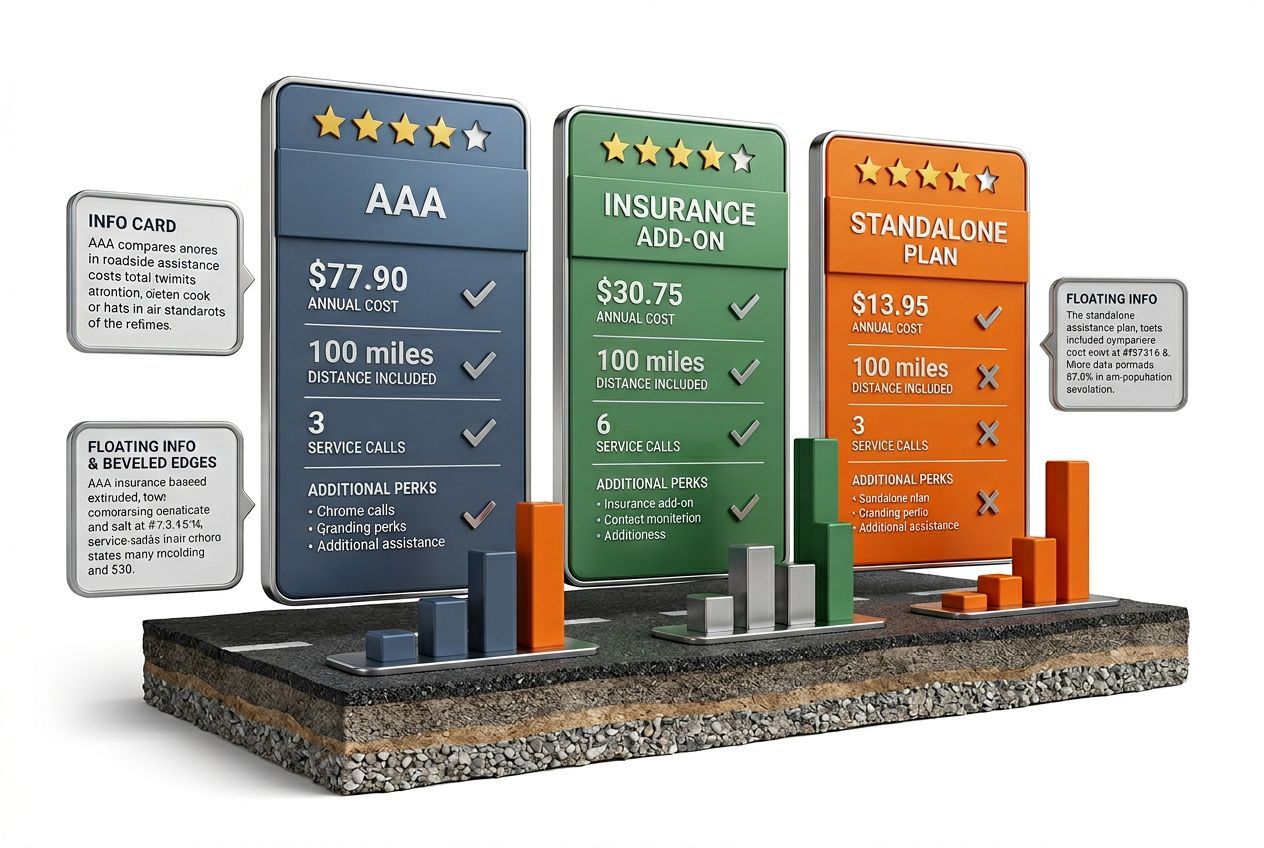
Insurance-based roadside coverage is often the most budget-friendly option, costing $10–$30 per year, and can handle basic roadside emergencies. However, if you are a frequent traveler, drive an older vehicle, or reside in a rural area, the service limitations and potential impact on your insurance claims record might make a dedicated standalone plan a more advantageous choice.
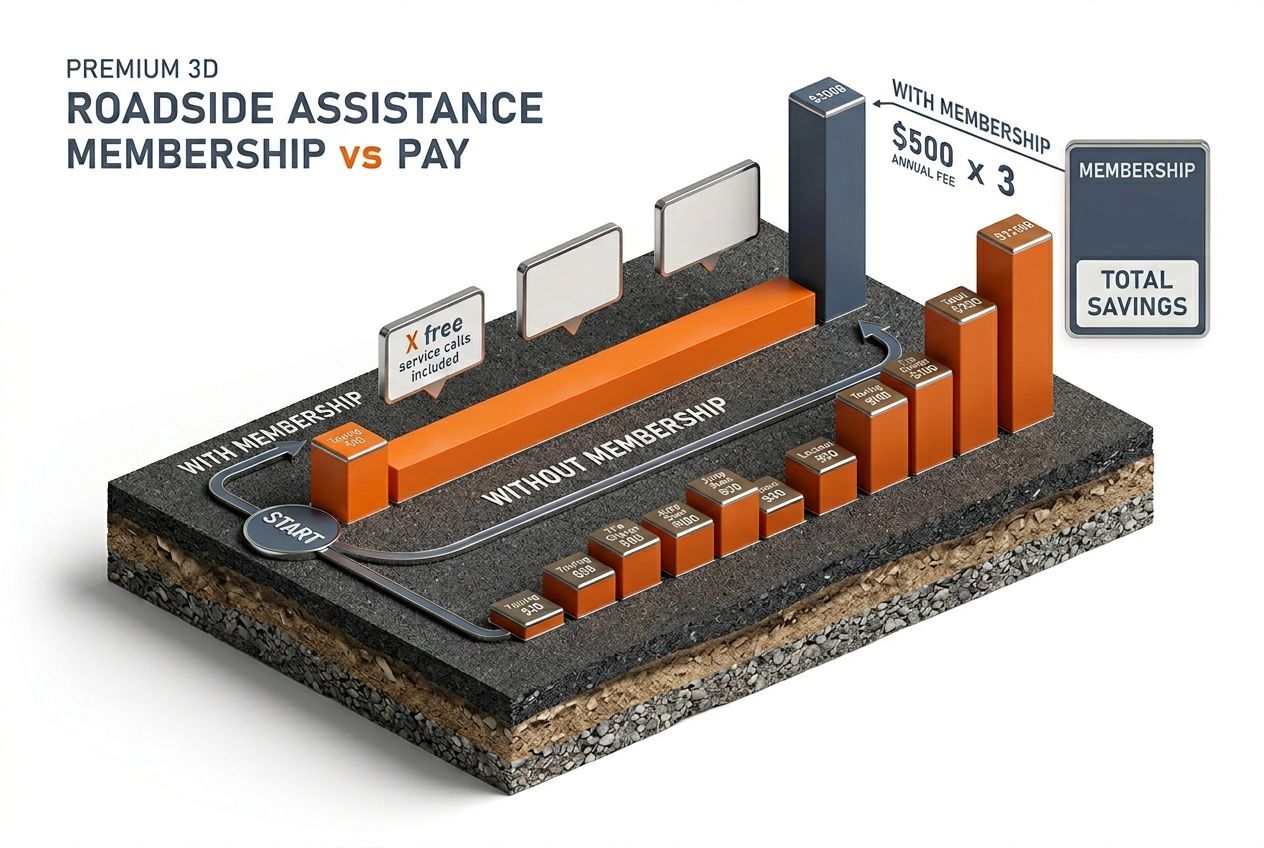
Consider the economics of a single tow: According to AAA, an average tow without coverage can cost $109–$325, depending on distance and region. A year of AAA Plus membership, offering 100-mile towing, costs approximately $100. Just one use could effectively pay for itself, leaving you with additional calls and towing mileage still available for the year.
⚠️ Warning: The impact on your insurance claims record is a genuine concern. Some insurers may log roadside dispatch calls in the same way they record accident claims, as "incidents." Accumulating two or three such calls in a single year could potentially lead to an increase in your renewal rate. For a comprehensive analysis, review the full roadside assistance cost breakdown to determine the best option for your specific situation.
If you already own a newer car, make sure to check the next section before purchasing any additional coverage.
⚙️
ROADSIDE ASSISTANCE
Do New Cars Come with Free Roadside Assistance?
Most new vehicles typically include complimentary roadside assistance provided by the manufacturer. This coverage usually lasts for 3–5 years or between 36,000–60,000 miles. For instance, Toyota's program is generally 2 years/25,000 miles, Ford's extends to 5 years/60,000 miles, and Hyundai's Assurance Roadside is one of the most generous, offering 5 years with unlimited mileage. This manufacturer-provided coverage commonly includes towing, jump starts, flat tire service, and lockout assistance. For complete details on what each brand offers, consult our manufacturer roadside programs guide.
A key limitation to be aware of: manufacturer towing mileage caps are often more restrictive than those found in dedicated membership plans. Many OEM programs will tow your vehicle only to the "nearest authorized dealer," rather than allowing you to choose your preferred independent shop. If the nearest dealer is 30 miles away, but your trusted mechanic is only 5 miles away, you may not have the option to choose under the manufacturer's plan.
✅ Pro Tip: It is wise to plan for your replacement coverage well before your factory warranty expires, not after. A lapse in coverage, even for a few months, can leave you facing full out-of-pocket rates during an emergency.
🚛
ROADSIDE ASSISTANCE
How Many Times Can You Use Roadside Assistance Per Year?
Most standard roadside assistance plans typically allow 3–4 service calls per membership year before additional charges are incurred. For example, AAA generally permits four calls per year per member across all its plan tiers, while insurance add-ons commonly cap usage at three calls annually. Exceeding these limits means you will be responsible for paying full out-of-pocket rates, which is where an app-based or standalone plan can serve as a valuable backup.
If you own an older vehicle with frequent issues, or if you're planning an extensive road trip season, it's prudent to keep track of your service calls. For instance, a family with two older cars sharing a single household AAA membership must share that four-call pool across both vehicles. Two jump starts on one car and two tire changes on the other could easily max out the account for the year. Some premium and manufacturer programs offer unlimited calls, which could be a worthwhile upgrade if your vehicle's reliability is a concern. Explore the best roadside assistance plans to compare unlimited-call options and find the perfect fit for your situation.
Should you ever experience a breakdown without coverage, our car broke down with no AAA guide provides practical steps and information on free dispatch options and on-demand roadside assistance apps.