🔧
TOW TRUCK TYPES & METHODS
How Does a Wheel-Lift Tow Truck Work?
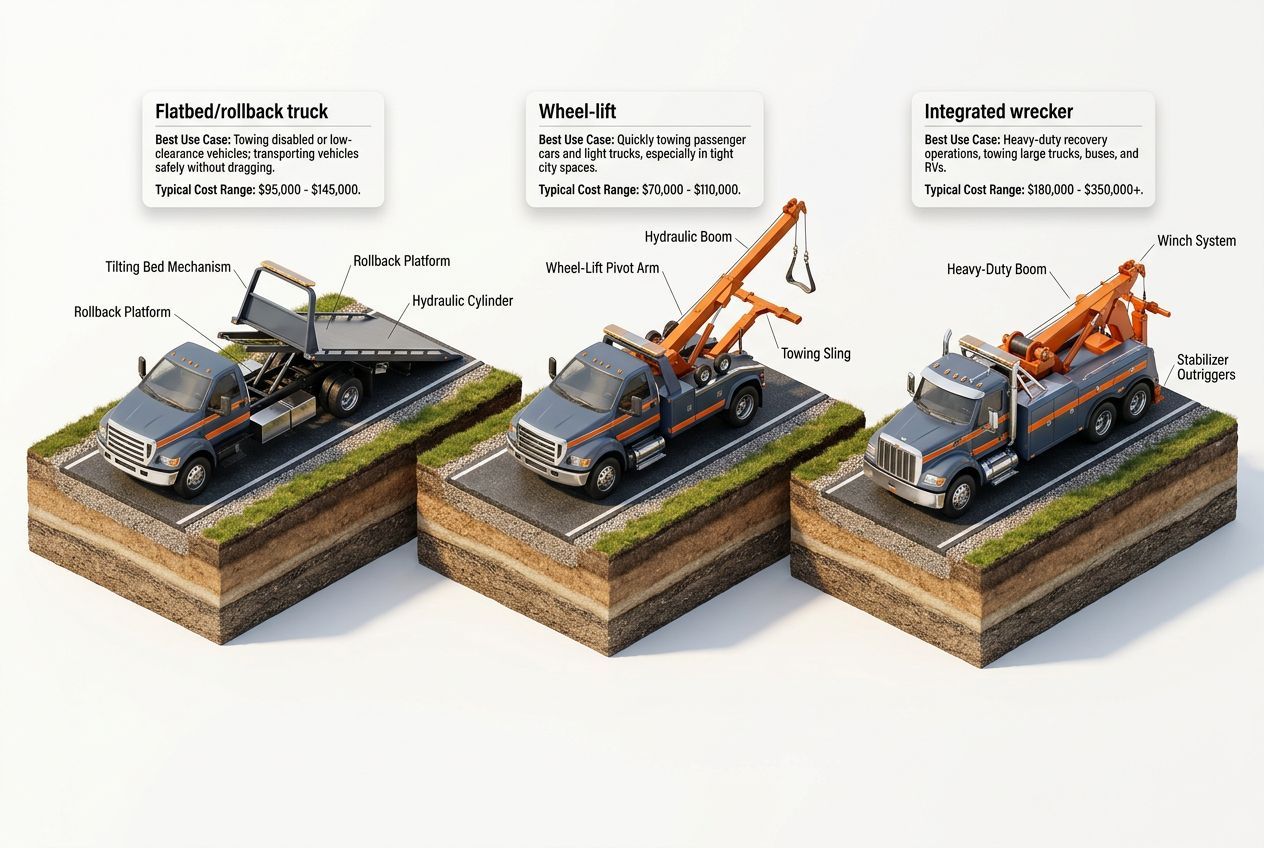
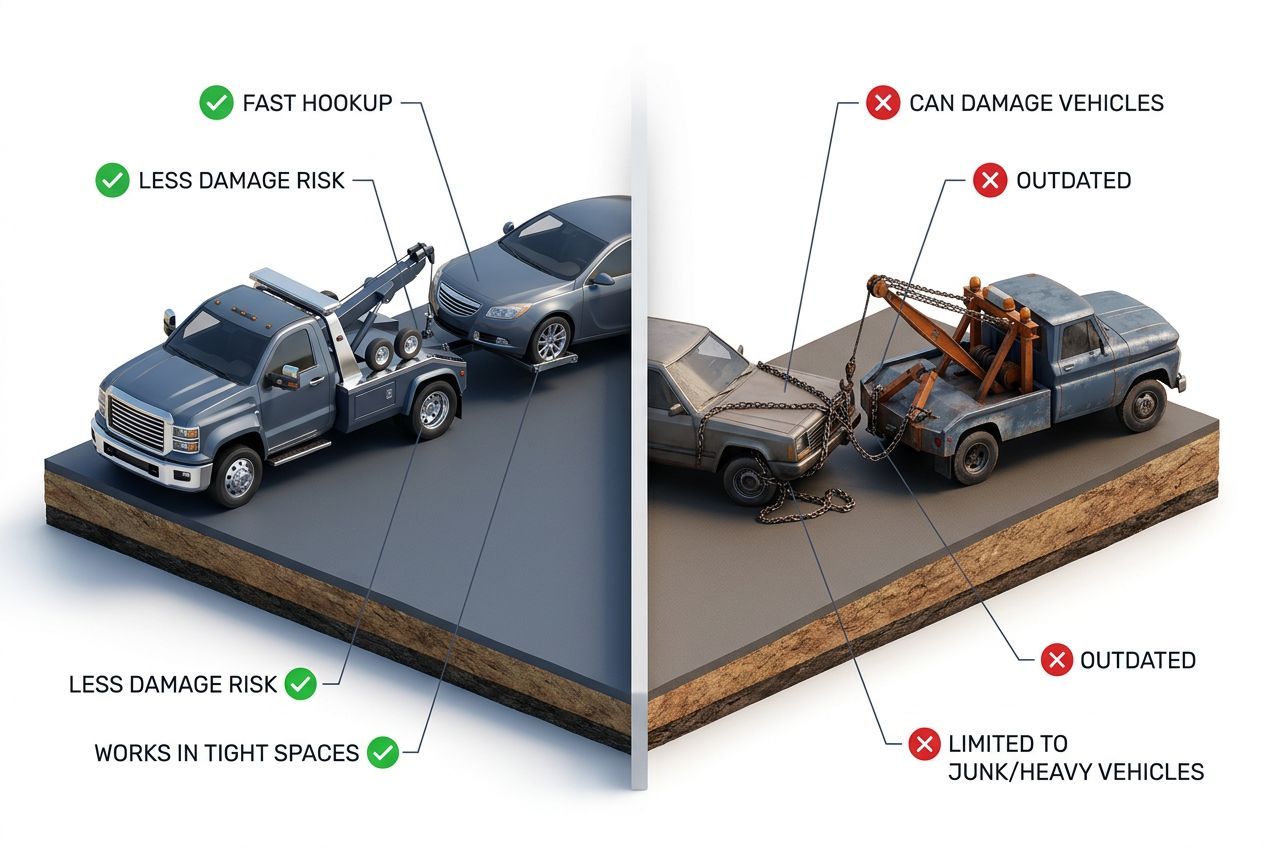
A wheel-lift tow truck uses a metal yoke — a U-shaped cradle — that slides under either the front or rear wheels and hydraulically lifts that axle off the ground. The other two wheels stay on the road and roll freely during transit. Setup takes minutes, which is why wheel-lift trucks dominate urban fleets and parking enforcement operations where speed matters. Wheel-lift trucks evolved from hook and chain rigs in the 1980s as a safer alternative that doesn't require chains touching the vehicle's frame. The yoke cradles the tires themselves, not the undercarriage, which significantly reduces body damage risk compared to the old hook and chain method.
Best Use Cases for Wheel-Lift
- Front-wheel-drive cars towed from the rear (driven wheels off the ground)
- Rear-wheel-drive cars towed from the rear (driven wheels off the ground)
- Short-distance tows on paved roads — typically under 10–15 miles
- Parking enforcement and repossession (fast hookup, fast release)
Critical Limitations of Wheel-Lift
Be cautious when considering a wheel-lift for certain vehicles. Wheel-lift towing with the drive wheels on the pavement is only safe for relatively short distances. Transmission fluid doesn't circulate without the engine running, so spinning the output shaft dry can cause premature wear.
⚠️ Warning: Most manufacturers recommend against towing FWD cars with front wheels down for more than a few miles. If you drive an AWD vehicle, a wheel-lift truck should not be your first call — it puts all four wheels in motion and risks costly damage. Our flatbed vs. wheel-lift comparison goes deeper on that tradeoff.
Wheel-lift tows average $75–$150 for a standard car within 10 miles, making them the most affordable option for routine light-duty towing.
🛡️
TOW TRUCK TYPES & METHODS
Are Hook and Chain Tow Trucks Still Used Today?
Hook and chain tow trucks are largely obsolete in professional towing, accounting for less than 5% of tows today. The method works by wrapping chains around the vehicle's frame or axle and using a boom to lift the towed end off the ground — the other end drags on the road. It's cheap and simple, but the damage potential is significant: chains scratch paint, bend frames, crack plastic bumpers, and can snap suspension components on modern unibody vehicles.
⚠️ Warning: Hook and chain towing made sense in the 1950s and 60s when body-on-frame construction was universal. Today's unibody cars — which is nearly every passenger vehicle built since the 1990s — have no true frame to safely chain around. Using this method on a modern car risks severe damage.
When Hook and Chain is Still Used
- Junk car and salvage yard pickups where cosmetic damage is irrelevant
- Scrap metal recovery
- Some rural towing operations with older equipment
If a tow company shows up with a hook and chain rig for your drivable car, you're within your rights to decline and request a different truck. The U.S. Department of Transportation doesn't mandate a specific tow method, but most state towing regulations require operators to use equipment that minimizes vehicle damage.
📋
TOW TRUCK TYPES & METHODS
What Are Integrated and Heavy-Duty Tow Trucks Used For?
Integrated tow trucks are purpose-built heavy-duty recovery rigs that combine a boom and wheel-lift system on a multi-axle reinforced chassis, designed to recover semis, buses, large RVs, and other commercial vehicles. These are not scaled-up versions of light-duty wreckers — they're engineered from the ground up for gross vehicle weights exceeding 50,000 lbs.
Why Integrated Trucks are Different
The specialized design of integrated trucks provides superior rigidity. Manufacturers like Jerr-Dan and Miller Industries build integrated units rated for 25-ton to 50-ton recovery operations. The "integrated" name comes from the fact that the boom, underlift, and chassis are all engineered as a single unit rather than a body bolted onto a commercial truck frame — which gives them superior structural rigidity for severe-duty recovery.
Typical deployment scenarios:
- Semi-truck breakdown on an interstate
- Bus or motorcoach recovery after a collision
- Large RV or fifth-wheel that's slid off a highway
- Commercial fleet breakdowns requiring on-site upright positioning
Integrated Truck Limitations
Even heavy-duty trucks have their limits. Even a 50-ton integrated unit can't right an overturned 80,000-lb loaded tanker on its own. That job goes to a rotator.
💡 Key Takeaway: Integrated trucks are expensive to dispatch — expect to pay $300–$700+ for a heavy-duty integrated tow, with complex recoveries running well over $1,000 depending on time on-scene and equipment required.
For a detailed look at integrated rigs, see our integrated tow truck guide.
⚙️
TOW TRUCK TYPES & METHODS
How Do Boom and Rotator Tow Trucks Handle Recovery?
Boom tow trucks use a hydraulic crane arm — the boom — to reach vehicles in positions where a flatbed or wheel-lift can't operate: ditches, embankments, water-adjacent terrain, and off-road positions. A standard boom truck can reach out and drag a vehicle back to a recoverable position, then hand off to a flatbed for transport.
Rotator vs. Standard Boom
Rotator tow trucks significantly enhance recovery capabilities by adding a full 360-degree rotating crane. That rotation is what makes them indispensable for overturned tractor-trailers. A rotator can position the crane arm precisely regardless of approach angle, then right the overturned vehicle with controlled tension.
📊 Quick Fact: Rotator cranes from manufacturers like NRC and Jerr-Dan carry lift capacities up to 75 tons, though 35-ton and 50-ton models are more common in regional fleets.
Complex Recovery Scenarios
Rotators are essential for the most challenging recoveries. Consider a real-world scenario: A fully loaded 80,000-lb tanker truck jackknifes and rolls onto its side blocking two lanes of an interstate. A standard integrated rig can't safely right it alone — the geometry doesn't work.
✅ Pro Tip: A 50-ton rotator pulls up, sets its outriggers, positions the crane arm over the overturned cab, attaches recovery straps to the frame, and lifts with controlled tension while the trailer is simultaneously stabilized. That operation can take 2–4 hours and cost $800–$3,000+ depending on the complexity.
💡 Key Takeaway: In northern states, rotator and boom deployments spike significantly after ice storms. An iced-over embankment adds extraction resistance that can double or triple the load compared to a dry recovery. Operators factor that in when rigging — and you should factor it in when estimating cost and wait time.
For specifics on rotator operations, our rotator tow truck guide covers rigging, capacity, and cost in detail.
🚛
TOW TRUCK TYPES & METHODS
Which Type of Tow Truck Is Best for Your Vehicle?
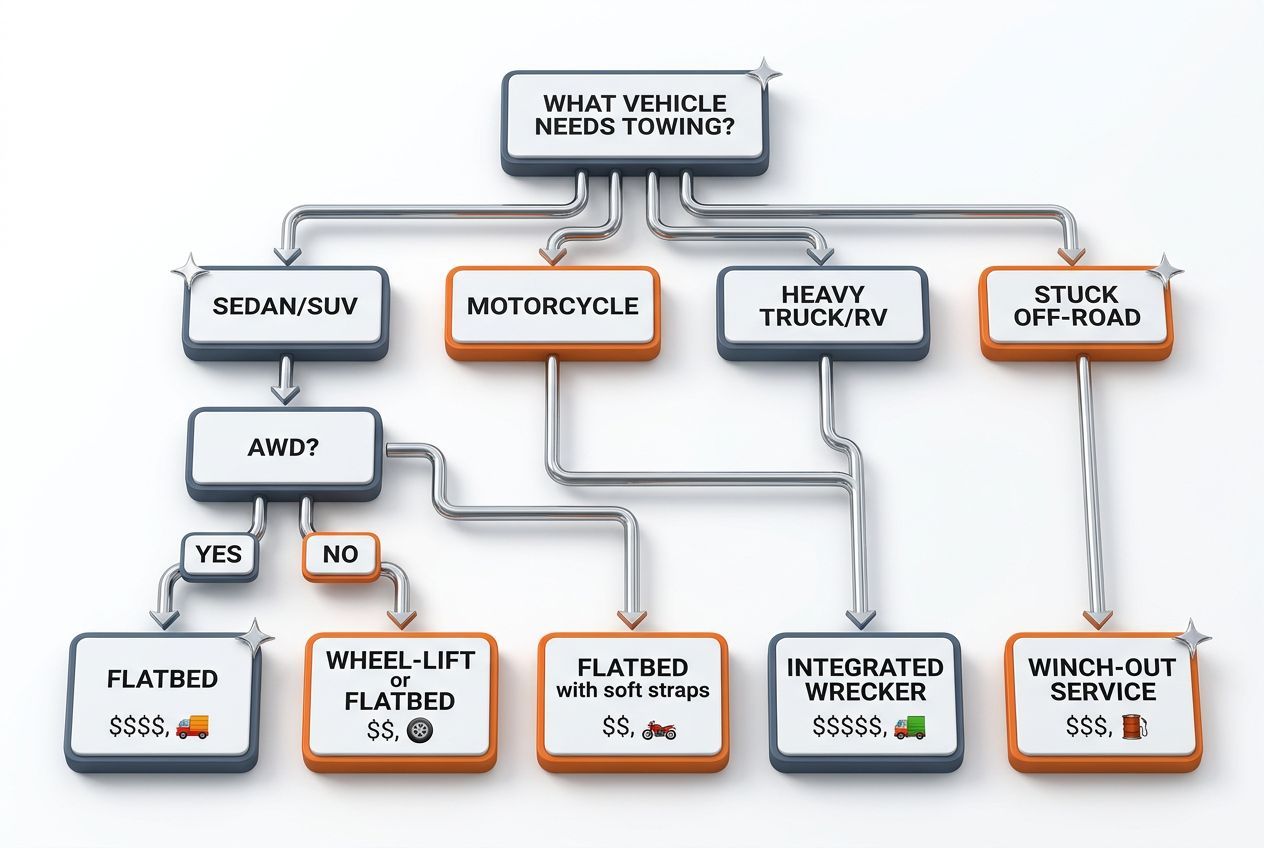
Selecting the correct tow truck is paramount to avoid damage. The right tow truck type depends on three factors: your vehicle's drivetrain configuration, its condition, and the distance and terrain involved. Getting this wrong isn't just inconvenient — it can cause expensive damage.
Here's a guide to help you choose:
-
AWD and 4WD vehicles:
- Requirement: Flatbed transport. Full stop.
- Reason: Manufacturers including Subaru, Toyota, and Ford all specify flatbed-only towing in their owner's manuals for AWD/4WD models. Towing a Toyota RAV4 AWD with a wheel-lift truck — even with the rear wheels up — risks spinning the front axle and damaging the transfer case.
-
Luxury and lowered vehicles:
- Requirement: Flatbeds.
- Reason: A standard wheel-lift yoke requires enough ground clearance to slide under the front or rear tires. Lowered vehicles often don't have that clearance. Even if the yoke fits, loading angle matters — scraping a carbon fiber front splitter on a sports car during pickup creates a damage claim that far exceeds the cost of a flatbed tow.
-
Standard FWD or RWD cars:
- Requirement: Wheel-lift is safe for short distances on paved roads.
- Reason: If you've got a front-wheel-drive sedan that dead-batted in a parking lot and needs to go three miles to the dealership, a wheel-lift truck is fast, available, and perfectly safe.
-
Totaled or junk vehicles:
- Requirement: Hook and chain is appropriate.
- Reason: If the car's going to the crusher, chain marks on the frame are irrelevant.
-
Semis, buses, and large RVs:
- Requirement: Integrated or boom trucks.
- Reason: A light-duty wrecker attempting a heavy-duty recovery is a safety failure waiting to happen. The FMCSA sets standards for commercial vehicle recovery, and underequipped recovery attempts are one of the leading causes of secondary crashes at accident scenes.
Our choosing the right tow method guide walks through the decision process step by step.
📝
TOW TRUCK TYPES & METHODS
How Much Does Each Type of Tow Truck Cost?
Tow truck costs vary significantly by type, distance, time of day, and geographic market. Here's what you can realistically expect to pay for each type. For a deeper breakdown by region and vehicle type, use our towing cost calculator or check the towing cost guide.
Tow Truck Cost Comparison by Type
Tow Truck Cost Comparison by Type — data table
| Tow Truck Type |
Typical Base Rate (≤10 mi) |
Per-Mile Rate Beyond Base |
Best For |
Damage Risk |
| Hook & Chain |
$75–$125 |
$2.50–$4.00/mi |
Junk/salvage vehicles only |
High |
| Wheel-Lift |
$75–$150 |
$2.50–$5.00/mi |
FWD/RWD cars, short tows |
Low–Medium |
| Flatbed (Rollback) |
$95–$250 |
$3.50–$7.00/mi |
AWD, 4WD, luxury, damaged |
Very Low |
| Integrated (Heavy-Duty) |
$300–$700+ |
$5.00–$10.00/mi |
Semis, buses, large RVs |
Very Low |
| Boom/Rotator |
$400–$3,000+ |
Hourly ($150–$400/hr) |
Off-road recovery, overturned vehicles |
Very Low |
Source: Consumer towing cost surveys and Edmunds pricing data. Rates as of 2025–2026. Regional variation applies.
Cost Considerations
The cheapest tow isn't always the most economical. A $75 wheel-lift tow on an AWD vehicle can easily generate a $1,500–$3,000 transfer case repair.
✅ Pro Tip: The $60–$100 premium for a flatbed pays for itself immediately in that scenario. If your roadside assistance plan (like AAA) covers towing, call and specifically request a flatbed if you drive AWD — most plans honor that request without extra cost.
💡 Key Takeaway: Holiday and overnight surcharges are real. Expect 25–50% above standard rates on late-night calls and major holiday weekends. That's not padding — towing is a 24/7 operation with real overtime costs.
💰
TOW TRUCK TYPES & METHODS
Flatbed vs. Wheel-Lift vs. Hook and Chain — Side-by-Side
For typical vehicle owners, these are the three most common tow truck types you'll encounter. If you're in a hurry and just need a fast comparison, here's the direct breakdown.
Flatbed vs. Wheel-Lift vs. Hook and Chain — Side-by-Side — data table
| Feature |
Flatbed (Rollback) |
Wheel-Lift |
Hook and Chain |
| Method |
Hydraulic bed tilts; vehicle loaded fully |
Metal yoke lifts one axle |
Chains wrap frame/axle; one end lifted |
| Wheels on Road |
None |
Two |
Two (often dragging) |
| Speed of Hookup |
Moderate (5–10 minutes) |
Fast (under 5 minutes) |
Fast (under 5 minutes) |
| Damage Risk |
Very Low (Safest) |
Low–Medium (if used incorrectly) |
High (can cause significant cosmetic/frame damage) |
| Best For |
AWD, 4WD, Luxury, Lowered, Damaged vehicles |
FWD/RWD cars (short, paved tows) |
Junk/Salvage vehicles only |
| Relative Cost |
Higher |
Lower |
Lowest |
| Modern Usage |
Dominant (60%+ of light-duty fleet) |
Common for light-duty, urban fleets |
Largely Obsolete (less than 5% of tows) |
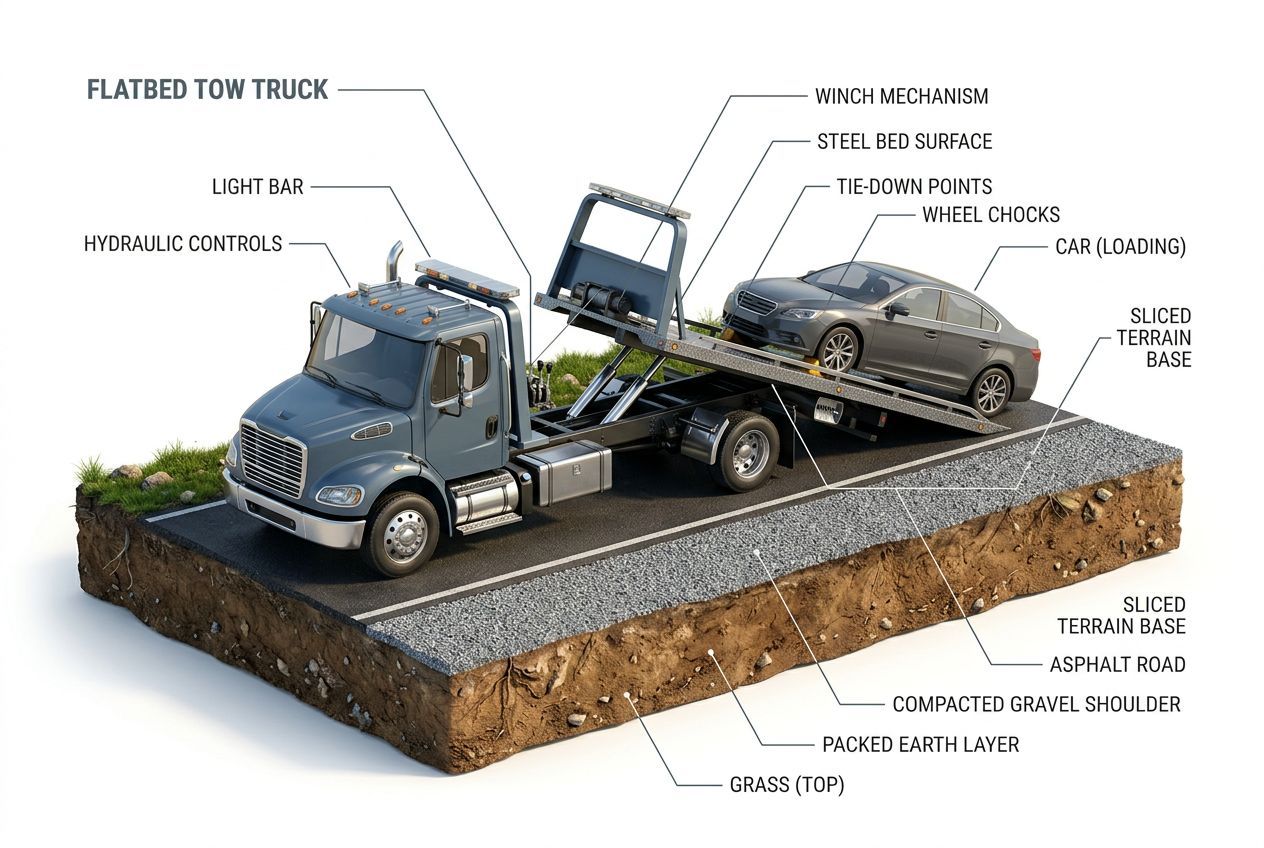
Flatbed is the safest method and the one most professionals default to for any vehicle worth protecting. Setup takes 5–10 minutes longer than a wheel-lift, and it costs more, but the protection is unmatched. The hydraulic bed tilts to ground level — the vehicle rolls or gets winched up, the bed raises, and transport begins with zero wheels touching the road.
Wheel-lift is faster, cheaper, and perfectly appropriate for the right situation. The yoke slides under in minutes, and hookup-to-moving typically takes under five minutes. The tradeoff is two wheels on the road, which creates limits on drivetrain type, distance, and road condition.
Hook and chain has no place in modern professional towing for any vehicle with resale or repair value. The damage potential — frame bending, paint scratching, suspension stress — simply isn't worth the marginal cost savings.
For longer distance moves, especially cross-state vehicle transport, our dolly towing guide covers another option worth considering. And if your vehicle needs to be pulled out of a ditch before it can even be towed, a winch-out service is the first step — separate from the tow itself.
Want to know exactly which tow method fits your specific vehicle? Our tow vehicle matchmaker tool and can I tow this tool can help you sort it out before you make the call.