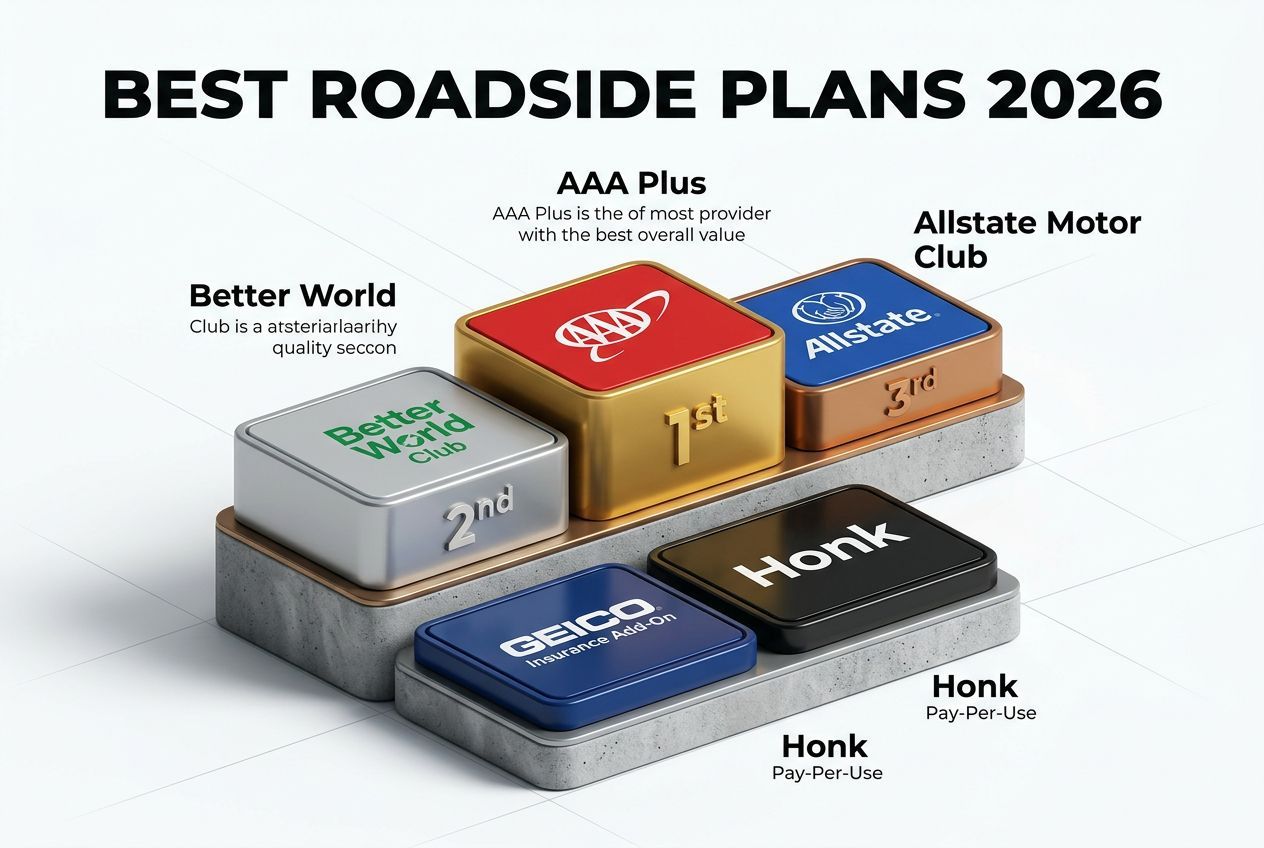
Utilize our interactive comparison tool above to input your vehicle type, annual mileage, and location. The tool evaluates your towing distance needs against annual cost and generates a personalized ranking of the best roadside assistance plans for your specific situation, accounting for state-specific factors like average tow distances and provider network density.
📊
ROADSIDE ASSISTANCE
How Much Does Roadside Assistance Cost Per Year?
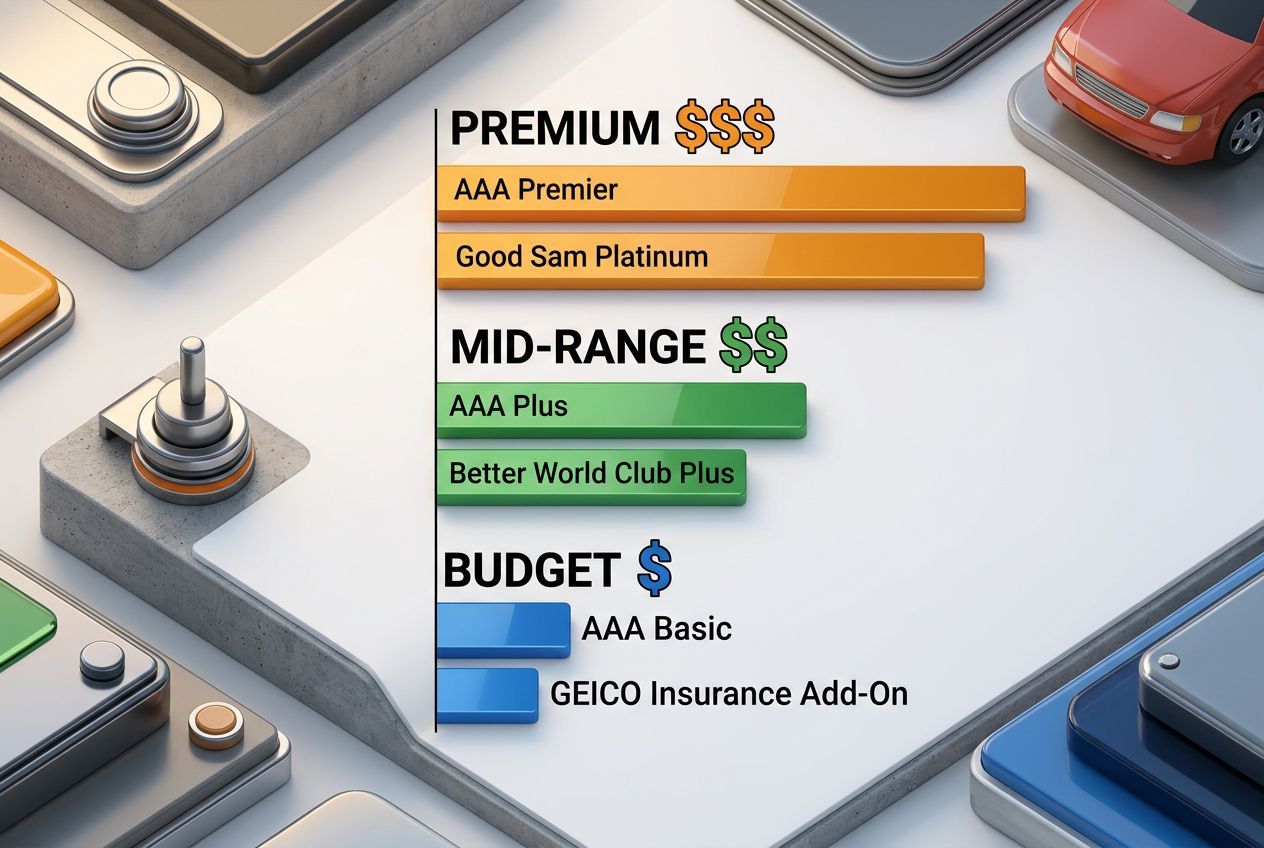
Roadside assistance plans in 2026 vary significantly in cost, ranging from $0 (when bundled with auto insurance or certain credit cards) up to $199/year for premium motor club memberships. Basic standalone plans from providers like Allstate Motor Club or Good Sam typically start between $52–$79/year. AAA Classic costs approximately $68, while AAA Premier reaches $164. For infrequent drivers, pay-per-use apps such as Honk or Urgently offer a cost-effective alternative, charging $49–$150 per service call.
Insurance-bundled roadside is generally the cheapest option.
- GEICO charges about $14/year ($12 per 6-month policy).
- Progressive costs $18/year.
- State Farm offers its Motor Club tier for $25/year.
These add-ons usually limit towing to 15–25 miles and restrict coverage to the insured vehicle only, meaning it doesn't follow the member if they drive a second car, borrow a friend's truck, or rent a vehicle.
AAA's three-tier structure addresses different use cases:
- AAA Classic ($68/year): Covers basic services but limits towing to a mere 5 miles, which is often insufficient for modern highway spacing.
- AAA Plus ($110/year): Extends towing to a much more practical 100 miles.
- AAA Premier ($164/year): Provides one tow of up to 200 miles per membership year (other tows up to 100 miles) plus a complimentary one-day car rental following breakdowns that last longer than two hours.
⚠️ Warning: AAA Classic's 3–7 mile towing limit (depending on the club) is largely inadequate for today's highway distances and rural breakdowns, potentially leaving you stranded unless you pay significant out-of-pocket overage fees.
Specialty plans for RVs and motorcycles naturally incur higher costs due to the specialized equipment required for service. Good Sam Platinum, at $114/year, covers RVs of any length and the towed vehicle, which is crucial when both units require transport during a breakdown. American Motorcyclist Association (AMA) roadside assistance costs about $79/year for bikes, including towing directly to your home or campsite.
Pay-per-use apps eliminate membership fees but charge per incident. Honk and Urgently dispatch the nearest available contractor digitally, often resulting in 20–40% faster arrival times in urban areas compared to traditional motor clubs. These apps are cost-effective if you need service less than twice per year. Beyond three calls, an annual membership typically becomes more economical.
Consider this breakeven calculation: A driver needing a tow once every two years might pay $75 per incident with Honk (average metro cost), amortizing to $37.50/year. The same driver with a $110/year AAA Plus membership effectively spends $220 for that single tow over two years—nearly triple the pay-per-use cost. However, if that driver breaks down three times in one year, Honk would cost $225 compared to $110 with AAA Plus.
Many credit cards include roadside assistance as a complimentary benefit. Cards like the Chase Sapphire Reserve ($550/year) offer up to four service calls annually with $50 reimbursement per incident. The American Express Platinum Card ($695/year) provides similar coverage. For cardholders already paying high annual fees for travel rewards, this roadside benefit is a free bonus. For a full breakdown of coverage specifics, consult our guide on what does roadside assistance cover.
When comparing roadside assistance costs, look beyond the initial membership fee and calculate the cost-per-towing-mile. A $68 plan that tows 5 miles costs $13.60 per mile of coverage. In contrast, a $110 plan that tows 100 miles costs $1.10 per mile—representing significantly better value if you ever need the full distance.
🔧
ROADSIDE ASSISTANCE
Is AAA Still Worth It Compared to Other Roadside Assistance Plans?
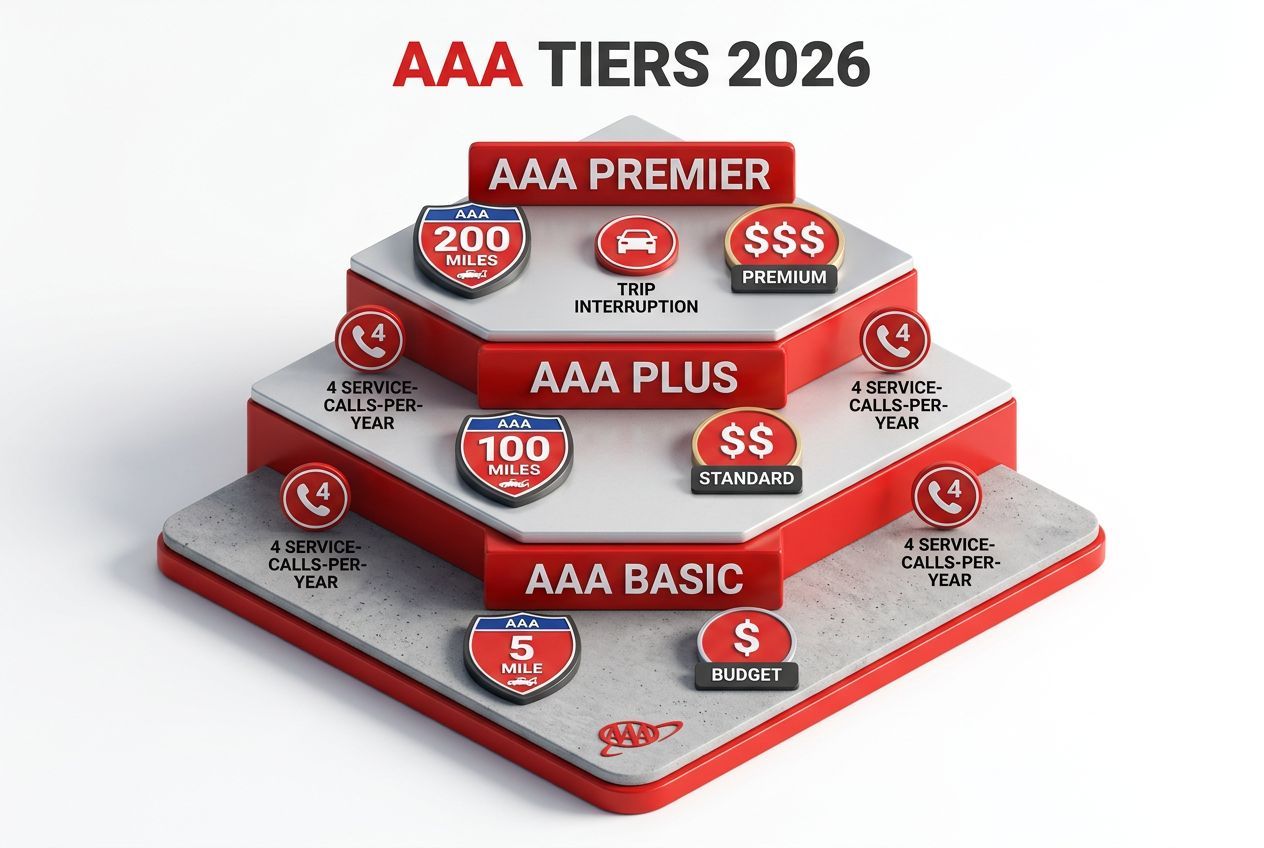
In 2026, AAA remains a strong contender primarily due to its member-follows-vehicle coverage, extensive discount network, and convenient DMV-adjacent services. However, AAA's Basic tier, with its restrictive 3–7 mile towing limit, often falls short in rural settings. With insurance-bundled and app-based services now offering comparable towing distances at lower costs, AAA's true value proposition often lies in its Plus or Premier tiers.
AAA's member-follows-not-vehicle coverage is a key differentiator. This means that if your spouse is driving your car and it breaks down, or if you're borrowing a friend's truck and get a flat, or even if you're driving a rental car on vacation and the battery dies, AAA covers you. This contrasts sharply with insurance-based roadside assistance, which typically covers only the insured vehicle, potentially leaving gaps for multi-car households or when driving non-owned vehicles.
The extensive AAA discount network provides substantial savings, with members reporting an average of $427 in savings in 2025 through discounts on:
- Hotels: 10–20% off at major chains like Best Western and Hilton.
- Rental Cars: $5–$15/day off base rates at Hertz and Budget.
- Theme Parks & Attractions: $10–$30 off admission.
- Restaurants and Retailers: Various local and national deals.
A family taking just two road trips per year could easily recoup the $110 AAA Plus membership fee through hotel and rental car savings alone.
However, AAA's towing network density has seen changes. In many rural counties, AAA contracts with the same local towing companies utilized by app-based services like Honk and Urgently. The primary difference often lies in response time, with app-based services frequently arriving 15–25 minutes faster due to real-time geo-location and direct contractor dispatch.
The 5-mile towing limit of AAA Classic is a significant drawback for highway drivers. According to FMCSA facility density data, the average distance from a rural interstate breakdown to the nearest full-service repair facility is 31 miles. A 5-mile tow would only get you to the nearest exit, leaving you to pay significant out-of-pocket fees (around $3.50/mile for 26 additional miles) on top of your membership cost. Our AAA towing distance guide breaks down the per-tier limits across Classic, Plus, and Premier in more depth.
AAA Plus addresses this with 100-mile towing, but at $110/year, it faces direct competition from:
- Good Sam ($114/year with unlimited calls)
- Better World Club ($79/year with carbon-neutral towing)
Both offer comparable towing distances without AAA's traditional membership structure. We've explored this in detail in is AAA roadside assistance worth it.
For drivers over 65, AAA Premier ($164/year) adds extra value with its complimentary one-day rental car benefit. This can save $75–$100 if your car requires overnight or multi-day repairs, which is common for major issues like transmission or engine failures, especially when breakdowns occur outside of repair shop hours.
AAA has also made strides in digital convenience, adding app-based service requests with GPS location and estimated arrival times in 2024. Yet, some users find the interface less streamlined than those of GEICO or Progressive, which can add a slight delay to dispatch.
💡 Key Takeaway: AAA Plus or Premier are most worthwhile for drivers with multiple vehicles, frequent road trips, or those who consistently utilize the discount network. AAA Classic is generally not recommended due to its insufficient 5-mile towing limit. For single-vehicle urban drivers, insurance-bundled roadside from GEICO or Progressive often provides better value.
🛡️
ROADSIDE ASSISTANCE
What Does Roadside Assistance Typically Cover?
Standard roadside assistance coverage typically includes five core services, with most plans also offering winch-out/extrication up to a defined dollar limit. Understanding the varying coverage caps is crucial; towing limits can range from 5 to 200 miles, and some plans restrict service calls to 3–4 per membership year.
Core Services Included:
- Towing: To the nearest repair facility. This is often the most valuable service.
- Flat Tire Change: Installation of your functional spare tire. If no spare or spare is flat, a tow is provided.
- Battery Jump Start: For vehicles with a low or dead battery that can accept a charge.
- Lockout Assistance: To unlock your vehicle if keys are inside. Modern vehicles with smart keys may incur surcharges or exclusions on some plans.
- Emergency Fuel Delivery: Provides 2–3 gallons of gas or diesel to reach the nearest station, with the fuel cost typically reimbursed by the member.
Towing is the most financially significant service. A 50-mile tow without coverage can cost $199–$289. AAA Plus covers this at no extra charge beyond the annual membership, justifying its cost for just one service incident every 2–3 years.
✅ Pro Tip: Regularly check your spare tire's pressure. A flat or missing spare means a flat tire service will become a tow, consuming your towing benefit.
Battery jump starts are effective if the battery is merely discharged. If the battery has a dead cell or is old, a jump won't work, requiring a replacement. AAA's battery service often includes mobile installation of a new battery at competitive pricing ($150–$220 installed), potentially saving a tow. For details, see AAA battery service.
Lockout assistance typically covers one unlock per service call. Be aware that some budget plans may exclude lockouts entirely or charge extra for complex modern smart-key systems. Always review the fine print.
Winch-out and extrication services apply when your vehicle is stuck without damage (e.g., in mud, snow, or a ditch). These services are usually capped at $100–$300 in labor costs. If heavy-duty equipment like a wrecker or rotator truck is needed for severe recoveries, costs often exceed coverage limits, and you'll pay the difference. We once saw a rotator recovery for a car stuck in snow cost $850, with AAA covering only $300.
Trip interruption benefits are a feature of premium plans like AAA Premier. If you break down over 100 miles from home and repairs take more than 24 hours, the plan can reimburse lodging ($150–$300/night for 3 nights), meals, and alternate transportation. This acts as a form of travel insurance, valuable for cross-country drivers but less so for commuters.
Coverage exclusions are where plans diverge significantly. Insurance-bundled roadside often excludes:
- Commercial use vehicles or those used for ride-sharing (Uber, Lyft).
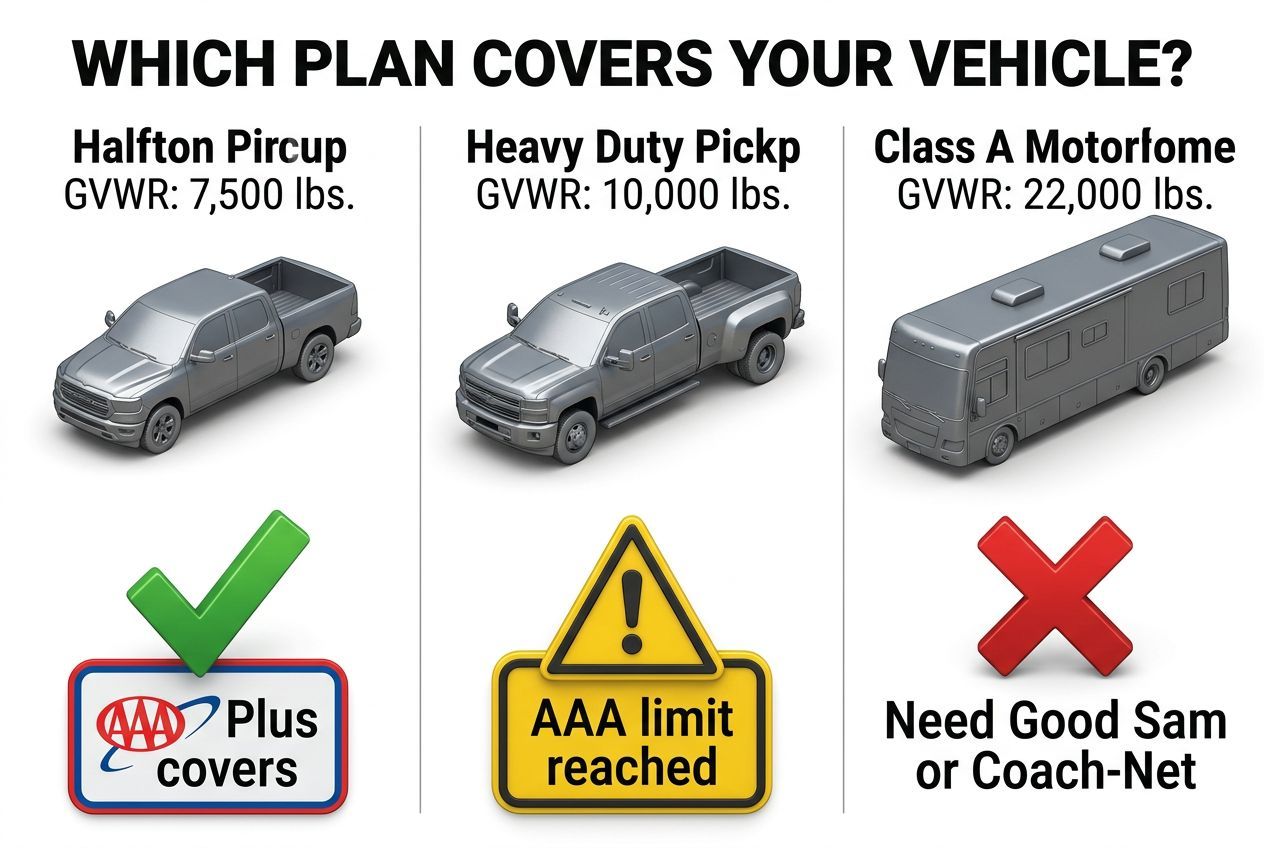
- Vehicles over 10,000 lbs GVWR or with dual rear wheels.
- Service calls beyond 2–3 per policy year.
- Towing to a facility more than 15–25 miles away.
In contrast, motor club plans like AAA, Good Sam, and Better World Club typically allow 4+ service calls per year and cover the member in any vehicle, including rentals and borrowed cars. For a full comparison, refer to insurance roadside vs AAA.
📋
ROADSIDE ASSISTANCE
Which Roadside Assistance Plan Is Best for Truck Owners and RVs?
For truck owners in 2026, specialized roadside assistance is essential. Good Sam Roadside Assistance is ideal for RV and trailer coverage, while AAA Premier or Coach-Net are strong choices for heavy-duty pickup trucks. Standard plans frequently exclude vehicles over 10,000 lbs GVWR or impose surcharges on dual-rear-wheel pickups. Good Sam covers RVs of any length for approximately $114/year, and Coach-Net offers unlimited towing distance for enrolled RVs—a critical advantage given the specialized nature and dispersed locations of large-vehicle repair facilities.
The challenge for heavy-duty vehicle owners: A 2022 Ford F-350 Super Duty with a camper package (8,800 lbs empty) and a loaded fifth-wheel trailer (13,500 lbs) combines for 22,300 lbs. If this rig breaks down 60 miles from a heavy-duty Ford dealer, standard plans might deny the claim or charge hefty surcharges (e.g., $4.50/mile for 60 miles = $270, plus a $75 dually surcharge). This could leave you $345 out-of-pocket before repairs even start.
Good Sam Roadside Assistance Platinum ($114/year) specifically addresses these needs.
- Covers both the RV and the tow vehicle.
- Provides up to 100 miles of towing.
- Offers unlimited service calls.
- Transports both units if your truck fails while towing, preventing your trailer from being stranded.
- Includes RV-specific services like tire changes for dual-axle trailers, locksmith services for RV entry doors, and fuel delivery for diesel Class A motorhomes.
Coach-Net elevates coverage with unlimited towing distance for enrolled RVs. Annual membership costs $179 for motorhomes and $139 for towable RVs. This unlimited towing is invaluable, especially in Western states where RV-certified repair facilities can be 150+ miles apart. For example, an engine problem in rural Utah might necessitate a 220-mile tow to Salt Lake City, a $900+ expense fully covered by Coach-Net.
AAA Premier ($164/year) expanded its coverage in 2024 to include one-ton trucks (Ford F-350/450, Chevy 3500HD, RAM 3500). However, it excludes commercial trucks and any vehicle towing a trailer over 10,000 lbs at the time of breakdown. For active towers, AAA will transport your truck but not the trailer unless separate RV coverage is purchased, making it less convenient than Good Sam.
For truck owners who don't regularly tow RVs but drive heavy-duty pickups for work, Better World Club ($79/year) covers vehicles up to one ton with 100-mile towing. They also offer a Hybrid Add-On plan ($99/year) that guarantees flatbed-only towing for electric and hybrid vehicles, protecting their battery systems—a crucial consideration for owners of Ford F-150 Lightning or Chevy Silverado EV.
Motorcycle and ATV riders require specialized coverage. American Motorcyclist Association (AMA) roadside assistance costs $79/year and includes transport to your home or campsite, rather than just the nearest shop. This is vital when you're far from home on a weekend ride and local dealerships are closed.
The rise of electric trucks (F-150 Lightning, Rivian R1T, Silverado EV) has created a new coverage gap: many flatbed tow operators refuse to transport EVs on wheel-lift equipment due to the risk of drivetrain damage. While AAA's network adopted flatbed-only protocols for EVs in 2025, availability remains limited in rural areas. Our guide on towing electric vehicles provides more information on plans that guarantee flatbed transport for EVs.
⚠️ Warning: Be aware of hidden weight-based surcharges. Many plans claiming to cover "all passenger vehicles" will charge $50–$150 extra for dual rear wheels, lifted trucks, vehicles with aftermarket bumpers blocking tow hooks, or any truck actively towing a trailer. Good Sam and Coach-Net typically include these scenarios in their base pricing for personal (non-commercial) use.
⚙️
ROADSIDE ASSISTANCE
Can I Use Roadside Assistance From My Car Insurance Instead of a Separate Plan?
Yes, most major auto insurers—including GEICO, Progressive, State Farm, and Allstate—offer roadside assistance add-ons for $10–$36/year, making them the most affordable option. However, insurance-based roadside typically:
- Caps towing at 15–25 miles.
- Limits service calls to 2–3 per year.
- May occasionally affect your loss history if you file multiple claims.
For drivers who rarely need service and remain within urban areas, insurance-bundled roadside is usually sufficient. Frequent travelers and rural drivers, however, often benefit more from dedicated motor club plans.
GEICO's roadside assistance costs approximately $14/year ($12 per 6-month policy) and covers up to $100 per service call, equating to about 15–20 miles of towing. This is adequate for short urban tows but insufficient for longer distances, where you'd pay $60–$80 out-of-pocket for overage fees on a 40-mile tow.
Progressive charges $18/year for its roadside coverage, also with a 15-mile towing limit. State Farm's Motor Club tier costs $25/year and provides the longest limit among insurance-bundled options at 25 miles. Allstate's add-on is $36/year, bridging the gap between insurance bundles and entry-level motor clubs like AAA Classic.
⚠️ Warning: While most insurers classify roadside claims as non-fault, a 2025 Consumer Reports analysis revealed that 8% of drivers reported premium increases averaging $47/year after filing two or more roadside claims, potentially negating the bundled coverage's cost savings.
USAA (exclusive to military members, veterans, and their families) offers a robust insurance-bundled roadside plan at $16/year, featuring 25-mile towing and four service calls annually. USAA explicitly guarantees that roadside claims will not affect rates or policy eligibility, making it a superior choice for eligible drivers unless AAA's discount network is a priority. For a deeper breakdown of how USAA roadside stacks up against AAA across all tiers, see our AAA vs USAA roadside comparison.
Service call limits are another restriction. GEICO allows unlimited roadside calls, but State Farm limits members to three calls per 12-month period. Exceeding this limit means paying full market rates for subsequent calls, which can be $150–$300 for a tow. Motor clubs like AAA and Good Sam generally allow 4–6 calls per year without overage fees.
Insurance-bundled roadside also restricts coverage to the insured vehicle. This means if you drive a different car, the coverage doesn't apply. AAA and Better World Club, however, cover the member in any vehicle, including rentals and borrowed cars, which is a notable advantage for multi-car households.
Wait times for insurance-bundled roadside are comparable to traditional motor clubs. Providers like Progressive and GEICO use the same national towing networks (e.g., Agero, Road America) as AAA. The main difference is often transparency; motor club apps typically show real-time truck locations, while insurance apps may provide less precise "60–90 minute" estimates.
💡 Key Takeaway: For urban drivers with short commutes and minimal travel outside metro areas, insurance-bundled roadside at $14–$36/year is an optimal, cost-saving choice. For rural drivers or frequent highway travelers, the added peace of mind from a $110 AAA Plus membership is often worth the extra cost. Our comparison in roadside assistance cost offers breakeven calculators for various household types.
🚛
ROADSIDE ASSISTANCE
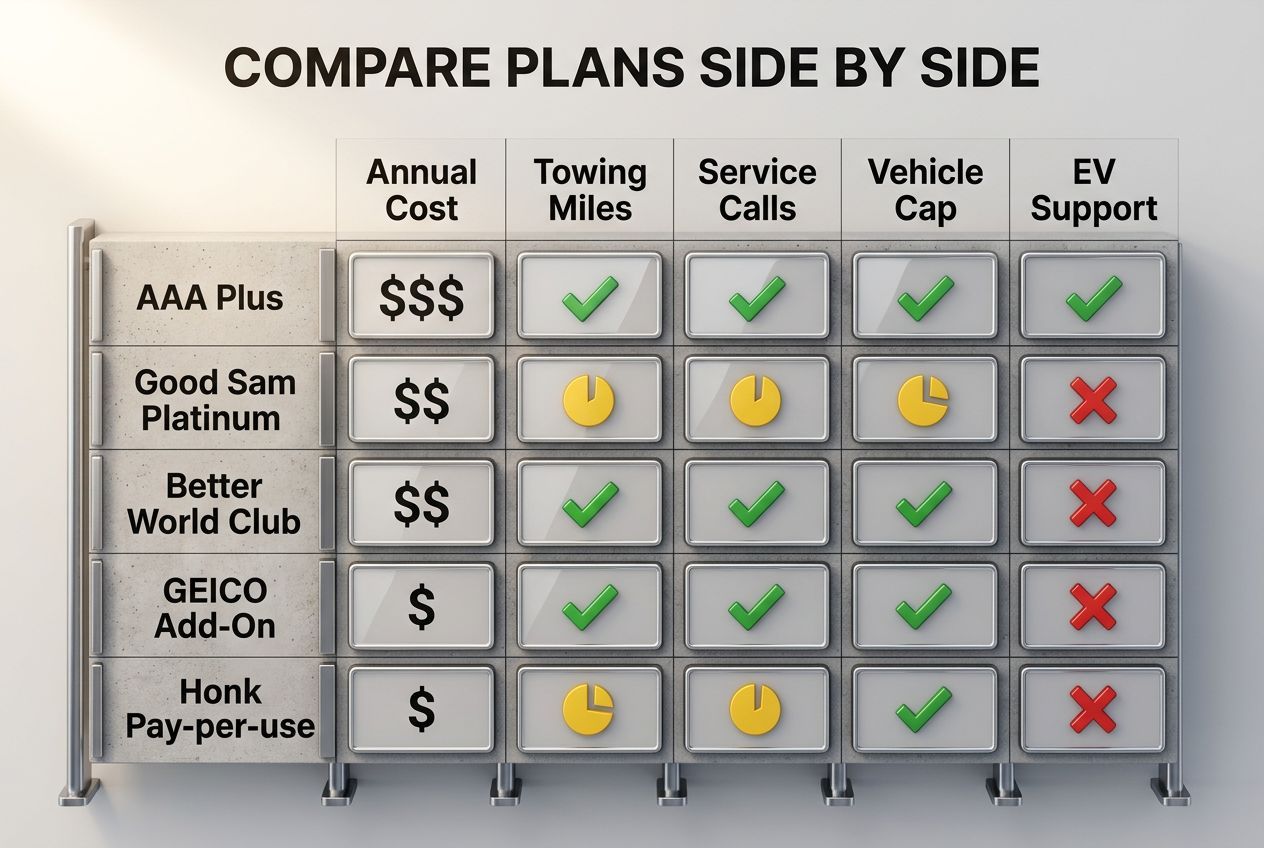
How Do I Compare Roadside Assistance Plans Side by Side?
To effectively compare roadside assistance plans, evaluate seven key factors: annual cost, towing distance limit, number of service calls per year, vehicle weight/type restrictions, average dispatch wait time, additional member benefits, and whether coverage follows the member or the vehicle. Our interactive roadside assistance comparison tool, mentioned below, can help you input your vehicle type, annual mileage, and location to receive a personalized ranking.
Start by prioritizing towing distance, as it's the most expensive service to pay for out-of-pocket.
- Calculate average distance: Use Google Maps to measure the typical distance from your home and frequent routes to the nearest:
- Dealership for your vehicle's make (for warranty work).
- Independent shop with ASE-certified mechanics.
- Tire shop that stocks your specific tire size (especially critical for trucks).
- Determine adequacy: If this average distance exceeds 15 miles, insurance-bundled roadside is likely inadequate, and you'll need a motor club plan offering 50–100 mile towing.
Next, review your historical service calls. Check your records for the past three years: how many times did you need a jump start, tire change, lockout, or tow?
- Zero or one call: Pay-per-use apps like Honk or Urgently will likely save you money compared to annual memberships.
- Three or more calls: A motor club membership will be more economical.
- Two calls over three years: You're at the breakeven point where either option could work.
Vehicle restrictions are crucial for truck and RV owners. Download and review the coverage agreement PDF from each provider. Search for exclusion terms such as:
- "10,000 lbs GVWR or less"
- "excludes dual rear wheels" or "dually surcharge applies"
- "commercial use vehicles excluded"
- "towing while under tow excluded"
If you find any of these, consider specialized providers like Good Sam or Coach-Net.
Wait time data is often anecdotal but insightful. While providers don't publish average response times, user reviews on platforms like Reddit and automotive forums suggest:
- AAA urban wait time: 35–50 minutes
- GEICO insurance roadside: 40–55 minutes
- Honk app-based: 25–40 minutes
- Rural areas (any provider): 75–120 minutes
App-based services tend to be faster in cities due to real-time GPS routing and direct contractor dispatch, bypassing regional call centers.
Evaluate additional member benefits beyond just roadside service.
- AAA's discount network: Saved active users an average of $427/year in 2025.
- Consider your usage: Do you stay at chain hotels 4+ nights/year? Rent cars frequently? Visit theme parks? If you answered yes to two or more questions, AAA's membership might pay for itself through discounts alone, making the roadside coverage effectively free. If not, insurance-bundled roadside might be a better fit.
The final deciding factor is whether coverage follows the member or the vehicle.
- Insurance plans: Typically cover only the insured vehicle, requiring separate add-ons for multiple cars.
- Motor clubs: Cover the member in any vehicle—one membership can cover your sedan, your spouse's SUV, and any rental car you drive.
The comparison tool mentioned earlier precisely weights these seven factors based on your inputs (vehicle type, annual mileage, and ZIP code). It cross-references towing distances to local repair facilities using extensive business location databases, providing a ranked list of the best plans for your specific situation. Recommendations for a driver in Omaha will differ significantly from those for a driver in Bozeman due to variations in infrastructure density.
For those regularly towing an RV or boat, also consult our guide to RV towing for specialized considerations like propane delivery and RV appliance assistance.
📝
ROADSIDE ASSISTANCE
What Happens If You Break Down Without Roadside Assistance?
If your car breaks down without roadside assistance, you will pay market rates for services. This typically means $109–$300 for a tow (depending on distance), $50–$100 for a jump start or tire change, and $75–$150 for lockout service. These costs can easily double in rural areas or during peak demand periods like evenings, weekends, and holidays. Your alternative is to call a local towing company directly, negotiate the price upfront, and pay on-site with cash or card. For a detailed guide on your options, see car broke down no AAA.
Pay-per-use apps like Honk, Urgently, and HONK offer on-demand service without membership fees. You enter your location and service need in the app, receive a fixed-price quote ($49–$150 depending on service and location), and dispatch confirms arrival time (typically 25–50 minutes in metro areas). Payment is processed securely through the app.
💡 Key Takeaway: Pay-per-use apps are cost-effective for one-time breakdowns. However, if you need service twice in one year, the math shifts: two $85 tows through Honk ($170) would cost more than a $110/year AAA Plus membership, which includes four service calls. The breakeven point is roughly 1.5 service calls per year.
Some credit cards include roadside assistance as a benefit. Cards like Chase Sapphire Reserve, American Express Platinum, and Citi Prestige offer 3–4 service calls per year with $50–$100 reimbursement per incident. You typically pay the tow company upfront, then submit a claim for a statement credit. This requires you to front the cash, which might not be feasible for a large tow bill if you have limited credit.
Calling a local towing company directly allows you to shop for quotes. Search "towing near me," call several companies, provide your location and destination, and ask for their base fee and per-mile rate before committing. Rates can vary significantly between providers.
If your breakdown occurs on a limited-access highway (interstate or turnpike), your options might be restricted. Many states contract with specific towing companies for highway calls, and these contractors may charge state-approved rates that are 20–40% higher than market rates due to hazard premiums.
Manufacturer roadside programs can also be an option if your vehicle is still under warranty or you have an extended service contract. Brands like Ford, Chevrolet, and Toyota typically include 3–5 years of complimentary roadside assistance with new vehicle purchases. This coverage often mirrors AAA Basic, providing 5–10 mile towing, jump starts, and flat tire changes, expiring with the warranty. For more information, see manufacturer roadside assistance programs.
For truck owners and RV travelers, breaking down without specialized coverage can lead to very expensive situations. A flatbed tow for a dually pickup can cost $225–$400 for 50 miles. A motorhome tow, requiring a heavy-duty wrecker, might range from $500–$1,200 depending on size and distance, far exceeding standard passenger car rates.
💰
ROADSIDE ASSISTANCE
Are Roadside Assistance Apps Faster Than Traditional Motor Clubs?
Roadside assistance apps like Honk, Urgently, and Allstate Digital Lounge typically dispatch service 20–40% faster than traditional motor clubs in urban areas. This speed advantage comes from their ability to directly connect you with the nearest available contractor via real-time GPS routing. Average wait times are generally 25–40 minutes for app-based services versus 35–50 minutes for AAA or insurance-bundled roadside in cities with populations over 250,000. In rural regions, where both systems rely on the same limited contractor networks, wait times tend to equalize at 75–120 minutes.
📊 Quick Fact: App-based roadside assistance services can be 20-40% faster in urban areas, with average wait times of 25-40 minutes compared to 35-50 minutes for traditional motor clubs.
The primary reason for this speed difference is the elimination of the call center layer. When you request service through an app, the platform instantly geo-locates your position, identifies available contractors nearby, and assigns the job to the soonest arriver. You receive driver details and estimated arrival time within seconds. Traditional motor clubs, however, route requests through regional dispatch centers, adding 5–10 minutes to the dispatch process due to verification and manual communication between caller, dispatcher, and driver. While this gap is relatively small for metro drivers, the personalized phone support and 24/7 live agents offered by traditional motor clubs remain valuable, especially in situations where an app fails or cell signal is lost. For a deeper review of which roadside assistance apps handle dispatch, pricing transparency, and rural coverage best, see our standalone guide.

