💡 Key Takeaway: The 5.7L V8 with Tow Package and 4x2 drivetrain hits the peak 10,500-lb rating; 4x4 and CrewMax models sit lower due to added curb weight. The 4.6L V8 is capped at 6,800 lbs.
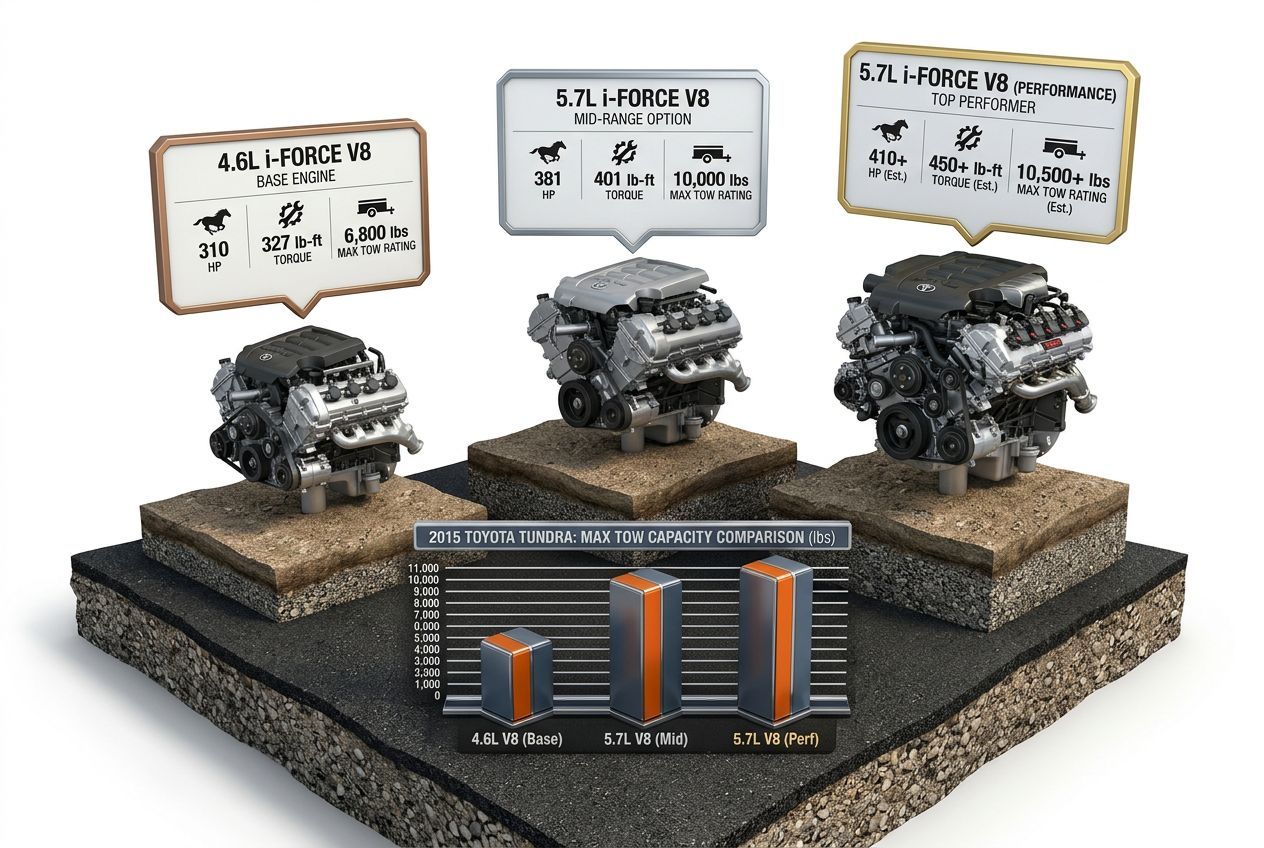
The 2015 Toyota Tundra towing capacity maxes out at 10,500 pounds when equipped with the 5.7L i-FORCE V8, a 4x2 drivetrain, and the factory Tow Package. Models with the 4.6L V8 are rated at 6,800 pounds. Configuration — cab style, bed length, and drivetrain — determines where your specific truck lands.
In This Article
💰
TRUCK TOWING CAPACITY
What Is the 2015 Tundra Towing Capacity?
Engine Options and Their Capabilities: The 2015 Toyota Tundra towing capacity spans 6,800 to 10,500 pounds across its two available engines and multiple configurations.
- 5.7L i-FORCE V8: This engine produces 381 horsepower and 401 lb-ft of torque. When properly equipped, trucks with this engine can achieve the maximum 10,500 lbs towing capacity.
- 4.6L i-FORCE V8: Available only on SR and SR5 trims, this engine produces 310 hp and 327 lb-ft of torque. It caps conventional towing at 6,800 lbs.
Use our towing capacity lookup tool to verify your exact VIN-level specs before you hook up anything heavy.
Try Our Free Truck Towing Capacity Lookup
Transmission and Standards: Both engines route power through a reliable 6-speed automatic transmission. According to Toyota's published towing guides at toyota.com, these ratings are achieved under SAE J2807 towing standards — the same benchmark used across the industry for apples-to-apples comparisons.

📊
TRUCK TOWING CAPACITY
How Much Can a 2015 Tundra With the 5.7L V8 Tow?
Range of Capacity: The 2015 Tundra 5.7L V8 supports towing capacities from 9,000 to 10,500 pounds. This range is influenced by factors such as cab style, drivetrain, and the presence of the factory Tow Package.
Achieving Max Capacity: Regular Cab and Double Cab 4x2 models, when equipped with the Tow Package, are capable of reaching the full 10,500-lb ceiling.
Impact of Configuration: CrewMax 4x4 configurations will typically see their towing capacity drop toward the lower end of that range, closer to 9,000 lbs. This reduction is primarily because the added drivetrain hardware and larger cab contribute to a higher curb weight, which in turn reduces the available headroom within the Gross Combined Weight Rating (GCWR).
📊 Quick Fact: The 2015 Tundra's 5.7L models typically have a Gross Combined Weight Rating (GCWR) of approximately 16,000 lbs.
Understanding GCWR: To calculate your potential trailer weight, you subtract the truck's curb weight from the GCWR. The curb weight for 5.7L models ranges from roughly 5,285 lbs (Regular Cab 4x2) to 5,880 lbs (CrewMax 4x4). This calculation directly explains the variation in towing capacities across different Tundra configurations.
For broader context on how full-size half-tons stack up, see our half-ton truck towing capacity guide.
🔧
TRUCK TOWING CAPACITY
What Is the Towing Capacity of the 2015 Tundra With the 4.6L V8?
Fixed Rating: The 2015 Tundra with the 4.6L V8 is rated at a maximum of 6,800 pounds for conventional towing. This represents a significant difference compared to the 5.7L V8.
Suitable Applications: With 310 hp and 327 lb-ft of torque, the 4.6L engine is well-suited for lighter towing tasks, such as single-axle boat trailers, small campers, and utility trailers. It handles these loads comfortably.
⚠️ Warning: A 26-foot travel trailer, which often weighs between 6,500–7,500 lbs when loaded, is typically outside the safe and comfortable towing range for the 4.6L engine. Exceeding this limit can strain the vehicle and compromise safety.
Trim and Configuration Availability: The 4.6L engine was exclusively available in SR and SR5 trims, and only in specific cab and bed configurations. If you are considering a used 2015 Tundra for towing, it's crucial to confirm the engine type before purchase. The VIN decoder at NHTSA.gov can accurately tell you what's under the hood.
🛡️
TRUCK TOWING CAPACITY
Does the 2015 Tundra Need a Tow Package to Reach Max Capacity?
Essential for Max Rating: Yes, the factory Tow Package is absolutely required for the 2015 Tundra to achieve its 10,500-lb maximum towing capacity rating. This package isn't just about the hitch; it includes several critical infrastructure upgrades.
Components of the Factory Tow Package: The Toyota Tow Package adds several key components designed to enhance towing performance and safety:
- A dedicated tow-hitch receiver
- 4-pin and 7-pin electrical connectors for trailer lights and brakes
- A supplemental transmission oil cooler to prevent overheating
- A heavy-duty battery for increased electrical demand
- A 130-amp alternator to support trailer charging and accessories
These components are integral to the load-tested and published towing rating. Without them, the stated maximum capacity does not apply.
Towing Without the Package: If the Tow Package is absent, the real-world safe towing capacity typically decreases by 1,000–1,500 lbs. This is because the transmission is prone to running hotter, and the electrical system may struggle to simultaneously power trailer brakes, lighting, and battery charging during extended towing.
✅ Pro Tip: When buying a used 2015 Tundra, always check the driver's side B-pillar door-jamb sticker for the official Gross Vehicle Weight Rating (GVWR) and payload capacity. Additionally, verify the Tow Package (Toyota option code PT228) was either factory-installed or properly dealer-added. A quick visual check for a round 7-pin connector behind the bumper confirms the full wiring harness is present; a flat 4-pin only usually indicates the full package is not installed.
2015 Tundra Towing Capacity by Trim, Cab & Engine
Here's the full breakdown across configurations. Note that these figures reflect Toyota's published specs and assume the factory Tow Package is installed on 5.7L models where indicated.
| Configuration | Engine | Drivetrain | Max Tow (lbs) | Max Payload (lbs) |
|---|---|---|---|---|
| SR / SR5 — Regular Cab | 5.7L V8 + Tow Pkg | 4x2 | 10,500 | ~2,080 |
| SR / SR5 — Regular Cab | 4.6L V8 | 4x2 | 6,800 | ~1,985 |
| SR5 / Limited — Double Cab | 5.7L V8 + Tow Pkg | 4x2 | 10,500 | ~1,730 |
| SR5 / Limited — Double Cab | 5.7L V8 + Tow Pkg | 4x4 | 9,900 | ~1,635 |
| 1794 / Platinum / TRD Pro — CrewMax | 5.7L V8 + Tow Pkg | 4x2 | 10,000 | ~1,635 |
| 1794 / Platinum / TRD Pro — CrewMax | 5.7L V8 + Tow Pkg | 4x4 | 9,000 | ~1,440 |
Source: Toyota Motor Corporation towing guide (toyota.com), NHTSA vehicle database (nhtsa.gov). Payload figures are representative maximums — always verify your door-jamb sticker for the actual number on your specific truck.

⚙️
TRUCK TOWING CAPACITY
What Is the Payload Capacity of a 2015 Toyota Tundra?
Payload Range: The 2015 Tundra's payload capacity varies significantly, ranging from approximately 1,440 to 2,080 pounds.
- Highest Payload: The maximum payload capacity is found in the lightest configuration, specifically the SR Regular Cab 4x2 equipped with the 5.7L engine.
- Lowest Payload: Conversely, the lowest payload capacity is attributed to the heaviest configuration, such as a CrewMax 4x4 model.
Interrelation with Towing: Payload and towing capacity are intrinsically linked. Every pound added to your truck, whether it's passengers, cargo, or tongue weight from a trailer, directly reduces your available payload.
Real-World Scenario: Consider this example:
- Trailer Weight: You are towing a 20-foot travel trailer with a loaded weight of 8,500 lbs.
- Tongue Weight: At a conservative 12% tongue weight, this equates to 1,020 lbs pressing down on your hitch ball.
- Occupants & Gear: Add yourself (e.g., 195 lbs), a passenger (e.g., 155 lbs), and 150 lbs of miscellaneous gear, water, and a full tank of fuel.
- Total Consumed Payload: This totals roughly 1,520 lbs of payload consumed.
If you're using a CrewMax 4x4 model, which might have a payload rating as low as 1,440 lbs, you would already be over your legal payload limit in this scenario. This highlights why understanding and monitoring your payload is as crucial as knowing your maximum tow rating.
Our towing capacity vs. payload guide explains how these two numbers interact — a worthwhile read before you shop for a trailer.
🚛
TRUCK TOWING CAPACITY
How Does the 2015 Tundra Compare to the 2015 F-150 for Towing?
Peak Towing Capacity Comparison: The 2015 Ford F-150 generally surpasses the 2015 Tundra in peak towing capacity.
- F-150 Max: The 2015 F-150, particularly with its 3.5L EcoBoost engine, can achieve up to 12,200 lbs.
- Tundra Max: The Tundra's maximum rating is 10,500 lbs.
This 1,700-lb difference can be a deciding factor if your loaded trailer consistently weighs between 11,000–12,000 lbs. In terms of raw numbers, the F-150 holds an advantage.
Platform and Durability Considerations: However, the comparison is not solely about maximum numbers:
- 2015 F-150: This model year marked the debut of the F-150's aluminum-alloy body. While this contributed to its lighter weight and higher ratings, it introduced new variables for used buyers today, such as potential repair costs and corrosion behavior specific to aluminum.
- 2015 Tundra: The Tundra utilizes a conventional steel body and a fully boxed ladder frame, a design Toyota carried over from a previous generation (2014 refresh). This architecture has a strong record for durability and reliability. According to Edmunds, the 2014–2021 Tundra consistently ranks among the most reliable full-size trucks in long-term ownership surveys.
Engine Performance Under Load: For buyers who regularly tow in the 8,000–10,000-lb range, the Tundra's naturally aspirated 5.7L V8 offers consistent pulling power. It typically performs without the heat sensitivity that turbocharged engines can sometimes exhibit on sustained grades.
For a more granular comparison, see our full F-150 towing capacity breakdown and the dedicated 2015 F-150 towing capacity article.

📝
TRUCK TOWING CAPACITY
Can a 2015 Tundra Tow a Fifth-Wheel or Gooseneck Trailer?
Within Limits, With Caveats: The 2015 Tundra can technically tow certain fifth-wheel and gooseneck trailers, but it must remain strictly within its 10,500-lb conventional tow limit. There's also a crucial caveat: Toyota did not offer a factory fifth-wheel or gooseneck hitch receiver for the 2015 Tundra.
Aftermarket Solutions Required: To tow these types of trailers, you would need to install an aftermarket kit from reputable brands like B&W Turnoverball or Reese. This installation involves securely anchoring the hitch into the truck's bed and frame.
The Pin Weight Challenge: The primary limitation for fifth-wheel and gooseneck towing with a half-ton like the Tundra is pin weight.
- Fifth-wheel trailers typically transfer 15–25% of their gross weight directly to the truck's bed via the kingpin.
- For a 9,000-lb fifth-wheel, this translates to 1,350–2,250 lbs landing in your truck's bed. This amount directly consumes your payload capacity.
⚠️ Warning: A CrewMax 4x4 Tundra, with its approximate 1,440-lb payload rating, cannot safely handle a 9,000-lb fifth-wheel if it exerts a 20% pin weight (1,800 lbs). The math simply doesn't allow for safe operation.
Recommendation for Heavy Hauling: If you regularly plan to tow fifth-wheels weighing above 8,000 lbs, a 3/4-ton platform, such as the Chevrolet Silverado 2500HD or RAM 2500, would be a much more appropriate and safer match. While the 2015 Tundra is a capable half-ton truck, it is not designed for heavy-duty fifth-wheel or gooseneck applications beyond its conventional limits.
Our Toyota Tundra towing capacity hub covers how the platform evolved across model years if you want to compare options.
💰
TRUCK TOWING CAPACITY
Altitude and Load: Two Things That Change Your Real-World Numbers
Impact of Altitude on Naturally Aspirated Engines: The 2015 Tundra's 5.7L i-FORCE V8 is a naturally aspirated engine, meaning it relies on ambient air pressure for combustion. This characteristic makes it susceptible to power loss at higher elevations.
📊 Quick Fact: Naturally aspirated engines typically lose approximately 3% of their power per 1,000 feet above sea level.
Real-World Example: If you're towing at 7,000 feet (common in mountain passes across states like Colorado, Wyoming, or Utah), your engine will be producing about 15–18% less output than its sea-level rating. Towing a 10,500-lb trailer on flat terrain in Texas is a vastly different task than pulling 8,500 lbs up a 6% grade at 6,000 feet.
Planning for High Elevation Towing:
- Capacity Buffer: If your towing routes frequently involve high elevations, it's prudent to leave a 15–20% buffer between your actual trailer weight and the Tundra's maximum rating.
- Performance Benefits: This buffer will help you maintain better speed control, keep transmission temperatures lower, and provide your brakes with a better chance on descents.
Trailer Braking: Speaking of brakes, if your trailer weighs over 3,000 lbs, it is legally and safely imperative to ensure it has electric brakes. Furthermore, confirm that your Tundra's brake controller is properly calibrated.
✅ Pro Tip: The FMCSA guidelines for commercial trailers offer valuable reference points. Even for recreational towing, proper brake proportionality is a critical safety factor that is often overlooked.
For year-specific comparisons within the Tundra lineup, check our 2016 Toyota Tundra towing capacity and 2017 Toyota Tundra towing capacity articles — the platform changed minimally across those years, so the data is a useful cross-reference.
Sources & Methodology
- 1.Toyota Motor Corporation — 2015 Tundra Trailer Towing Guide and owner's manual towing supplement, accessed via toyota.com. Primary source for all towing and payload ratings.
- 2.NHTSA Vehicle Database — Vehicle safety ratings, GVWR, and VIN-level specification data, accessed via nhtsa.gov. Used to verify curb weight and GVWR figures across configurations.
- 3.Edmunds — 2015 Toyota Tundra long-term reliability data and owner reviews, accessed via edmunds.com. Referenced for reliability context in competitive comparison.
- 4.SAE International J2807 Standard — Industry-standard towing test methodology. Toyota adopted J2807 compliance for the 2014 Tundra redesign and forward.
- 5.FMCSA — Federal Motor Carrier Safety Administration guidelines for trailer braking and weight distribution, referenced for safety context at fmcsa.dot.gov.
Methodology: Towing and payload figures in this article are drawn from Toyota's published specs for the 2015 model year. Payload figures shown in the table are representative maximums for each configuration class — the precise number for any individual truck appears on the driver's side door-jamb sticker and may vary by up to 100–150 lbs based on installed options.
TowingServiceHub is reader-supported: we may earn money from ads and from some links on this page. See our editorial policy.

Mark
Founder & Editor
Mark is the founder and editor of TowingServiceHub, which he launched in 2026 after struggling to find clearly sourced towing costs and truck specs. He works in enterprise technology and tows his own boats, trailers, and equipment, so he knows the questions drivers actually ask.
Read full bio →Need a tow truck right now?
Browse vetted local providers in your area. Real Google ratings, verified business info, free to use.
Or browse all 50 states from our directory
Frequently Asked Questions
Maximum Capacity: The 2015 Toyota Tundra max towing capacity is 10,500 pounds. This is achieved specifically with the 5.7L V8 engine, 4x2 drivetrain, and the factory Tow Package. CrewMax 4x4 models with the same engine typically have a lower rating, dropping to around 9,000 lbs. The 4.6L V8 engine is consistently capped at 6,800 lbs, regardless of the trim or configuration.
Trim vs. Configuration: No, the 2015 Tundra SR5 and Limited trim levels do not inherently have different tow ratings. Towing capacities are determined by the specific combination of engine, cab style, bed length, and drivetrain. Therefore, an SR5 Double Cab 4x2 with the 5.7L V8 and Tow Package will have the same 10,500-lb rating as a Limited Double Cab 4x2 with the identical setup. Trim level primarily influences interior features and aesthetics, not fundamental towing capability.
Recommended Range: Toyota recommends maintaining a tongue weight between 10–15% of the gross trailer weight for the 2015 Tundra. * At Max Towing: For the maximum 10,500-lb towing capacity, this translates to a tongue weight range of 1,050–1,575 lbs. * Payload Consideration: It's crucial to remember that this entire tongue weight amount counts directly against your truck's available payload rating. Always monitor both your tongue weight and remaining payload simultaneously to ensure safe operation.
Depends on Weight: Whether a 2015 Tundra can tow a 30-foot travel trailer depends heavily on the trailer's loaded weight. Many 30-foot travel trailers commonly weigh between 7,000–9,500 lbs when fully loaded. * Lower End: A properly equipped 2015 Tundra with the 5.7L 4x2 engine can typically handle the lower end of this weight range. * Higher End: However, if the trailer approaches 9,500 lbs or more, you are nearing the Tundra's maximum capacity. In such cases, it's essential to meticulously confirm all weights (trailer, tongue, and truck payload) and carefully consider if a heavier-duty towing platform would be more appropriate for safety and comfort.
Platform Consistency: Yes, the 2015 and 2016 Toyota Tundra models share the same underlying platform and powertrain. Consequently, their conventional towing ratings are essentially identical across equivalent configurations. Any minor discrepancies would typically be negligible and related to slight variations in curb weight due to specific optional equipment.
