📊
TRUCK TOWING CAPACITY
How Much Can a 2016 Tundra With the 5.7L V8 Tow?
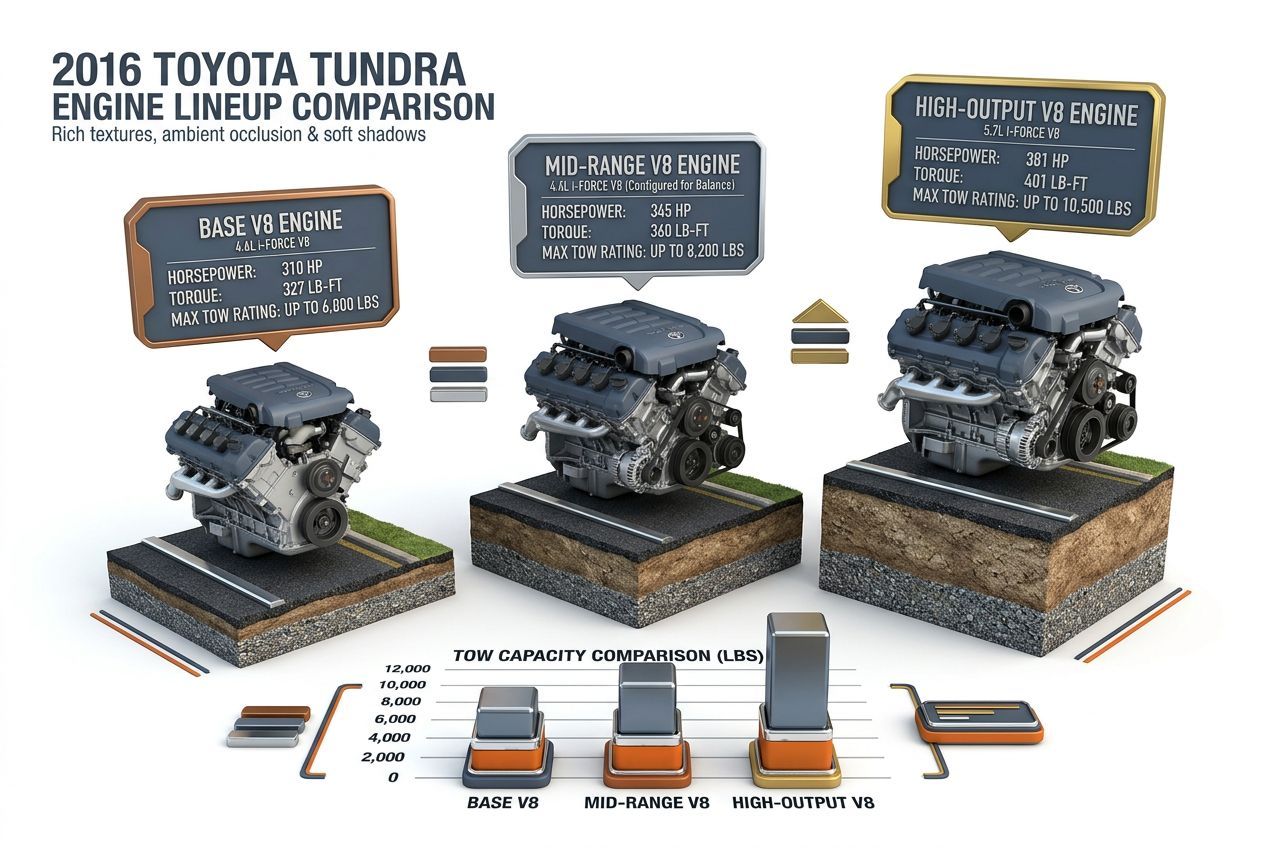
Max towing capacity: The 2016 Tundra 5.7L V8 towing capacity ranges from 9,800 to 10,500 lbs depending on cab style, bed length, and drivetrain. For maximum towing, the 4.30 rear axle ratio is the configuration to choose — it's what gets you to that 10,500-lb ceiling.
5.7L Engine Specifications
- Engine: 5.7L i-FORCE V8
- Horsepower: 381 hp
- Torque: 401 lb-ft
- Transmission: 6-speed automatic (AB60F)
- Rear Axle Ratio: 4.30 (for max towing)
Factors Affecting 5.7L Towing Capacity
Configuration matters: The Regular Cab and Double Cab 4x2 models with the short bed and 4.30 axle ratio hit the peak rating. CrewMax models rate slightly lower — typically 10,100 to 10,200 lbs — because the longer wheelbase and heavier cab add curb weight. The 4x4 variants with the 5.7L drop to 10,100–10,400 lbs depending on configuration.
📊 Quick Fact: The 5.7L in the 2016 Tundra uses a dual independent Variable Valve Timing with intelligence (VVT-i) system, known as Dual VVT-i. This engine, also found in the Sequoia and Land Cruiser, has a strong track record of reliability under sustained tow loads. Its broad torque curve (peak torque available from 3,400 rpm) is key to the Tundra's towing performance.
For a full look at how the 5.7L performs across model years, see our complete Toyota Tundra towing capacity guide.
🔧
TRUCK TOWING CAPACITY
What Is the Towing Capacity of the 2016 Tundra 4.6L V8?
Towing limits: The 2016 Tundra 4.6L V8 towing capacity tops out at 6,800 lbs in 4x2 form and 6,400 lbs with 4x4. This is the base engine option.
4.6L Engine Specifications
- Engine: 4.6L V8 (1UR-FE)
- Horsepower: 310 hp
- Torque: 327 lb-ft
- Transmission: 6-speed automatic (same as 5.7L)
- Rear Axle Ratio: 3.91
Towing Suitability of the 4.6L V8
Ideal for lighter loads: If you're towing a mid-size aluminum fishing boat around 3,500 lbs, a cargo trailer under 6,000 lbs, or a small camper in the 5,000-lb range, this engine handles it without strain. However, if you're eyeing a bumper-pull travel trailer in the 7,000–9,000-lb range, you'll want to step up to the 5.7L. The 4.6L is available only on the SR and SR5 trims.
✅ Pro Tip: Be aware that the 4.6L's tow package availability differs slightly. Some 4.6L SR configurations may not include the supplemental transmission cooler as standard equipment. This is a critical component if you plan to consistently tow near the 6,800-lb ceiling, especially on hilly routes.
🛡️
TRUCK TOWING CAPACITY
Does the 2016 Tundra Towing Capacity Change by Trim Level?
Trim levels impact towing capacity, not because Toyota engineered separate ratings for each badge, but because trim level dictates which engine and equipment come standard, and higher luxury trims carry more curb weight. The SR and SR5 offer both the 4.6L and 5.7L V8. The Limited, Platinum, TRD Pro, and 1794 Edition all come standard with the 5.7L, but their higher curb weights trim the towing ceiling by 100–400 lbs compared to a base 5.7L Regular Cab.
Here's the full breakdown by engine and drivetrain:
Does the 2016 Tundra Towing Capacity Change by Trim Level? — data table
| Configuration |
Engine |
Drivetrain |
Max Tow Rating |
Source |
| Regular Cab / Double Cab |
5.7L V8 |
4x2 |
10,500 lbs |
Toyota Towing Guide |
| Double Cab / CrewMax |
5.7L V8 |
4x4 |
10,100–10,400 lbs |
Toyota Towing Guide |
| CrewMax |
5.7L V8 |
4x2 |
10,200 lbs |
Toyota Towing Guide |
| Regular Cab / Double Cab |
4.6L V8 |
4x2 |
6,800 lbs |
Toyota Towing Guide |
| Double Cab / CrewMax |
4.6L V8 |
4x4 |
6,400 lbs |
Toyota Towing Guide |
Source: Toyota 2016 Tundra Trailer Towing Guide, published by Toyota Motor North America.
💡 Key Takeaway: The TRD Pro is 4x4 only, placing it in the 10,100–10,400-lb range with the 5.7L. While capable, it does not achieve the absolute peak towing numbers due to its standard 4x4 drivetrain and specific trim features.
You can compare this against similar-era trucks in our half-ton truck towing capacity roundup.
📋
TRUCK TOWING CAPACITY
What Tow Package Came on the 2016 Toyota Tundra?
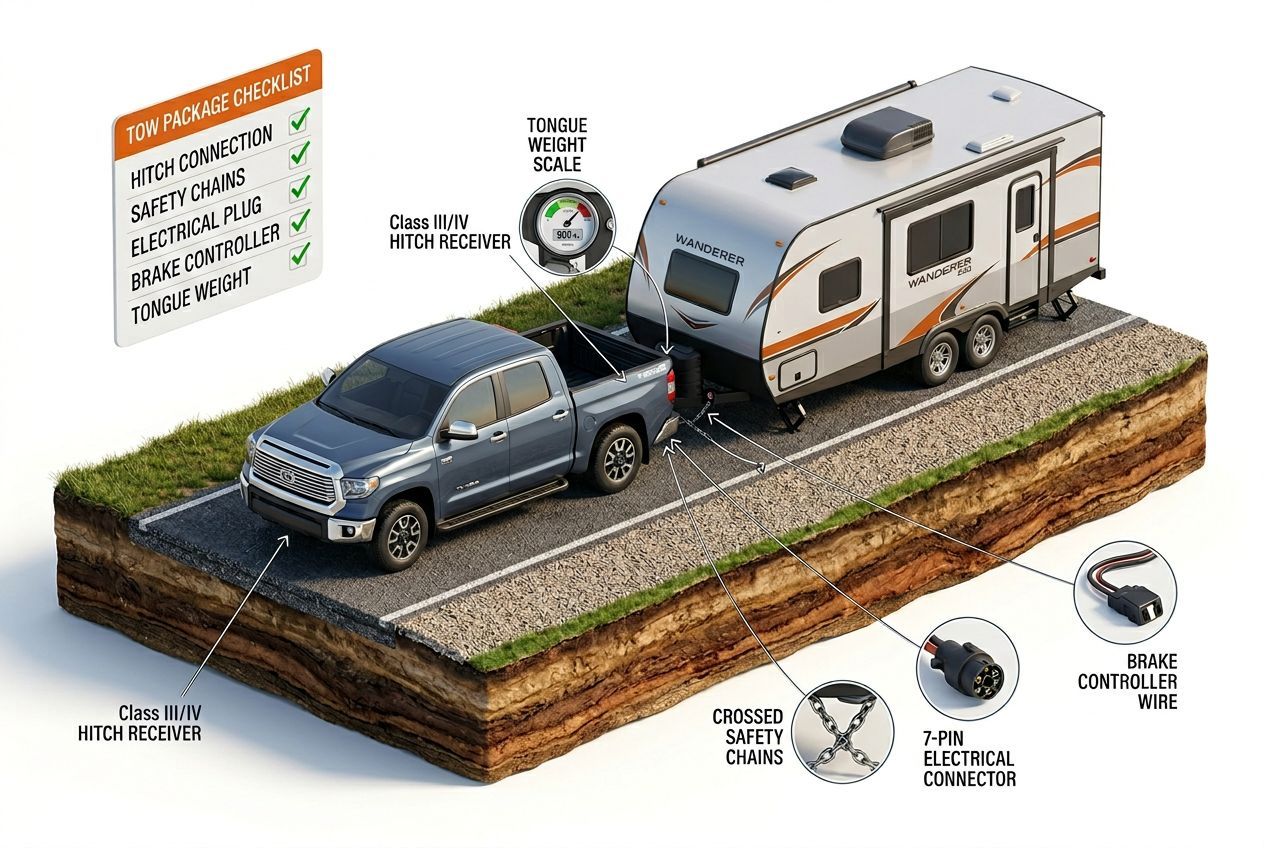
Factory tow package components: The 2016 Tundra tow package includes several critical features designed to enhance towing capability and safety:
- Class IV tow hitch receiver (rated to 10,500 lbs GTW)
- 4-pin and 7-pin wiring harness
- Supplemental engine oil cooler
- Transmission oil cooler
- Trailer-Sway Control (TSC) integration
- 130-amp alternator
On 5.7L-equipped trims, this package is standard. On the base 4.6L SR, it's an add-on.
Trailer-Sway Control (TSC): According to NHTSA, Trailer-Sway Control operates through the VSC (Vehicle Stability Control) system by selectively applying brakes and reducing throttle when the system detects trailer oscillation. It's not a substitute for a properly loaded trailer — tongue weight, trailer brake controllers, and sway-control hitches still matter — but it's a meaningful safety net.
Verifying the tow package: The Class IV receiver on the 2016 Tundra is stamped on the receiver tube itself. Look for "Class IV" or "GTW 10,500" near the pin hole. If you're buying used and can't verify the tow package was dealer-installed rather than aftermarket, cross-check the build sheet using the vehicle's VIN through Toyota's customer service line or a service like Edmunds.
⚠️ Warning: Without the factory tow package, Toyota explicitly does not certify the published maximum tow ratings. An aftermarket hitch may bolt on, but you lose the cooler, the wiring integration, and the TSC activation — and you're operating outside the tested configuration.
⚙️
TRUCK TOWING CAPACITY
What Is the Payload Capacity of a 2016 Toyota Tundra?
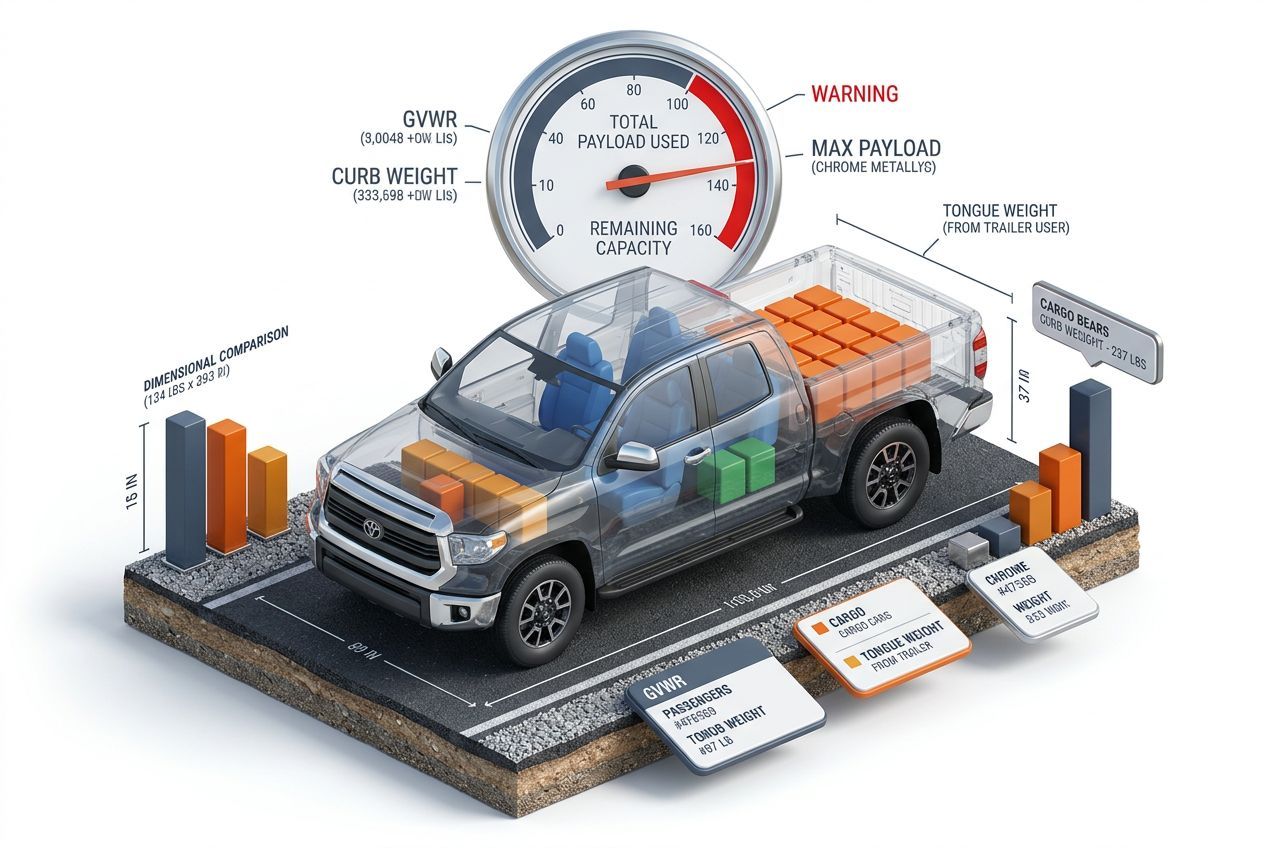
Payload range: The 2016 Tundra payload capacity ranges from 1,440 to 2,080 lbs depending on cab style, bed length, engine, and drivetrain. Regular Cab models with the 6.5-ft bed and 5.7L 4x2 offer the highest payload. CrewMax models with the 5.5-ft bed and 5.7L 4x4 sit at the lower end of that range.
Understanding Payload vs. Towing
Connected capacities: Payload and towing capacity are connected in a way that surprises a lot of owners. Your payload isn't just for cargo in the bed — it includes passengers, fuel, and tongue weight from the trailer. According to the Federal Motor Carrier Safety Administration, tongue weight should be 10–15% of gross trailer weight for stable towing.
Real-World Payload Example
Consider this scenario: You're towing an 8,500-lb bumper-pull travel trailer with your 5.7L CrewMax.
- At 12% tongue weight, that's 1,020 lbs on the hitch.
- Add yourself (195 lbs), a passenger (165 lbs), and 60 lbs of gear in the cab. That's an additional 420 lbs.
- Total payload consumed so far: 1,020 lbs + 420 lbs = 1,440 lbs.
This example puts you right at the lower end of a CrewMax payload rating, with zero room left for anything in the bed. A full tank of fuel (26-gallon tank × ~6 lbs/gallon = 156 lbs) pushes you over. That's a real constraint you need to plan around.
⚠️ Warning: Always find your specific payload rating on the driver's-side B-pillar door-jamb sticker. It says "Combined Weight of Occupants and Cargo Should Not Exceed XXX lbs." That number is calculated for your exact truck, not the average of the lineup.
For a deeper look at how payload and towing interact, read our towing capacity vs. payload explainer.
🚛
TRUCK TOWING CAPACITY
Can a 2016 Toyota Tundra Tow a Travel Trailer or Fifth Wheel?
Towing capabilities vary: A 2016 Tundra with the 5.7L V8 can tow most mid-size bumper-pull travel trailers. Dry weights in the 6,000–8,500-lb range are realistic targets, keeping loaded trailer weight under the 10,500-lb ceiling. For fifth wheels and gooseneck trailers, it's a different story.
Travel Trailer Capabilities
Bumper-pull suitability: For bumper-pull travel trailers, keep loaded weight below 8,500 lbs to maintain margin for passengers and cargo. Run the payload math before every trip — not just once when you buy the trailer. Seasonal gear, water tanks, and full propane cylinders add up fast. If you want to know whether your exact trailer and load work with your 2016 Tundra, our Can My Truck Tow This? calculator runs through the full numbers.
Fifth Wheel Limitations
Heavy duty requirements: Most entry-level fifth wheels start around 12,000–14,000 lbs loaded. The 2016 Tundra's 10,500-lb ceiling makes it incompatible with those loads. Beyond the tow rating, fifth-wheel towing requires a kingpin-to-axle clearance and a payload large enough to absorb pin weight (typically 18–22% of gross trailer weight). Even if you found a fifth wheel at 10,000 lbs loaded, the pin weight alone — around 1,800–2,200 lbs — would blow past the Tundra's payload rating before you load the cab.
Consider a heavy-duty truck: If your fifth wheel is the goal, you need to look at three-quarter-ton trucks minimum. For a side-by-side comparison of what those alternatives bring, see our towing capacity guide or check the RAM 1500 towing capacity and Silverado towing capacity pages to benchmark the competition.
⚠️ Warning: One more condition to factor in: altitude. At 6,000 feet in the Rockies or Sierra Nevada, a naturally aspirated V8 loses roughly 3% of its power output per 1,000 feet above sea level. The 5.7L's 10,500-lb rating was tested at sea level. At 7,000 feet, you're effectively towing with about 15–18% less available power — not a dealbreaker, but something to respect on long grades with an 8,500-lb trailer behind you.
✅ Pro Tip: When towing at altitude or on challenging grades, drop your cruising speed and use Tow/Haul mode. This mode holds lower gears longer and manages downshift timing on descents, helping to preserve your brakes and maintain control.