Important Caveat: While the F-150 holds the "highest rated" title, this doesn't automatically translate to the "best experience" for every buyer. The 14,000-lb rating typically applies only to specific configurations, such as a 2WD, Regular Cab, long-bed with the max-tow package. Most buyers opt for popular configurations like SuperCrew cabs with 4WD, which can drop the effective towing rating to roughly 12,000–12,700 lbs. This puts it much closer to competitors like the Ram and Silverado. For a full breakdown of F-150 specs, our F-150 towing capacity page details every cab, bed, and engine combination.
🔧
TRUCK TOWING CAPACITY
Can a Half-Ton Truck Tow a Travel Trailer or Fifth Wheel?
Yes, a properly equipped half-ton truck can handle most travel trailers under 8,500 lbs GVWR with ease. Some configurations can even manage fifth wheels in the 10,000–12,000 lb range. However, it's crucial to understand that payload capacity is typically the first constraint you'll encounter, not the truck's maximum towing capacity rating.
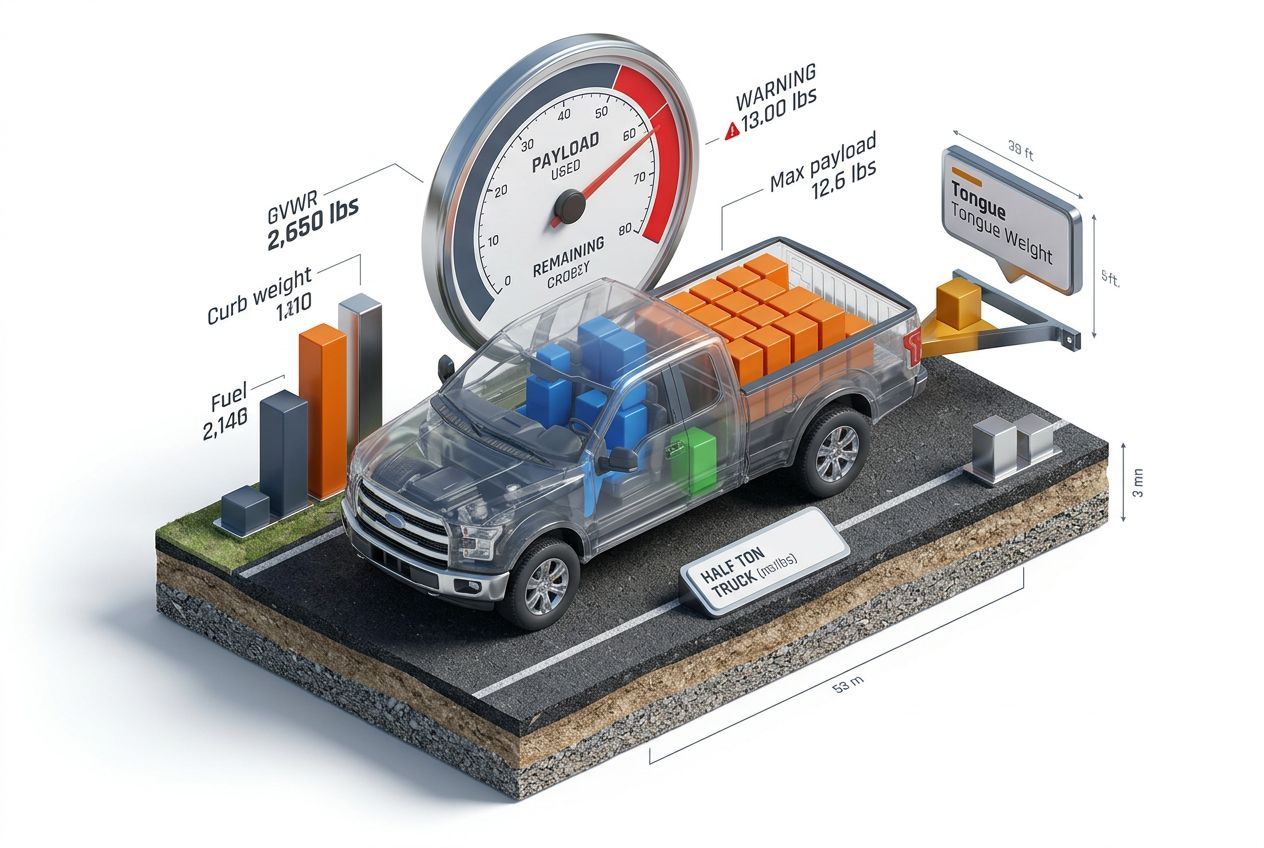
Understanding Payload Limitations
Let's consider a real-world example:
- Trailer: You're pulling a 7,800-lb travel trailer.
- Truck: A Ram 1500 with a 1,900-lb payload rating.
- Tongue Weight: At 13% of trailer GVWR, this is 1,014 lbs.
- Occupants & Gear:
- Driver: 210 lbs
- Passenger: 160 lbs
- Gear in cab: 150 lbs
- Total Occupants & Gear: 520 lbs
Calculating Your Payload Use:
- Tongue Weight: 1,014 lbs
- Occupants & Gear: 520 lbs
- Subtotal: 1,534 lbs
Against a 1,900-lb payload rating, you're already at 81% capacity before loading anything into the truck bed or topping off the fuel tank (a full 20-gallon tank adds roughly 140 lbs). While legally compliant, you're close to the limit. Adding items like a cooler, a toolbox, or additional passengers could easily push you over your truck's rated payload.
Fifth Wheel Considerations
⚠️ Warning: For fifth wheels specifically, pin weight (the vertical load on the kingpin) typically ranges from 18–25% of the trailer's GVWR. A 12,000-lb fifth wheel would place 2,160–3,000 lbs of pin weight on your truck's payload. This amount often exceeds the payload rating of every half-ton truck in the segment.
This scenario is precisely what's discussed in our towing capacity vs. payload guide. For a realistic travel trailer setup, a half-ton works well. For a large fifth wheel, however, a 3/4-ton truck (or heavier) is generally a minimum requirement.
🛡️
TRUCK TOWING CAPACITY
What Is the Difference Between Towing Capacity and Payload Capacity?
Towing capacity refers to the maximum weight a truck can pull on a trailer attached to its hitch. Payload capacity, on the other hand, is the maximum weight the truck can carry on itself. This includes everything in and on the truck: passengers, cargo, fuel, and crucially, the tongue weight (or pin weight for fifth wheels) transferred from the trailer. When it comes to half-ton towing, payload is almost always the limiting factor you'll encounter first.
✅ Pro Tip: To determine your specific truck's actual payload rating (not the marketing "up to X lbs" figure), always check the yellow sticker on the driver's side door jamb. This sticker lists your exact Gross Vehicle Weight Rating (GVWR) and curb weight. Subtracting the curb weight from the GVWR reveals your real payload ceiling. The number in the brochure represents a stripped-down, base model. Your loaded SuperCrew 4WD with a higher trim package will have significantly less usable payload.
Our payload calculator can perform this calculation for you automatically. If you're curious how Gross Combined Weight Rating (GCWR) fits into the equation, our GCWR explainer clarifies it in plain terms.
📋
TRUCK TOWING CAPACITY
How Does the Max Tow Package Affect Half-Ton Towing Capacity?
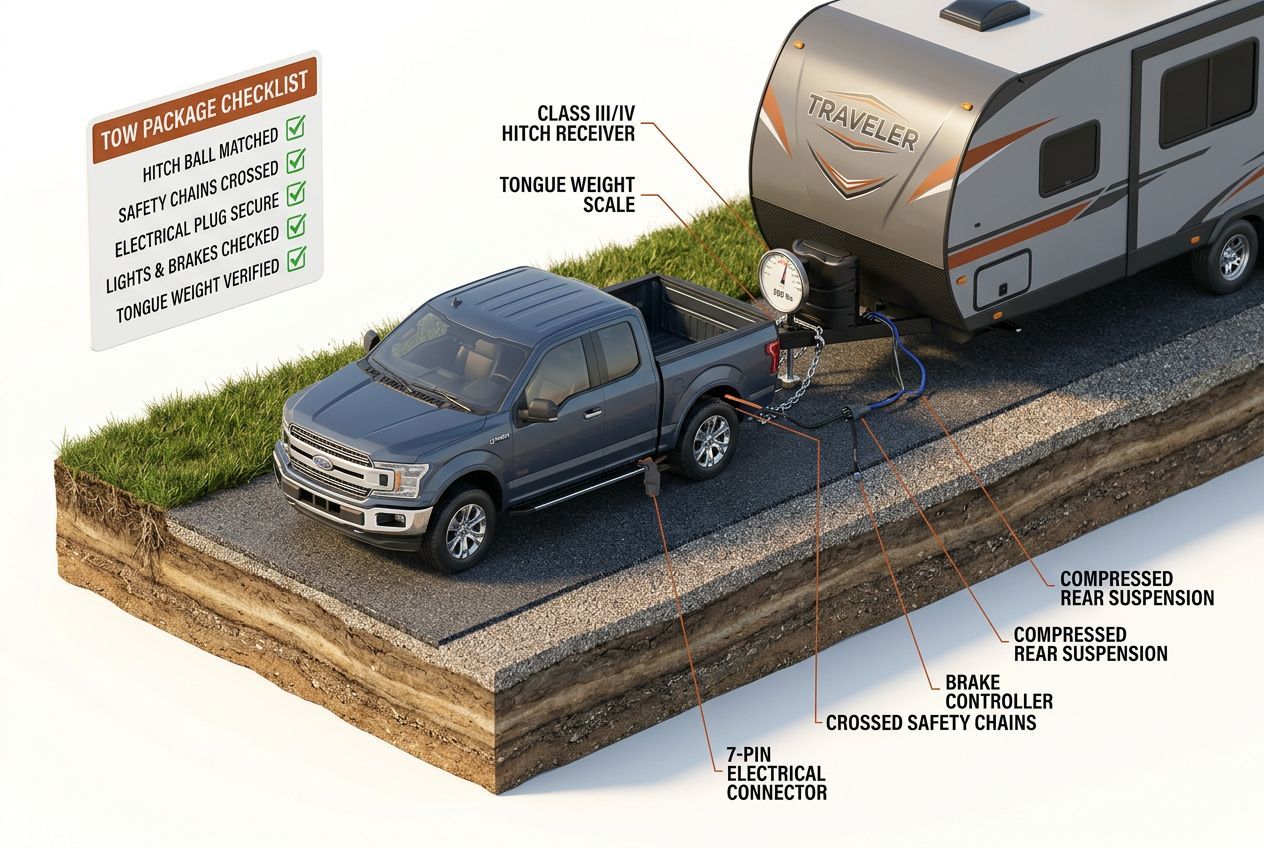
A factory max tow package is a game-changer for half-ton towing, capable of adding a substantial 2,000–4,000 lbs of towing capacity compared to a base configuration. You simply cannot achieve the manufacturer's advertised maximum without it. This is a non-negotiable requirement for every major half-ton truck in 2026, and the difference it makes is far from minor.
What's Included in a Max Tow Package?
Here's a breakdown of what each OEM typically includes in their max tow configurations:
- Ford Max Trailer Tow Package (option 53C):
- 3.73 limited-slip rear axle
- Heavy-duty radiator
- Engine oil cooler
- Transmission oil cooler
- Integrated trailer brake controller
- 7-pin/4-pin trailer wiring
- Ram 1500 Max Tow Group:
- 3.92 axle ratio
- Active-level four-corner air suspension
- Trailer brake controller
- 7-pin wiring harness
- Class IV receiver hitch
- Silverado/Sierra 1500 Max Trailering Package:
- 3.73 or 3.42 axle ratio (engine dependent)
- Enhanced cooling
- Trailering mirrors
- Trailer sway control
- Integrated brake controller
- 7-pin harness
- Toyota Tundra Towing Technology Package:
- Trailer sway control (standard on all Tundras)
- Integrated Trailer Brake Controller
- Panoramic View Monitor inputs for trailer connection
⚠️ Warning: Simply skipping the factory package and adding an aftermarket hitch will not provide the same benefits or rating. Critical components like the specific axle ratio, enhanced cooling systems, and integrated brake controller are integral to the manufacturer's tow rating. According to NHTSA towing test standards at nhtsa.gov, manufacturer-published tow ratings are established under specific equipment conditions. Operating outside these conditions effectively voids the basis for the published rating, potentially leading to unsafe towing and legal issues.
⚙️
TRUCK TOWING CAPACITY
Is a Half-Ton Truck Enough, or Do I Need a 3/4-Ton?
For the majority of recreational towing needs, a half-ton truck is perfectly sufficient. This covers a wide range of applications including bumper-pull travel trailers, boat trailers, car haulers, and utility trailers, typically up to about 10,000–12,000 lbs. However, if your loaded trailer consistently exceeds that range, a 3/4-ton truck becomes the more appropriate and safer tool for the job.
When a Half-Ton Reaches Its Limit
The towing ceiling for half-ton trucks is a firm reality. Even the Ford F-150, which tops out at 14,000 lbs, is still a light-duty truck. If your fifth wheel, once loaded, weighs 15,000 lbs or more, a half-ton simply isn't adequate. In such cases, you would require a minimum of an F-250, Silverado 2500HD, or Ram 2500, which are rated for conventional towing capacities of 20,000+ lbs.
Impact of Terrain and Altitude
There are also specific conditions where the usable capacity of a half-ton truck can feel lower than its official spec sheet suggests.
- Altitude: When towing at high altitudes—for example, 7,000 feet in Colorado—naturally aspirated engines can lose approximately 3% of their power for every 1,000 feet of elevation gain. Even turbocharged engines experience some reduction in efficiency due to less dense air for the intercooler to work with.
- Towing Experience: A load that feels effortless on flat terrain, like I-10 in Texas, can become significantly more challenging when traversing mountain passes, such as those on US-40 through the Rockies.
If you frequently tow through mountainous regions, it's a wise practice to reduce your real-world usable capacity by 10–15% from the rated maximum and choose your truck accordingly.
The Ram 1500 towing capacity page and Silverado 1500 towing capacity page both include trim-by-trim breakdowns if you're comparing half-ton versus bumping to a heavy-duty.
🚛
TRUCK TOWING CAPACITY
What Engine and Drivetrain Options Give the Best Towing Numbers?
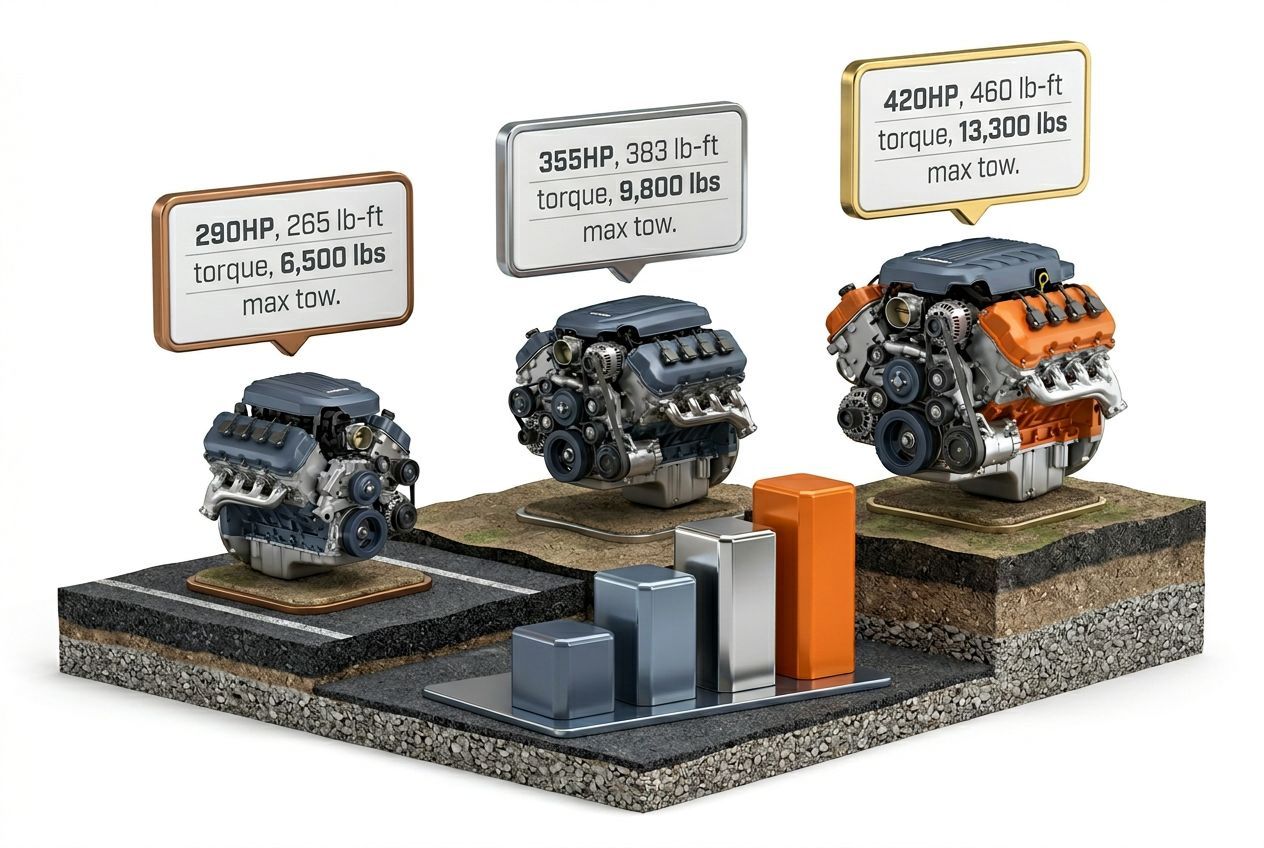
For the highest towing numbers in the 2026 half-ton segment, turbocharged six-cylinder engines are the clear leaders. Specifically, Ford's 3.5L EcoBoost (generating 570 lb-ft of torque) and Ram's 3.0L Hurricane twin-turbo inline-six (420 lb-ft) consistently deliver superior performance. High torque produced at low RPM is the critical factor for effectively moving a heavy trailer, and turbo-sixes are engineered to generate this torque earlier in the rev range compared to traditional V8s.
Drivetrain Configuration Matters
Drivetrain setup significantly impacts published tow ratings.
- A 2WD configuration, especially when combined with a max-ratio rear axle (such as 3.73 or 3.92) and a long-wheelbase cab/bed combination, will typically yield the highest published towing capacities.
- Opting for 4WD will generally reduce your rated capacity by 200–500 lbs, depending on the manufacturer. This reduction occurs because the added weight of the transfer case and front differential, along with increased mechanical losses, diminishes the available margin for towing.
V8 and Hybrid Options
V8 options remain competitive, but often don't reach the absolute peak numbers of the turbo-sixes. For instance, the Toyota Tundra's 3.5L twin-turbo V6 (i-FORCE MAX hybrid) produces an impressive 583 lb-ft of torque—even more than the EcoBoost. However, Toyota's more conservative Gross Vehicle Weight Rating (GVWR) and Gross Combined Weight Rating (GCWR) targets cap its published towing rating at 12,000 lbs. The Tundra's unique approach is detailed further on our Toyota Tundra towing capacity page.
📊 Quick Fact: For those considering the electric route, the Ford F-150 Lightning towing capacity tops out at 10,000 lbs. While solid for many applications, this is below the gas F-150's maximum, and electric towing is subject to significant range reduction under load.
In Summary: When comparing half-ton trucks for towing, it’s essential to match your trailer's loaded GVWR (not just its dry weight) to the truck's payload-adjusted capacity, rather than relying solely on the maximum tow sticker. Always factor in variables like terrain, the number of passengers, and fuel weight. Before making a purchase or heading out, use the can my truck tow this tool or the tow vehicle matchmaker to run your specific numbers. And if managing expenses is a concern, our towing cost calculator can help you estimate fuel and wear costs throughout your towing season.