
📊
TRUCK TOWING CAPACITY
How Much Can a 2017 Tundra With the 5.7L V8 Tow?
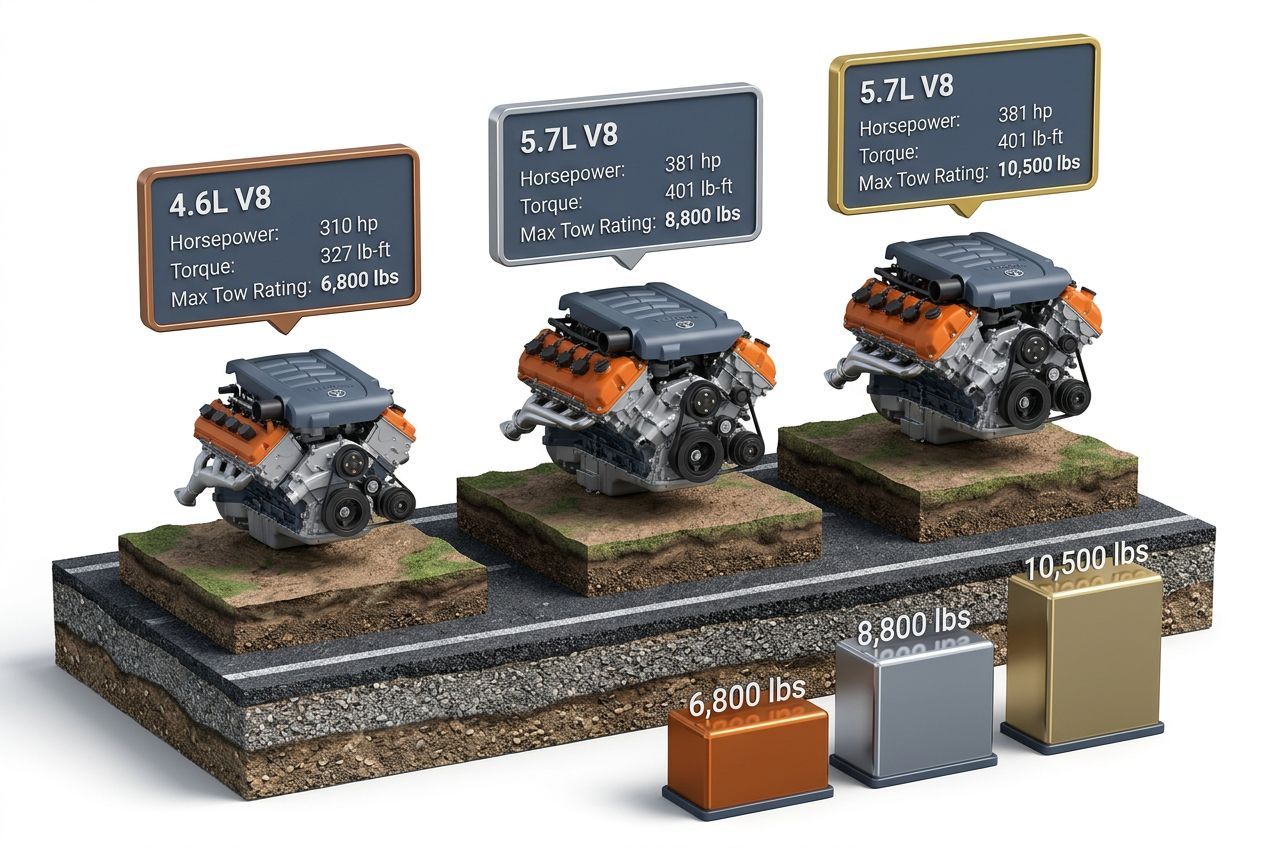
The 5.7L i-FORCE V8 engine gives the 2017 Tundra a towing capacity ranging from 9,800 to 10,200 pounds. This range depends on the specific cab style, bed length, and drivetrain configuration. When paired with the six-speed automatic transmission and the 4.30:1 rear axle ratio, this engine is the optimal choice for anyone planning to tow substantial loads like large travel trailers, fifth wheels, or heavy boats. The 3.91:1 axle ratio, often found on work-spec SR trims, will slightly reduce the tow rating.
Toyota's i-FORCE 5.7L (3UR-FE) is a naturally aspirated V8 engine that has a long history, being in continuous production since the 2007 Tundra generation. This longevity is a significant advantage in the used market, as the engine boasts well-documented maintenance patterns and a strong reputation for reliability, often exceeding 200,000 miles when properly maintained.
⚠️ Warning: One limitation of naturally aspirated engines like the 5.7L i-FORCE is their performance at high altitudes. According to general engineering principles recognized by NHTSA, these engines lose approximately 3% of their power for every 1,000 feet of elevation gain. This means that at 7,000 feet — for instance, while crossing a Colorado mountain pass with a loaded camper — you're effectively operating with about 15% less engine output than the sea-level rating assumes. Always plan accordingly and downshift early on grades to manage this power reduction.
🔧
TRUCK TOWING CAPACITY
What Is the Towing Capacity of the 2017 Tundra With the 4.6L V8?
The 4.6L i-FORCE V8, a sibling to the 5.7L (also designated 3UR-FE), produces 310 hp and 327 lb-ft of torque. This engine option significantly limits the 2017 Tundra's tow rating to 6,800 lbs in 4×2 configurations and 6,400 lbs in 4×4. This engine is exclusively available on SR and SR5 trims. Its lower tow ceiling is an important consideration if you're planning to tow objects like an 18–22-foot boat or a mid-size travel trailer.
⚠️ Warning: If your trailer's loaded weight will be above 7,000 lbs — even occasionally — it is strongly recommended to avoid the 4.6L engine. Persistent towing near or above its limit can lead to increased stress on the transmission and cooling system, which may not show immediate signs of wear but can accumulate damage over time. The 5.7L is unequivocally the right choice for any towing scenario approaching the truck's full potential.
For comparison, see how the 2016 Toyota Tundra towing capacity and 2018 Toyota Tundra towing capacity stack up. The second-generation Tundra's specifications remained largely stable across this period.
🛡️
TRUCK TOWING CAPACITY
Does the 2017 Tundra SR5 Tow as Much as the Limited or Platinum?
When comparing tow ratings across trim levels, the 2017 Tundra SR5's towing capacity can match that of the Limited, Platinum, 1794 Edition, and TRD Pro. This is true when those trims share the exact same engine, drivetrain, and cab configuration. Ultimately, trim badges do not alter the underlying physics of towing.
Engine availability is key: A critical distinction is that upper trims — such as Limited, Platinum, and 1794 Edition — are exclusively sold with the 5.7L V8 engine. Therefore, if you are comparing an SR5 equipped with the 4.6L engine against a Platinum, the Platinum will always possess a higher tow rating by default, as it cannot be ordered with the smaller engine.
The TRD Pro trim deserves a specific mention. It is exclusively equipped with the 5.7L V8 and features a lifted suspension with Bilstein shocks, tuned for off-road performance. While this specific suspension geometry does not technically reduce the tow rating on paper, the elevated center of gravity and softer damping characteristics can affect real-world trailer stability, particularly at highway speeds.
✅ Pro Tip: If you intend to regularly tow heavy loads, a standard SR5 or Limited trim with the 5.7L V8 offers a more neutral and often more stable platform compared to the lifted TRD Pro.
📋
TRUCK TOWING CAPACITY
2017 Toyota Tundra Towing Capacity by Configuration
2017 Toyota Tundra Towing Capacity by Engine, Drivetrain & Cab — Source: Toyota Motor Corporation Towing & Payload Guide (2017)
| Engine |
Drivetrain |
Cab Style |
Max Tow Rating |
Payload Range |
| 5.7L V8 |
4×2 |
Regular / Double Cab |
10,200 lbs |
1,730–2,080 lbs |
| 5.7L V8 |
4×4 |
Regular / Double Cab |
10,100 lbs |
1,640–1,970 lbs |
| 5.7L V8 |
4×2 / 4×4 |
CrewMax |
9,800–10,000 lbs |
1,440–1,730 lbs |
| 4.6L V8 |
4×2 |
Double Cab |
6,800 lbs |
1,600–1,830 lbs |
| 4.6L V8 |
4×4 |
Double Cab |
6,400 lbs |
1,520–1,740 lbs |
Always verify your specific truck's payload on the door-jamb sticker located on the driver's side B-pillar. This white label provides your individual truck's Gross Vehicle Weight Rating (GVWR) and gross axle weight ratings, which override any general spec-sheet number by accounting for actual installed options and trim weight.
⚙️
TRUCK TOWING CAPACITY
What Is the Payload Capacity of a 2017 Toyota Tundra?
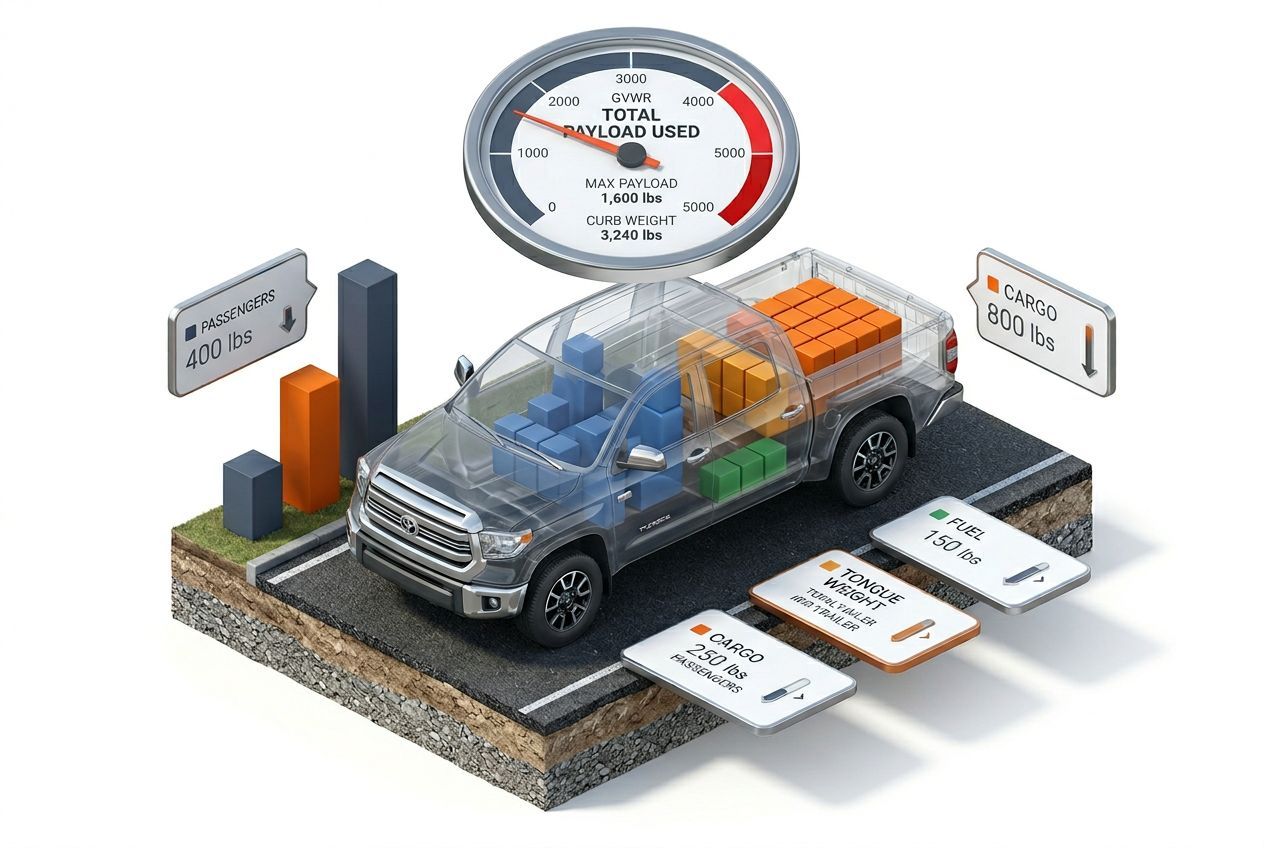
The 2017 Tundra's payload capacity ranges from 1,440 to 2,080 pounds, depending on the specific configuration. Payload refers to the total weight your truck can carry, which includes all passengers, cargo, and the trailer's tongue weight combined. Toyota generally recommends maintaining a trailer tongue weight between 10–15% of the total trailer weight for optimal towing stability. This is practical guidance, but for exact regulatory limits, you should always consult the Trailer Towing Supplement included in your owner's documentation.
Consider this real-world example of payload calculation: Imagine you're towing a 26-foot travel trailer with a loaded weight of 8,500 lbs.
- At a 12% tongue weight, this equates to 1,020 lbs pressing down on the hitch.
- Now, add two adults (approximately 375 lbs combined), 100 lbs of gear in the cab, and a full 38-gallon fuel tank (roughly 260 lbs).
- Your total payload load becomes 1,755 lbs (1020 + 375 + 100 + 260).
📊 Quick Fact: If this scenario involved a CrewMax 4×4 with a specific payload rating of 1,440 lbs, you would already be 315 lbs over its legal capacity—even before adding a cooler or duffel bags. In this situation, that truck would legally be unable to tow that trailer in that configuration.
Understanding towing capacity vs payload is crucial before purchasing a trailer. You can also utilize our payload calculator to accurately determine your specific numbers and avoid exceeding limits with your actual load.
The Gross Combined Weight Rating (GCWR) for 5.7L-equipped 2017 Tundras is 16,000 lbs. This GCWR represents the absolute maximum combined weight of the truck, its contents, and the trailer — a critical ceiling that must not be exceeded, regardless of individual component ratings. For a more in-depth explanation, refer to our guide on what GCWR means.
🚛
TRUCK TOWING CAPACITY
How Does the 2017 Tundra Compare to the F-150 and Silverado for Towing?
When comparing peak towing ratings, the 2017 Tundra's 10,200-lb ceiling falls behind its primary competitors. The 2017 Ford F-150 boasts a maximum of 12,200 lbs, and the 2017 Chevrolet Silverado 1500 leads with 12,500 lbs. This difference represents a significant gap—roughly two full tons—which is particularly relevant if you frequently tow larger fifth wheels or heavy equipment trailers.
However, raw maximum numbers do not tell the complete story. The F-150 achieves its 12,200-lb rating with the 3.5L EcoBoost, a turbocharged engine that some owners report as more maintenance-sensitive under sustained towing heat compared to Toyota's naturally aspirated 5.7L V8. The Silverado 1500's 12,500-lb figure is derived from its 6.2L V8, an engine not available across all trim levels.
💡 Key Takeaway: According to long-term data from Edmunds and KBB, the Tundra consistently ranks among the most reliable full-size trucks in the segment. This reputation for dependability is a significant factor, especially when you're hundreds of miles from home with a trailer in tow.
If towing requirements regularly exceed 10,200 lbs, the 2017 Tundra may not be the most appropriate vehicle. In such cases, a 3/4-ton truck—such as an F-250, Silverado 2500HD, or RAM 2500 (as Toyota did not produce a 3/4-ton option)—is better suited for that heavy-duty cycle and will handle the load more safely. For a comprehensive look, see how the RAM 1500 towing capacity rounds out the half-ton comparison.
📝
TRUCK TOWING CAPACITY
What Tow Package Options Came on the 2017 Tundra?
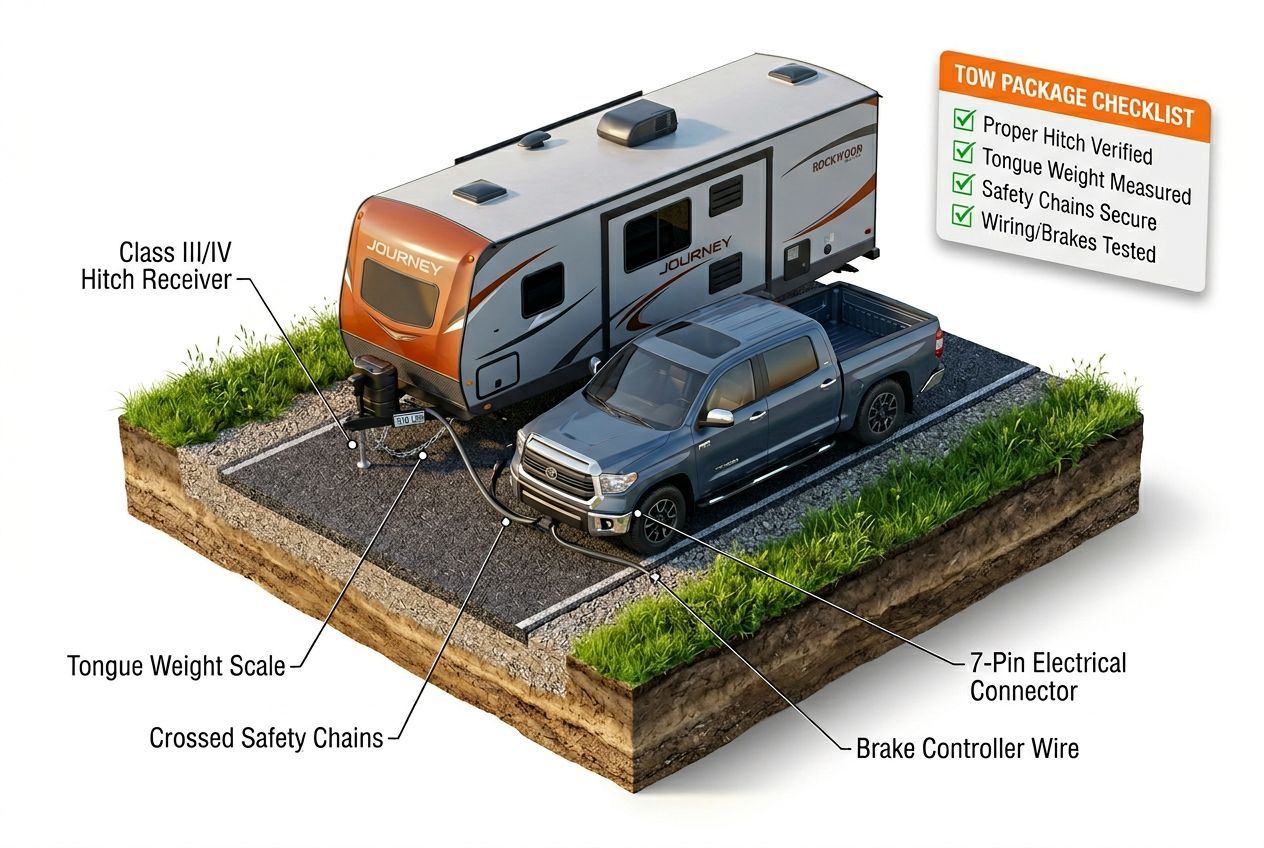
The 2017 Tundra Tow Package includes several essential components for safe and capable towing:
- A Class IV tow hitch receiver, rated for up to 10,000 lbs gross trailer weight.
- A combined 4-pin and 7-pin wiring harness for trailer lighting and accessories.
- A supplemental transmission oil cooler to manage heat during heavy loads.
- Integrated wiring for a trailer brake controller.
This package was standard on SR5 and higher trims when equipped with the 5.7L V8. On base SR trims, it might have been an optional extra, so it's vital to verify the build sheet when considering any used truck.
While the trailer brake controller wiring is factory-integrated, the actual controller unit is typically a dealer-installed item or an aftermarket purchase. For trailers with a gross weight exceeding 6,000 lbs, a brake controller is not merely recommended; it is a legal requirement in many states.
⚠️ Warning: Always check the specific towing laws for your state through our towing laws by state tool before your first haul to ensure compliance.
✅ Pro Tip: When purchasing a used 2017 Tundra, it is crucial to visually verify that the tow package components are physically installed, rather than simply relying on a listing that states it was an option. Look for the stamped "Class IV" marking on the hitch receiver tube near the pin hole, and confirm the presence of the 7-pin connector behind the receiver. Missing components mean you cannot safely or legally reach the 10,200-lb ceiling, regardless of what the original window sticker indicated.
For owners evaluating the 2015 model year's spec sheet alongside the 2017, the 2015 Toyota Tundra towing capacity article covers the differences in detail. The second-generation Tundra platform was largely unchanged between 2014 and 2021, so the delta is mostly in minor equipment revisions rather than structural changes.

