Skip to content
🛡️ VEHICLE SAFETY & RECOVERY

Best Tire Inflator for Car: Top 7 Portable Air Compressors in 2026

Published · Updated · 12 min read
MarkUpdated Apr 15, 2026Viair Corporation

Key Takeaways

  • ✓**Viair 88P** is the best overall 12V tire inflator at ~$50 with 120 PSI max
  • ✓Cordless inflators offer convenience but most only fill **2-4 tires per charge**
  • ✓Budget picks under **$35** handle basic car tire inflation adequately
  • ✓For towing, choose a 12V model that reaches **80+ PSI** for trailer tires
  • ✓Every tow vehicle should carry a portable inflator — low tires cause **trailer sway**

Key Takeaways

  • Viair 88P is the best overall 12V tire inflator at ~$50 with 120 PSI max
  • Cordless inflators fill 2-4 car tires per charge — convenient but limited
  • Budget picks under $35 handle basic car tire inflation just fine
  • For towing, choose a model that reaches 80+ PSI to handle trailer tires
  • Underinflated tires are a leading cause of trailer sway — carry an inflator when towing

A flat tire or slow leak at the wrong time can turn a road trip into a roadside assistance call. A portable tire inflator costs less than a single tow truck dispatch and handles the problem in minutes. Whether you need a 12V compressor that plugs into your vehicle or a cordless model that works anywhere, the right inflator is one of the cheapest safety investments you can make — especially if you tow a trailer.


💰
VEHICLE SAFETY & RECOVERY

What Should You Look for in a Portable Tire Inflator?

A good car tire inflator needs to do three things: reach the right PSI for your tires, inflate reasonably fast, and survive being bounced around in your trunk for years between uses. Here's what actually matters and what's marketing fluff.

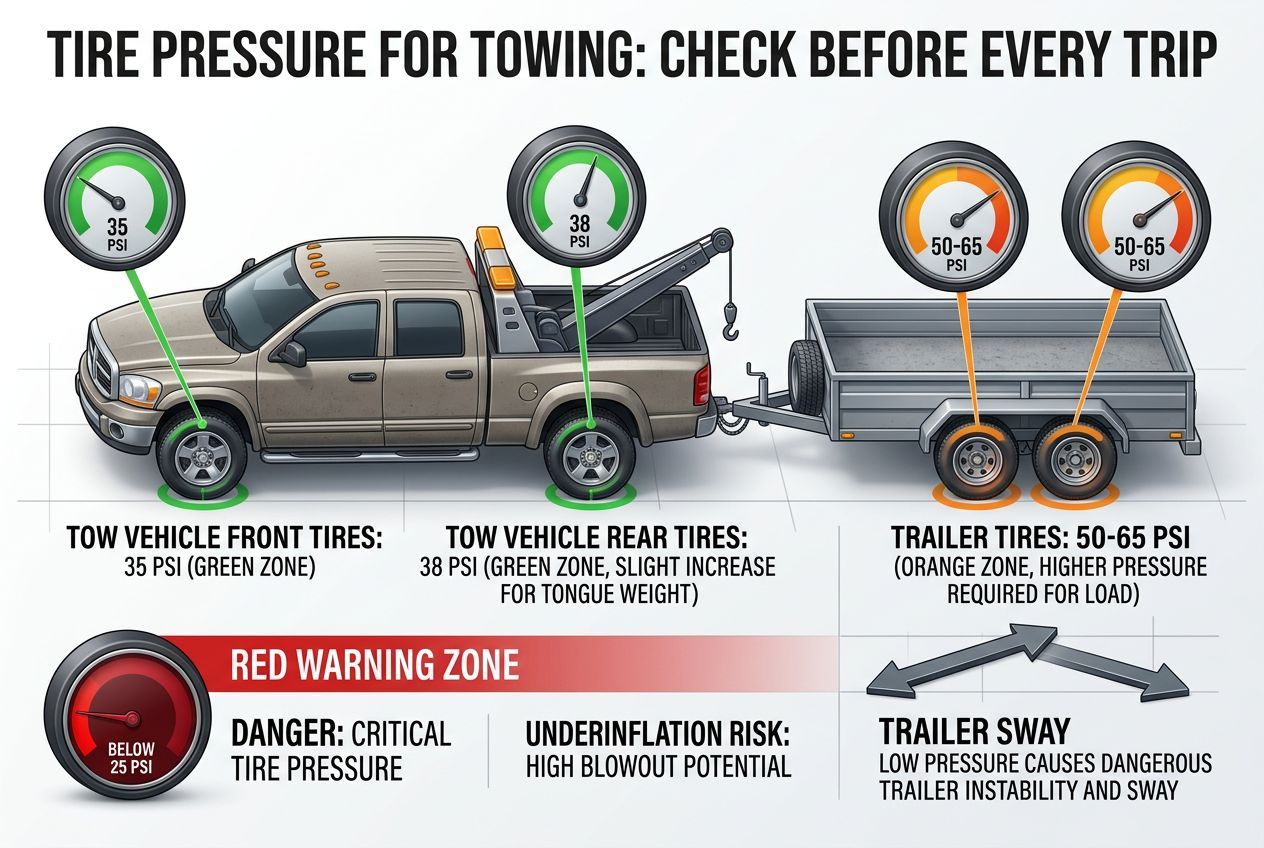
Max PSI: Most car tires need 30-35 PSI. Truck tires need 40-80 PSI. Trailer tires often need 50-65 PSI. Any inflator rated at 100+ PSI handles all passenger vehicles. If you tow, look for 120+ PSI to handle trailer and truck tires with headroom.

Inflation speed (CFM): CFM (cubic feet per minute) determines how fast the compressor fills a tire. Higher CFM = faster inflation. Most portable 12V models deliver 1.0-1.5 CFM, which fills a standard car tire from 25 to 35 PSI in about 3 minutes. Cordless models typically deliver 0.5-1.0 CFM and take longer.

Power source: 12V models plug into your vehicle's cigarette lighter or clip directly to the battery. They have unlimited runtime but need a running vehicle. Cordless models run on rechargeable lithium-ion batteries — typically 18V or 20V platforms shared with power tools. Convenient, but limited by battery capacity.

Accuracy: Built-in gauges should be accurate to within ±1 PSI. Digital gauges are easier to read than analog dials. Auto-shutoff at a preset PSI is the most useful feature — set your target and walk away.

Pro Tip: Ignore max PSI marketing numbers above 150 PSI. No passenger tire, truck tire, or trailer tire needs that much pressure. What matters is the CFM at your target PSI — a compressor that claims 150 PSI but only delivers 0.3 CFM at 60 PSI will take forever to fill a truck tire.
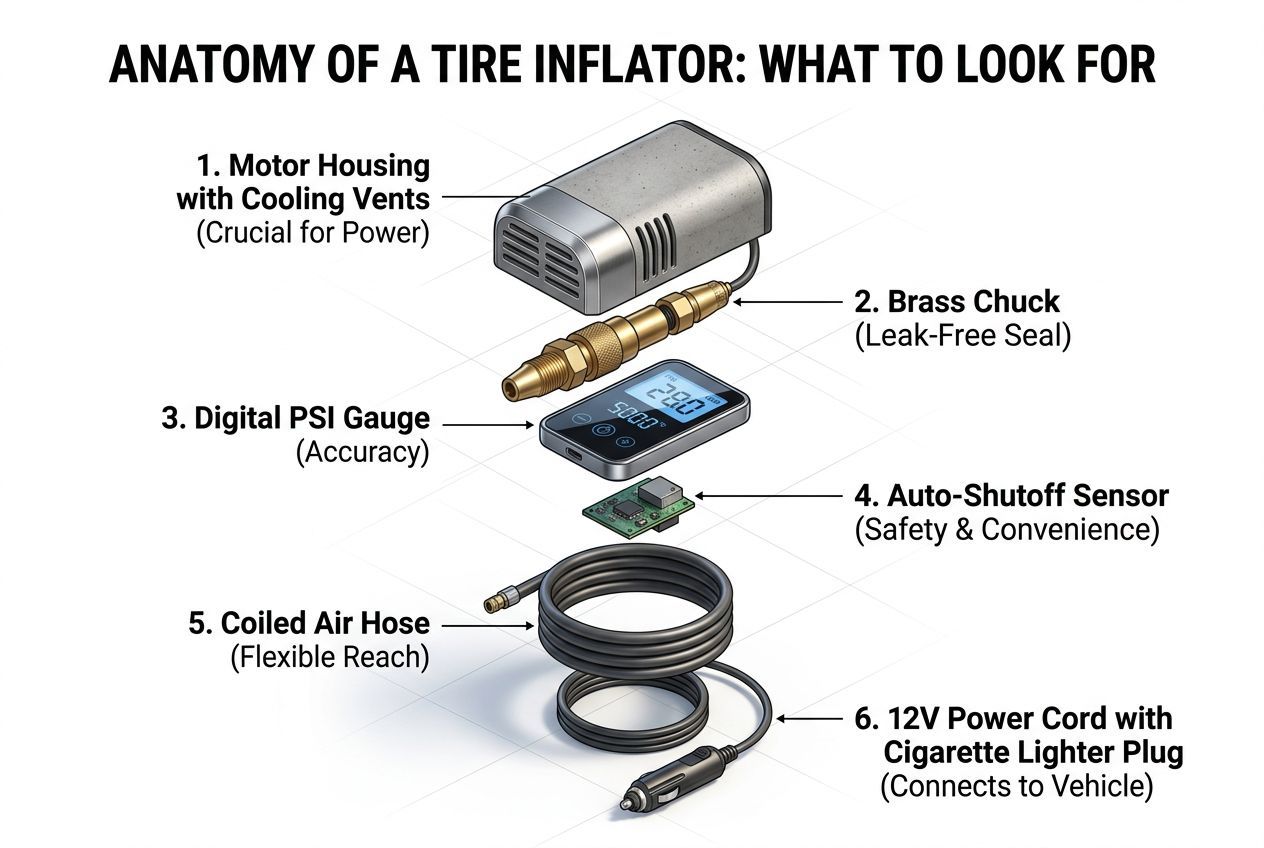

Portable tire inflator key features diagram showing PSI gauge chuck cord and motor components
📊
VEHICLE SAFETY & RECOVERY

What Are the Best Tire Inflators for Cars in 2026?

After evaluating inflators across price, performance, reliability, and real-world use cases, here are the seven best options across every budget and use case.

What Are the Best Tire Inflators for Cars in 2026? — data table
Inflator Type Max PSI Price Best For
Viair 88P 12V (cig lighter) 120 PSI ~$50 Best overall — fast, durable, proven
Ryobi 18V ONE+ Inflator Cordless (18V) 150 PSI ~$50 (tool only) Best cordless — if you own Ryobi batteries
AstroAI 12V Compressor 12V (cig lighter) 100 PSI ~$30 Best budget — gets the job done for less
DeWalt 20V MAX Inflator Cordless (20V) 160 PSI ~$80 (tool only) Best premium cordless — fastest cordless inflation
Viair 84P 12V (battery clamp) 60 PSI ~$40 Best for passenger cars only — simple and reliable
Milwaukee M18 Inflator Cordless (18V) 150 PSI ~$70 (tool only) Best for Milwaukee battery owners
EPAuto 12V Compressor 12V (cig lighter) 100 PSI ~$30 Best budget alternative — widely available

Source: Manufacturer specifications, verified pricing April 2026
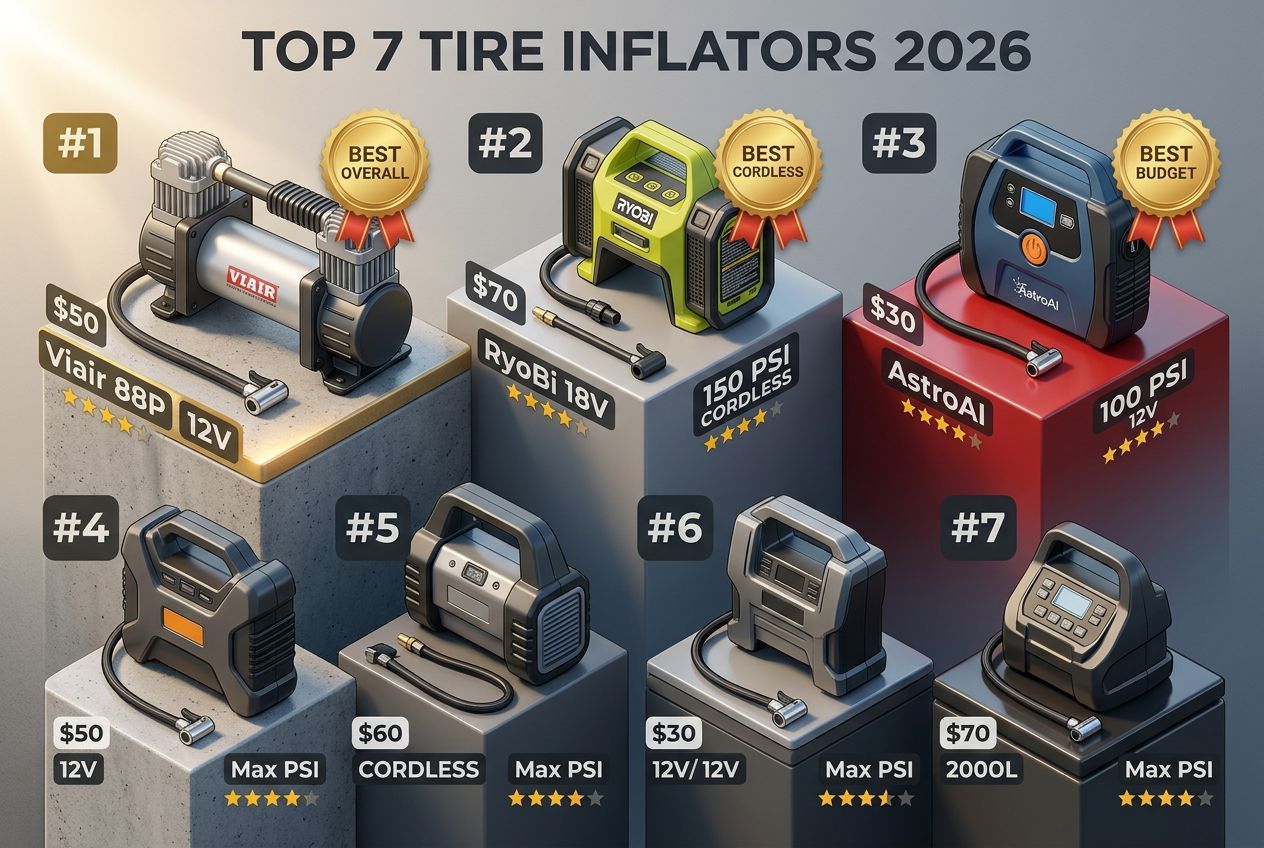

Best tire inflators 2026 comparison showing top 7 models with prices and ratings

Need a tow truck?

Use our free tools to estimate costs and find help near you.

Try Free Tools
🔧
VEHICLE SAFETY & RECOVERY

Which Is the Best Overall Tire Inflator?

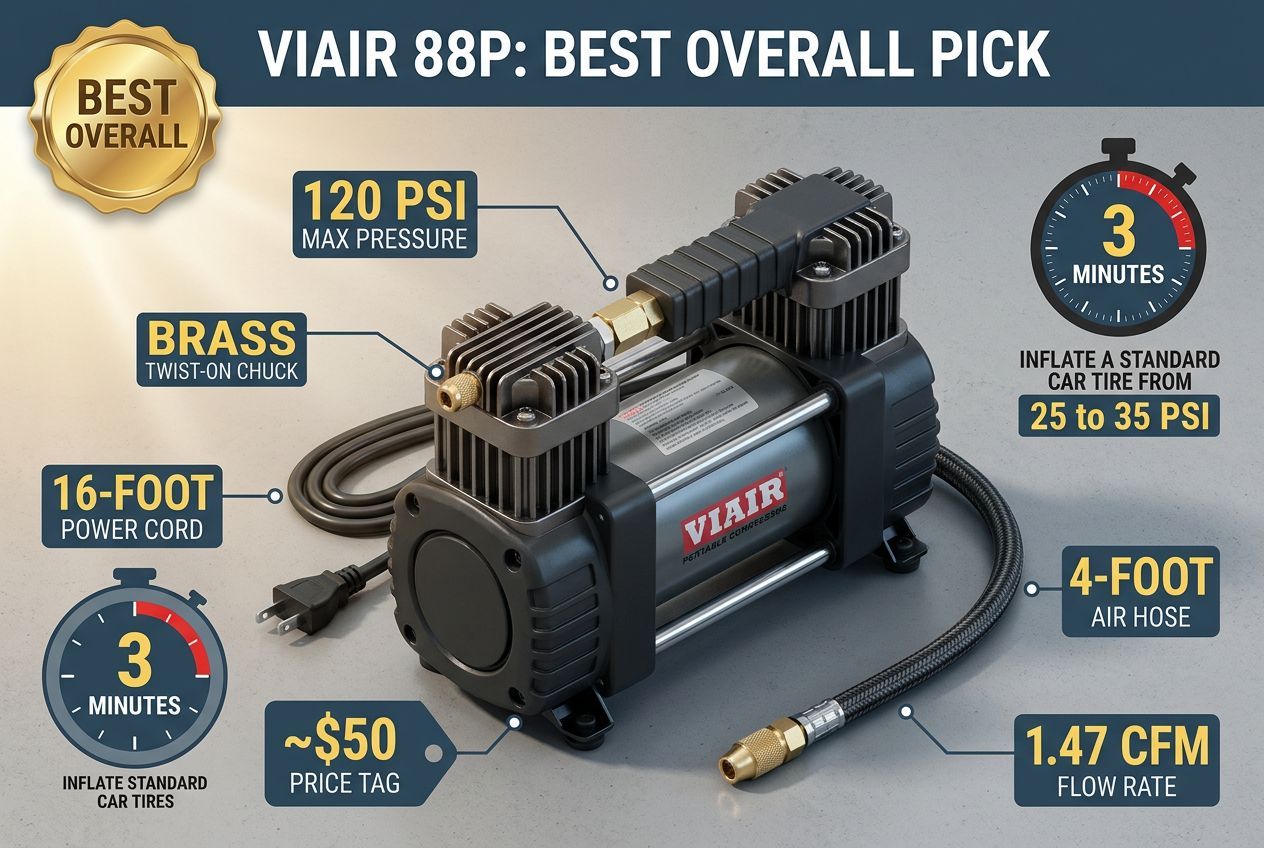
The Viair 88P earns the top spot for most car owners. It plugs into any standard 12V cigarette lighter outlet, reaches 120 PSI (more than enough for any passenger or light truck tire), and inflates a standard car tire from 25 to 35 PSI in about 3 minutes. The brass twist-on chuck seals tighter than the push-on chucks found on cheaper models, which matters when you're trying to inflate a tire at 2 AM on the highway shoulder.

Build quality sets Viair apart from the $20-30 range of compressors. The 88P uses a metal cylinder and piston instead of the all-plastic internals in budget models. It runs hotter during continuous use (10+ minutes) but handles that heat without the plastic warping that kills cheaper compressors after a few uses. The 16-foot power cord and 4-foot air hose give you enough reach to access all four tires without repositioning the unit.

Limitations: No built-in battery — requires a running vehicle or external 12V source. No auto-shutoff on all variants (some newer versions add it). The analog gauge is harder to read in the dark than a backlit digital display.

Key Insight: Viair makes compressors for the commercial vehicle and off-road markets. The 88P is their consumer model, but it shares engineering DNA with their heavy-duty products. If you want something that works every time you pull it out of the trunk, this is it.


Viair 88P portable tire inflator review showing 120 PSI specs and best overall rating

🛡️
VEHICLE SAFETY & RECOVERY

Are Cordless Tire Inflators Worth the Extra Cost?

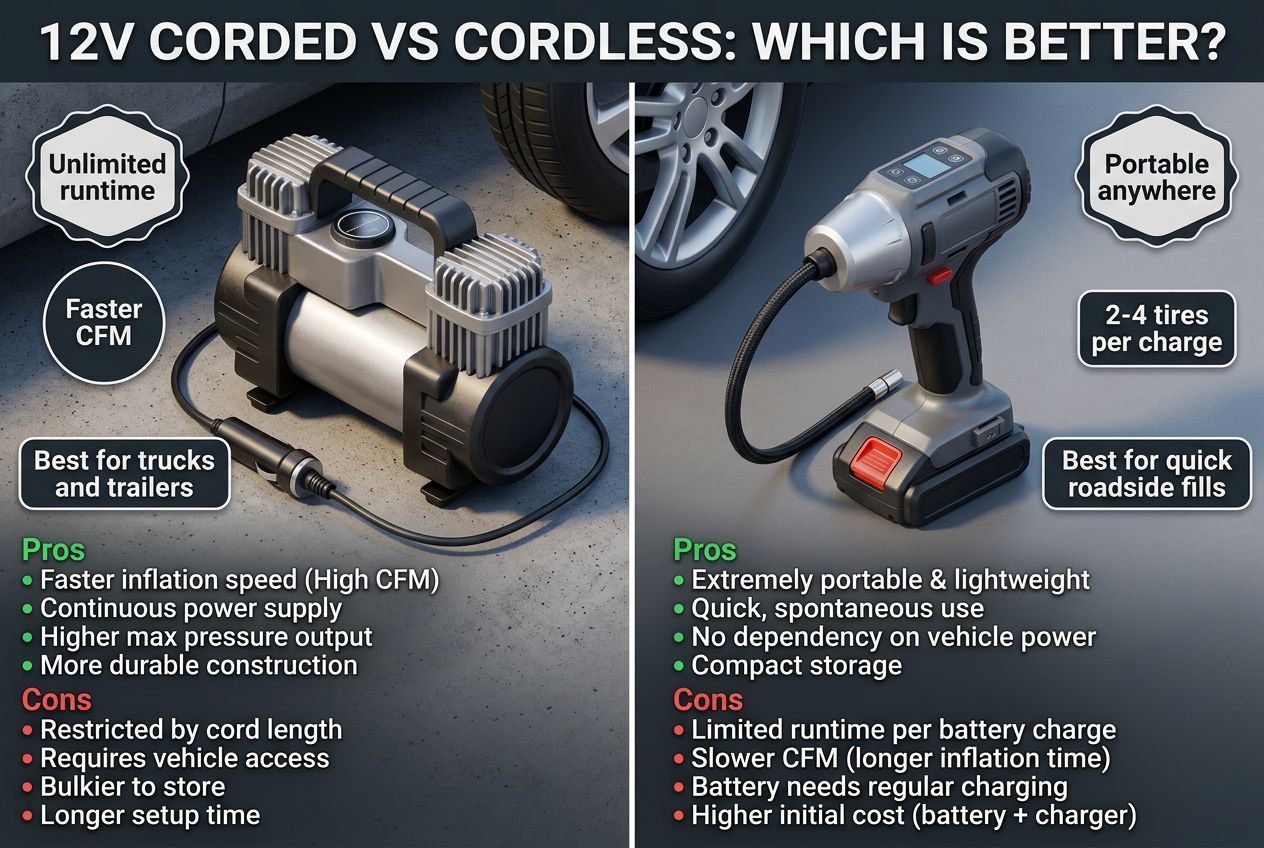
Cordless inflators are the fastest-growing category in portable air compressors, and they solve real convenience problems — but they come with trade-offs that matter for towing.

Advantages of cordless:

  • Work anywhere without a running vehicle or power outlet
  • Lighter and more compact than most 12V models
  • Shared battery platforms (Ryobi, DeWalt, Milwaukee) mean you may already have batteries
  • Great for non-car uses: bikes, sports balls, inflatable kayaks, air mattresses

Disadvantages of cordless:

  • Battery limits runtime to 2-4 full car tire inflations per charge
  • Slower CFM than most 12V models at higher pressures
  • Battery capacity degrades in cold weather (exactly when you need it most)
  • Tool-only pricing means the actual cost is $100+ if you don't already own the battery platform

For towing specifically, a 12V model is the better choice. You might need to inflate four trailer tires and four tow vehicle tires in a single session — that's 8 tires, which exceeds the battery capacity of every cordless model on the market. A 12V compressor runs indefinitely off your vehicle's battery.

If you don't tow and mainly want a tire inflator for emergency breakdowns, a cordless model stored in the trunk is perfectly fine.

Common Mistake: Buying a cordless tire inflator without the battery, then realizing the battery and charger cost more than the tool itself. DeWalt 20V batteries run $60-$100 each. If you're not already in a battery ecosystem, a 12V model gives better value.


12V versus cordless tire inflator comparison showing runtime speed and portability trade-offs
📋
VEHICLE SAFETY & RECOVERY

How Do You Use a Portable Tire Inflator Correctly?

Using a portable inflator is straightforward, but a few details make the difference between a quick fix and a frustrating experience.

Check the recommended PSI. Look at the sticker on the driver's door jamb — not the tire sidewall. The door jamb lists the vehicle manufacturer's recommended pressure. The tire sidewall lists the maximum pressure the tire can handle, which is higher and not the target inflation.

Start the vehicle first (for 12V models). Running the compressor with the engine off draws directly from the battery and can drain it in 20-30 minutes. Keep the engine running to maintain the battery while inflating.

Connect the chuck firmly. A poor seal at the valve stem wastes air and extends inflation time. Brass twist-on chucks (like the Viair 88P) seal better than push-on rubber chucks. If you hear hissing at the connection, reposition and try again.

Don't exceed the duty cycle. Most portable compressors are rated for 15-30 minutes of continuous use, then need a 30-minute cooldown. Overheat protection will shut some models off automatically, but cheaper models just melt. If you're filling multiple tires, check the compressor housing temperature between tires.

Set auto-shutoff if available. Digital models with auto-shutoff let you set a target PSI and walk away. The compressor stops automatically when the tire reaches pressure. This prevents over-inflation, which is especially important for trailer tires where proper pressure prevents sway.

Pro Tip: Check tire pressure when tires are cold — before driving or after sitting for 3+ hours. Tires gain 1 PSI for every 10°F increase in temperature. Checking after a highway drive gives artificially high readings. For towing, inflate trailer tires to the pressure listed on the tire sidewall (not the door jamb — trailers don't have one) since trailer tires carry maximum load.


⚙️
VEHICLE SAFETY & RECOVERY

Why Should Every Tow Vehicle Carry a Tire Inflator?

Tire pressure is the single most overlooked factor in towing safety. Low tire pressure on either the tow vehicle or trailer causes increased heat buildup, accelerated wear, and — most critically — trailer sway that can lead to loss of control.

A trailer tire at 45 PSI instead of the recommended 60 PSI flexes more under load, generates more heat, and creates an uneven contact patch that changes the trailer's tracking behavior. On a highway at 65 mph with a loaded trailer, that 15 PSI deficit can be the difference between a stable tow and a sway event.

Portable inflators are cheap insurance. A $30-50 compressor stored in the tow vehicle pays for itself the first time you arrive at the campground and discover a slow leak. Without an inflator, you're calling for roadside assistance or limping to the nearest gas station — assuming there's one within range.

Check tow vehicle and trailer tire pressures before every tow. It takes 5 minutes with a portable inflator and a $5 gauge. That 5 minutes eliminates one of the most common causes of towing incidents on the road.


Tow vehicle and trailer tire pressure diagram showing correct PSI levels and underinflation warning

Sources & Methodology

  1. 1.
    Viair Corporation — Official specifications for the 88P and 84P portable compressor models.
  2. 2.
    Consumer Reports — Independent tire inflator testing methodology and performance ratings.
  3. 3.
    NHTSA Tire Safety — Federal recommendations for tire pressure maintenance, TPMS, and underinflation risks.
  4. 4.
    Tire Industry Association — Industry standards for tire inflation pressures and equipment safety.
  5. 5.
    SAE J2657 — Society of Automotive Engineers standard for tire pressure monitoring systems.

TowingServiceHub is reader-supported: we may earn money from ads and from some links on this page. See our editorial policy.

Mark — Founder & Editor

Mark

Founder & Editor

Mark is the founder and editor of TowingServiceHub, which he launched in 2026 after struggling to find clearly sourced towing costs and truck specs. He works in enterprise technology and tows his own boats, trailers, and equipment, so he knows the questions drivers actually ask.

Read full bio →

Need a tow truck right now?

Browse vetted local providers in your area. Real Google ratings, verified business info, free to use.

Or browse all 50 states from our directory

Frequently Asked Questions

The Viair 88P is the best overall 12V tire inflator for most car owners, with 120 PSI max pressure, fast inflation speed, and a durable brass chuck for around $50. For cordless convenience, the Ryobi 18V ONE+ inflator is the best option if you already own Ryobi batteries, delivering 150 PSI max with no cord or cigarette lighter required.

Cordless tire inflators are worth it for convenience and portability. They work anywhere without needing a running vehicle or 12V outlet. The trade-off is battery life — most cordless models inflate 2-4 car tires per charge. For frequent use or larger tires (truck, RV, trailer), a 12V model with unlimited runtime from the vehicle's battery is more practical.

Most portable car tire inflators fill a standard passenger tire from 25 PSI to 35 PSI in 2-4 minutes. From completely flat to full, expect 4-8 minutes depending on the compressor's CFM rating. 12V models with higher CFM ratings are generally faster than cordless models running on battery power.

Most portable car tire inflators can fill truck tires, but it takes significantly longer due to the larger volume. For LT truck tires at 50-80 PSI, expect 8-15 minutes per tire. For trailer tires, check that the inflator reaches the required PSI — many trailer tires need 50-65 PSI, which is within range of most 12V compressors but may exceed some cordless models.

Choose 12V if you primarily use it with your vehicle, need to inflate larger tires, or want unlimited runtime. Choose cordless if you value portability, already own compatible batteries, or need to inflate items away from your car like bikes and sports equipment. For towing, 12V models are generally better since you may need to inflate trailer tires too.

Related Articles

Explore More Towing Guides

Browse all 157 expert guides and 10 free tools.