Skip to content
🛡️ VEHICLE SAFETY & RECOVERY

Car Shaking When Driving: 10 Causes and How to Fix Each One

Published · Updated · 12 min read
MarkUpdated Apr 15, 2026AAA Automotive Research

Key Takeaways

  • ✓**Tire imbalance** is the #1 cause of car shaking — cheapest fix at $15-$40 per tire
  • ✓Shaking at **60-70 mph** usually points to tires or wheels; at **any speed** points to suspension
  • ✓Shaking **when braking** means warped rotors — $150-$300 per axle to replace
  • ✓Shaking **during acceleration** suggests CV joints, U-joints, or motor mounts
  • ✓Sudden onset shaking is **more urgent** than gradual vibration that worsens over time

Key Takeaways

  • Tire imbalance is the #1 cause — cheapest fix at $15-$40 per tire
  • Shaking at 60-70 mph usually means tires or wheels; at any speed suggests suspension
  • Shaking when braking = warped rotors ($150-$300 per axle to fix)
  • Shaking during acceleration = CV joints, U-joints, or motor mounts
  • Sudden onset shaking is more urgent than gradual vibration buildup

Car shaking ranges from a mild steering wheel vibration at highway speed to a violent shudder that makes you pull over. The good news: most causes are straightforward to diagnose based on when and where the shaking occurs. The bad news: ignoring it usually makes the problem worse and more expensive. Tire-related shaking at $15-$40 per tire becomes $400+ for new tires if the imbalance wears them unevenly. A $200 CV joint replacement becomes a $1,000+ axle replacement if the joint fails completely.

If your car is shaking badly enough to feel unsafe, don't push it. Pull over and call roadside assistance or a tow truck — the cost of a tow is always less than the cost of an accident.


💰
VEHICLE SAFETY & RECOVERY

What Causes Car Shaking at Highway Speeds (55-70 mph)?

Vibration that starts or worsens at highway speeds almost always originates from the wheels and tires. At 60+ mph, the rotational forces amplify any imbalance or imperfection that's unnoticeable at slower speeds.

Cause 1: Unbalanced Tires

This is the single most common cause of highway-speed shaking. Tires lose balance over time as tread wears unevenly or balance weights fall off. The vibration is typically felt in the steering wheel (front tires) or the seat (rear tires). It's smooth and consistent — a steady buzz that gets stronger with speed.

Fix: Tire balance at any tire shop. Cost: $15-$40 per tire, $40-$100 for all four. Takes 30-45 minutes.

Cause 2: Bent or Damaged Wheel

Hitting a pothole, curb, or road debris can bend a wheel rim. Even a small bend creates a wobble at speed. The vibration pattern is similar to tire imbalance but may include a rhythmic thump.

Fix: Wheel repair ($75-$150) or replacement ($100-$500+ depending on the wheel). An alloy wheel specialist can straighten most bent aluminum wheels.

Cause 3: Tire Wear or Defects

Uneven tire wear — cupping, feathering, or flat spots from hard braking — creates vibration as the irregular surface rotates. Tire separation (internal belt shifting) causes a more violent shake and is a blowout risk.

Fix: Tire replacement ($100-$200 per tire installed). If only one tire is worn, replace in pairs (both fronts or both rears) for balanced handling.

Pro Tip: If the shaking appeared right after a tire rotation or new tire installation, go back to the shop. The most likely cause is incorrect balance or a weight that fell off during installation. Most shops will rebalance for free within 30 days.


📊
VEHICLE SAFETY & RECOVERY

What Causes Car Shaking When Braking?

Shaking that only happens when you press the brake pedal — and gets worse with harder braking — points directly to the brake system. This is the second most common type of vehicle vibration and the easiest to diagnose.

Cause 4: Warped Brake Rotors

Brake rotors warp from heat cycling — heavy braking followed by cooling creates uneven thickness across the rotor surface. When the brake pad clamps onto the high and low spots, it creates a pulsing vibration. Front rotor warping is felt in the steering wheel. Rear rotor warping is felt in the brake pedal and seat.

Fix: Rotor resurfacing ($30-$60 per rotor) if there's enough material remaining. Rotor and pad replacement ($150-$300 per axle) is the permanent fix.

Cause 5: Stuck Brake Caliper

A brake caliper that doesn't fully release keeps the pad in partial contact with the rotor. This creates heat, warps the rotor, and causes vibration. You may also notice the car pulling to one side during braking, a burning smell after driving, or one wheel being noticeably hotter than the others.

Fix: Caliper replacement ($200-$400 per caliper with labor). Rotor and pad replacement usually needed too since the stuck caliper likely damaged them.

Common Mistake: Ignoring brake shaking because "it's not that bad yet." Warped rotors wear brake pads unevenly, which damages the new rotors faster when you eventually replace them. Fix it early — resurfacing a rotor is $30-$60 versus $150+ for full replacement once it's too thin to machine.
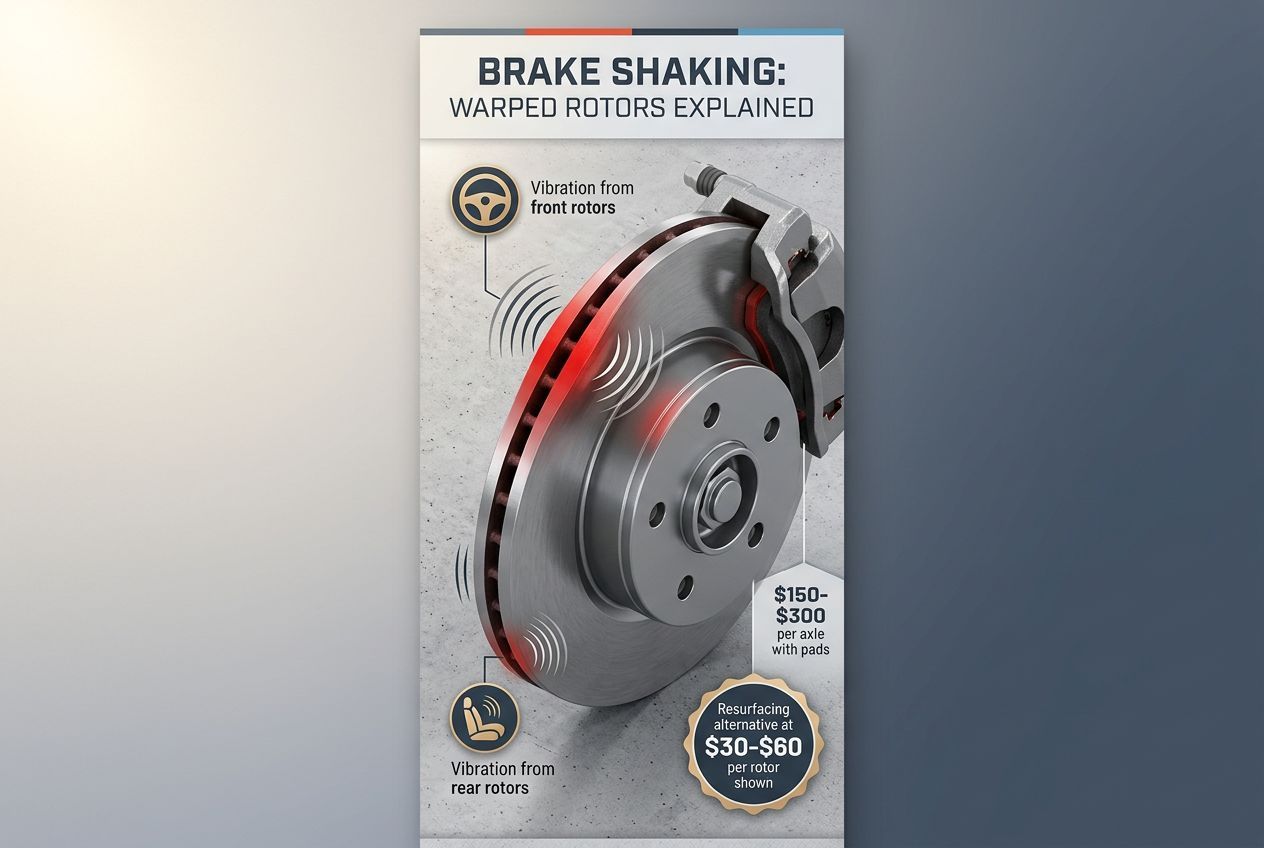
Warped brake rotor causing vibration when braking with cost range

Need a tow truck?

Use our free tools to estimate costs and find help near you.

Try Free Tools
🔧
VEHICLE SAFETY & RECOVERY

What Causes Car Shaking During Acceleration?

Vibration that appears or worsens specifically when you press the gas pedal — especially from a stop or during hard acceleration — indicates drivetrain component wear.

Cause 6: Worn CV Joints (Front-Wheel Drive / AWD)

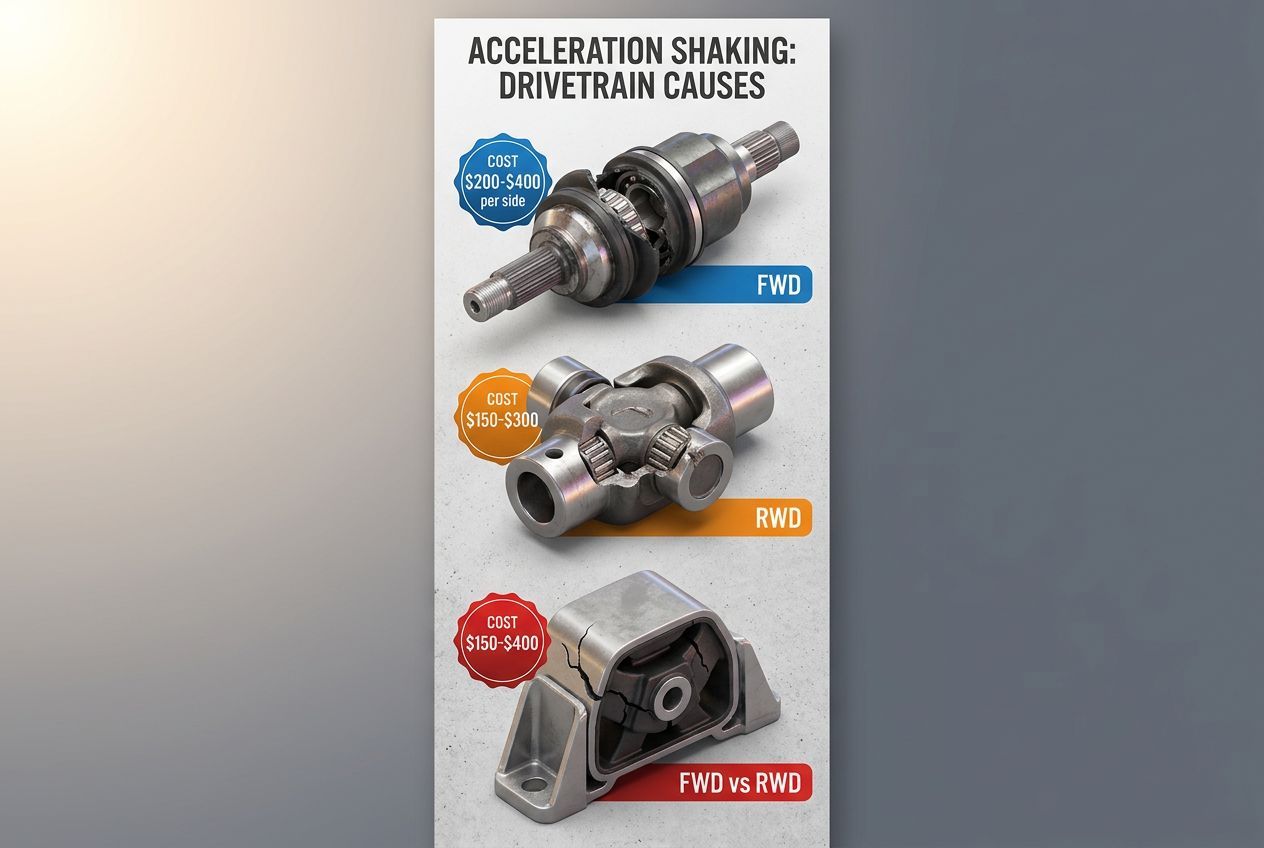
CV (constant velocity) joints connect the transmission to the front wheels, allowing them to turn while the suspension moves up and down. When the rubber boot protecting the CV joint tears, grease leaks out and dirt gets in. The joint wears and starts clicking during turns and vibrating during acceleration.

Fix: CV axle replacement ($200-$400 per side including labor). Don't just replace the boot — once dirt enters the joint, replacement is the only reliable fix.

Cause 7: Worn U-Joints (Rear-Wheel Drive / 4WD)

Universal joints connect the driveshaft to the transmission and rear differential. Worn U-joints create a vibration that's felt through the entire vehicle during acceleration and may include a clunking sound when shifting between drive and reverse.

Fix: U-joint replacement ($150-$300). If ignored, a failing U-joint can let the driveshaft drop to the ground while driving — an extremely dangerous failure.

Cause 8: Worn Motor Mounts

Motor mounts secure the engine to the vehicle frame and absorb engine vibration. When mounts crack, deteriorate, or break, engine vibration transfers directly to the cabin. You'll feel shaking at idle that worsens during acceleration, and the engine may visibly shift when you rev it.

Fix: Motor mount replacement ($150-$400 per mount, most vehicles have 3-4 mounts). The repair is labor-intensive because the engine must be supported while the mount is removed.

Key Insight: Acceleration-related shaking that only happens when the engine is cold and goes away after 5-10 minutes of driving is typically motor mounts. The rubber hardens in cold temperatures and softens as it warms up. This is still a sign the mounts are deteriorating and should be replaced before they fail completely.


Three causes of acceleration shaking CV joint U-joint and motor mount
🛡️
VEHICLE SAFETY & RECOVERY

What Causes Car Shaking at All Speeds?

If the vibration is present at all speeds — from parking lot crawl to highway — the problem is less likely to be rotational (tires/wheels) and more likely to be structural or suspension-related.

Cause 9: Worn Suspension Components

Ball joints, tie rod ends, control arm bushings, and wheel bearings all contribute to smooth vehicle operation. When any of these components wear, they allow play in the wheel assembly that creates vibration, wandering steering, and uneven tire wear. A worn wheel bearing often produces a humming or growling sound that changes with speed and gets louder in turns.

Fix: Component replacement varies widely. Ball joints ($150-$350 per side), tie rod ends ($100-$250), wheel bearings ($200-$500 per wheel). These should be inspected during any alignment service.

Cause 10: Wheel Alignment Issues

Misalignment doesn't directly cause shaking in most cases, but it causes uneven tire wear that eventually creates vibration. If your car drifts to one side and the tires show uneven wear patterns (one edge more worn than the other), alignment is likely the root cause of the vibration.

Fix: Wheel alignment ($75-$150). This should be done any time you replace tires, after hitting a significant pothole, or annually as preventive maintenance.

Pro Tip: When describing shaking to a mechanic, note: what speed it starts, whether it happens during braking or acceleration, where you feel it (steering wheel, seat, pedal), and whether it appeared suddenly or gradually. This information saves diagnostic time and money — a good description can cut a 2-hour diagnosis to 30 minutes.


📋
VEHICLE SAFETY & RECOVERY

How Do You Diagnose Which Part Is Causing the Shaking?

Use this diagnostic process to narrow down the cause before visiting a mechanic. The more information you bring, the faster and cheaper the diagnosis.

The speed test: If shaking starts at 55-70 mph and is steady, check tires and wheels first. If it happens at all speeds, check suspension. If it only happens above 40 mph during braking, check rotors.

The braking test: Apply brakes gently at various speeds. If shaking only appears during braking, rotors are the issue. If shaking is present while cruising and gets slightly better during braking (the pads dampen the rotor vibration), the cause is tires or suspension.

The acceleration test: From a stop, accelerate moderately. If vibration worsens with throttle input, check CV joints (FWD/AWD), U-joints (RWD), or motor mounts. Rev the engine in park — if it shakes in park, motor mounts are the likely cause.

The tire swap test: If you have a full-size spare, swap it onto each wheel position one at a time and test drive. If the shaking disappears when a specific wheel position gets the spare, the tire or wheel from that position is the problem.

If your car breaks down due to severe shaking, pull over safely and assess whether driving to a shop is possible. Violent shaking, grinding noises, or a pull to one side during braking warrant a tow rather than continuing to drive.


⚙️
VEHICLE SAFETY & RECOVERY

How Much Does It Cost to Fix a Shaking Car?

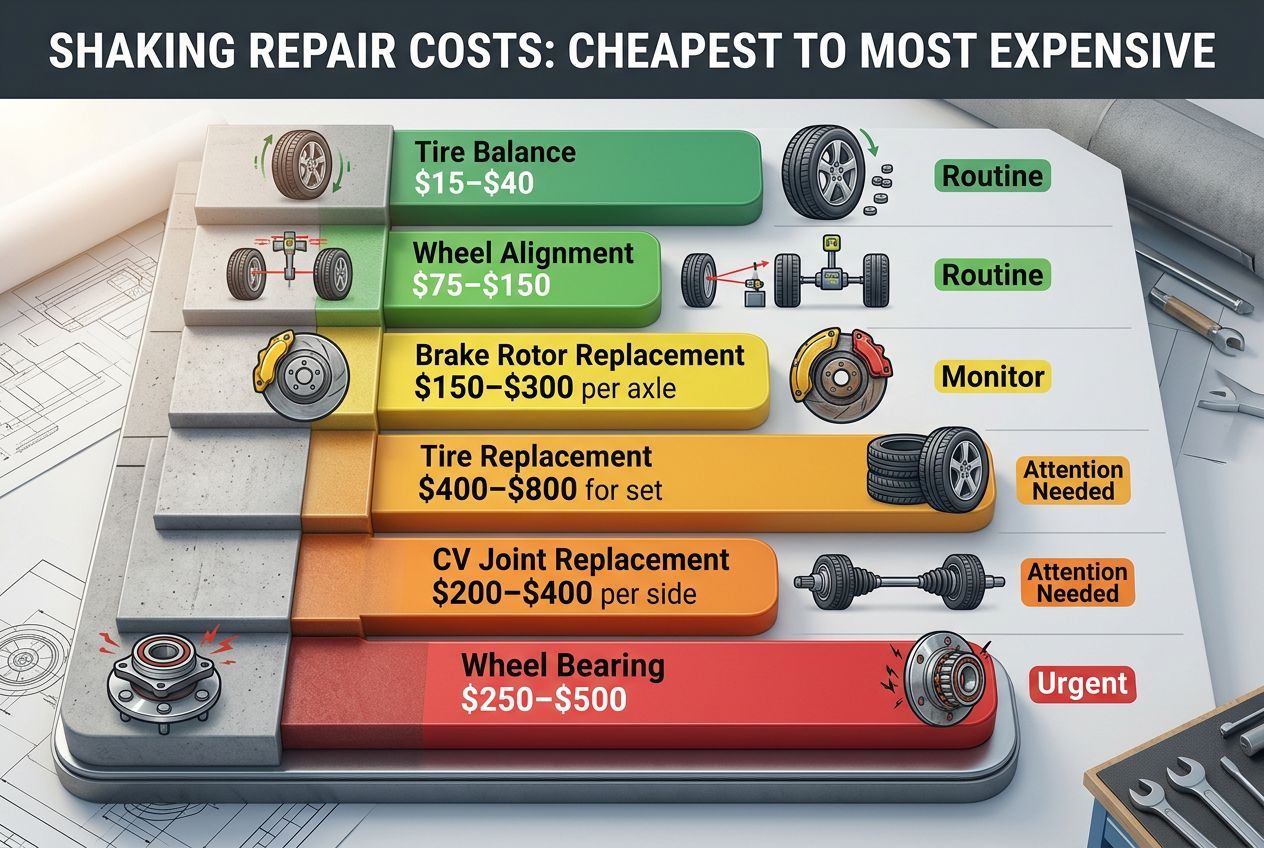
Here's a cost summary for the 10 most common causes, from cheapest to most expensive.

How Much Does It Cost to Fix a Shaking Car? — data table
Cause Repair Cost Range Urgency
Tire imbalance Rebalance $15-$100 (all 4) Low — fix within 1-2 weeks
Brake rotor resurface Machine rotors $60-$120 (per axle) Medium — fix within 1 week
Wheel alignment Align $75-$150 Low — fix within 2-4 weeks
Tire replacement New tires $400-$800 (set of 4) Medium — depends on wear severity
Bent wheel Repair/replace $75-$500 Medium — depends on severity
Brake rotors + pads Replace $150-$300 (per axle) Medium — fix within 1 week
Tie rod ends Replace $100-$250 (per side) High — affects steering control
U-joints Replace $150-$300 High — driveshaft drop risk
CV joints Replace axle $200-$400 (per side) High — can strand you if it fails
Motor mounts Replace $150-$400 (per mount) Medium — won't strand you, but worsens

Source: AAA Automotive Research, RepairPal national repair cost averages

Start with the cheapest diagnostic steps. A tire balance at $15-$40 per tire takes 30 minutes and eliminates or confirms the most common cause. If balancing doesn't solve it, move to inspection of brakes, suspension, and drivetrain components.


Car shaking repair cost chart from tire balance to CV joint replacement by urgency

Sources & Methodology

  1. 1.
    AAA Automotive Research — Vehicle maintenance recommendations and national average repair cost data.
  2. 2.
    NHTSA Vehicle Complaints Database — Federal safety complaint data for vibration-related issues across vehicle makes and models.
  3. 3.
    Tire Industry Association — Tire balance, alignment, and wear pattern diagnostic standards for the tire service industry.
  4. 4.
    ASE (Automotive Service Excellence) — Certified technician diagnostic procedures for vehicle vibration, noise, and harshness issues.
  5. 5.
    SAE International — Engineering standards for vehicle NVH (noise, vibration, harshness) analysis and diagnosis.

TowingServiceHub is reader-supported: we may earn money from ads and from some links on this page. See our editorial policy.

Mark — Founder & Editor

Mark

Founder & Editor

Mark is the founder and editor of TowingServiceHub, which he launched in 2026 after struggling to find clearly sourced towing costs and truck specs. He works in enterprise technology and tows his own boats, trailers, and equipment, so he knows the questions drivers actually ask.

Read full bio →

Need a tow truck right now?

Browse vetted local providers in your area. Real Google ratings, verified business info, free to use.

Or browse all 50 states from our directory

Frequently Asked Questions

A car shaking at highway speeds (55-70 mph) is most commonly caused by unbalanced tires, worn tire tread, or a bent wheel. At higher speeds, even a small imbalance creates noticeable vibration. Tire balance is the cheapest fix at $15-$40 per tire and should be checked first before investigating more expensive causes.

Shaking when braking is almost always caused by warped brake rotors. The brake pads clamp onto an uneven surface, creating a pulsing vibration felt through the steering wheel (front rotors) or the seat and pedal (rear rotors). Rotor resurfacing costs $30-$60 per rotor. Replacement costs $150-$300 per axle with pads.

It depends on the cause. Mild vibration from tire imbalance is annoying but not immediately dangerous — get it fixed within a week. Shaking from a damaged wheel bearing, loose suspension components, or a failing CV joint is a safety issue — stop driving and get it inspected immediately. Shaking that gets worse over time or appears suddenly should be treated as urgent.

Costs range from $15 for a tire balance to $1,500+ for a transmission issue. The most common fixes are tire balancing ($15-$40 per tire), wheel alignment ($75-$150), brake rotor replacement ($150-$300 per axle), and tire replacement ($400-$800 for a set of four). Diagnosis at a shop typically costs $50-$100.

Shaking during acceleration points to drivetrain components: worn CV joints (front-wheel drive), damaged driveshaft U-joints (rear-wheel drive), worn motor mounts, or transmission issues. CV joint replacement costs $200-$400 per side. Motor mounts cost $150-$400 per mount. These should be inspected promptly as they can worsen quickly.

Related Articles

Explore More Towing Guides

Browse all 157 expert guides and 10 free tools.