Skip to content
🛡️ VEHICLE SAFETY & RECOVERY

Car Died While Driving: What to Do and 8 Common Causes

Published · Updated · 12 min read
MarkUpdated Apr 15, 2026NHTSA

Key Takeaways

  • ✓**Hazards on, steer right, coast to safety** — the first 10 seconds matter most
  • ✓Failed alternator is the **#1 cause** — watch for the battery warning light
  • ✓Empty fuel or failed fuel pump is **#2** — engine sputters before dying
  • ✓Brakes still work without the engine but require **more pedal force**
  • ✓Most stall repairs cost **$150-$800** plus a $75-$200 tow to the shop

Key Takeaways

  • Hazards on, steer right, coast to safety — the first 10 seconds are critical
  • Failed alternator is the #1 cause of a car dying while driving
  • Empty fuel tank or failed fuel pump is #2 — engine sputters before stalling
  • Brakes still function without the engine but need significantly more pedal force
  • Most repairs cost $150-$800 plus a $75-$200 tow to the shop

A car dying while driving is one of the most alarming vehicle failures. The engine shuts off, power steering goes heavy, and the brake pedal stiffens — all while you're surrounded by traffic. The first 10 seconds determine your safety. This guide covers exactly what to do in the moment, the 8 most common causes, how to diagnose each one, and what you'll spend to fix it.


💰
VEHICLE SAFETY & RECOVERY

What Should You Do the Moment Your Car Dies While Driving?

The engine just cut out. Here's the sequence, step by step.

Seconds 1-3: Hazard lights on. Hit the hazard button immediately. This alerts every driver around you that something is wrong. The hazard lights run on battery power and work even with the engine off.

Seconds 3-5: Do NOT slam the brakes. The brake booster uses engine vacuum to assist your pedal force. Without the engine, you lose power assist — but the brakes still physically work. You'll need to push the pedal much harder than normal. Pump the pedal once or twice to build any remaining vacuum, then apply steady, firm pressure.

Seconds 5-10: Steer to safety. Power steering is also gone, making the wheel heavier — especially at low speed. Steer toward the right shoulder, a parking lot, or any area away from moving traffic. Use your remaining momentum to coast as far right as possible.

Once stopped: Shift to park (automatic) or neutral (manual). Set the parking brake. Keep your seatbelt on. If you're on a highway shoulder, stay inside the vehicle — getting out puts you at risk from passing traffic. If you're in a safe location (parking lot, residential street), you can exit to assess.

Try to restart. Turn the key off completely, wait 10 seconds, then try to restart. If it starts and runs, drive immediately to the nearest mechanic or safe location. If it cranks but won't start, or won't crank at all, you need a tow or roadside assistance.

Key Insight: Do NOT try to restart while the car is still rolling. Shift to neutral and coast to a stop first. Some vehicles lock the steering column when you cycle the ignition — restarting while moving could leave you unable to steer. Always stop completely before attempting a restart.
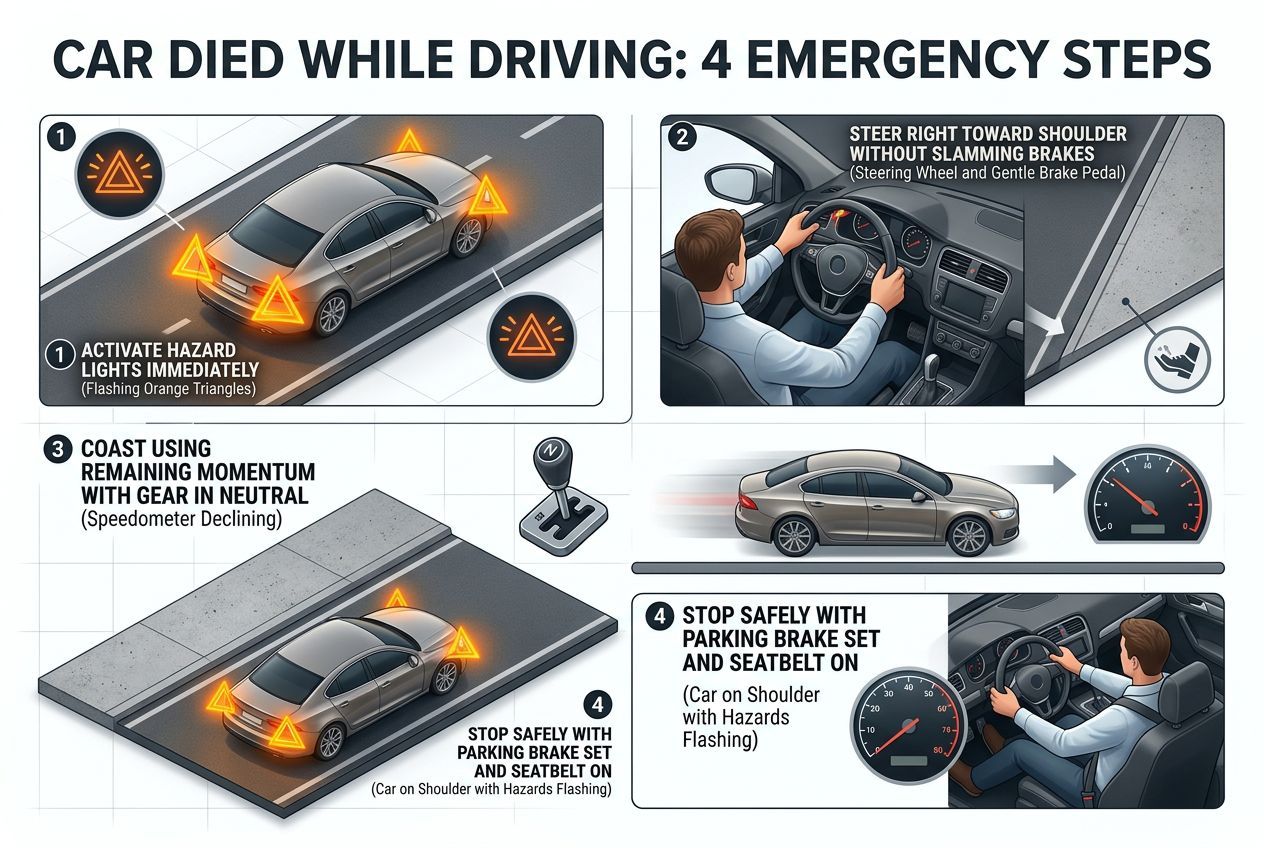

Emergency steps when car dies while driving hazards steer coast and stop safely
📊
VEHICLE SAFETY & RECOVERY

What Are the Most Common Causes of a Car Dying While Driving?

Eight causes account for the vast majority of engine-dies-while-driving failures. The symptoms before the stall tell you which system failed.

What Are the Most Common Causes of a Car Dying While Driving? — data table
Cause Warning Signs Before Stall Repair Cost Urgency
Failed alternator Battery light, dimming lights, electronics failing $300-$600 High — won't restart
Out of gas / fuel pump failure Sputtering, loss of power, surging $0-$800 High — won't restart
Crankshaft position sensor Intermittent stalling, rough idle before dying $150-$300 Medium — may restart
Overheating Temp gauge high, steam, warning light $100-$2,000 Critical — do NOT restart hot
Ignition system failure Misfires, rough running before stall $100-$400 Medium — may restart
Timing belt/chain failure Sudden death with no warning, engine sounds different $500-$1,500 Critical — do NOT restart
Clogged fuel filter Gradual power loss, sputtering under load $50-$150 Low — may restart temporarily
Faulty ignition switch Electrical flickering, intermittent power loss $150-$350 Medium — may restart by jiggling key

Source: AAA roadside data, ASE diagnostic procedures
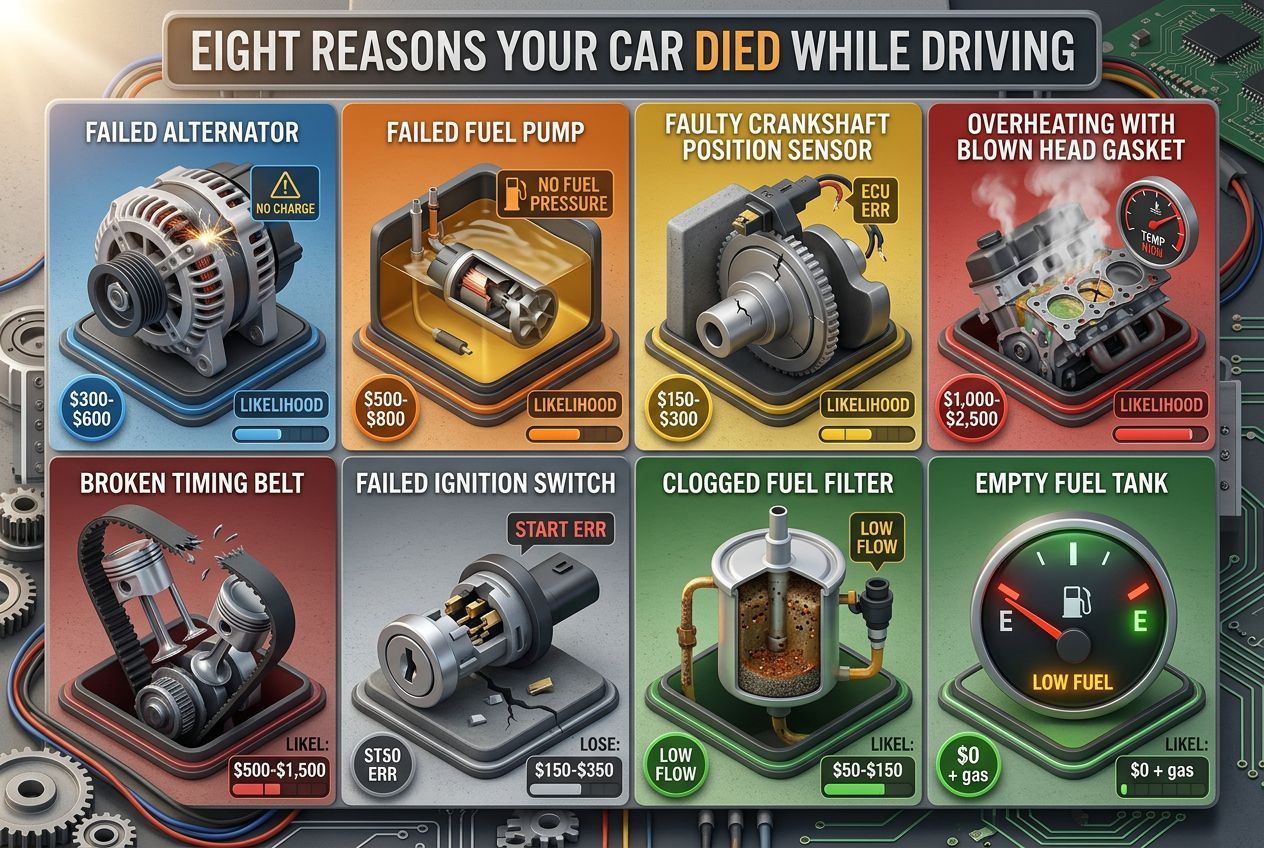

Eight common causes of car dying while driving from alternator to fuel pump with repair costs

Need a tow truck?

Use our free tools to estimate costs and find help near you.

Try Free Tools
🔧
VEHICLE SAFETY & RECOVERY

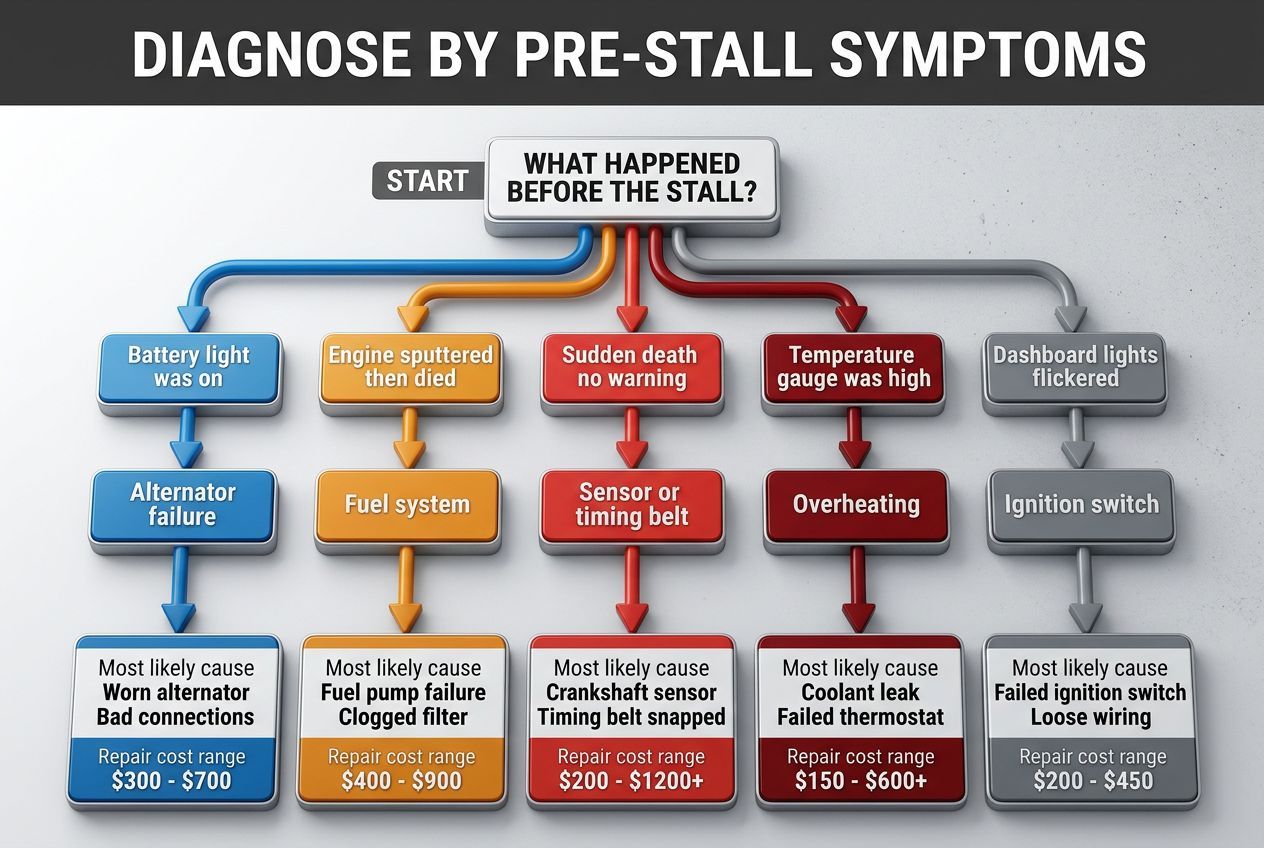
How Do You Diagnose Why Your Car Died?

The symptoms before the stall are your best diagnostic clues. Think back to the 30-60 seconds before the engine cut out.

Did the battery warning light come on first? The alternator failed. The car ran on battery power until it was depleted. Dashboard lights dimmed progressively. Headlights got weaker. Eventually the battery couldn't power the ignition system and the engine died. This is the most common cause and follows a predictable pattern: warning light → dim electronics → engine death over 20-45 minutes.

Did the engine sputter or surge before dying? Fuel system issue — either the tank is empty, the fuel pump failed, or the fuel filter is clogged. The engine runs lean, sputters, surges, and eventually starves for fuel. If the gauge shows empty, the diagnosis is obvious. If the gauge shows fuel, the pump or filter is suspect.

Did the engine die suddenly with no warning? Crankshaft position sensor failure or timing belt/chain failure. Both can cause an instant stall with no sputtering or warning signs. A crankshaft sensor failure usually allows restart after cooling. A timing belt snap does not — and attempting to restart can cause catastrophic engine damage on interference engines.

Was the temperature gauge climbing before the stall? The engine overheated and either stalled from heat damage or triggered a protective shutdown (some modern vehicles do this automatically). Do NOT attempt to restart until the engine has cooled for at least 30 minutes. Opening the radiator cap on a hot engine can cause severe burns from pressurized steam.

Did the dashboard electronics flicker or cut out? Faulty ignition switch. The switch intermittently loses contact, cutting power to the entire ignition and fuel system. Jiggling the key may temporarily restore contact. This is more common on older vehicles with physical key ignition.

Common Mistake: Assuming you ran out of gas because the gauge reads empty. Modern fuel gauges are notoriously inaccurate, and a faulty fuel level sensor can read empty with a quarter tank remaining. If you recently filled up and the gauge reads empty, the sensor may have failed — the actual problem could be something else entirely.


Diagnostic flowchart for car dying while driving based on pre-stall symptoms

🛡️
VEHICLE SAFETY & RECOVERY

Which Car Stall Causes Are Dangerous and Which Are Not?

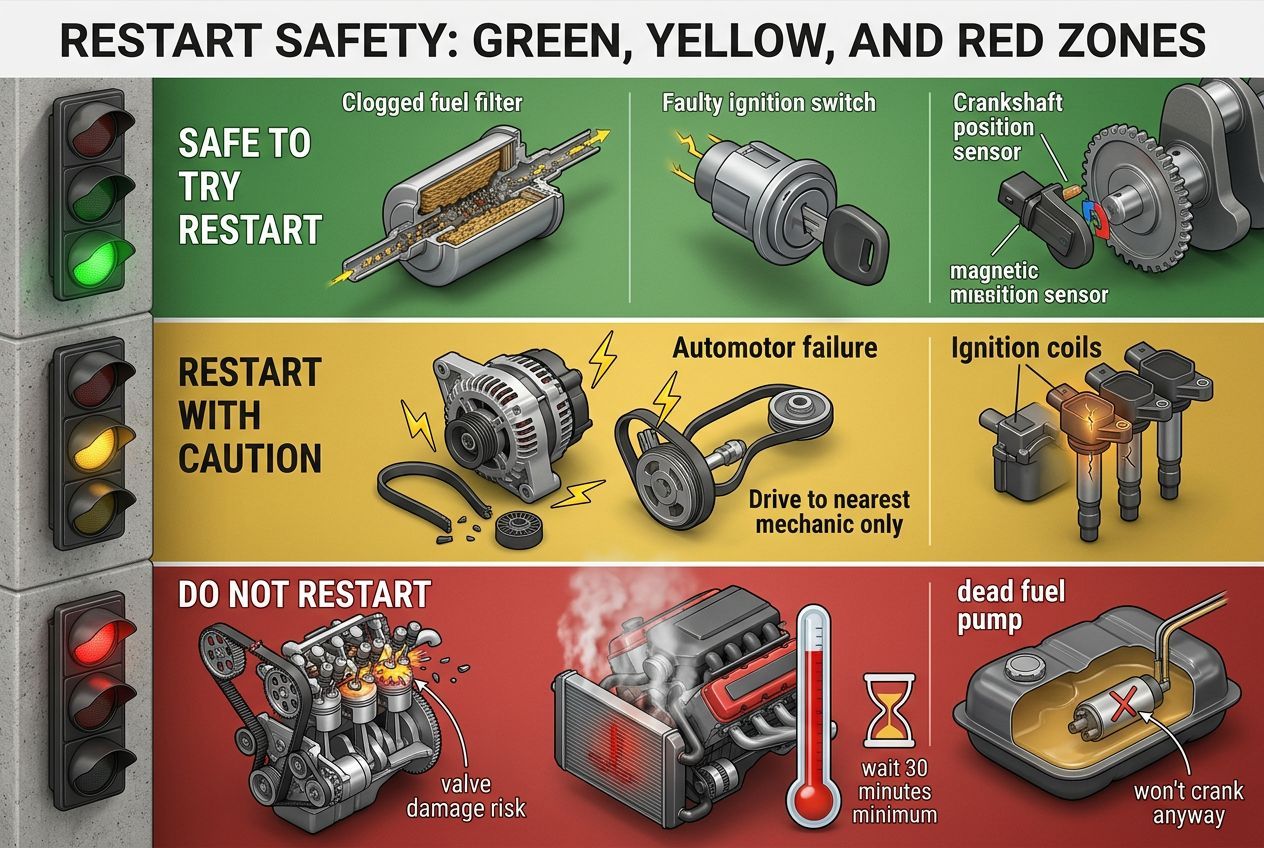
Not all stall causes carry the same risk. Some let you safely restart and drive to a shop. Others can destroy the engine if you try.

Safe to restart and drive (carefully):

  • Clogged fuel filter — may run rough but won't cause damage. Drive directly to a mechanic.
  • Faulty ignition switch — intermittent. May stall again. Stay on local roads, avoid highways.
  • Crankshaft position sensor — may restart after cooling. Drive slowly to nearest shop.

Restart cautiously, drive to shop immediately:

  • Failed alternator — if the car restarts, you're running on battery alone. You have 10-20 minutes of drive time. Turn off all non-essential electronics (AC, radio, lights if daytime) to conserve battery. Head to the nearest shop or safe parking area.
  • Ignition coil failure — may run on fewer cylinders. Rough but driveable short distance.

Do NOT restart — call a tow:

  • Timing belt/chain failure — restarting an interference engine with a broken belt bends valves and pistons. Repair goes from $500-$1,500 (belt replacement) to $3,000-$6,000 (engine rebuild).
  • Overheated engine — restarting a severely overheated engine can crack the head gasket, warp the cylinder head, or seize the engine. Wait 30+ minutes minimum. If coolant is pooling under the car, the cooling system is breached — tow it.
  • Complete fuel pump failure — won't restart no matter what you try. Need a tow.

If you need a tow and don't have roadside assistance, expect to pay $75-$200 for a local tow depending on distance. Having AAA or insurance roadside coverage saves this cost.

Pro Tip: Before calling a tow truck, try one restart attempt (unless overheated or you heard a loud bang/snap). If it starts, you may be able to drive to a shop and save the tow fee. If it cranks but won't start after two attempts, stop trying — you're just draining the battery. Time to call for help.


Restart safety guide for car stalls showing safe caution and do not restart categories
📋
VEHICLE SAFETY & RECOVERY

How Can You Prevent Your Car from Dying While Driving?

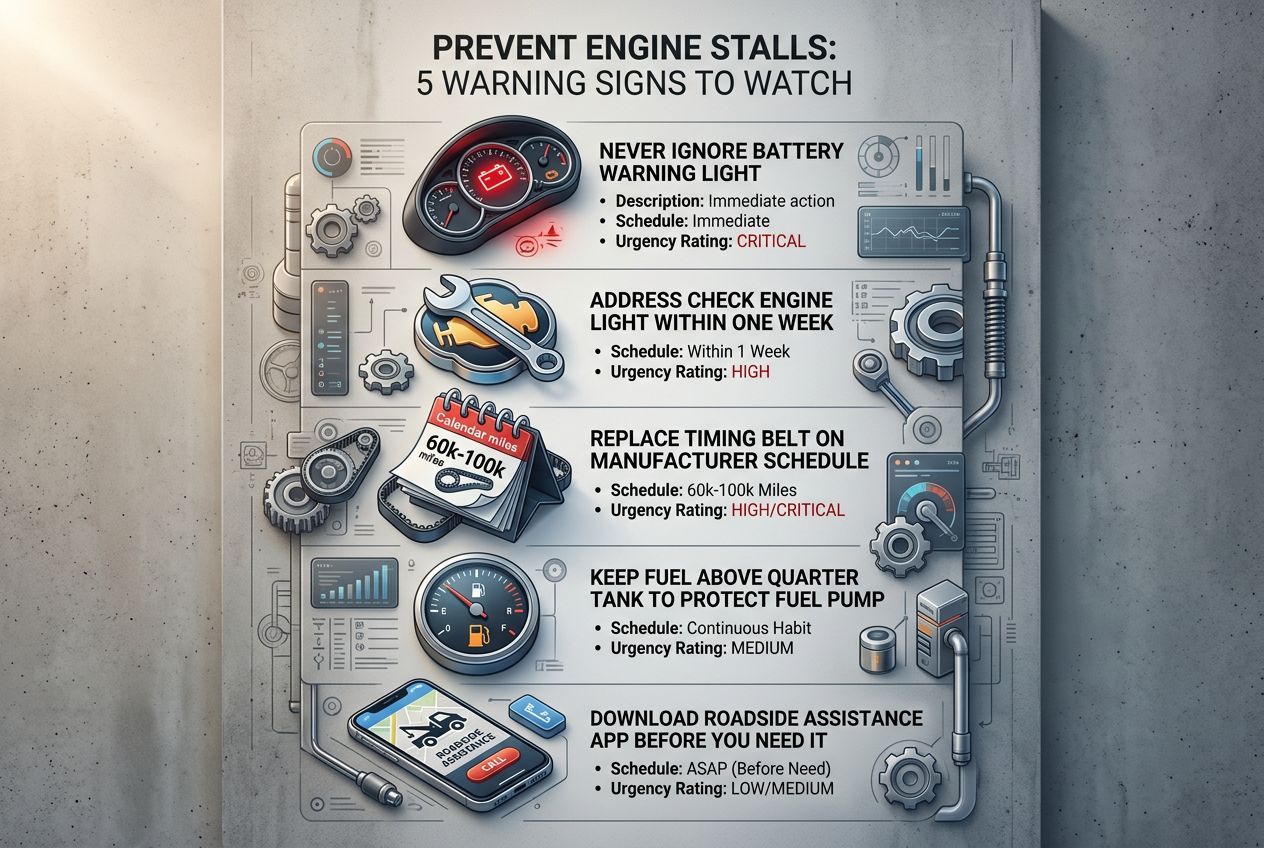
Most engine-dies-while-driving failures are predictable and preventable with basic maintenance.

Watch for the battery warning light. If this light comes on while driving, the alternator has stopped charging. You have 20-45 minutes before the engine dies. Don't panic — drive directly to the nearest mechanic or auto parts store. Every auto parts store tests alternators for free.

Don't ignore the check engine light. A steady check engine light often precedes a crankshaft sensor failure, ignition system issue, or fuel system problem. Get the code scanned (free at auto parts stores) and address it before it leaves you stranded.

Replace the timing belt on schedule. If your vehicle has a timing belt (not a chain), the manufacturer specifies a replacement interval — typically 60,000-100,000 miles. A $500-$1,500 belt replacement is far cheaper than the $3,000-$6,000 engine rebuild that follows a snap.

Monitor fuel levels realistically. Running the tank below 1/4 regularly exposes the fuel pump to air, accelerating wear. The pump uses fuel for cooling — low fuel means less cooling. Keeping above 1/4 tank extends fuel pump life by years.

Carry a roadside assistance app or membership. When the car dies and won't restart, the speed of getting help matters — especially on a highway shoulder. Having a tow service one tap away on your phone reduces a stressful situation to a manageable inconvenience.


Prevention checklist for car dying while driving including warning lights and maintenance schedule

Sources & Methodology

  1. 1.
    NHTSA — Vehicle stall complaint database, safety recommendations for highway breakdowns, and recall data.
  2. 2.
    AAA — Roadside assistance breakdown cause statistics and average response time data.
  3. 3.
    ASE (Automotive Service Excellence) — Certified technician diagnostic procedures for engine stall conditions.
  4. 4.
    National Safety Council — Highway breakdown safety data and lane departure accident statistics.
  5. 5.
    FHWA — Federal Highway Administration shoulder safety studies and vehicle breakdown incident management.

TowingServiceHub is reader-supported: we may earn money from ads and from some links on this page. See our editorial policy.

Mark — Founder & Editor

Mark

Founder & Editor

Mark is the founder and editor of TowingServiceHub, which he launched in 2026 after struggling to find clearly sourced towing costs and truck specs. He works in enterprise technology and tows his own boats, trailers, and equipment, so he knows the questions drivers actually ask.

Read full bio →

Need a tow truck right now?

Browse vetted local providers in your area. Real Google ratings, verified business info, free to use.

Or browse all 50 states from our directory

Frequently Asked Questions

Stay calm, turn on hazard lights immediately, steer toward the right shoulder or nearest safe area, and coast as far as possible using remaining momentum. Do not slam the brakes — the brake pedal will feel harder without engine vacuum assist but still works. Once stopped, put the car in park, set the parking brake, and stay inside with your seatbelt on if you're on a highway.

The most common causes are a failed alternator (battery drains while driving), empty fuel tank or failed fuel pump, a faulty crankshaft position sensor, or an overheating engine that triggered a safety shutdown. Less common causes include a broken timing belt, ignition switch failure, or a clogged fuel filter. Diagnosis depends on warning lights and symptoms before the stall.

Yes. A failed alternator stops charging the battery while the engine runs. The car continues driving on battery power alone for 20-45 minutes until the battery is fully drained, then the engine dies. Warning signs include a battery warning light on the dashboard, dimming headlights, and electrical accessories failing before the engine shuts down.

You can safely try to restart after pulling over. If it restarts and runs normally, drive to a mechanic promptly — the stall will likely recur. If it won't restart, don't keep cranking for more than 10-15 seconds per attempt to avoid draining the battery completely. If the engine overheated, do NOT restart until it has cooled for at least 30 minutes.

Repair costs range from $0 (ran out of gas) to $1,500+ (timing belt or fuel pump with labor). Common fixes: alternator $300-$600, fuel pump $400-$800, crankshaft position sensor $150-$300, ignition coil $100-$300. A tow to the shop adds $75-$200 depending on distance.

Related Articles

Explore More Towing Guides

Browse all 157 expert guides and 10 free tools.