Detailed Towing Capacity Breakdown: Here's a full breakdown of 2010 F-150 towing capacity by engine and configuration, sourced from Ford's official 2010 Trailer Towing Guide (available via ford.com):
What Is the 2010 F-150 Towing Capacity? — data table
| Engine |
Config |
Axle Ratio |
Drive |
Max Tow (lbs) |
| 5.4L 3V V8 |
Regular Cab, Short Bed |
3.73 |
2WD |
11,300 |
| 5.4L 3V V8 |
SuperCrew, Short Bed |
3.73 |
4WD |
10,100 |
| 4.6L 3V V8 |
Regular Cab, Short Bed |
3.73 |
2WD |
9,500 |
| 4.6L 2V V8 |
SuperCab, Long Bed |
3.55 |
2WD |
7,700 |
| 4.6L 2V V8 |
Regular Cab, Short Bed |
3.31 |
2WD |
6,100 |
Source: Ford Motor Company 2010 Trailer Towing Guide. All ratings assume factory tow package installed.
Understanding Weight Impact: Towing numbers shift quickly based on your truck's specific build. A SuperCrew body adds significant weight over a Regular Cab, and opting for 4WD adds another 100–200 lbs of drivetrain mass. Both of these factors reduce your available tow capacity.
✅ Pro Tip: Check the door-jamb sticker on your driver's side B-pillar for your GVWR (Gross Vehicle Weight Rating), GAWR (Gross Axle Weight Rating), and payload. Cross-reference these with Ford's Trailer Towing Supplement, which is a separate document from the owner's manual, for accurate figures.

📊
TRUCK TOWING CAPACITY
How Much Can a 2010 F-150 with the 5.4L V8 Tow?
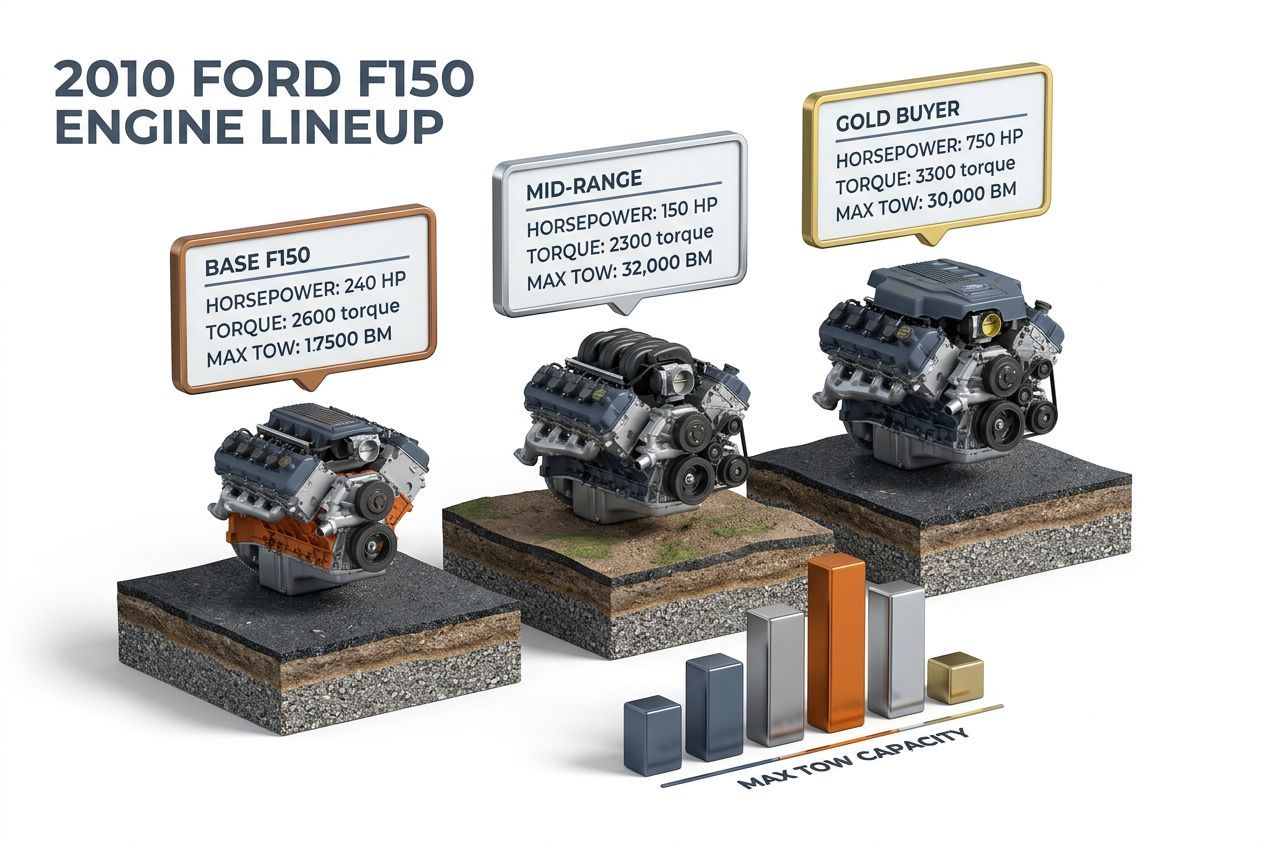
Top-Tier Performance: The 2010 F-150 with the 5.4L 3-valve Triton V8 produces 310 hp and 365 lb-ft of torque, reaching a maximum conventional tow rating of 11,300 lbs in the best-case configuration: Regular Cab, 2WD, short bed, 3.73 limited-slip rear axle, and factory tow package. This is the most capable engine Ford offered in the 2010 F-150 lineup.
Engine and Transmission Pairing: The 5.4L 3V was the top engine in the 12th-generation F-150 lineup and the same block Ford used in the SVT Raptor (though the Raptor used a unique tune). Paired with the 6R80 6-speed automatic — the same transmission used in the Mustang GT at the time — this setup handles sustained towing loads well, provided the essential tow package cooling upgrades are in place.
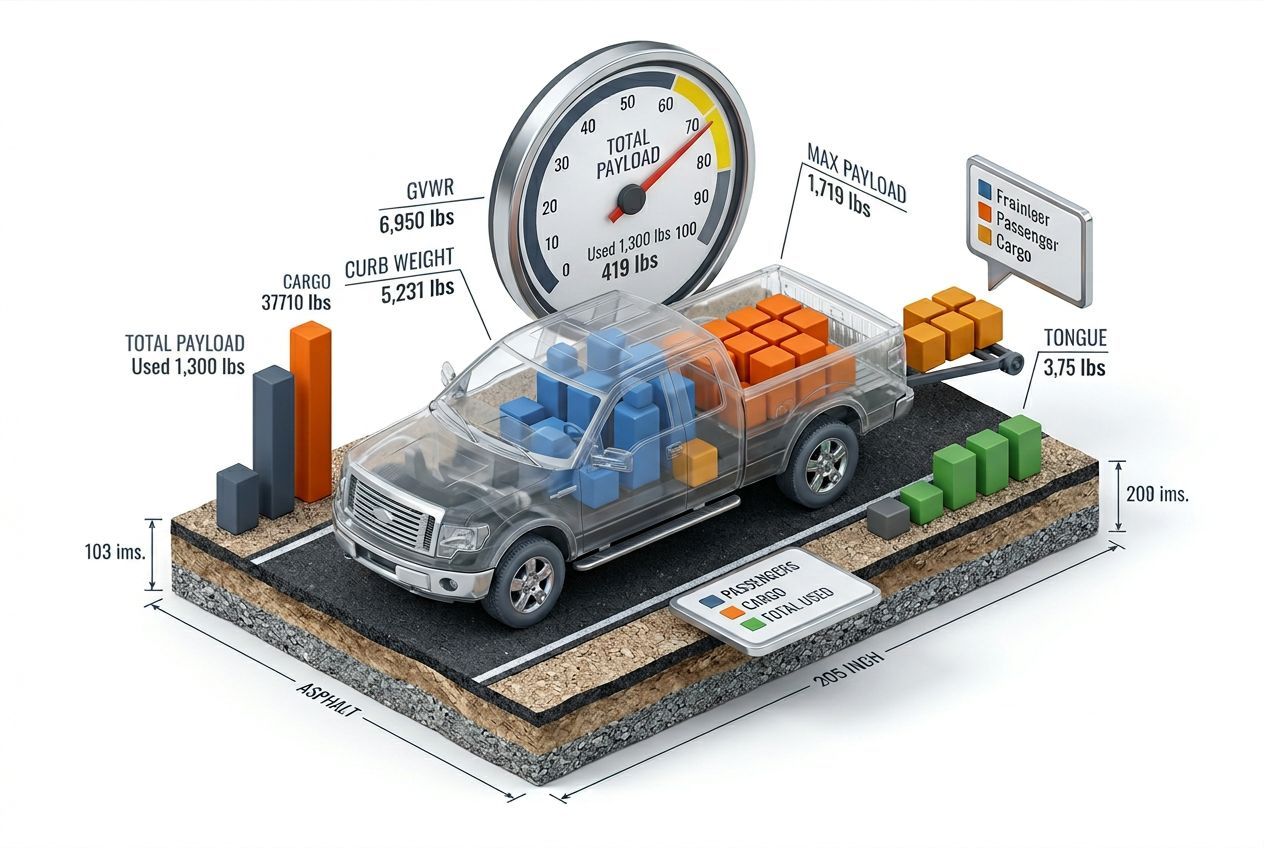
Practical Payload Example: Consider towing a loaded 8,500-lb travel trailer. If the tongue weight is 13%, that's approximately 1,105 lbs pressing down on your hitch. Now, add a driver (200 lbs), a passenger (160 lbs), and 150 lbs of gear in the cab. This totals 1,615 lbs, which directly counts against your truck's available payload. If your 5.4L Regular Cab is rated at 1,900 lbs payload, you'd have roughly 285 lbs of headroom — enough for a full fuel tank (~140 lbs) but very little else. While not overloaded, you're close. A SuperCrew 5.4L, often having a lower payload rating, could easily push you over the limit before adding much cargo.
If you're comparing the 2010 to nearby model years, our 2009 F-150 towing capacity and 2011 F-150 towing capacity pages break down what changed year to year.
🔧
TRUCK TOWING CAPACITY
What Is the Towing Capacity of a 2010 F-150 with the 4.6L V8?
Understanding 4.6L Engine Variants: The 2010 F-150 with the 4.6L 3-valve V8 produces 292 hp and 320 lb-ft of torque, achieving a maximum tow capacity of approximately 9,500 lbs with a Regular Cab 2WD setup and 3.73 rear axle. The 4.6L 2-valve variant — rated at 248 hp and 276 lb-ft — tops out between 6,100 and 7,700 lbs depending on configuration.
Significant Power Differences: That gap between the 2-valve and 3-valve 4.6L engines is significant. The difference between 248 hp and 292 hp isn't just a spec sheet number — it translates directly to pulling power at highway speeds and when climbing grades.
✅ Pro Tip: If you're not sure which 4.6L variant you have, check the engine cover or the emissions decal under the hood. The 3-valve (3V) will be clearly marked. Alternatively, a VIN decoder at Edmunds or Kelley Blue Book will confirm your engine code.
Impact on Used Purchases: Many 2010 F-150 buyers on a budget ended up with the 4.6L 2V, as it was the standard engine on XL and base trims. If you're shopping used, always confirm the engine code before assuming a mid-range tow capacity.
🛡️
TRUCK TOWING CAPACITY
Does the 2010 F-150 Need a Tow Package to Reach Max Towing?
The Necessity of the Factory Tow Package: Yes — the 2010 F-150 absolutely requires Ford's factory tow package to achieve its published maximum tow rating. Without it, you're towing on base-spec cooling and wiring that wasn't engineered for sustained heavy loads, and your actual safe capacity can drop by 1,500 to 2,000 lbs or more.
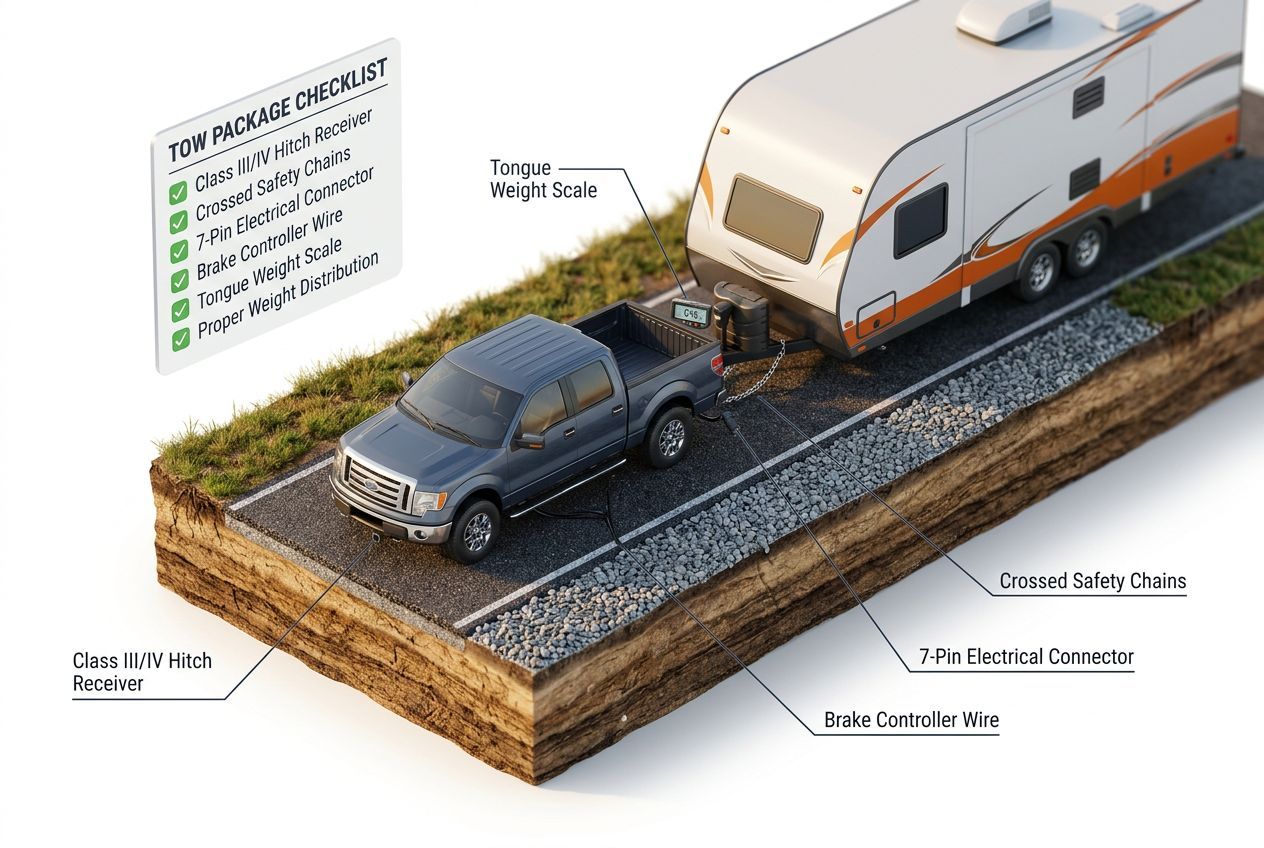
Key Components of the Class IV Trailer Tow Package: Ford's factory Class IV Trailer Tow Package on the 2010 F-150 includes several crucial upgrades:
- Class IV hitch receiver: Rated for 10,000-lb gross trailer weight, typically stamped on the receiver tube near the pin hole.
- 7-pin wiring harness: Essential for trailer brake and lighting connections.
- Upgraded transmission oil cooler: Critical for maintaining safe transmission temperatures under sustained heavy loads with the 6R80 transmission.
- Engine oil cooler: Included on 5.4L-equipped trucks for additional thermal management.
- Heavy-duty flasher relay: Ensures proper signaling with additional trailer lights.
- Trailer sway control: Integrated with AdvanceTrac on equipped vehicles for improved stability.
⚠️ Warning: Towing at max capacity with a used 2010 F-150 and degraded transmission fluid compounds this risk considerably. According to Ford's own service guidance, Mercon LV is the specified ATF for the 6R80. Towing on old, contaminated Mercon LV is one of the fastest ways to shorten a transmission's life. Change it before any serious towing season.
Verifying Your Tow Package: To verify if your used 2010 F-150 has the factory tow package, ask a Ford dealer to pull the factory build sheet by VIN, or use the VIN to pull the window sticker through Ford's Monroney label lookup.
For a full breakdown of how tow package components affect capacity across all F-150 generations, see our F-150 towing capacity guide.
📋
TRUCK TOWING CAPACITY
What Is the Payload Capacity of a 2010 Ford F-150?
Understanding Payload Limits: The 2010 Ford F-150 payload capacity ranges from approximately 1,500 lbs to 3,030 lbs depending on configuration. Payload is the total weight of passengers, cargo, and tongue weight combined — and it's the number that most tow-focused buyers overlook.
⚠️ Warning: According to NHTSA (nhtsa.gov), exceeding payload is a safety violation that affects handling, braking, and tire integrity. It can lead to dangerous situations and premature wear on vehicle components.
Locating Your Exact Payload: Your exact payload is printed on the yellow Tire and Loading Information label on the driver's side door jamb. It will read something like "The combined weight of occupants and cargo should never exceed XXX lbs." That specific number is the one that matters, not a general trim-based estimate.
Why Payload Matters for Towing: Payload is critically important for towing because tongue weight — typically 10–15% of your trailer's loaded weight — comes directly out of your payload budget. For example, a 9,000-lb trailer at 12% tongue weight puts 1,080 lbs on your hitch ball. Add two adults (350 lbs combined) and 200 lbs of cab gear, and you've consumed 1,630 lbs of payload capacity before you've moved an inch. A base-trim 2010 F-150 with a 1,500-lb payload rating would already be over the limit in that scenario. This is the crucial math that separates safe towing from dangerous towing.
Our towing capacity vs payload article covers this calculation in detail.
⚙️
TRUCK TOWING CAPACITY
Can a 2010 F-150 Tow a Travel Trailer or Fifth-Wheel?
Towing Travel Trailers: A properly equipped 2010 F-150 with the 5.4L V8 can tow most mid-size travel trailers with a loaded weight up to 7,000–8,000 lbs safely. This falls well within its 11,300-lb conventional towing ceiling, and leaves reasonable payload margin for passengers and gear. Shorter, lighter trailers are also well within reach for the 4.6L-equipped trucks.
Fifth-Wheel and Gooseneck Limitations: Here's the honest limitation: the 2010 F-150 is not factory-rated for fifth-wheel or gooseneck towing. Ford did not offer a factory fifth-wheel or gooseneck prep package on the 12th-generation F-150 for this model year. Fifth-wheel hitches impose substantial pin weights, typically ranging from 1,500 to 3,000 lbs. This load sits directly in the truck bed and immediately consumes payload capacity. At 3,000 lbs of pin weight, you've likely exceeded the maximum payload of most 2010 F-150 configurations before you've even added any passengers or gear.
⚠️ Warning: If your loaded fifth-wheel hits 12,000 lbs or more, this is not the truck for you. You need a 3/4-ton minimum — such as an F-250, Silverado 2500HD, or RAM 2500 — for that duty cycle. A half-ton simply cannot safely manage the structural and payload demands of a heavy fifth-wheel.
Altitude Factor for Naturally Aspirated Engines: There's also an altitude factor worth keeping in mind. The 5.4L is naturally aspirated, and according to general SAE standards, naturally aspirated engines lose roughly 3% of power per 1,000 feet of elevation gain. If you're towing to a mountain campground at 7,000 feet in Colorado, you're working with approximately 15% less pulling power than the sea-level rating suggests. Plan accordingly — that 11,300-lb maximum effectively becomes closer to 9,600 lbs at high altitude.
For broader half-ton towing comparison, see our half-ton truck towing capacity breakdown.
🚛
TRUCK TOWING CAPACITY
What Rear Axle Ratio Is Best for Towing a 2010 F-150?
Optimal Axle Ratios for Towing: The 3.73 rear axle ratio delivers the best towing performance in the 2010 F-150, enabling the maximum factory tow rating of 11,300 lbs and providing the most low-speed pulling torque multiplication. The 3.55 ratio offers a reasonable balance between towing capability and fuel economy, while the 3.31 ratio primarily favors highway efficiency at a real cost to tow capacity.
Available Axle Ratios: The 2010 F-150 offered four rear axle ratios: 3.15, 3.31, 3.55, and 3.73. The 3.15 is the efficiency-first ratio, generally found on lower-trim base configurations, making it the weakest option for towing. The 3.73 is explicitly the towing ratio, and it's the one you want if the truck will regularly see a trailer.
✅ Pro Tip: To confirm your axle ratio, check the door-jamb sticker on the driver's side B-pillar — it lists the axle code. You can then decode it using Ford's Trailer Towing Supplement. The axle tag on the rear differential housing will also stamp the ratio directly on the metal.
Fuel Economy vs. Towing Capacity: One practical note: the 3.73 axle with the 5.4L V8 and the 6R80 transmission is a strong combination for towing, but it does typically drop fuel economy by 1–2 MPG compared to the 3.31 ratio on the highway. If you're not towing regularly, that fuel difference might matter. However, if you are towing regularly, the significant capacity difference provided by the 3.73 is almost certainly worth far more than the minor fuel savings from a taller (numerically lower) gear.
For comparison with how axle ratios affect other F-150 generations, our 2008 F-150 towing capacity and 2012 F-150 towing capacity articles cover adjacent model years in the same generation.
Understanding GCWR alongside axle ratio is also important — our what is GCWR page explains how gross combined weight rating limits the total of truck plus trailer, independent of the tow capacity figure.