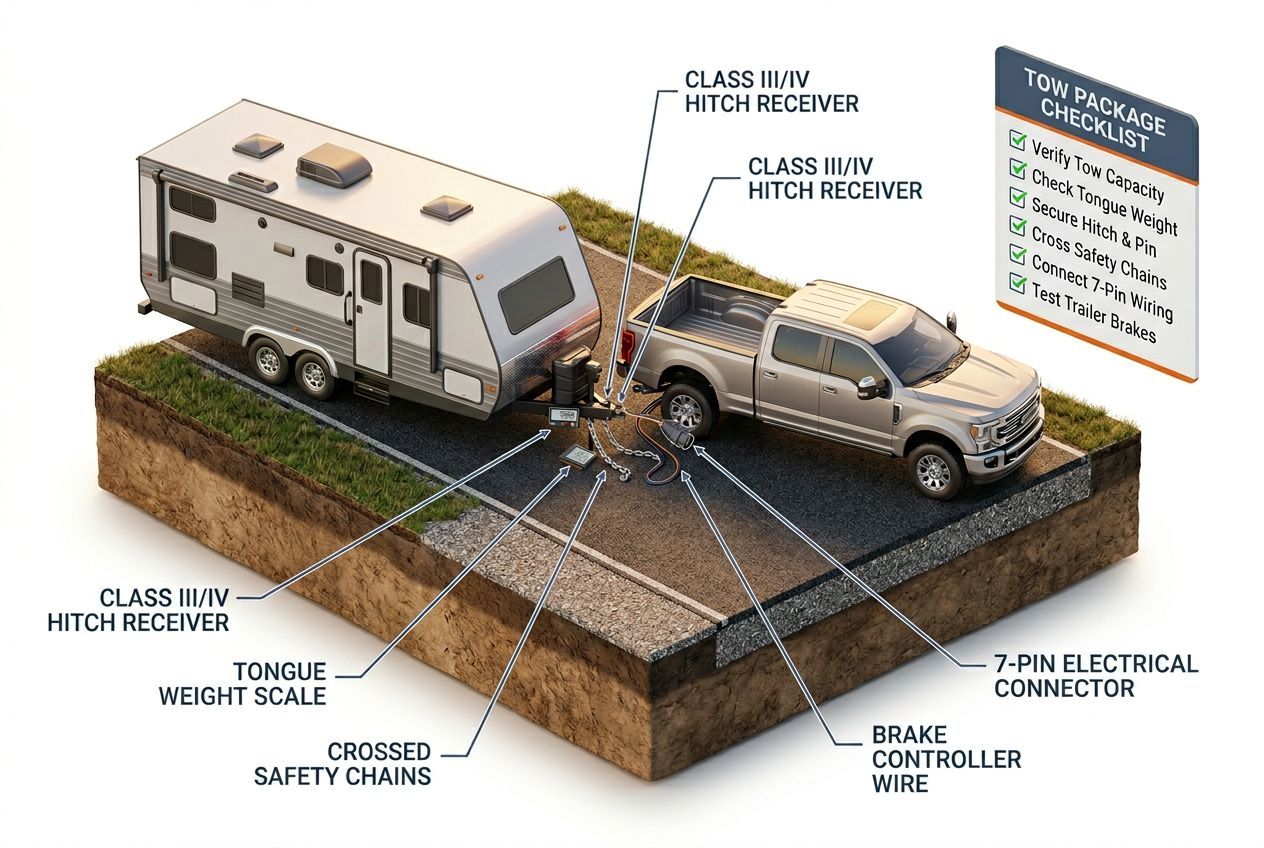
- Towing capacity is configuration-specific — the same model year can have a 4,000-lb spread depending on engine, axle ratio, cab size, and tow package.
- Tongue weight (10–15% of trailer weight) counts against your payload, not your tow rating — two separate limits you can hit simultaneously.
- SAE J2807 is the standardized test protocol most manufacturers use; ratings tested under this standard are directly comparable across brands.
- Exceeding your towing capacity can void your manufacturer warranty and give an insurer grounds to deny a collision claim.
- Half-ton trucks top out around 14,000 lbs; if your loaded trailer exceeds that, you need a ¾-ton or heavier.
What Is Towing Capacity and What Does It Mean?
Towing capacity is the maximum weight your vehicle can legally and safely pull on a trailer, as determined by the manufacturer and published in your owner's manual. That number includes the trailer itself plus every pound loaded onto it — gear, fuel, water, passengers in the trailer, all of it. It's not a rough guideline; it's an engineering ceiling.
The term "tow rating" means exactly the same thing. You'll see both used interchangeably by Ford, GM, Ram, and Toyota in their spec sheets. What the towing capacity meaning comes down to in practical terms is this: your engine, transmission, brakes, frame, and hitch system were engineered to handle up to that number — not a pound more.
Consider this grounding scenario when calculating your limits: You're planning to tow a loaded 24-foot travel trailer that weighs 7,200 lbs. Your truck's sticker says max tow rating: 8,500 lbs. You have 1,300 lbs of margin — that sounds comfortable. But wait. That trailer's tongue weight at 12% is 864 lbs. Add a driver (200 lbs), a passenger (160 lbs), and 150 lbs of camping gear in the cab. You're now at 1,374 lbs against a payload rating of, say, 1,410 lbs. You're 99% into your payload ceiling before the trailer even moves, even though you're well under the tow rating. Both numbers matter, every time.
📊 Quick Fact: In the example above, even with 1,300 lbs of towing margin, your payload capacity could be nearly exhausted by tongue weight, passengers, and gear. Always check both limits!
For a deeper look at how payload and towing interact, see our towing capacity vs. payload breakdown.
How Is Towing Capacity Determined by Manufacturers?
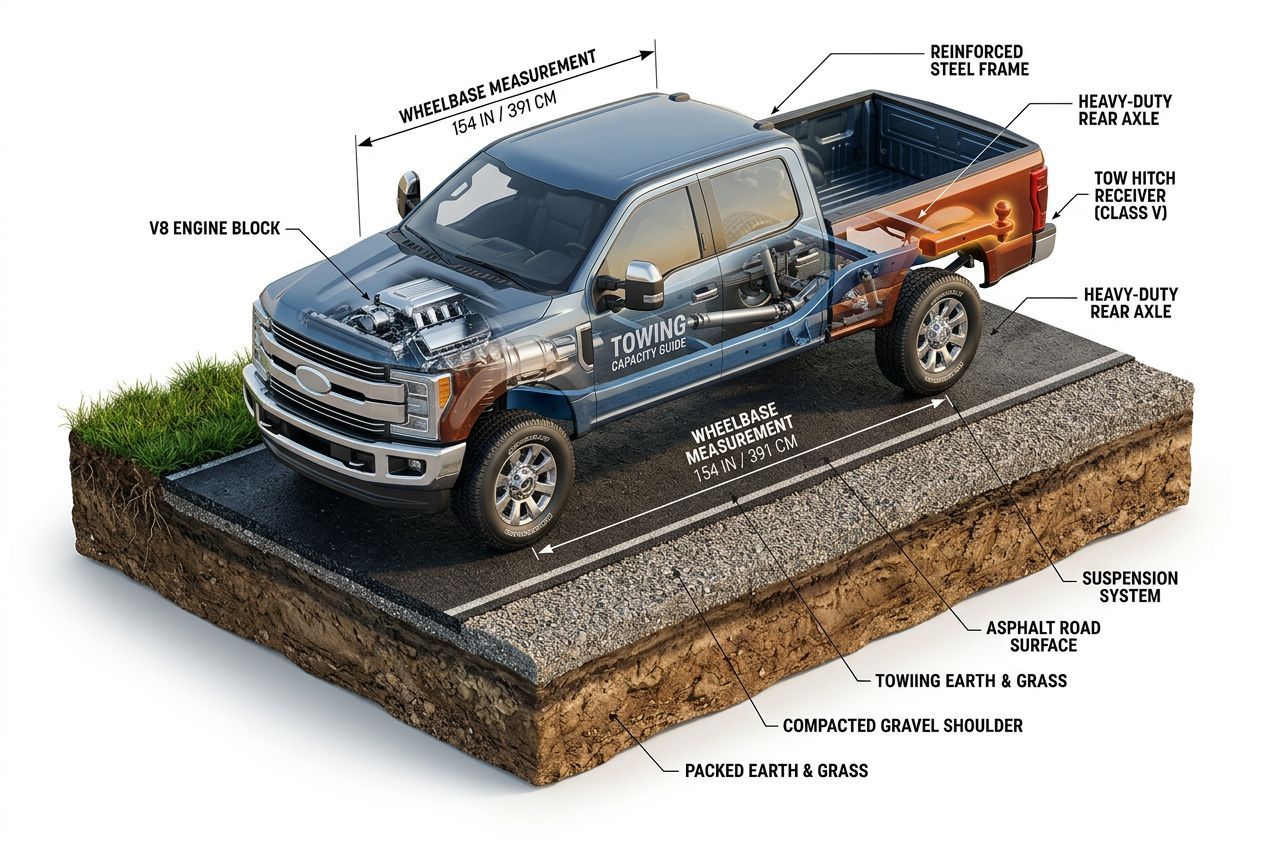
Manufacturers determine towing capacity through a standardized engineering protocol called SAE J2807, which most major automakers adopted by the 2013 model year. Before J2807, Ford, GM, and Ram each used their own in-house methods — which made cross-brand comparisons nearly meaningless. Now the playing field is mostly level.
The SAE J2807 test protocol requires rigorous performance benchmarks. The vehicle, loaded to its GVWR with the trailer attached, must complete a series of challenging tests, including:
- 12% Grade Hill-Start: The loaded rig must start from a stop and climb a 12% grade without rolling back or stalling.
- Sustained Grade at Speed: The vehicle must maintain 40 mph on a 5% grade at an ambient temperature of 100°F.
- Braking Distance: The rig must stop within 200 feet from 30 mph on a level surface.
- Trailer Sway Correction: The vehicle's stability control must demonstrate the ability to suppress trailer oscillation.
Factors Beyond the Test Protocol
How towing capacity is determined also depends on a multitude of factors beyond the test itself. Engineers factor in axle ratio, because a 3.55 rear axle pulls differently than a 4.10. Wheelbase affects stability under load. Transmission oil cooler capacity determines sustained thermal limits. And the presence or absence of a factory tow package changes the entire equation. For example, according to Ford's published towing guides at ford.com, the Class IV Trailer Tow Package (option code 53B) adds a dedicated transmission oil cooler, heavy-duty radiator, upgraded flasher relay, and 7-pin wiring harness. Without that package installed from the factory, Ford's maximum published tow rating doesn't apply to your truck.
✅ Pro Tip: Always verify if your vehicle has a factory tow package installed. Without it, your truck's actual towing capacity will be significantly lower than the maximum published rating for its model.
This is also why two F-150s with the same engine can have different tow ratings. Cab configuration, drivetrain (4x2 vs. 4x4), and bed length all affect the final number. Four-wheel drive adds roughly 200–400 lbs of curb weight, which reduces net capacity relative to the equivalent 2WD configuration.
What Is the Difference Between Towing Capacity and Payload Capacity?
Towing capacity is what you can pull. Payload capacity is what you can carry — inside the cab, in the bed, or on the roof. They're separate ratings with a critical overlap: tongue weight from your trailer counts against payload, not against the tow rating.
Payload is printed on the yellow sticker inside your driver's door jamb. It accounts for everything above the truck's curb weight: passengers, cargo, accessories, and tongue weight. Per NHTSA guidance, this Gross Vehicle Weight Rating (GVWR) minus curb weight gives you your usable payload. The GVWR is also stamped on that same door-jamb sticker.
Understanding the payload math with real numbers is crucial. Say your half-ton shows a payload rating of 1,750 lbs. You're towing a boat that weighs 5,400 lbs on the trailer. Tongue weight at 10% is 540 lbs. Two adults in the cab (370 lbs), a tackle box and cooler (90 lbs), and a full fuel tank already counted in curb weight. Your payload consumption: 540 + 370 + 90 = 1,000 lbs. You have 750 lbs of payload headroom left. That's workable, but if you upgrade to a heavier boat trailer, the tongue weight alone could push you over.
💡 Key Takeaway: Tongue weight directly reduces your available payload, even if you are well within your vehicle's stated towing capacity. Always calculate both simultaneously!
One thing payload can't do: stretch to cover your tongue weight if you've already filled the cab with people and gear. The only solutions are a lighter trailer, a lighter load, or a truck with a higher payload rating. Our payload calculator tool walks through this math for your specific rig.
How Do You Find Your Vehicle's Exact Towing Capacity?
Your vehicle's exact towing capacity lives in three places: the driver's door-jamb sticker, the owner's manual, and the manufacturer's trailer towing supplement (a separate document Ford and GM both publish outside the standard owner's manual).
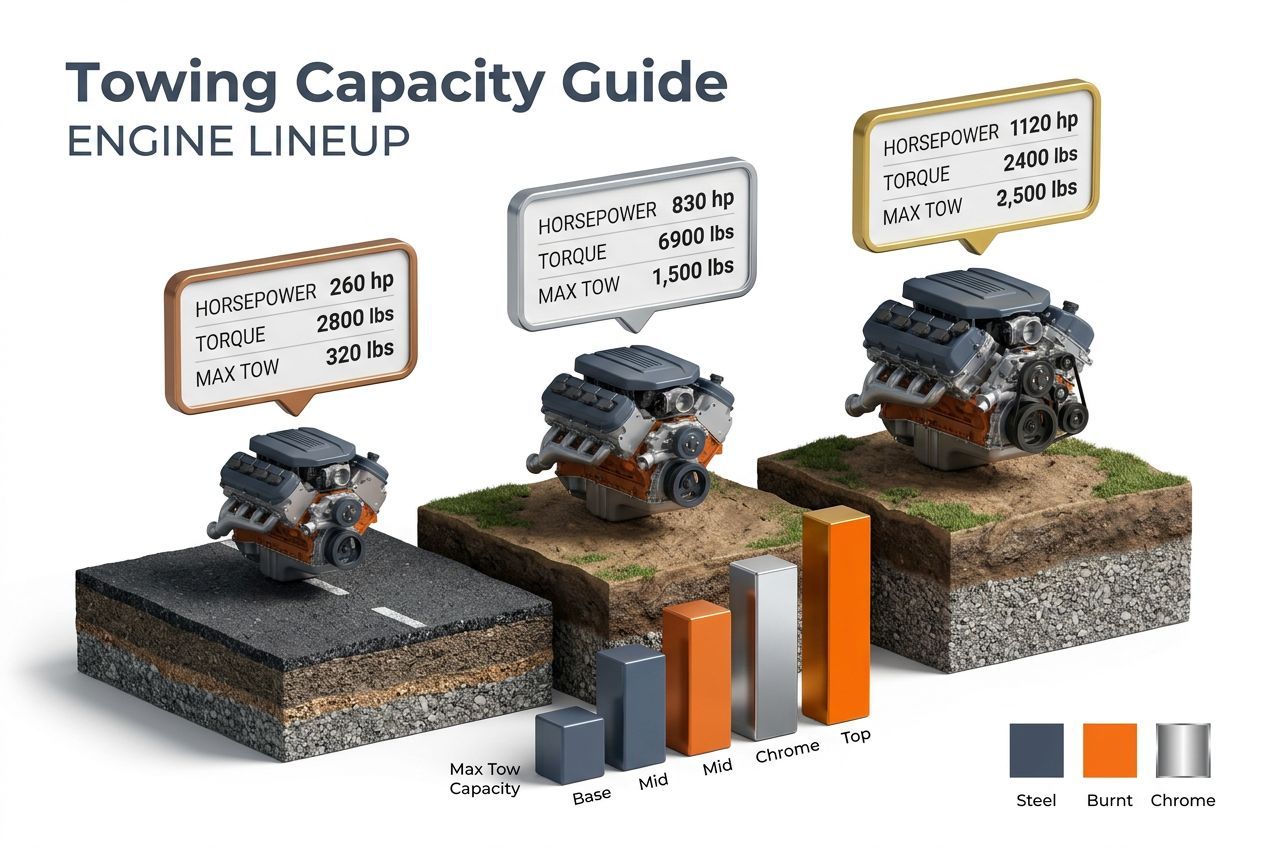
For precise figures, a VIN-specific search is often necessary. Why VIN-specific? Because the same 2026 F-150 with a 3.5L EcoBoost can be rated anywhere from 11,100 to 14,000 lbs depending on cab, bed, axle, and package configuration. A generic "F-150 tows up to 14,000 lbs" number only applies to one specific build. According to Edmunds, trim-level tow ratings are among the most frequently misread specs in truck shopping — buyers often pick up the peak number for the model without checking whether their specific configuration qualifies.
Enter your year, make, model, engine, drivetrain, and options into a VIN-specific tool to get a number you can actually trust.