📊
TRUCK TOWING CAPACITY
How Much Can a 2014 F-150 with the 3.5 EcoBoost Tow?
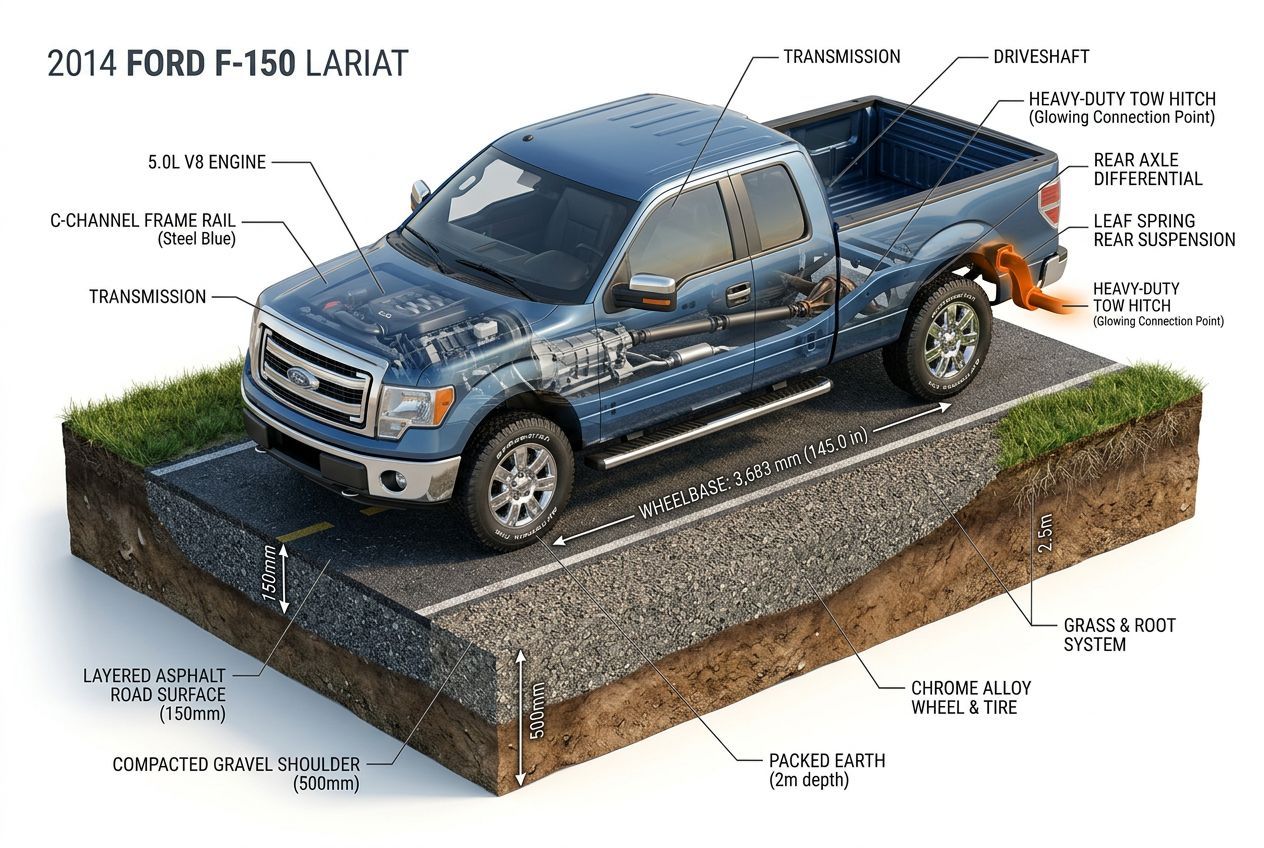
The 3.5L EcoBoost V6 is the towing powerhouse of the 2014 F-150 lineup. This engine delivers a towing capacity ranging from 7,300 to 11,300 pounds, depending on the truck's configuration. Ford's twin-turbo 3.5L EcoBoost generates an impressive 365 hp and 420 lb-ft of torque, making it the highest torque output in the 2014 F-150 lineup and the clear choice for demanding towing in a half-ton package.
To reach the maximum 11,300-lb capacity, you'll need the 3.73 axle ratio plus the Max Trailer Tow Package (SuperCab and SuperCrew) or the Heavy-Duty Payload Package (regular cab 4x2).
A historical note on the EcoBoost: The 2014 F-150 was part of Ford's 12th-generation platform (2009–2014), which marked the introduction of the EcoBoost engine as a serious contender for heavy towing. By 2014, the 3.5 EcoBoost had a proven track record, and Ford's confidence was evident in its ratings, which surpassed the 5.0L V8 by 1,300 lbs in peak configuration.
⚠️ Warning: If towing near the 11,000-lb range in mountainous terrain, especially with a loaded trailer over sustained climbs, be aware that 2014 EcoBoost intercoolers can experience heat-soak, potentially leading to performance reduction at altitude. Tow ratings are established at sea level.
For context on how this compares to other model years, check out our articles on 2013 F-150 towing capacity and 2015 F-150 towing capacity.
🔧
TRUCK TOWING CAPACITY
What Is the Towing Capacity of a 2014 F-150 with the 5.0L V8?
The 2014 F-150 5.0L Coyote V8 provides robust towing capacity for those who prefer naturally aspirated power. It delivers between 7,500 and 10,000 pounds of towing capability. With 360 hp and 380 lb-ft, this V8 is the peak naturally aspirated option, offering a proven, simpler engine design without turbos or intercoolers.
Achieving the 10,000-lb peak capacity requires the 3.73 axle ratio and Heavy-Duty Payload Package in a regular cab 4x2 (145-inch wheelbase) configuration. A 5.0L SuperCrew 4x4 is rated between 7,500 and 9,300 lbs, depending on axle ratio and bed length.
✅ Pro Tip: The 5.0L V8 is paired with the 6R80 six-speed automatic transmission, which uses Mercon LV ATF. If you purchased a used 2014 F-150 with unknown service history, consider changing the transmission fluid before serious towing. This is an affordable preventative measure against transmission failure when towing at max capacity.
🛡️
TRUCK TOWING CAPACITY
2014 F-150 Towing Capacity by Engine and Configuration
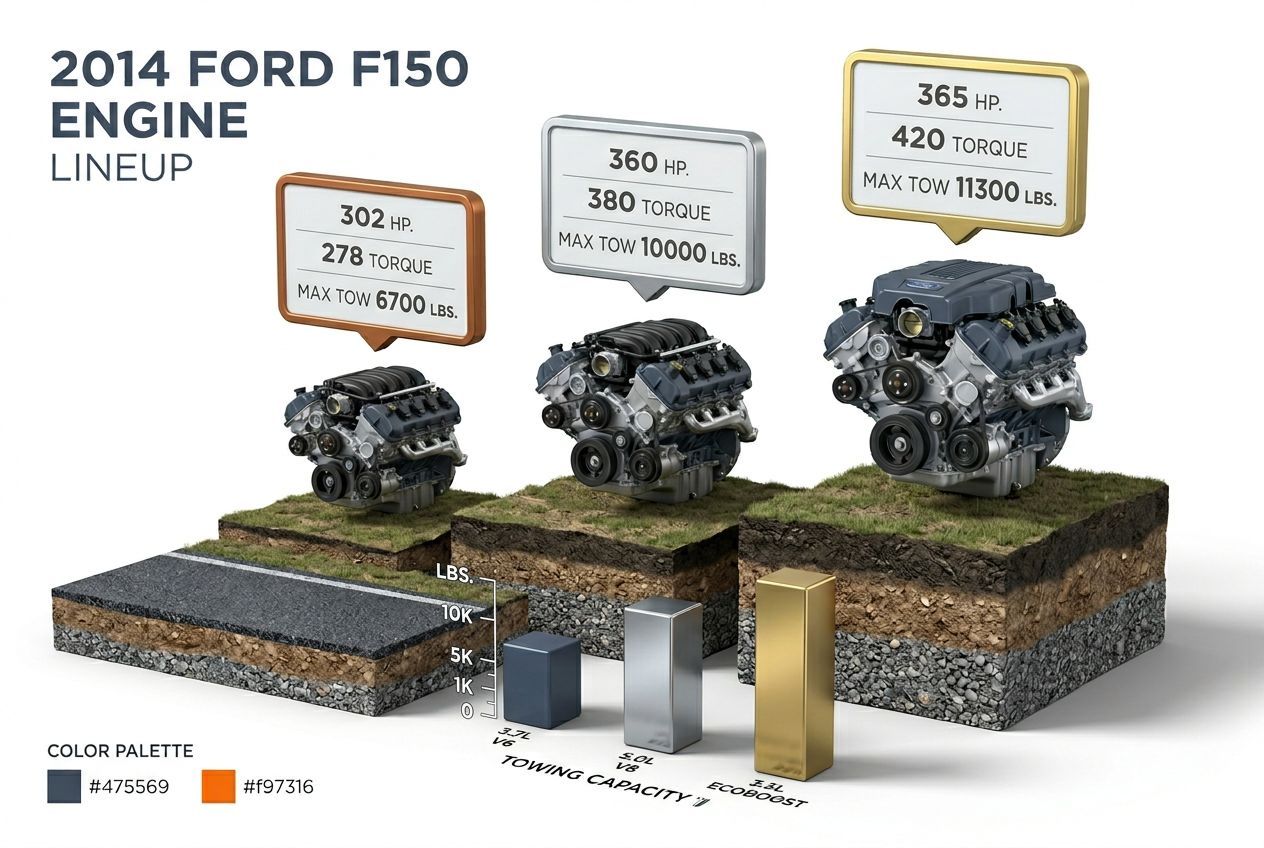
Here's a breakdown of the four available engines and their maximum towing capacities. These ratings reflect properly configured trucks with the Max Tow Package and 3.73 rear axle where applicable.
2014 F-150 Towing Capacity by Engine and Configuration — data table
| Engine |
HP / Torque |
Max Tow Capacity |
Notes |
| 3.7L Ti-VCT V6 |
302 hp / 278 lb-ft |
6,700 lbs |
Base engine; lowest tow ceiling |
| 5.0L Coyote V8 |
360 hp / 380 lb-ft |
10,000 lbs |
Best naturally aspirated option |
| 3.5L EcoBoost V6 |
365 hp / 420 lb-ft |
11,300 lbs |
Highest-rated; requires Max Tow Pkg + 3.73 axle |
| 6.2L V8 |
411 hp / 434 lb-ft |
11,300 lbs |
Non-Raptor trucks with 3.73 axle; SVT Raptor (4.10 axle) is rated 6,000–8,000 lbs |
Ratings are the highest figure for each engine in the F-150 Trailer Towing Selector of Ford's 2014 RV & Trailer Towing Guide. SuperCrew 4x4 ratings are lower. Consult your door-jamb certification label for your specific truck.
📊 Quick Fact: The 6.2L V8 matches the EcoBoost's 11,300-lb ceiling in non-Raptor F-150s with the 3.73 axle, but the off-road SVT Raptor version is rated at only 6,000–8,000 lbs.
📋
TRUCK TOWING CAPACITY
Does the 2014 F-150 Trim Level Affect Towing Capacity?
Yes, trim level indirectly impacts towing capacity by influencing payload. Heavier trim levels reduce your available payload, which is a critical part of the towing equation.
How Trim Weight Affects Payload
Consider the weight difference between configurations. For instance, an XL regular cab in its base configuration might weigh around 4,600 lbs. In contrast, a Platinum SuperCrew with the same engine could easily weigh 5,400 lbs or more. This 800-lb difference in curb weight directly subtracts from your available payload, thereby limiting the amount of tongue weight you can safely carry.
Let's walk through an example:
- Trailer Load: Imagine you're towing a 7,500-lb travel trailer with a 10% tongue weight, which equates to 750 lbs on your hitch ball.
- Occupant & Gear Load: Add a 200-lb driver, a 170-lb passenger, and 100 lbs of gear in the cab.
- Total Load: Your total payload load (tongue weight + occupants + gear) is 1,220 lbs.
Now, compare two trucks:
- XL Regular Cab: With the 5.0L and Heavy-Duty Payload Package, its certified payload can reach 3,120 lbs. Your 1,220-lb load represents only 39% of capacity, leaving plenty of room.
- Platinum SuperCrew 4x4: This truck might have a payload rating closer to 1,450 lbs. The same 1,220-lb load now puts you at 84% capacity. Adding a full fuel tank, a cooler in the bed, or other small items could easily push you over the limit.
Trim-level comparisons get more granular in our F-150 towing capacity hub. For a side-by-side look at how the F-150 stacks up against its half-ton competition, see our half-ton truck towing capacity guide.
⚙️
TRUCK TOWING CAPACITY
What Is the Payload Capacity of a 2014 Ford F-150?
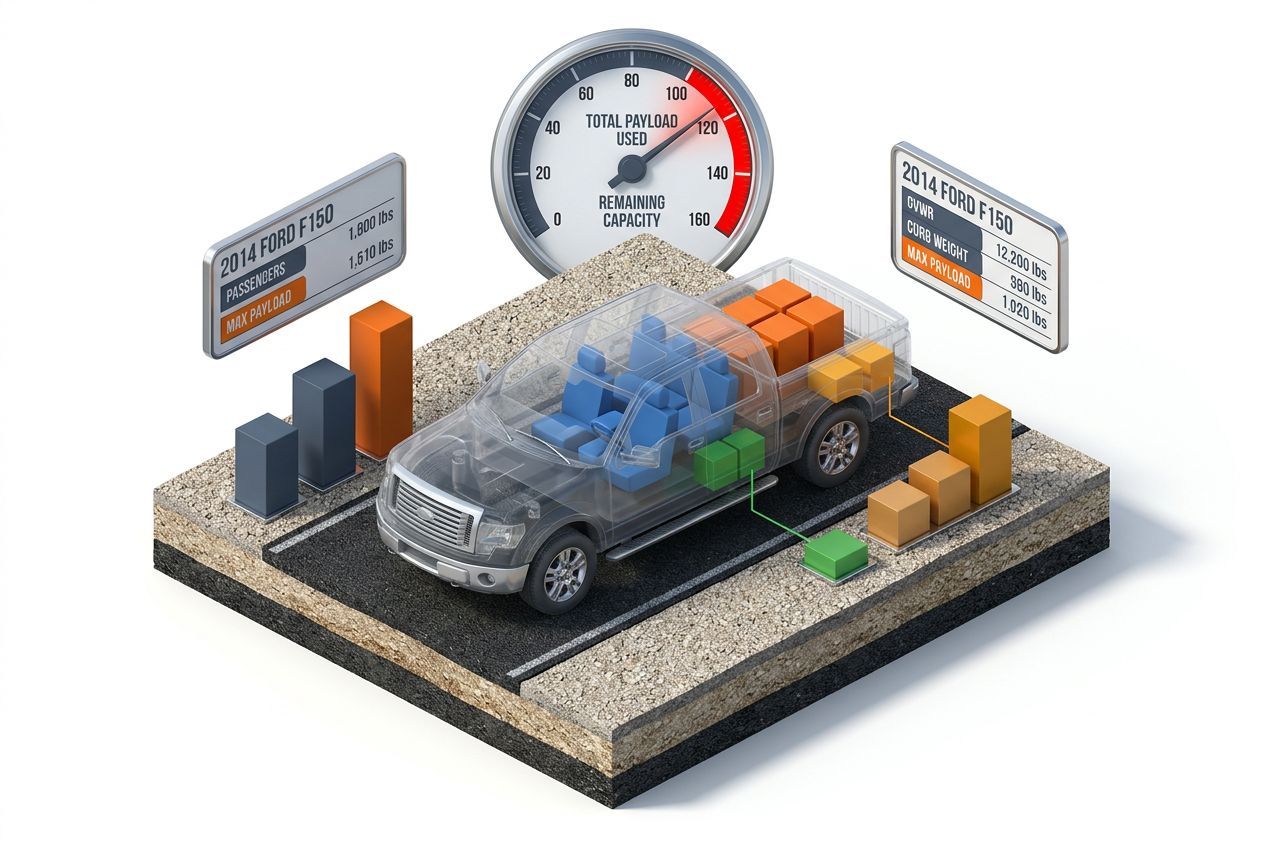
The 2014 Ford F-150 payload capacity typically ranges from approximately 1,010 to 3,120 pounds. Payload refers to the total weight your truck can safely carry within its cab and bed. This includes all occupants, cargo, and, crucially, the trailer tongue weight. The highest payload rating, 3,120 lbs, is achieved with Ford's Heavy-Duty Payload Package on the XL regular cab 4x2 equipped with the 5.0L V8.
Finding Your Truck's Specific Payload:
Your certified payload capacity is unique to your vehicle and is found on the door-jamb sticker, located on the driver-side B-pillar (NHTSA explains the Tire and Loading Information Label). Look for the label that states, "The combined weight of occupants and cargo should never exceed XXX lbs." This VIN-specific number is your true payload limit.
💡 Key Takeaway: Many owners mistakenly focus only on the tow rating and overlook payload. Remember that trailer tongue weight is a direct load against your truck's payload capacity. Both numbers are critical for safe towing. For a detailed explanation of how these two numbers interact, consult our towing capacity vs. payload guide.
🚛
TRUCK TOWING CAPACITY
What Axle Ratio Does a 2014 F-150 Need for Maximum Towing?
To achieve the maximum tow ratings across all engine options, the 2014 F-150 requires a 3.73 rear axle ratio. This ratio provides the best mechanical advantage for pulling heavy loads.
Axle Ratio Trade-offs
Other axle ratios offer different compromises. The 3.55 ratio is a reasonable middle ground; you'll lose a few hundred pounds of rated capacity compared to the 3.73, but you'll gain slightly better highway fuel economy. The 3.15 and 3.31 ratios, often found on base work-truck configurations, significantly reduce towing capacity and are best suited for lighter duty.
Locating Your Axle Ratio
You can find your axle ratio in two key places:
- Door-Jamb Certification Label: This label uses an axle code (e.g., "26", "B6" or "L6" for 3.73 on 2014 F-150 models), which you can cross-reference in Ford's Trailer Towing Supplement.
- Rear Axle Tag: A physical tag stamped on the differential housing itself.
✅ Pro Tip: If you're considering buying a used 2014 F-150 and the seller is unsure of the axle ratio, be sure to check the door sticker and/or differential tag before committing to ensure the truck meets your towing needs.
Axle ratio decisions have broad implications beyond just tow ratings — they also affect fuel economy, transmission shift points, and highway cruise RPM. For more on how these variables interact, our how to find towing capacity guide covers the full spec-reading process step by step.
📝
TRUCK TOWING CAPACITY
Can a 2014 F-150 Tow a Fifth Wheel or Gooseneck Trailer?
Only in limited cases, and it's rarely the right tool. Ford's 2014 towing guide lists combined conventional and 5th-wheel ratings for the F-150, but notes that 5.5-ft box models (133-inch SuperCab and 145-inch SuperCrew) and the Raptor are not compatible with current 5th-wheel trailer designs.
Why Fifth-Wheel Towing is Not Recommended
It's crucial to understand this limitation: a 5th-wheel hitch in a 2014 F-150 bed has to stay within the truck's payload and rear axle rating, and the guide calls for 15–25% of the trailer's weight on the king pin, versus 10–15% for a conventional trailer. Few half-ton beds can carry that load with passengers aboard.
The reason for this limitation is engineering. Fifth-wheel pin weight for a typical mid-size RV can range from 1,500–2,000 lbs. This significant load transfers directly into the bed floor and frame in a fundamentally different way than a conventional bumper-pull trailer. The 2014 F-150's bed structure and frame were not engineered to handle this specific load path safely or effectively.
For fifth-wheel or gooseneck towing, a heavier-duty truck is required. The minimum platform for such trailers is generally an F-250 Super Duty. The half-ton F-150's ceiling is 11,300 lbs of conventional towing — an impressive figure for a half-ton, but not the appropriate tool for fifth-wheel applications. You can compare platform options in our towing capacity guide and explore what the next-generation truck brought to the table in our 2015 F-150 towing capacity article.
Last of a Generation: The 2014 model year marked the end of the 12th-generation F-150 before Ford's major 2015 redesign introduced the aluminum body. If you're cross-shopping used trucks from this generation, our coverage of the 2011 F-150 and 2012 F-150 provides context on how tow ratings evolved throughout the generation.
Need to know if your specific setup is legal in your state? Our towing laws by state tool covers trailer brake requirements, speed limits, and weight rules by jurisdiction.

