Skip to content
🛻 TRUCK TOWING CAPACITY

How to Find Your Vehicle's Towing Capacity

Published · Updated · 11 min read
MarkUpdated Mar 2, 2026Ford Motor Company

💡 Key Takeaway: Your towing capacity is tied to your specific build — engine, axle ratio, and factory tow package all affect the number, so generic specs won't cut it. The door jamb sticker shows GVWR and GCWR; subtract your loaded vehicle weight from GCWR to get your real-world towing limit. A factory tow package can add 1,000–4,000 lbs of rated capacity by upgrading the radiator, transmission cooler, and hitch receiver. Tongue weight (10–15% of trailer weight) counts against your payload, not your tow rating — a critical distinction most people miss. Exceeding your tow rating can void your warranty, trigger insurance denial, and cause brake fade or trailer sway at dangerous speeds.


💰
TRUCK TOWING CAPACITY

How Do I Find the Towing Capacity of My Vehicle?

Locating your vehicle's towing capacity requires checking specific manufacturer resources. Your vehicle's towing capacity lives in three places: the owner's manual towing supplement, the driver-side door jamb label, and the manufacturer's online towing guide. Each source reflects the rated limit for your specific configuration — not the trim's average or the engine family's maximum. For the most reliable answer, cross-reference at least two of these sources before hooking up any trailer.

Checking Your Owner's Manual

The owner's manual towing section is often the first place to look, but there's a catch. Ford, GM, and RAM all publish a separate Trailer Towing Supplement apart from the main owner's manual. Ford distributes this as a standalone PDF on ford.com — it's not always bundled in the glove box document packet.

⚠️ Warning: If you pull up your manual and find only a single page about towing, you're missing the detailed chart. Always seek out the dedicated towing supplement for comprehensive data.

Interpreting the Door Jamb Label

The door jamb label on the B-pillar tells you your Gross Vehicle Weight Rating (GVWR) and often your Gross Combined Weight Rating (GCWR). It won't say "towing capacity" in plain language, but subtracting your loaded vehicle weight from GCWR gives you exactly that.

✅ Pro Tip: While the door jamb won't state "towing capacity," understanding GVWR and GCWR is key. GCWR minus your actual loaded vehicle weight gives you your true available towing capacity.

For quick answers tied to your exact options, check our full towing capacity guide and use the towing capacity lookup tool to get specs matched to your year, make, and model.
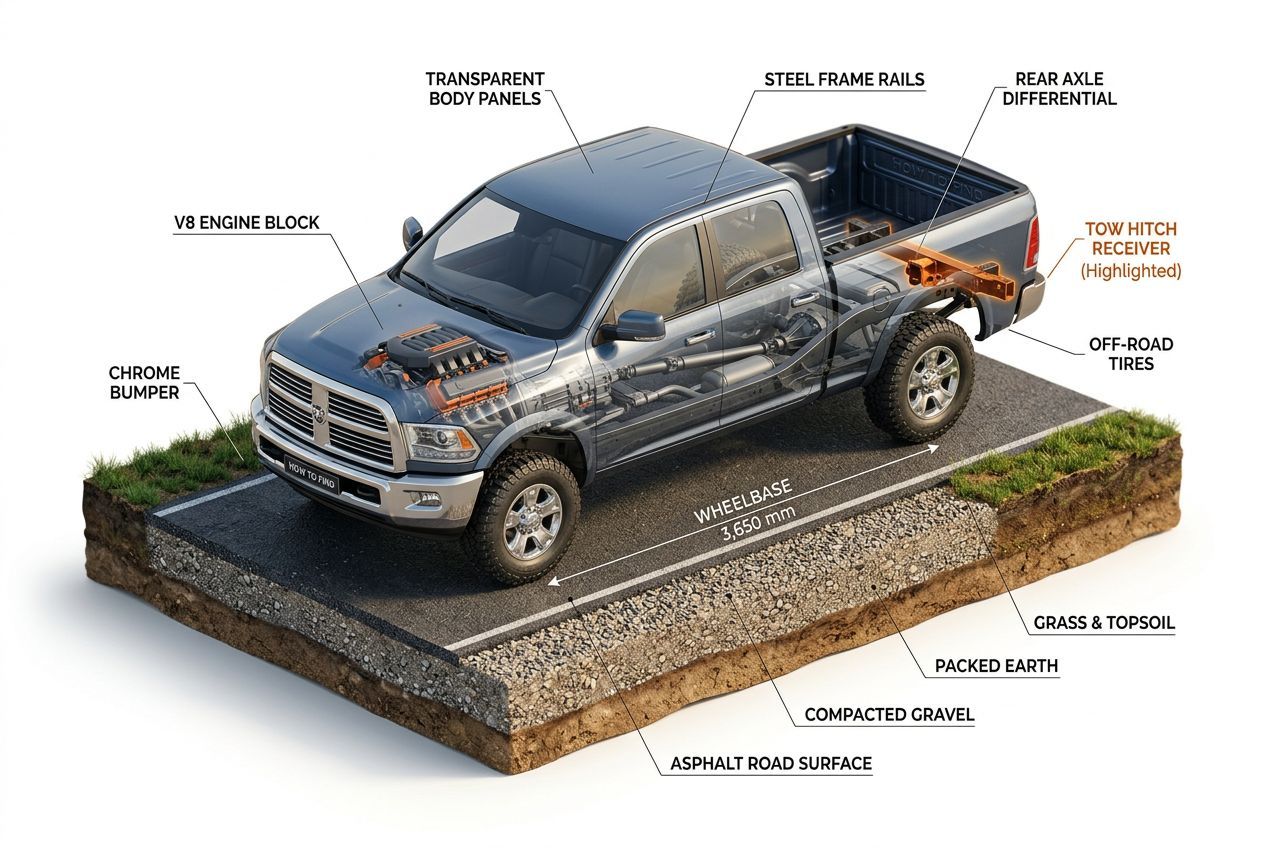

3D isometric cutaway of How To Find showing engine, frame, and tow hitch components
📊
TRUCK TOWING CAPACITY

Where Is Towing Capacity Listed on My Truck?

On your truck, towing capacity details are typically found in several key locations. It is listed on the driver-side door jamb sticker, in the manufacturer's towing supplement, and on the OEM website's towing guide or build-and-price tool. On trucks with a factory tow package, a second label sometimes appears on the jamb — look for a white or yellow sticker near the door latch that reads "Max Trailer Weight" or lists a GCWR upgrade.

Here's what each source actually tells you:

  • Door jamb sticker: Lists GVWR, GAWR (Gross Axle Weight Rating front and rear), and sometimes GCWR. These are federally mandated under NHTSA certification requirements (nhtsa.gov).
  • Towing supplement / owner's manual: Lists max trailer weight, tongue weight limit, and hitch class by configuration — usually organized by engine and axle ratio combination.
  • Manufacturer website: Ford, Chevy, RAM, and Toyota all publish downloadable towing guides by model year that include every trim and package combination in a chart format.

One thing the door jamb won't do: tell you whether your truck has the factory tow package installed. That's where VIN decoding becomes valuable.

💡 Key Takeaway: If you're shopping for a used truck, the difference between a tow-package and non-tow-package build can be 2,000+ lbs of rated capacity — and you can't see it from the outside. VIN decoding is essential.

For comparison across brands, our half-ton truck towing capacity breakdown lays out how these numbers stack up across the major players.


🔧
TRUCK TOWING CAPACITY

Can I Look Up Towing Capacity by VIN?

Yes, you can look up your towing capacity by VIN. Your 17-digit VIN encodes the engine, transmission, drivetrain, trim level, and factory-installed packages that together determine your rated towing capacity. A VIN-based lookup cross-references those codes against the manufacturer's towing chart and returns your exact number without guessing.

There are three ways to decode towing capacity by VIN:

  1. Dealership service department: Any Ford, GM, RAM, or Toyota dealer can pull your build sheet from the VIN and tell you exactly what's installed and what it's rated for. This process typically takes about five minutes.
  2. NHTSA VIN decoder: The tool at nhtsa.gov decodes your VIN into basic spec data including engine, body type, and plant codes — useful for verifying configuration but it won't directly output tow capacity.
  3. Online towing lookup tools: Several third-party tools, including the one here at TowingServiceHub, cross-reference VIN data with manufacturer charts to return a rated tow capacity.

Enter your vehicle details below to get your towing capacity matched to your specific build.
Try Our Free Truck Towing Capacity Lookup

⚠️ Warning: One honest limitation: VIN-based tools depend on manufacturer data accuracy. If a previous owner had a tow package dealer-installed after sale — not factory-coded — the VIN won't reflect it, and neither will the lookup. Always verify with the physical sticker and any dealer-installed documentation before trusting a higher number.


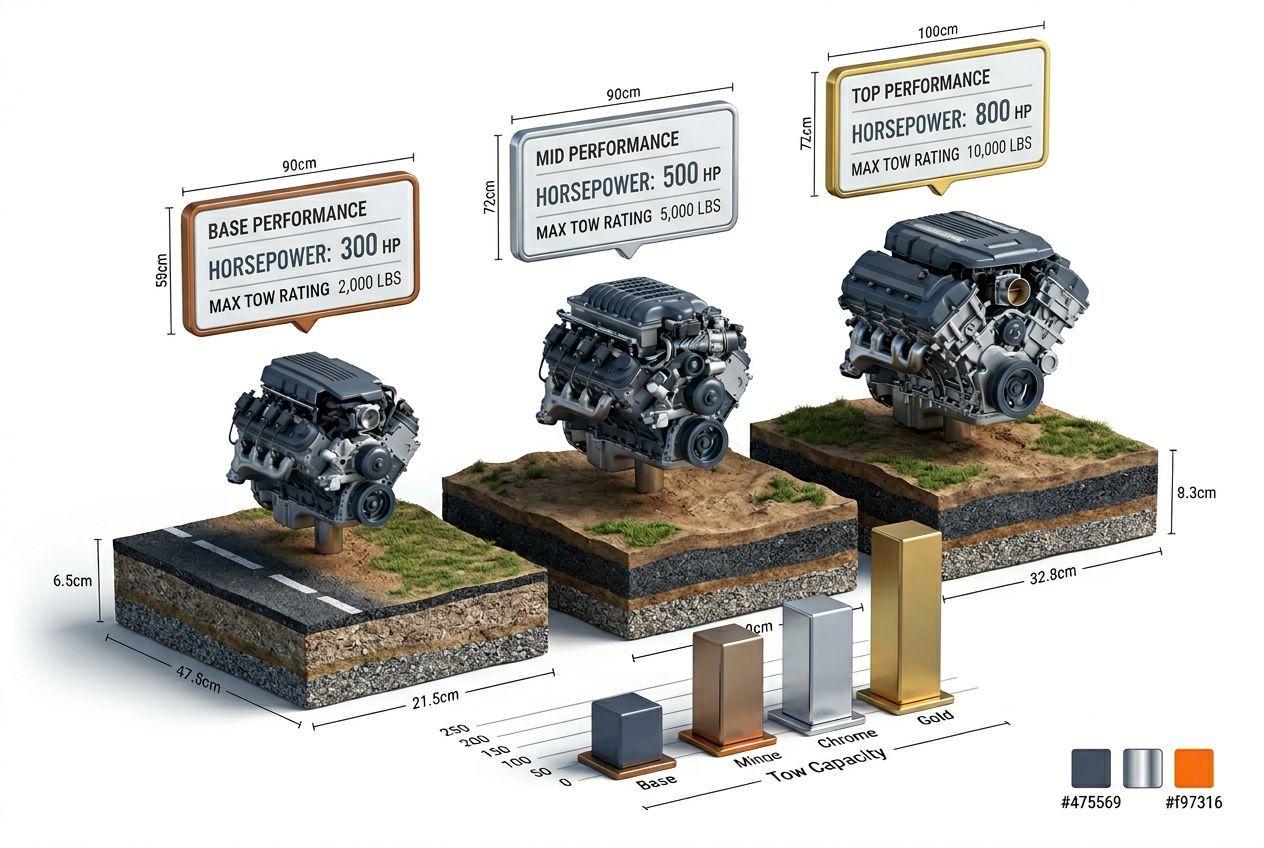
3D data visualization comparing How To Find engine options and towing capacities
🛡️
TRUCK TOWING CAPACITY

What Is the Difference Between GVWR and Towing Capacity?

GVWR and towing capacity are distinct metrics crucial for safe towing. GVWR is the maximum allowable total weight of your vehicle itself — loaded with passengers, cargo, and fuel. Towing capacity is the maximum weight you can pull behind it. They measure two different things, and confusing them is one of the most common (and dangerous) mistakes truck owners make.

💡 Key Takeaway: The number that actually governs safe towing math is GCWR — Gross Combined Weight Rating. This includes the weight of your fully loaded vehicle AND the fully loaded trailer.

Here's the formula:

Max Trailer Weight = GCWR − Actual Loaded Vehicle Weight

Let's illustrate with an example: Say your truck has a GCWR of 15,000 lbs. You, your passenger, a full tank of fuel, and 150 lbs of gear in the bed puts your loaded vehicle weight at 6,800 lbs. That leaves 8,200 lbs of available towing capacity — even if the sticker says "Max Tow: 9,100 lbs." The published max assumes a minimally loaded truck. Your real-world limit is lower.

For a deeper breakdown of how these ratings interact, see our article on GCWR and the towing capacity vs payload comparison.


📋
TRUCK TOWING CAPACITY

Does a Tow Package Increase Towing Capacity?

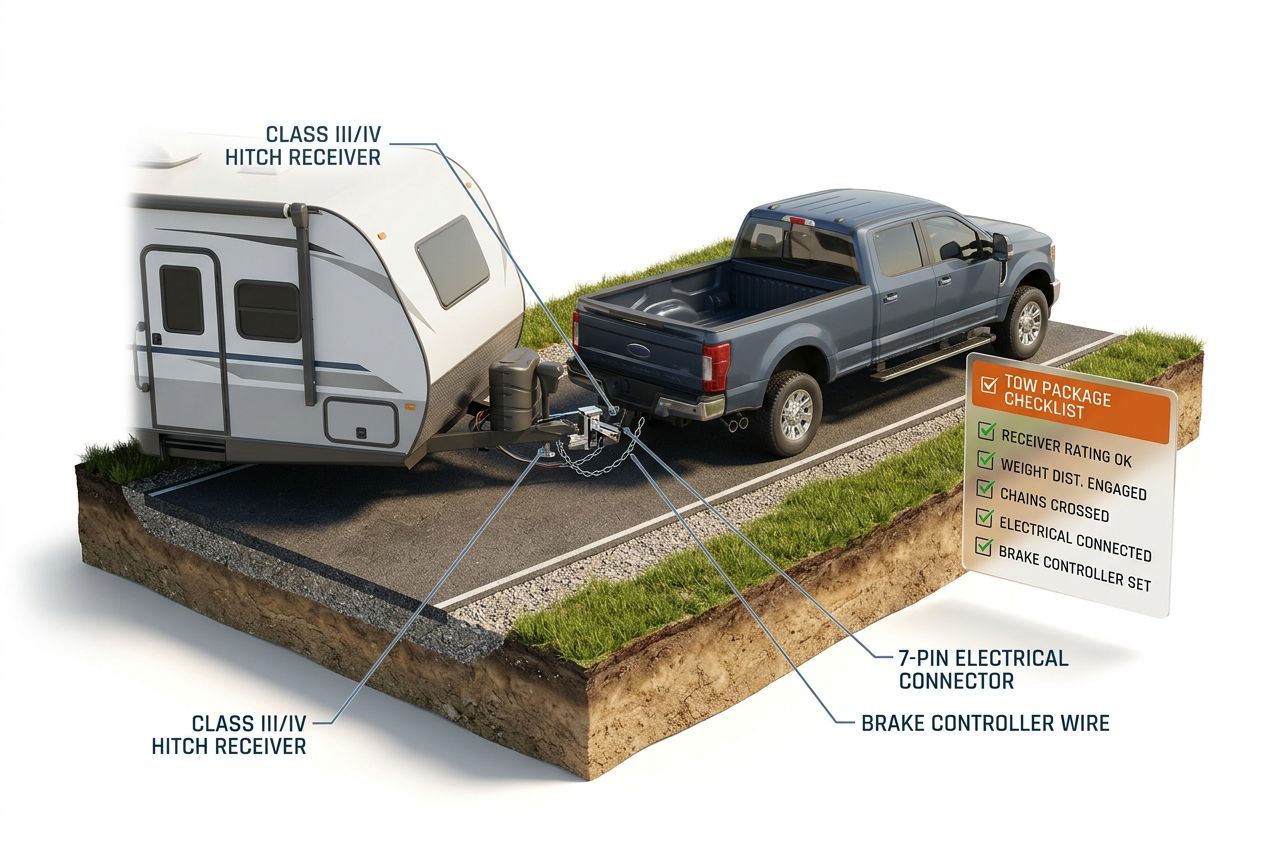
A factory tow package significantly increases towing capacity because it includes hardware changes—not just a hitch. A factory tow package can raise your rated towing capacity by 1,000–4,000 lbs. The factory Class IV Trailer Tow Package (option code 53B on Ford, Z82 on Chevy/GMC) typically adds a transmission oil cooler, heavy-duty radiator, 7-pin wiring harness, upgraded flasher relay, and sometimes a numerically higher rear axle ratio that improves pulling torque.

Real-World Example of Tow Package Impact

Here's what that looks like in practice: A 2024 Chevy Silverado 1500 with the 2.7L Turbo Plus and no tow package is rated at roughly 9,500 lbs. Add the Max Trailering Package (Z82), and that number climbs to 13,300 lbs — the same engine, a completely different rating. According to specs published on chevrolet.com, that jump comes from the auxiliary transmission cooler, the 3.42 rear axle, and the integrated trailer brake controller.

⚠️ Warning: What a tow package won't do: an aftermarket hitch receiver alone — even a quality Class IV from Curt or Reese — does not change your OEM-rated tow capacity. The hitch may physically hold the weight, but the engine cooling, transmission durability, and brake performance haven't been upgraded to match. Your manufacturer's rating still applies.

If you're researching specific models, our F-150 towing capacity, Silverado towing capacity, and RAM 1500 towing capacity pages detail exactly which packages unlock maximum ratings for each truck.


3D diagram showing proper tow setup for How To Find with hitch components and safety equipment
⚙️
TRUCK TOWING CAPACITY

2024 Half-Ton Max Towing Capacity by Truck

2024 Half-Ton Max Towing Capacity by Truck — data table
Truck Engine Tow Package Required Max Tow Rating
Ford F-150 3.5L EcoBoost Max Trailer Tow Package 13,500 lbs
Chevy Silverado 1500 2.7L Turbo Plus Max Trailering Package (Z82) 13,300 lbs
RAM 1500 5.7L HEMI eTorque Max Tow Group 12,750 lbs
Toyota Tundra 3.5L i-FORCE MAX Towing Technology Package 12,000 lbs
Ford Ranger 2.3L EcoBoost Trailer Tow Package 7,500 lbs

Sources: Ford towing guide (ford.com), Chevrolet towing guide (chevrolet.com), RAM towing guide (ramtrucks.com), Toyota towing guide (toyota.com). Ratings reflect maximum configuration for each model; your vehicle's actual rating may differ.


🚛
TRUCK TOWING CAPACITY

How Do I Calculate My Actual Towing Capacity?

Calculating your actual available towing capacity is essential because it differs from the published maximum. Your actual available towing capacity equals your GCWR minus your vehicle's current loaded weight. The published max tow rating on the sticker assumes a near-empty truck — once you add people, fuel, and gear, your real ceiling drops.

A Detailed Calculation Example

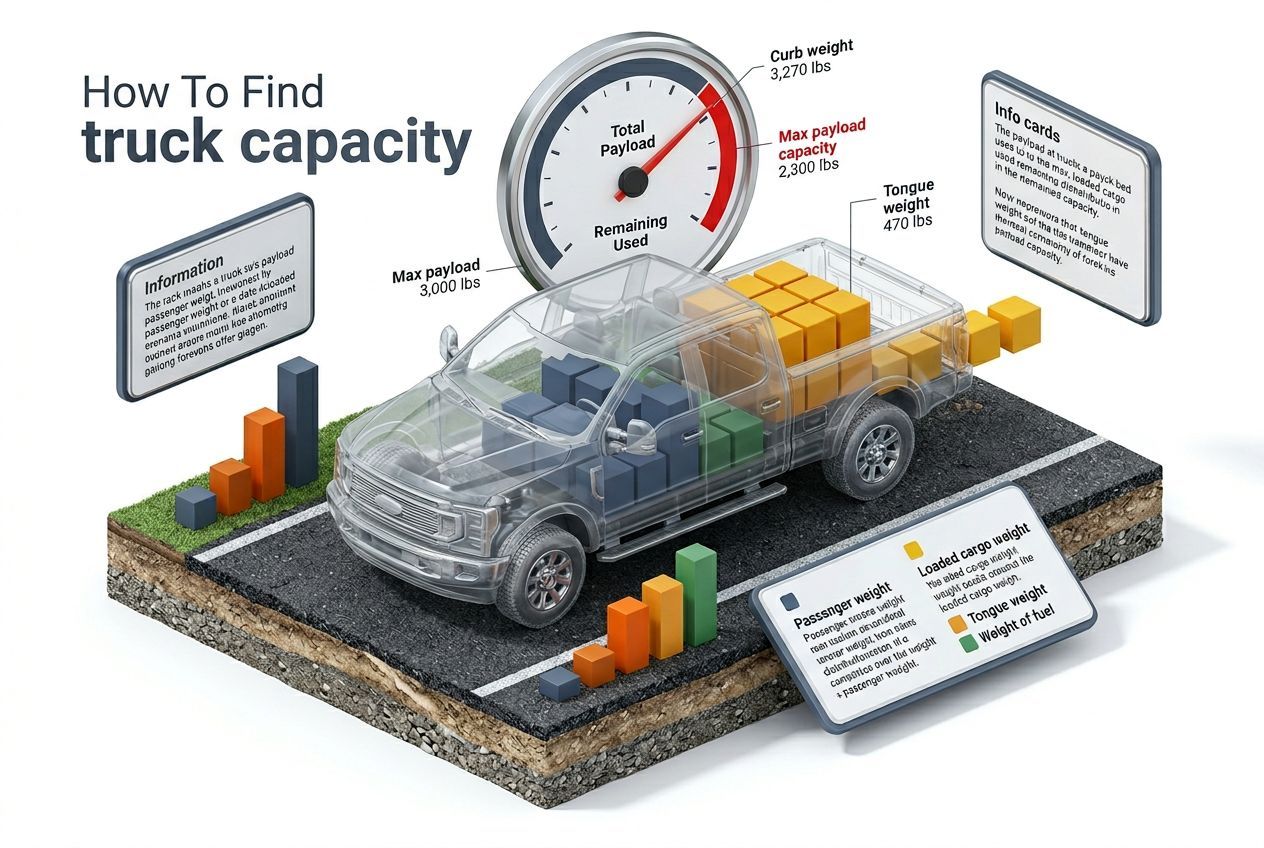
You're driving a 2024 RAM 1500 with a GCWR of 17,980 lbs. Your truck's curb weight is 5,355 lbs. Add yourself at 195 lbs, a passenger at 160 lbs, a full 26-gallon tank (about 170 lbs), and a loaded bed with a toolbox and straps at 240 lbs. Your loaded truck weighs roughly 6,120 lbs.

📊 Quick Fact: 17,980 (GCWR) − 6,120 (Loaded Vehicle Weight) = 11,860 lbs available towing capacity

RAM's published max is 12,750 lbs — you've already lost nearly 900 lbs before the trailer's even attached. Now factor in tongue weight: a 10,000-lb trailer at 12% tongue weight adds 1,200 lbs to your payload calculation on top of everything else. That brings your effective margin down to about 660 lbs. Not a lot of buffer.

⚠️ Warning: At altitude, margins shrink further. Per SAE testing methodology, naturally aspirated engines lose approximately 3% power per 1,000 feet above sea level. Towing in the Colorado Rockies at 8,000 feet with a turbocharged truck won't see quite the same drop, but intercooler efficiency decreases in thin air — expect reduced performance regardless of what the sea-level rating says.

Use our payload calculator to run these numbers for your specific truck before your next trip.


3D payload capacity visualization for How To Find showing weight distribution and remaining capacity
📝
TRUCK TOWING CAPACITY

What Happens If You Exceed Your Vehicle's Towing Capacity?

Exceeding your tow rating creates compounding risks across multiple systems simultaneously. According to the FMCSA (fmcsa.dot.gov), commercial vehicles operating beyond rated limits face fines and out-of-service orders. For personal vehicles, consequences are financial, mechanical, and physical.

Mechanical Risks of Overloading

  • Brake Fade: Can occur at as little as 10% over rated capacity on grades steeper than 6%. This severely compromises your ability to stop safely.
  • Transmission Overheat: Transmission fluid overheats, and on modern transmissions (e.g., Ford 6R80 running Mercon LV or a GM 8L90 running Dexron VI), heat-degraded ATF accelerates clutch pack wear faster than almost any other condition, leading to premature transmission failure.
  • Frame Stress: Accumulates invisibly over multiple overloaded hauls, potentially leading to frame cracks or structural fatigue.

Legal and Financial Risks

  • Insurance Denial: Most auto insurance policies exclude coverage in accidents where the vehicle was towing beyond its OEM-rated capacity. This is not a fine print footnote — it's a coverage denial that leaves you personally liable for all damages, medical bills, and legal fees.
  • Fines and Citations: Operating an overloaded vehicle, particularly in states with specific towing laws, can result in significant fines and legal penalties.
  • Accident Statistics: NHTSA crash data indicates trailer-involved incidents account for roughly 50,000 crashes per year, with overloading cited as a leading contributing factor.

Dynamic Risks on the Road

  • Trailer Sway: Becomes nearly uncontrollable when tongue weight drops below 10% of trailer weight — a situation that gets worse, not better, as speed increases. An overloaded trailer that sways at 45 mph on a flat road becomes a jackknife risk at 65 mph on a downhill grade.
  • Loss of Control: Reduced steering control, increased stopping distances, and instability are all direct results of towing beyond limits, increasing accident risk.

✅ Pro Tip: If your load exceeds your half-ton's ceiling, that's not a workaround situation. The F-150 tops out at 13,500 lbs — and that's the absolute maximum under ideal conditions. A 14,000-lb fifth-wheel means you need a 3/4-ton minimum: an F-250, Silverado 2500HD, or RAM 2500. Our can my truck tow this tool can confirm whether your setup is within range.

Also check towing laws by state — several states have specific weight and braking requirements for trailers that apply independently of your truck's rating.

Sources & Methodology

  1. 1.
    Ford Motor Company — 2024 F-150 Towing Guide and Trailer Towing Supplement. Accessed via ford.com. Used for tow package option codes and maximum tow ratings.
  2. 2.
    General Motors / Chevrolet — 2024 Silverado 1500 Towing Guide. Accessed via chevrolet.com. Used for Z82 package specifications and rated capacity data.
  3. 3.
    National Highway Traffic Safety Administration (NHTSA) — Vehicle certification label requirements and VIN decoder tool. Accessed via nhtsa.gov. Used for GVWR/GCWR label sourcing and crash incident data.
  4. 4.
    Federal Motor Carrier Safety Administration (FMCSA) — Cargo securement standards and overweight vehicle regulations. Accessed via fmcsa.dot.gov. Used for overloading penalty and commercial towing regulation citations.
  5. 5.
    RAM Trucks — 2024 RAM 1500 Towing Guide. Accessed via ramtrucks.com. Used for GCWR figures and max tow package specifications in the worked calculation example.

TowingServiceHub is reader-supported: we may earn money from ads and from some links on this page. See our editorial policy.

Mark — Founder & Editor

Mark

Founder & Editor

Mark is the founder and editor of TowingServiceHub, which he launched in 2026 after struggling to find clearly sourced towing costs and truck specs. He works in enterprise technology and tows his own boats, trailers, and equipment, so he knows the questions drivers actually ask.

Read full bio →

Need a tow truck right now?

Browse vetted local providers in your area. Real Google ratings, verified business info, free to use.

Or browse all 50 states from our directory

Frequently Asked Questions

Run the VIN through a manufacturer VIN decoder or visit a dealership service department. They can pull the build sheet and confirm the exact engine, axle ratio, and tow package installed — the three variables that determine the truck's official rated towing capacity.

Yes, significantly. A numerically higher rear axle ratio — like 3.73 vs. 3.31 — multiplies torque more aggressively

Related Articles

Explore More Towing Guides

Browse all 157 expert guides and 10 free tools.