Key Takeaways
- Tekonsha Prodigy P3 is the best overall at ~$130 — proportional, digital, 4-axle capable
- Proportional controllers provide smoother, more natural braking than time-delayed
- Every trailer with electric brakes requires a brake controller in the tow vehicle
- Wireless controllers eliminate under-dash wiring for cleaner installation
- Budget time-delayed controllers at $30-$60 work fine for occasional light towing
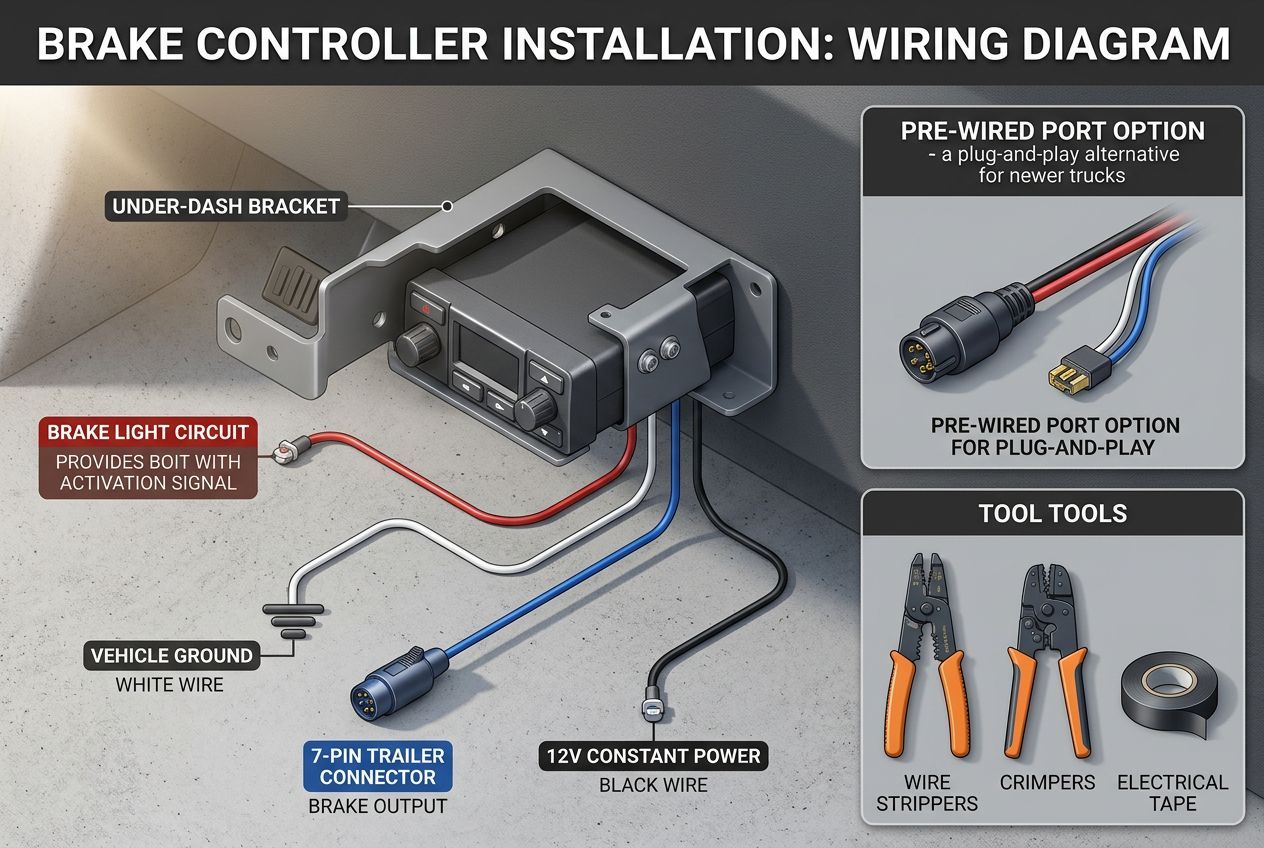
A trailer brake controller sends an electrical signal through the 7-pin trailer connector's blue wire to activate the trailer's electric brakes when you press the tow vehicle's brake pedal. Without one, the trailer brakes don't engage — your tow vehicle's brakes alone are stopping both the vehicle and a loaded trailer. That's unsafe and illegal in most states for trailers over 3,000 lbs GVWR.
The controller market splits into two categories: proportional (matches braking force in real time) and time-delayed (applies a preset force after a brief delay). Both work, but proportional is smoother, safer, and worth the extra cost for anyone who tows regularly.
What Is the Difference Between Proportional and Time-Delayed Brake Controllers?
This is the most important decision when buying a brake controller. The two types use fundamentally different methods to determine how much braking force to send to the trailer.
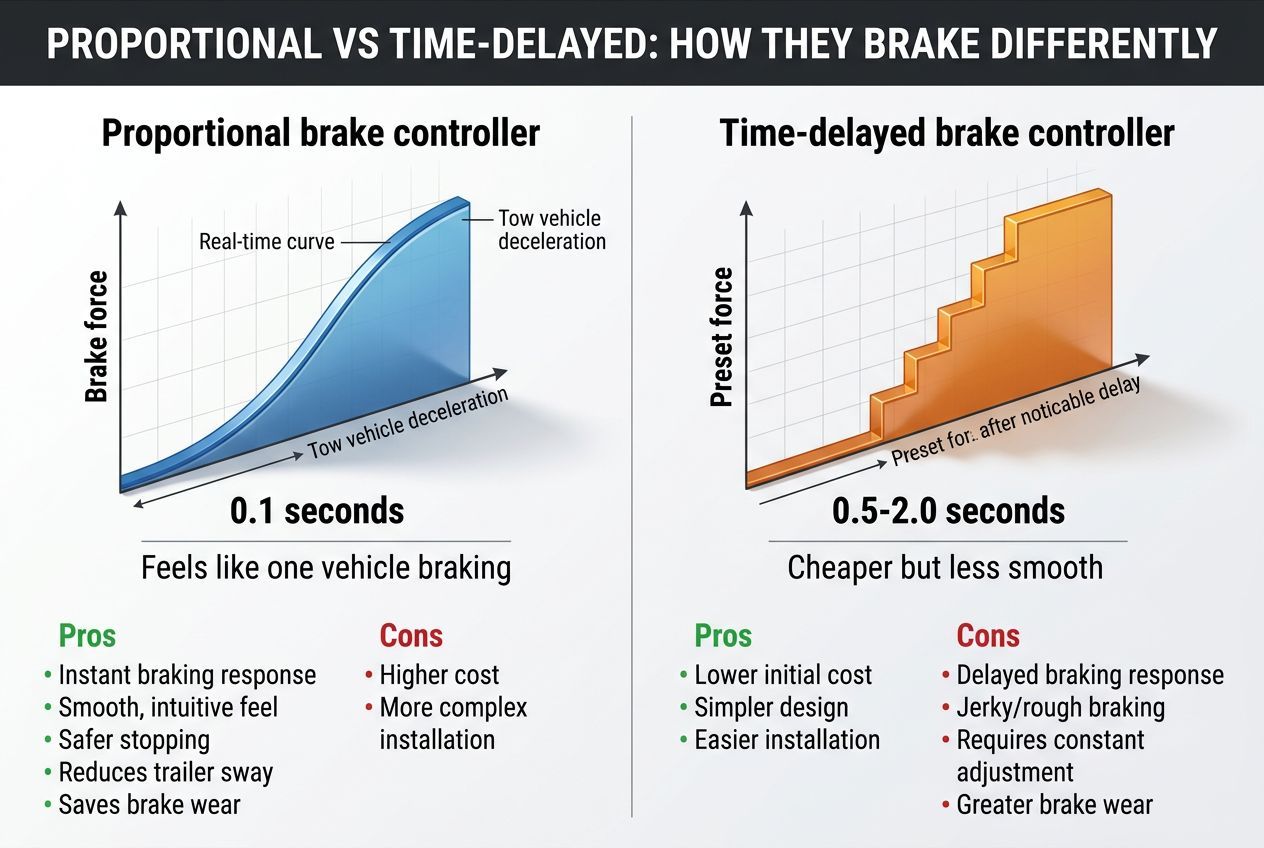
Proportional (inertia-based) controllers contain an accelerometer that senses how hard the tow vehicle is decelerating. Light brake pedal pressure = light trailer braking. Hard braking = aggressive trailer braking. The response is instantaneous and proportional — the trailer brakes match the tow vehicle's braking intensity in real time.
Time-delayed controllers apply a user-preset braking force after a short delay (typically 0.5-2 seconds) when the brake pedal is pressed. The braking force doesn't vary with how hard you brake — it ramps up to the preset level at a fixed rate regardless of whether you're gently slowing for a yellow light or panic-stopping for a deer.
| Feature | Proportional | Time-Delayed |
|---|---|---|
| Braking response | Instant, varies with pedal force | Delayed, fixed ramp-up |
| Smoothness | Very smooth — feels natural | Can feel jerky or abrupt |
| Emergency braking | Excellent — full force immediately | Delayed response |
| Price range | $80-$300 | $30-$80 |
| Brake pad wear | Even — less wear overall | Higher — applies max force more often |
| Best for | Regular towing, heavy trailers, highway | Occasional towing, light trailers |
Source: Tekonsha, Curt Manufacturing specifications
For anyone towing a travel trailer, boat trailer with brakes, or any trailer over 5,000 lbs, a proportional controller is worth the investment. The smoother braking reduces trailer sway, extends brake pad life, and provides safer emergency stopping.
Key Insight: In a panic stop at 60 mph, a proportional controller applies full trailer braking force within 0.1 seconds. A time-delayed controller takes 0.5-2 seconds to ramp up to full force. At 60 mph, a 1-second delay means traveling an extra 88 feet before the trailer brakes reach full effectiveness. That matters.
What Are the Best Trailer Brake Controllers in 2026?
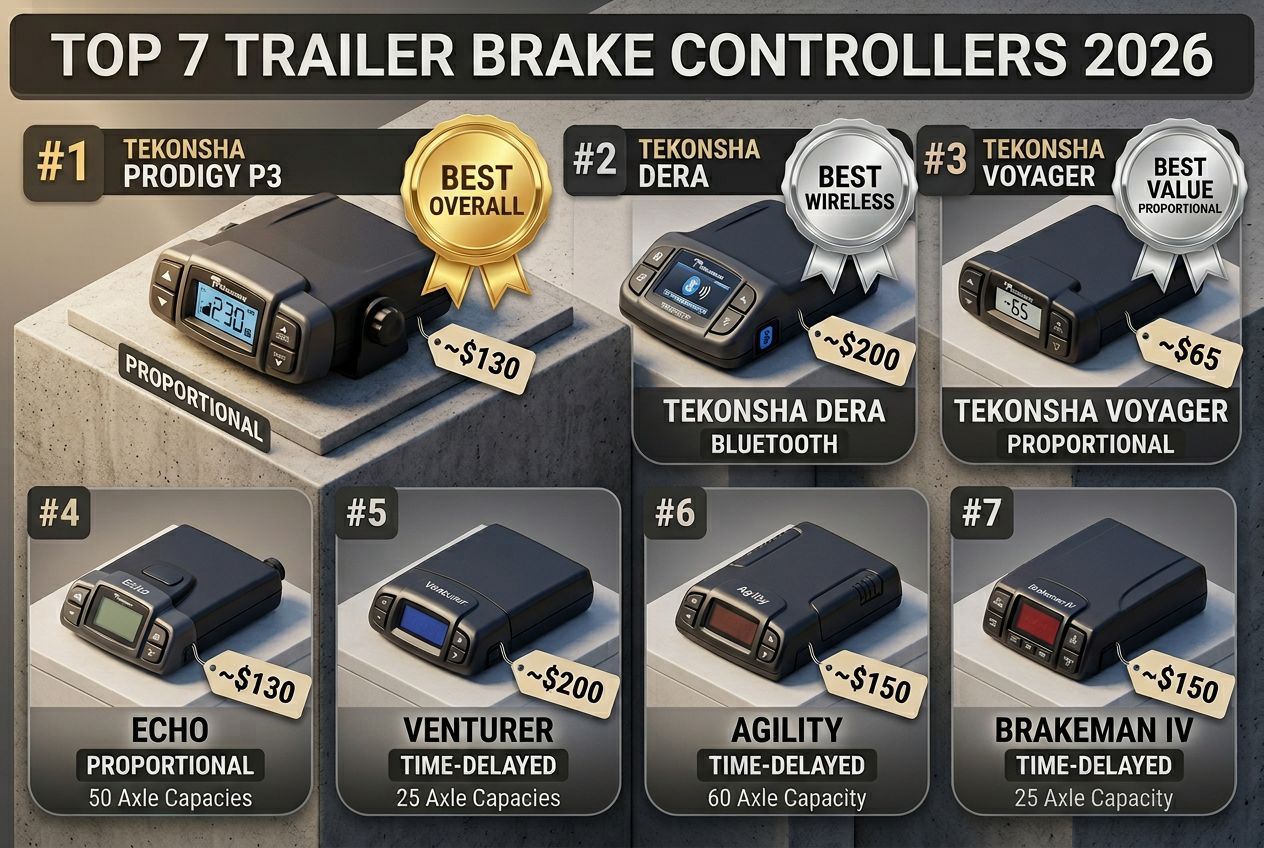
Here are the seven best brake controllers across every budget, tow setup, and installation preference.
| Controller | Type | Axles | Display | Price | Best For |
|---|---|---|---|---|---|
| Tekonsha Prodigy P3 | Proportional | 1-4 | Digital LED | ~$130 | Best overall — proven, reliable |
| Tekonsha DERA | Proportional | 1-4 | Bluetooth/app | ~$200 | Best wireless — no under-dash mount |
| Curt Echo | Proportional | 1-4 | Bluetooth/app | ~$175 | Best wireless alternative |
| Tekonsha Voyager | Proportional | 1-4 | LED indicator | ~$80 | Best budget proportional |
| Curt Venturer | Time-Delayed | 1-4 | LED indicator | ~$50 | Best budget time-delayed |
| Hopkins Agility | Proportional | 1-2 | Digital | ~$90 | Best value proportional |
| Reese Brakeman IV | Time-Delayed | 1-4 | LED | ~$35 | Cheapest option that works |
Source: Manufacturer specifications, verified pricing April 2026
Why Is the Tekonsha Prodigy P3 the Best Overall?
The Prodigy P3 has been the industry standard proportional brake controller for over a decade, and it earns that position through consistent performance and straightforward operation.
The digital LED display shows real-time braking output, boost level, and diagnostic codes. The three-axis accelerometer works accurately whether the controller is mounted at an angle, upside down, or in a non-standard position — unlike older single-axis controllers that had to be perfectly level. It handles 1-4 trailer axles (8 brakes simultaneously) with automatic proportional adjustment.
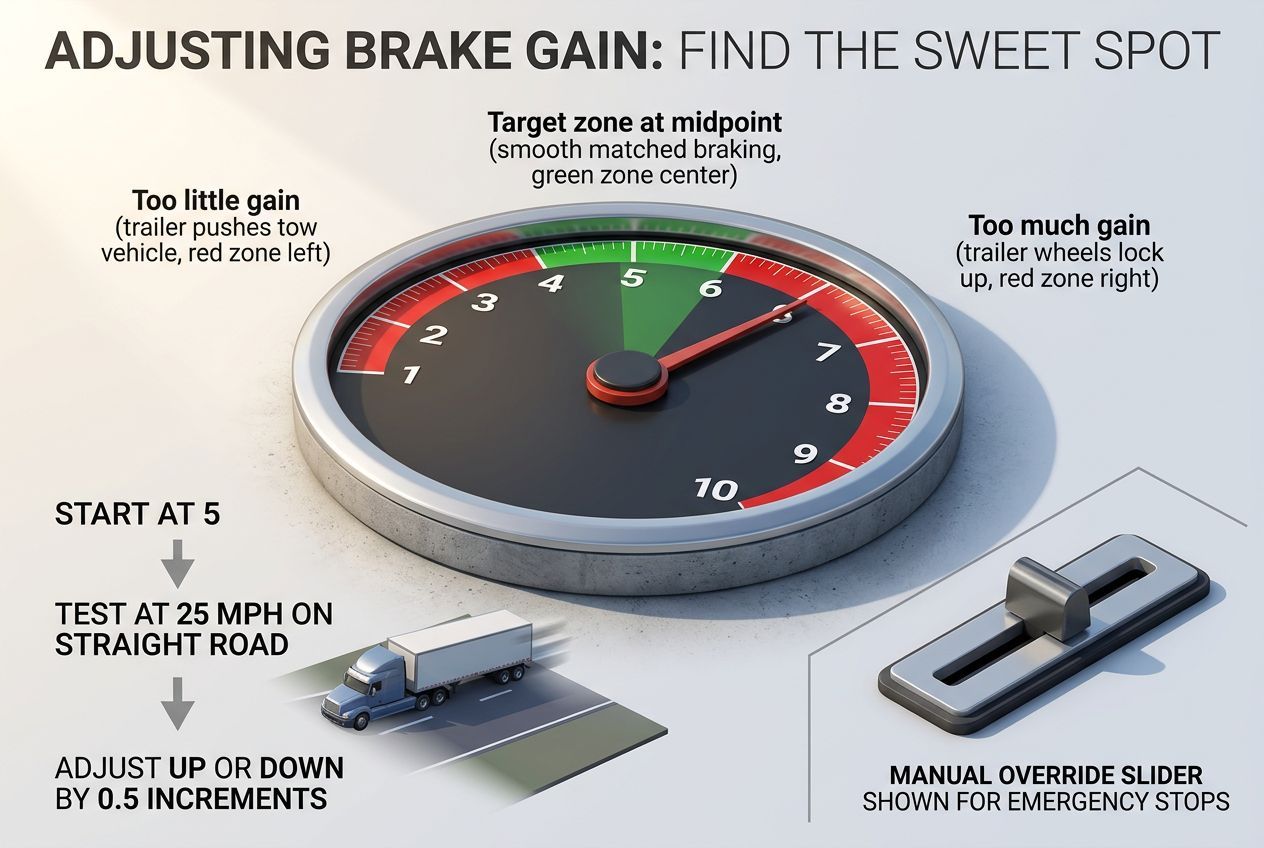
Setup takes 2 minutes: set the gain (power level) and boost (initial braking aggressiveness), then fine-tune on the road. The manual override slider on the front lets you activate the trailer brakes independently of the tow vehicle brakes — useful for controlling trailer sway or slowing the trailer on a downhill grade.
Limitations: Requires under-dash mounting, which means visible wiring. The LED display is small and hard to read in direct sunlight. No Bluetooth or app connectivity — purely hardware controls.
Pro Tip: Mount the Prodigy P3 within arm's reach of the driver. The manual override slider is your best tool for controlling trailer sway — if you feel the trailer start to oscillate, activating the trailer brakes independently slows the trailer and straightens the combination. You need to reach it without looking away from the road.