Real-World Scenario: Let's consider a practical example. You're towing a 6,500-lb travel trailer. Targeting 12% tongue weight means 780 lbs will be on the hitch ball. If you add a 200-lb driver, a 170-lb passenger, and 80 lbs of gear in the cab, that's 1,230 lbs total. Against a typical 1,650-lb payload rating for a half-ton truck, you've already used 75% of your payload before accounting for a full 26-gallon fuel tank (approximately 156 lbs) or any additional cargo in the truck bed, such as a cooler. This illustrates why pre-trip tongue weight calculations are essential.
For a deeper look at how all those numbers interact, the payload capacity explained guide walks through GVWR, GAWR, and how payload gets eaten up faster than most people expect. The curb weight vs gross weight guide covers the foundational difference between an empty truck's weight and its rated maximum — the math that feeds every other calculation.
🛡️
TRAILER & PAYLOAD
How Do You Measure Tongue Weight at Home?
You have three practical options for measuring tongue weight, ranging from dedicated tools to clever DIY methods and professional weigh stations.
Dedicated Tongue Weight Scale
Ease of Use: These specialized scales, typically priced between $40–$150, are designed to sit directly between your hitch ball and trailer coupler. You simply lower the trailer coupler onto the scale, and it provides an immediate readout of the downward load.
Accuracy: Brands such as Weigh Safe and RebelT offer versions, some with integrated hitch ball scales and digital displays. They usually offer an accuracy of ±5 lbs, which is more than sufficient for properly adjusting your trailer's load.
Bathroom Scale Fulcrum Method
Leverage for Heavier Trailers: Most standard bathroom scales have a weight limit of around 300 lbs. For heavier trailers, you can use a leverage multiplier setup.
Setup Process: Place a 2×4 flat on your bathroom scale. Then, balance a longer, sturdy board on a fulcrum point (a piece of pipe works well) positioned at a measured distance from the scale. Carefully lower the trailer tongue onto the far end of this lever board.
Calculation: Multiply your bathroom scale reading by the leverage ratio. This ratio is calculated by dividing the distance from the fulcrum to the trailer tongue by the distance from the fulcrum to the scale. While requiring a few minutes to set up, this method is effective for trailers exceeding a bathroom scale's direct capacity.
Public CAT Scale
Professional Accuracy: Pull into almost any truck stop, and you'll find a CAT scale, which typically costs around $12–$16 per weigh. This is often considered the most accurate method.
Weighing Procedure: Weigh your entire rig (truck and trailer) once with the trailer attached. Then, disconnect the trailer and weigh the truck alone. The difference in your truck's rear-axle weight between these two readings provides your precise tongue weight.
Additional Benefits: The CAT scale also simultaneously confirms that you are within your rear axle weight rating (GAWR) — a critical safety limit typically ranging from 3,000–3,800 lbs for a half-ton truck.
✅ Pro Tip: Regardless of the method you choose, always measure your tongue weight with the trailer fully loaded, exactly as it will be on the road. This includes fuel, water, gear, and anything else you'll be carrying to ensure an accurate, real-world reading.
📋
TRAILER & PAYLOAD
What Happens If Tongue Weight Is Too Heavy or Too Light?
Both extremes of tongue weight are inherently dangerous, each presenting a distinct set of risks that can compromise your safety on the road.
Too Heavy Tongue Weight
Impact on Your Vehicle: When tongue weight is excessively heavy, your rear suspension becomes overly compressed, causing the truck to squat significantly. This lifts the front tires, reducing their contact pressure with the road.
Steering and Braking Issues: Ford's towing supplement highlights that excessive tongue weight can diminish front tire contact force by 20–30%, leading to a disconnected or vague steering feel. This condition also accelerates rear tire wear and dramatically increases braking distances. Furthermore, your rear Gross Axle Weight Rating (GAWR) can be exceeded long before you even reach your overall tow rating. Always check your door-jamb sticker on the driver's side B-pillar for your specific rear GAWR; it represents a non-negotiable hard ceiling.
Too Light Tongue Weight
Trailer Instability: Conversely, if the tongue weight is too light, the trailer's tail becomes heavier than its nose. Research from the University of Michigan Transportation Research Institute (UMTRI) indicates that trailers with less than 10% tongue weight are significantly more susceptible to lateral oscillation. This "trailer sway" amplifies with speed and can quickly become uncontrollable, often above 45 mph, if not corrected immediately.
Highway Hazards: Once trailer sway begins at highway speeds, it's extremely challenging to mitigate. In mountain towing scenarios, such as descending a steep grade in Colorado at 7,000 feet, insufficient tongue weight combined with a downhill slope can initiate sway from even a slight steering correction. At such altitudes, naturally aspirated engines also lose approximately 3% power per 1,000 feet above sea level, further reducing your engine braking authority to compensate.
The overloaded truck risks guide covers what actually happens to your suspension and brake hardware when you push past these limits.
⚙️
TRAILER & PAYLOAD
How Does Tongue Weight Affect Towing Safety?
The Foundation of Stability: Tongue weight is arguably one of the most critical factors directly influencing trailer stability. It dictates whether your trailer will track faithfully behind your tow vehicle or begin to "develop a mind of its own," leading to dangerous situations.
Physics at Play: Correct tongue weight ensures the trailer's front remains heavier than its rear. This means that any lateral disturbance – be it a crosswind, a groove in the pavement, or a quick lane change – is damped out rather than amplified. The hitch ball acts as a pivot, and with proper loading, the laws of physics work in your favor to maintain control.
⚠️ Warning: When loading a boat trailer, always account for the actual wet weight. Boats in coastal states like Florida and Louisiana can easily weigh significantly more than their advertised dry weight once fueled, equipped with water in the bilge, and loaded with gear. A boat specified at 3,800 lbs dry can easily reach 4,500 lbs, potentially shifting your tongue weight well outside the safe range without any visible warning until you're already on the highway.
Vehicle Limits: Your truck's ultimate capacity to handle tongue weight is constrained by its combined towing capacity and payload rating. Before hitching up, use the towing capacity lookup tool to confirm both numbers for your specific year, make, model, and configuration.
🚛
TRAILER & PAYLOAD
Do I Need a Weight Distribution Hitch for Tongue Weight?
When a WDH Becomes Essential: A weight distribution hitch (WDH) is strongly recommended when your tongue weight surpasses 300–500 lbs, or when your trailer's weight exceeds 50% of your tow vehicle's curb weight – whichever threshold is met first.
OEM Recommendations & Warranty: Major manufacturers like Ford, GM, and RAM explicitly state in their towing supplements that maximum tow ratings are only achievable with a WDH once these weight thresholds are crossed. Towing above these limits without a WDH can not only compromise safety but may also void warranty coverage on critical suspension and drivetrain components.
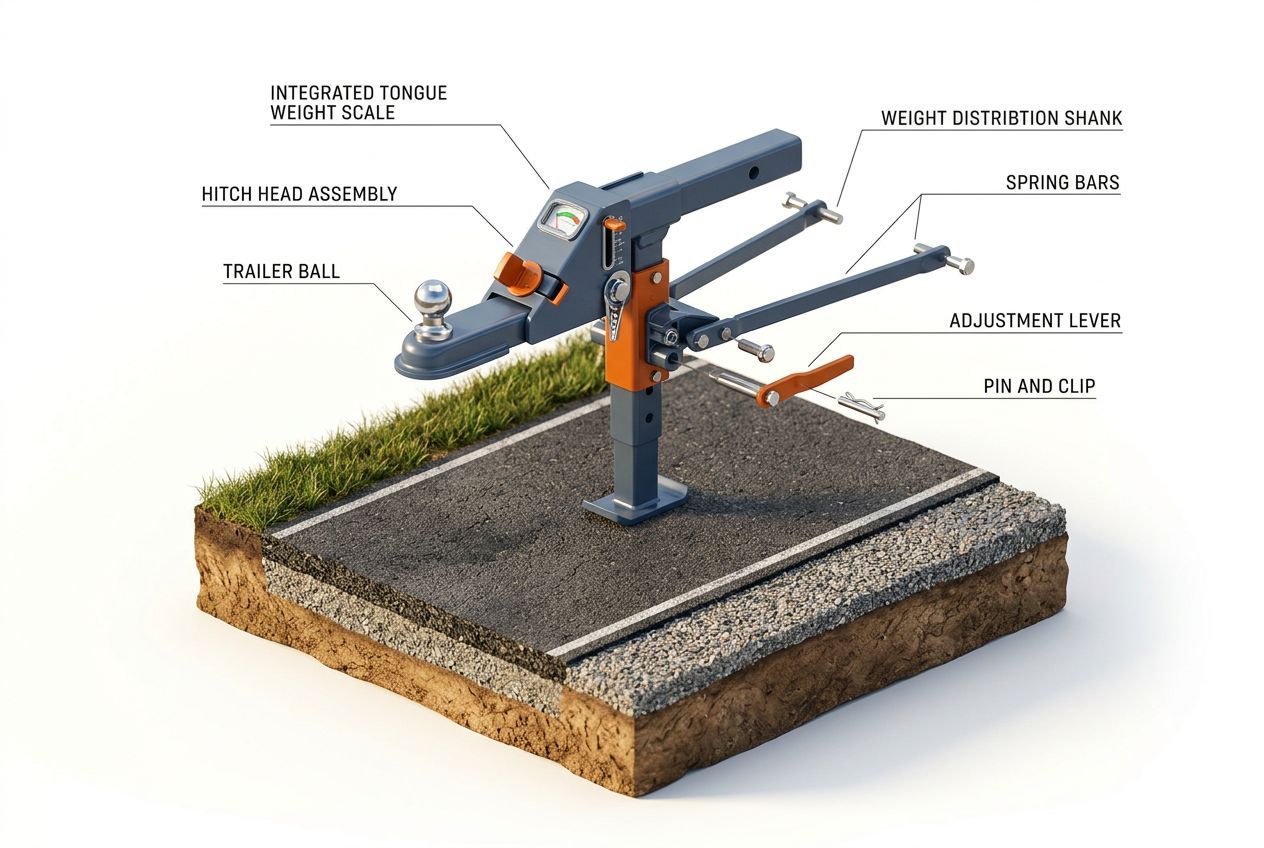
How a WDH Works: A WDH employs spring bars (available in either round bar or trunnion style) to effectively transfer a portion of the load from the rear axle of the tow vehicle forward to its front axle, and also back to the trailer axles. This action restores crucial front-axle contact pressure, levels out the truck, and returns the steering feel to normal. It's important to understand that a WDH doesn't reduce your actual tongue weight; instead, it redistributes the effects of that weight across more axles, improving overall stability and handling.
The weight distribution hitch guide explains how to set spring bar tension correctly, because an improperly adjusted WDH can actually make handling worse by overloading the trailer's front axle.
📝
TRAILER & PAYLOAD
What Is the Difference Between Tongue Weight and Pin Weight?
Connection Point Distinction: Tongue weight refers specifically to bumper-pull trailers that utilize a ball-and-coupler connection, typically located behind the rear bumper of the tow vehicle. Pin weight, on the other hand, is the equivalent measurement for fifth-wheel and gooseneck trailers, where a kingpin connects directly into the truck bed, positioned either over or very near the rear axle.
Geometric Implications: This difference in geometry is significant. Because the fifth-wheel or gooseneck hitch sits directly over the rear axle, the weight transfer to the truck is more direct and less reliant on leverage compared to a bumper-pull setup. This is why the acceptable percentage band for pin weight is higher (15–25%) and why pin weights of 1,500–2,500 lbs are common for typical 10,000-lb fifth-wheels. Consequently, safely handling these heavier pin weights generally requires a three-quarter-ton or heavier truck.
💡 Key Takeaway: The placement of the hitch (behind the bumper vs. over the axle) fundamentally changes the dynamics of weight transfer, impacting stability and required tow vehicle capacity.
For a side-by-side breakdown of how fifth-wheel and gooseneck connections compare in real towing scenarios, the fifth-wheel vs. gooseneck guide covers hitch types, weight ratings, and which setup fits which use case.