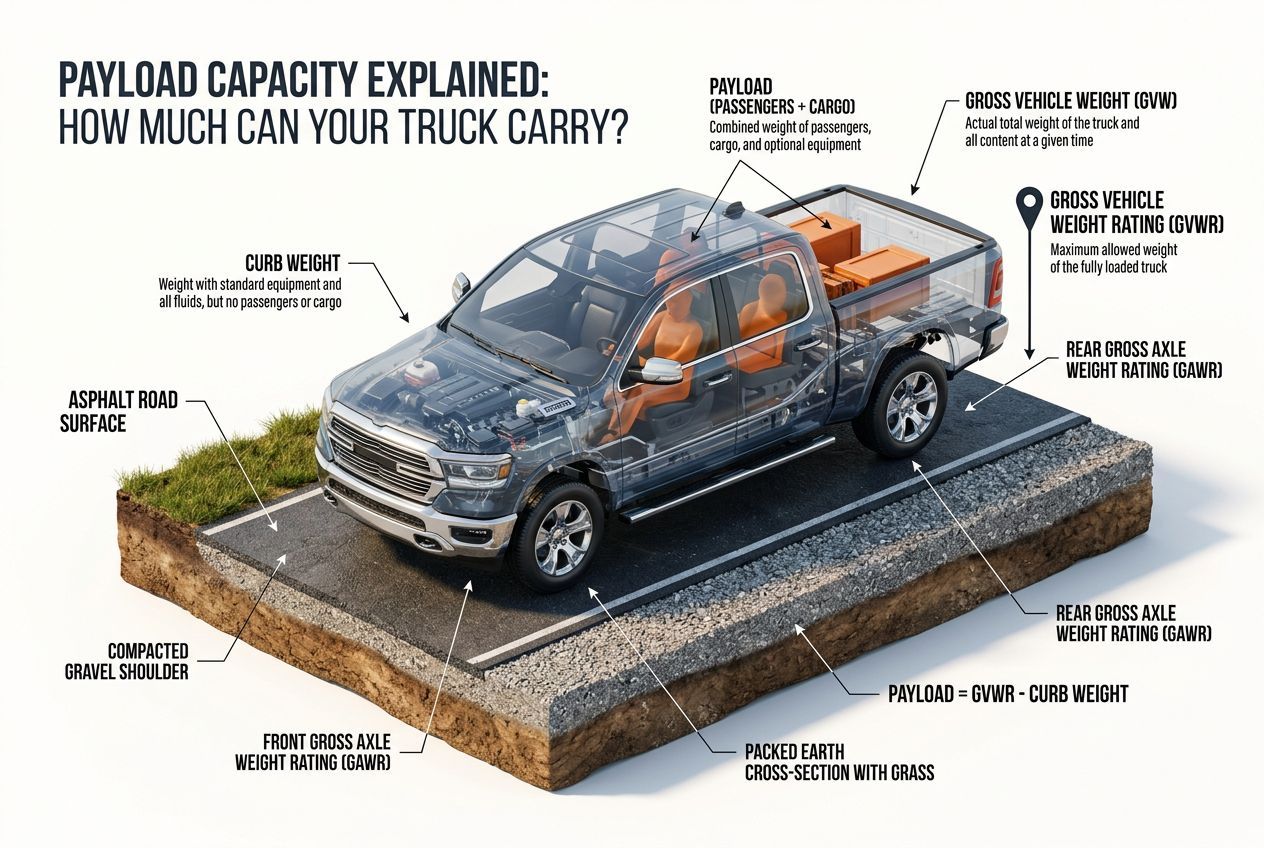
Here's a worked example with real numbers: Say you own a 2024 Ford F-150 SuperCrew 4×4 with a 2,100-lb payload rating. Here's what your budget looks like before you load a single piece of cargo:
How Do You Calculate Your Truck's Payload Capacity? — data table
| Item |
Weight |
| Driver + passenger |
370 lbs |
| Spray-in bed liner |
75 lbs |
| Aluminum toolbox |
120 lbs |
| Tonneau cover |
60 lbs |
| Subtotal consumed |
625 lbs |
| Payload remaining for cargo + tongue weight |
1,475 lbs |
Now add a 7,000-lb trailer. At 12% tongue weight, that's 840 lbs. Your actual cargo budget is now 635 lbs — not 2,100. That's a significant difference, and it's exactly why understanding this calculation matters before you load up and hit the road. Our payload capacity explained guide walks through more scenarios like this one.
🔧
TRAILER & PAYLOAD
What Is the Difference Between Payload Capacity and Towing Capacity?
Payload capacity vs. towing capacity are distinct but interconnected metrics. Payload capacity is the weight on your truck; towing capacity is the weight behind it. They're separate ratings, but they directly affect each other — because tongue weight, which is the downward force the trailer hitch puts on the truck, counts against your payload.
Think of it this way: your towing capacity tells you how heavy a trailer you can pull. Your payload capacity tells you how much of that trailer's weight your truck's frame, springs, axles, and tires can absorb while still being able to steer and stop safely. Both limits must be respected simultaneously, not just one or the other.
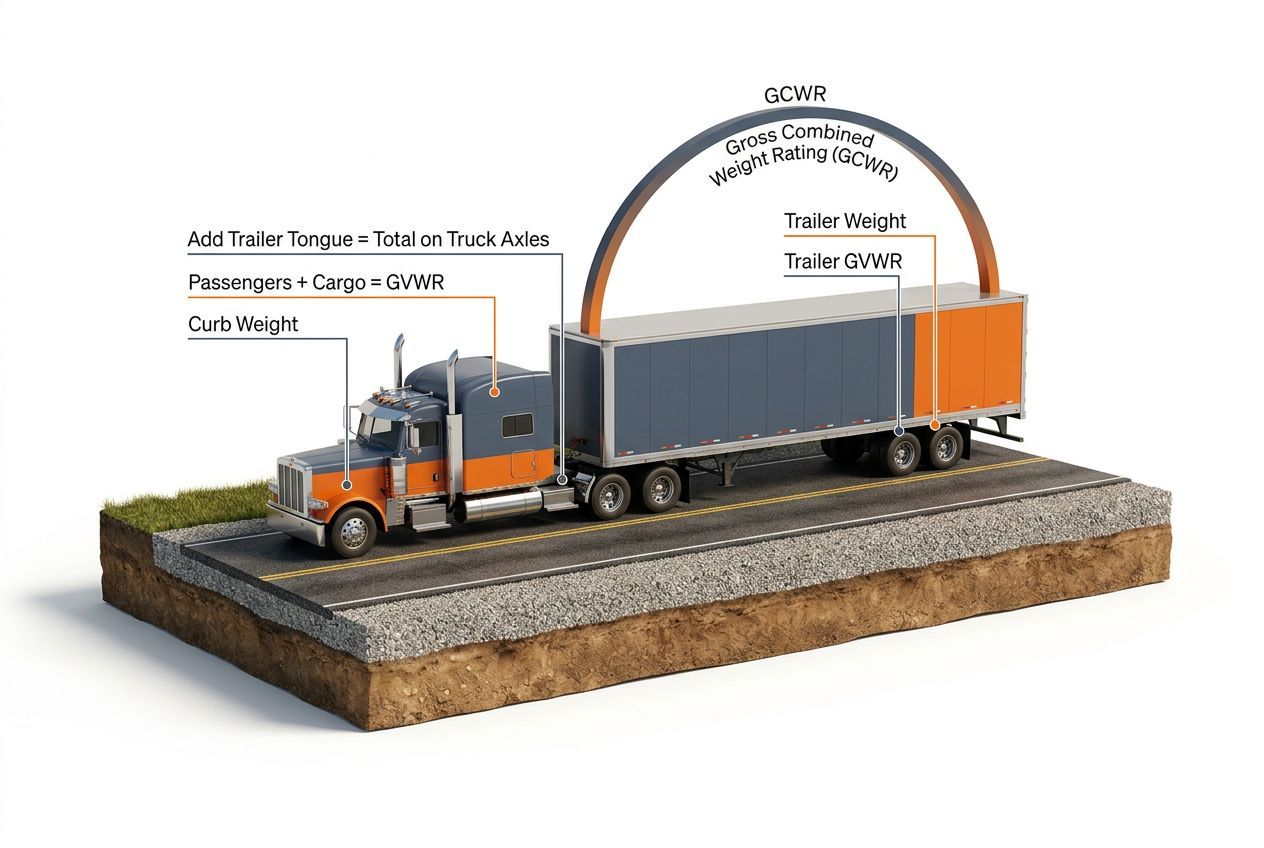
The Gross Combined Weight Rating (GCWR) adds another critical layer. GCWR is the maximum total weight of the truck plus the loaded trailer combined. You can hit your towing capacity number while staying under GCWR, or vice versa. Exceeding either is a problem and compromises safety and legality.
💡 Key Takeaway: Always consider payload, towing, and GCWR together. Exceeding any one of these ratings can lead to dangerous driving conditions, legal penalties, and potential insurance claim denials.
For a full side-by-side breakdown, our towing capacity guide covers the GCWR, axle ratings, and how they interact with payload limits. And if you want to verify your specific truck's numbers quickly, the towing capacity lookup tool pulls specs by year, make, and model.
🛡️
TRAILER & PAYLOAD
How Much Payload Can a Half-Ton, Three-Quarter-Ton, and One-Ton Truck Carry?
Payload capacity varies dramatically by truck class — and within each class, it varies by cab style, bed length, engine, drivetrain, and factory options. The numbers below reflect 2024 model-year maximum ratings per manufacturer specifications published at ford.com, ramtrucks.com, chevrolet.com, and toyota.com.
How Much Payload Can a Half-Ton, Three-Quarter-Ton, and One-Ton Truck Carry? — data table
| Truck |
Class |
Max Payload (2024) |
Config That Achieves Max |
| Ford F-150 |
Half-ton |
2,345 lbs |
Regular cab, 4×2, payload pkg |
| Ram 1500 |
Half-ton |
2,300 lbs |
Regular cab, 4×2 |
| Chevrolet Silverado 1500 |
Half-ton |
2,280 lbs |
Regular cab, 4×2 |
| Toyota Tundra |
Half-ton |
1,940 lbs |
Regular cab, 4×2 |
| Ram 2500 |
Three-quarter-ton |
~4,010 lbs |
Regular cab, 4×2, gas engine |
| Ford F-350 |
One-ton |
~7,850 lbs |
Regular cab, DRW, 4×2 |
Source: Manufacturer towing and payload guides, 2024 model year.
Key observations regarding payload capacities:
- Configuration matters enormously. A 2024 F-150 SuperCrew 4×4 with the Max Payload Package might come in around 2,100 lbs — nearly 250 lbs less than the regular cab 4×2 that achieves the headline number. Adding a crew cab, 4WD, and a bigger engine all add curb weight, which eats into payload.
- Segment differences are significant. The Toyota Tundra's 1,940-lb ceiling is the lowest in the half-ton segment. If you regularly haul near your limit, a Tundra may not be the right tool. The can I tow this tool lets you enter your truck and load to get a fast answer.
- Heavy-duty trucks offer substantial increases. The F-350 DRW's 7,850-lb payload is in a different league entirely — designed for commercial flatbeds, service bodies, and dump inserts. Don't buy more truck than you need, but don't buy less either. See our 5th wheel vs gooseneck guide if you're trying to decide which hitch setup works for heavy hauling.
📋
TRAILER & PAYLOAD
Does Payload Capacity Include Passengers and Tongue Weight?
Yes, both passengers and tongue weight absolutely count against your payload. This is, in fact, the most common mistake truck owners make. Every adult in the cab, every bag on the back seat, every pound of tongue weight from your trailer is deducted from your payload budget the moment you put it in or on the truck.
⚠️ Warning: Underestimating the combined weight of passengers, gear, and tongue weight is a leading cause of accidental overloading. Always account for every item in your payload calculation.
Occupant weight estimates used by NHTSA typically use a standard of 150 lbs per occupant, but that's a baseline — many adults weigh more. Two passengers at 200 lbs each is 400 lbs gone instantly from your available payload.
📊 Quick Fact: NHTSA's baseline occupant weight is 150 lbs. However, actual passenger weights often exceed this, rapidly consuming available payload.
Consider this common weekend scenario: You're towing a 26-ft bumper-pull camper at 7,500 lbs loaded. Tongue weight at 13% is 975 lbs. Inside your truck, you've got:
- Two adults in the cab (400 lbs)
- A dog (70 lbs)
- Luggage (100 lbs)
- A full cooler (60 lbs) in the back seat
That's a total of 1,605 lbs consumed — before the truck's aftermarket accessories are even counted. If your truck's payload rating is 1,700 lbs, you're 5 lbs under the limit and haven't accounted for that bed-mounted cargo carrier you bolted on last spring.
✅ Pro Tip: Before every trip, create a mental (or actual) list of all passengers, cargo, and estimated tongue weight. Always round up when estimating to build in a safety margin.
Tongue weight and its relationship to payload is covered in depth in our trailer weight guide. If you're running a fifth wheel, the pin weight — typically 15–25% of trailer weight — hits your payload even harder. Our pin weight explained article has the numbers.
⚙️
TRAILER & PAYLOAD
What Happens If You Exceed Your Truck's Payload Capacity?
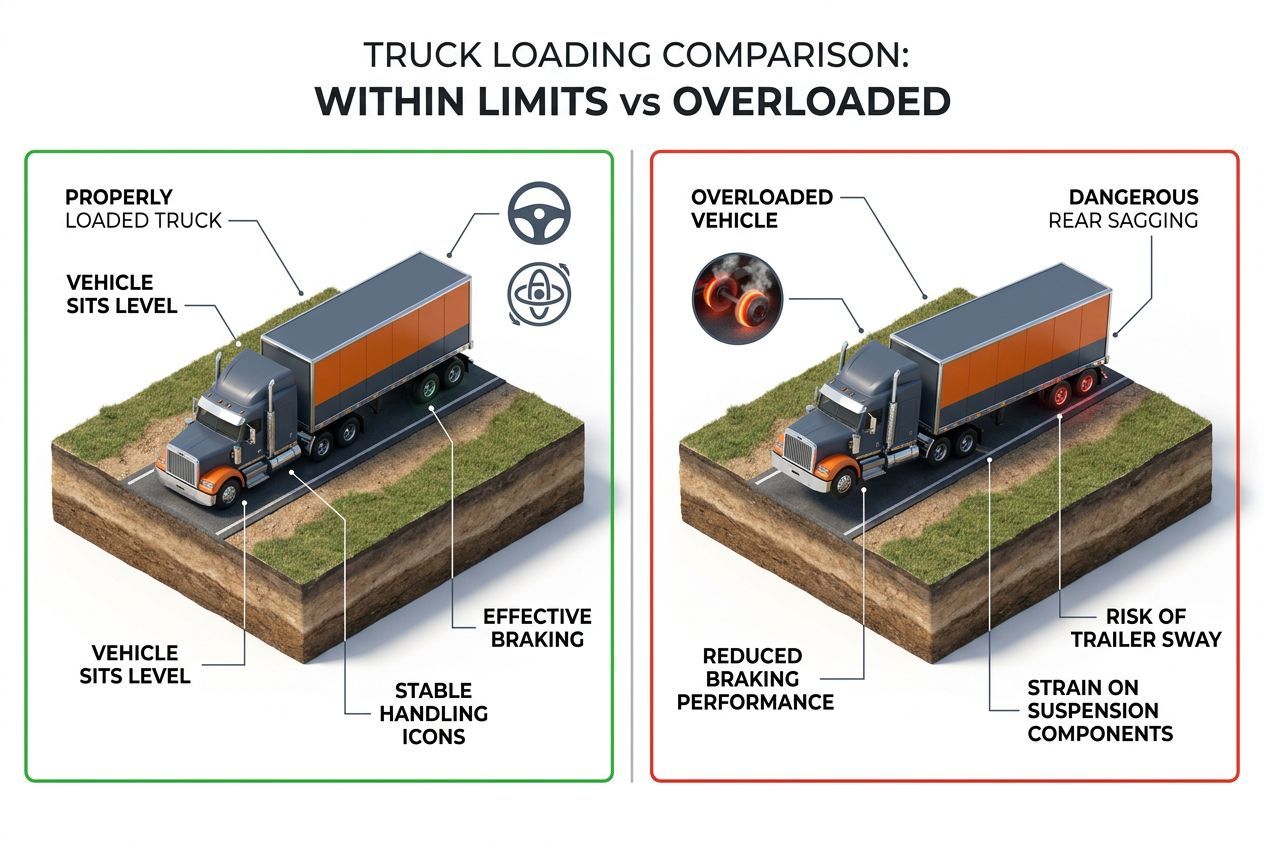
Exceeding payload capacity isn't just a spec-sheet violation — it creates immediate and measurable safety risks. Braking distances increase significantly, steering gets vague and sluggish, and suspension components deflect beyond their designed range. Tire sidewalls flex more than they're rated for, generating excessive heat that can lead to dangerous blowouts at highway speed.
⚠️ Warning: Overloading directly compromises your truck's ability to steer, brake, and remain stable, dramatically increasing the risk of an accident.
Structurally, repeated overloading fatigues the frame, bends axle housing, and cracks spring perches — damage that's often invisible until it fails catastrophically. According to NHTSA, overloaded vehicles are a contributing factor in thousands of crashes annually.
From a legal standpoint, DOT weigh stations can cite you for exceeding axle weight ratings, with fines ranging from $100 to over $10,000 depending on severity and state. Some states calculate fines per pound over the limit — at 5 cents per pound over 2,000 lbs excess, that's a $100 fine just for the math, and it scales fast. Check towing laws by state for your specific jurisdiction.
📊 Quick Fact: DOT fines for overloading can range from $100 to over $10,000, varying by state and the degree of overload.
Insurance exposure is also a very real concern. If you're involved in an accident while overloaded, your carrier can deny the claim on the grounds that the vehicle was operated outside its rated capacity. That's a denial on a total-loss claim that leaves you personally liable for damages and injuries. The full picture of what overloading does is in our overloaded truck risks article.
🚛
TRAILER & PAYLOAD
How Can You Increase or Maximize Your Truck's Payload Capacity?
The honest answer is this: you can optimize how you use your existing payload, but you can't legally increase the manufacturer's payload number stamped on your door jamb without buying a different truck.
What actually helps optimize your existing payload:
- Remove unnecessary aftermarket accessories: A steel toolbox, full-length bed liner, and heavy bumper can add 300–500 lbs of curb weight, directly reducing available payload.
- Choose lighter materials: Opt for aluminum toolboxes over steel for a savings of 80–120 lbs.
- Upgrade to load-rated tires: Using Load Range E tires instead of Load Range C won't change your GVWR, but it provides a crucial safety margin at the tire level, reducing blowout risk under heavy loads.
- Add air bags or helper springs: These modifications improve load leveling and ride quality under load by supporting the suspension, but they do not increase your legal GVWR or payload rating.
What doesn't legally increase your payload capacity:
- Aftermarket suspension upgrades do not change your legal payload rating. A set of Firestone Ride-Rite air bags might make your truck handle better at 2,400 lbs, but your manufacturer's 2,100-lb limit remains the legal and engineering boundary. Adding airbags and then loading 2,400 lbs anyway is still overloading — it's just more comfortable overloading.
If you genuinely need more payload, your best and safest option is to step up to a 3/4-ton or 1-ton platform. The jump from a Ram 1500 to a Ram 2500, for example, can nearly double your payload ceiling. Our truck bed weight capacity guide covers bed-specific limits and what configuration choices matter most. And if cost is part of the decision, the towing cost calculator can help you model the financial side of upgrading.
A weight distribution hitch won't increase payload either, but it redistributes tongue weight more evenly across all axles — which helps with handling and tire wear. See our weight distribution hitch guide for when it makes sense to add one.
One more regional note: at 7,000 feet elevation in Colorado or Utah, naturally aspirated engines lose roughly 3% power per 1,000 feet above sea level. Your payload rating was tested at sea level. You're not overloaded, but you're working with meaningfully less power to move that legal load — account for it on mountain grades.