🔧
TRAILER & PAYLOAD
What Is GVWR and How Is It Different from GVW?
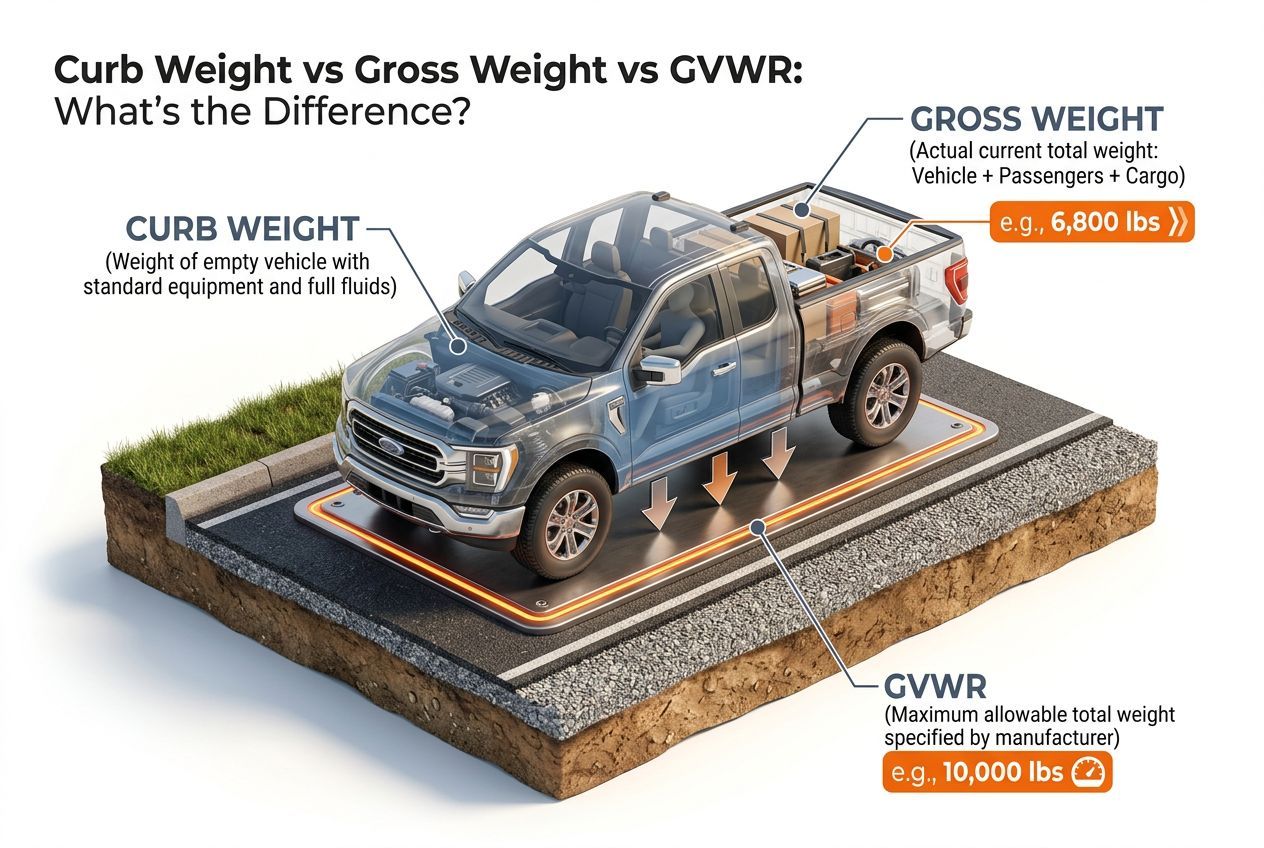
GVWR — Gross Vehicle Weight Rating — is the maximum total weight the manufacturer certifies your vehicle can safely handle. It covers curb weight plus maximum payload. It's a fixed ceiling set by engineers, stamped into the door jamb, and enforced by law.
💡 Key Takeaway: GVWR is a fixed safety limit set by the manufacturer. GVW is your vehicle's actual weight at any given moment. Your GVW must never exceed your GVWR.
The critical difference between GVWR and GVW: GVWR never changes. GVW changes every time you load or unload. Your job is to keep GVW from crossing above GVWR — ever.
For half-ton trucks, GVWR typically runs between 6,500 and 7,700 lbs. The 2024 Chevy Silverado 1500, for example, carries a GVWR range of 6,800 to 7,500 lbs depending on configuration, per Chevrolet's towing data. Three-quarter-ton and one-ton trucks run much higher — a Ram 3500 dually can carry a GVWR over 14,000 lbs.
⚠️ Warning: Exceeding GVWR isn't just a safety risk. State penalties for overweight violations range from $50 to over $16,000 depending on how far over you are and which state catches you.
For a deeper look at how this connects to your trailer math, check out payload capacity explained.
🛡️
TRAILER & PAYLOAD
What Is the Difference Between Curb Weight and Gross Vehicle Weight?
The difference between curb weight and gross vehicle weight is simple in concept: curb weight is the empty baseline, GVW is the loaded reality. But the practical gap between them is where most towing mistakes happen.
Here's the formula that ties everything together:
GVWR − Curb Weight = Maximum Payload Capacity
💡 Key Takeaway: Your payload capacity is the total weight budget for everything you add to the vehicle — people, gear, and the tongue weight from your trailer.
That payload number is the total budget for everything you add to the vehicle — people, gear, and tongue weight from your trailer. It's not a suggestion; it's the ceiling.
⚠️ Warning: NHTSA uses 150 lbs as its standard occupant weight in federal safety testing (NHTSA guidelines). If your family averages more than this, your actual payload use will be higher than standard calculations assume.
📋
TRAILER & PAYLOAD
How Do You Calculate Payload Capacity from Curb Weight and GVWR?
Payload capacity equals GVWR minus curb weight. That's the math. But applying it correctly to a real towing scenario takes a few more steps — because tongue weight counts against payload, not just against your trailer.
Worked Example: Calculating Payload Capacity
Here's a worked example with real numbers:
Scenario: You're driving a 2024 Ford F-150 XLT SuperCrew with the 3.5L EcoBoost.
- Curb weight: approximately 4,769 lbs.
- GVWR: 7,050 lbs.
- Maximum payload: 2,281 lbs (7,050 - 4,769).
Now, let's load it up:
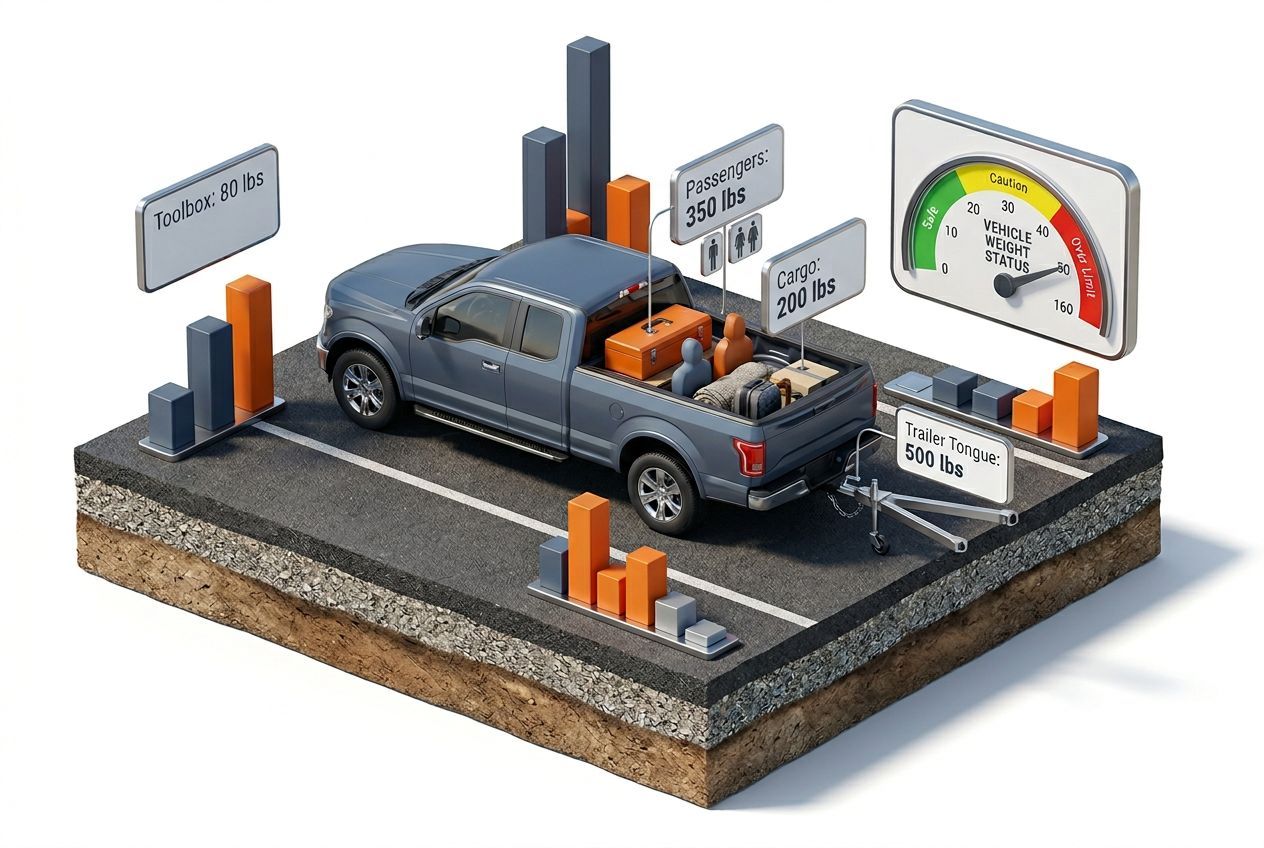
- Driver + passenger: 370 lbs
- Gear in cab and bed: 300 lbs
- Towing a 7,000-lb travel trailer with 12% tongue weight: 840 lbs pressing down on your hitch ball
Total weight counting against payload: 370 + 300 + 840 = 1,510 lbs
Remaining payload margin: 2,281 lbs - 1,510 lbs = 771 lbs
Sounds fine — until you add a full 36-gallon fuel tank (around 240 lbs), a toolbox (100 lbs), and a third passenger. You're now at roughly 2,100 lbs against a 2,281-lb cap. You're 92% loaded with no room for a bag of ice.
✅ Pro Tip: Calculate your trailer's tongue weight first. It's often the biggest single variable impacting your available payload. Consult our tongue weight guide for details.
Use our payload calculator to run your own numbers before you hitch.
⚙️
TRAILER & PAYLOAD
Comparing Common Truck Weight Ratings
Comparing Common Truck Weight Ratings — data table
| Truck |
Curb Weight (lbs) |
GVWR (lbs) |
Max Payload (lbs) |
| 2024 Ford F-150 (base) |
4,021 |
6,500 |
~2,479 |
| 2024 Ram 1500 (mid) |
5,100 |
6,900 |
~1,800 |
| 2024 Chevy Silverado 1500 |
4,650 |
7,200 |
~2,550 |
| 2024 Toyota Tundra (base) |
5,165 |
7,100 |
~1,935 |
| 2024 Ford F-250 (base) |
5,677 |
10,000 |
~4,323 |
Source: Manufacturer spec sheets via ford.com, ramtrucks.com, chevrolet.com, toyota.com. Figures are approximate and vary by configuration.
Notice how the F-250 nearly doubles the payload ceiling of a half-ton. That gap is why a loaded fifth-wheel that's borderline for an F-150 is routine work for an F-250. If you're bumping up against your half-ton's GVWR regularly, it's worth reading our overloaded truck risks breakdown before your next trip.
🚛
TRAILER & PAYLOAD
Where Do You Find Your Vehicle's Curb Weight and GVWR?
Finding your vehicle's weight ratings is critical for safe operation. Your GVWR is printed on the federal certification label on your driver-side door jamb.
Look for a white sticker listing:
- GVWR (Gross Vehicle Weight Rating)
- GAWR front (Gross Axle Weight Rating for the front axle)
- GAWR rear (Gross Axle Weight Rating for the rear axle)
- GCWR (Gross Combined Weight Rating)
This label is legally required by NHTSA for all vehicles sold in the U.S.
Curb weight is a little trickier. The door jamb sticker doesn't list it directly. You'll find it in these places:
- Owner's manual: Usually in the specifications section near the back.
- Manufacturer's website: Build-and-price tools and spec sheets often list it by configuration.
- The Monroney label: The window sticker on new vehicles lists the base curb weight for that specific build.
- A certified truck scale: The most accurate method, especially if you've added aftermarket equipment.
✅ Pro Tip: For the most accurate curb weight, drive to a CAT Scale with a full tank and zero cargo. This number reflects your real-world baseline, accounting for any aftermarket additions.
Our curb weight vs gross weight comparison at the tools page can help you cross-reference specs across multiple vehicles if you're still deciding between trucks.
📝
TRAILER & PAYLOAD
Why Do Curb Weight and GVWR Matter for Towing?
Curb weight and GVWR directly control how much tongue weight your vehicle can accept — which determines what trailers you can legally and safely pull. Since tongue weight comes directly off your payload budget, these two numbers set the entire towing equation.
Consider the honest limitation: a half-ton truck with a 1,800-lb payload capacity and a trailer with 15% tongue weight (a common boat trailer scenario) can only handle a trailer up to 12,000 lbs from a tongue-weight standpoint — and that's before you've added a single passenger or pound of gear. In practice, that same truck's tow rating might cap at 9,900 lbs anyway, which makes the trailer weight the binding constraint, not the tongue weight.
The truck towing capacity guide covers exactly where those ceilings come from and how manufacturers calculate them.
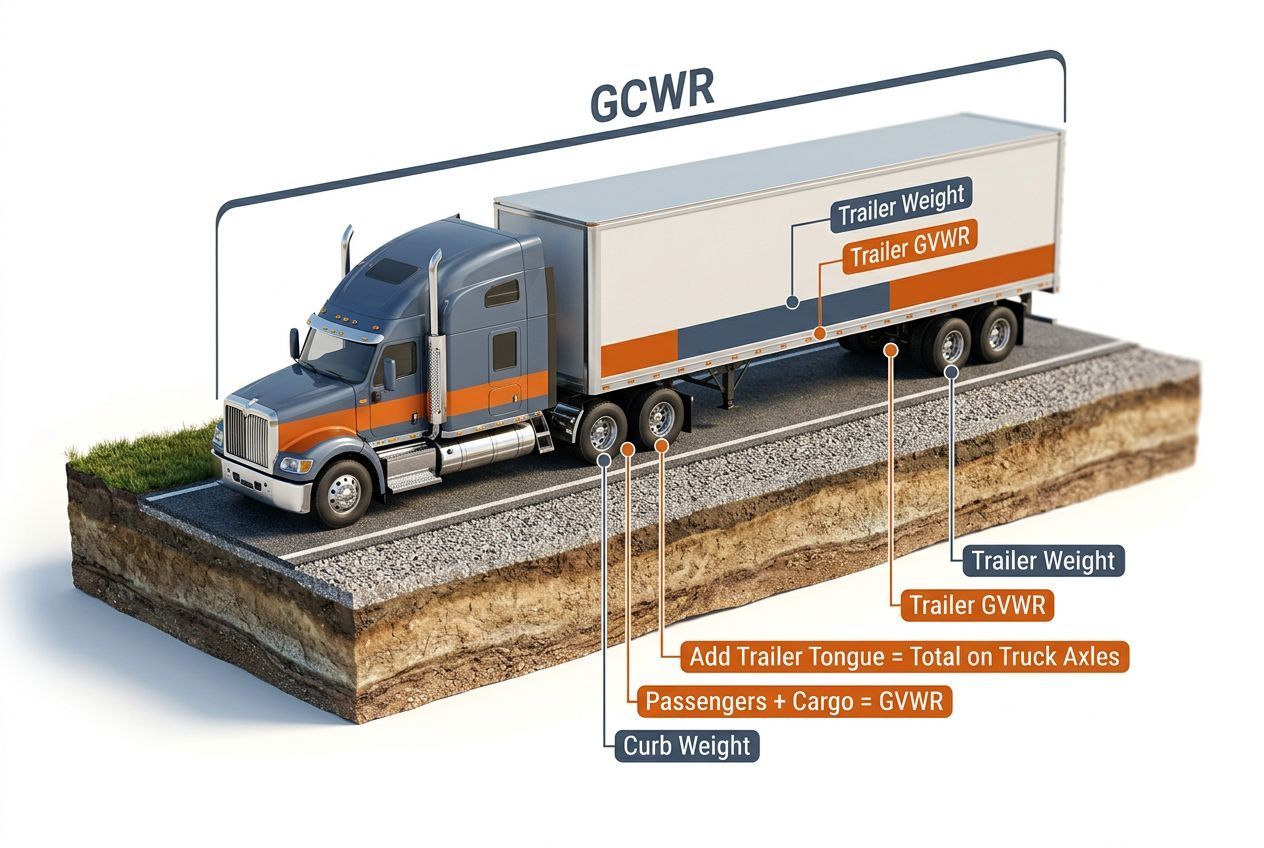
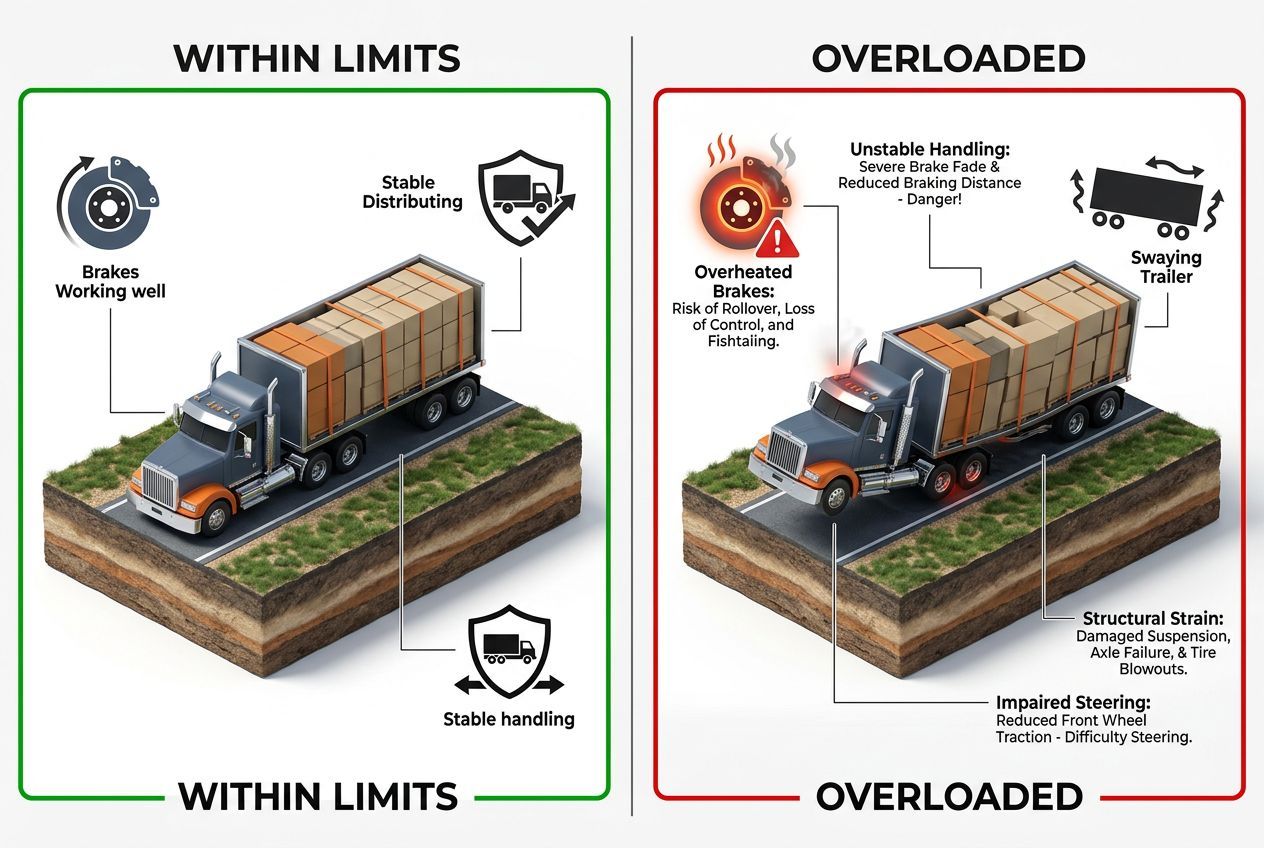
GCWR — Gross Combined Weight Rating — is another number worth knowing. It caps the total weight of your truck plus trailer together. Exceeding GCWR is less visible than exceeding GVWR but equally dangerous, especially for braking distance on mountain grades.
📊 Quick Fact: If you're regularly towing in mountainous regions like Colorado, Utah, or Wyoming, a 6% grade can stretch stopping distance by 40%. Staying well under all ratings is critical for safety.
The weight distribution hitch guide explains how proper hitch setup affects real-world control at these weights.
⚠️ Warning: For vehicles with a GVWR over 26,000 lbs — or GCWR over 26,001 lbs when the trailer exceeds 10,000 lbs — a Commercial Driver's License (CDL) is federally required. Most pickup truck owners won't hit that threshold, but it's a real line for heavy fifth-wheel operators pulling with dually trucks.
Trailer sway is another downstream consequence of poor weight management — if your tongue weight is too low relative to total trailer weight, instability follows.
💡 Key Takeaway: Incorrect tongue weight, often a result of miscalculating payload against GVWR, is a leading cause of dangerous trailer sway.
The trailer sway causes and fixes guide walks through the physics of why it happens and how to fix it before it becomes an emergency.
Finally, don't overlook what the trailer weight guide covers — knowing your trailer's actual loaded weight (not just its dry weight) is the other half of this equation.