📊
TRAILER & PAYLOAD
What Happens When You Overload a Truck?
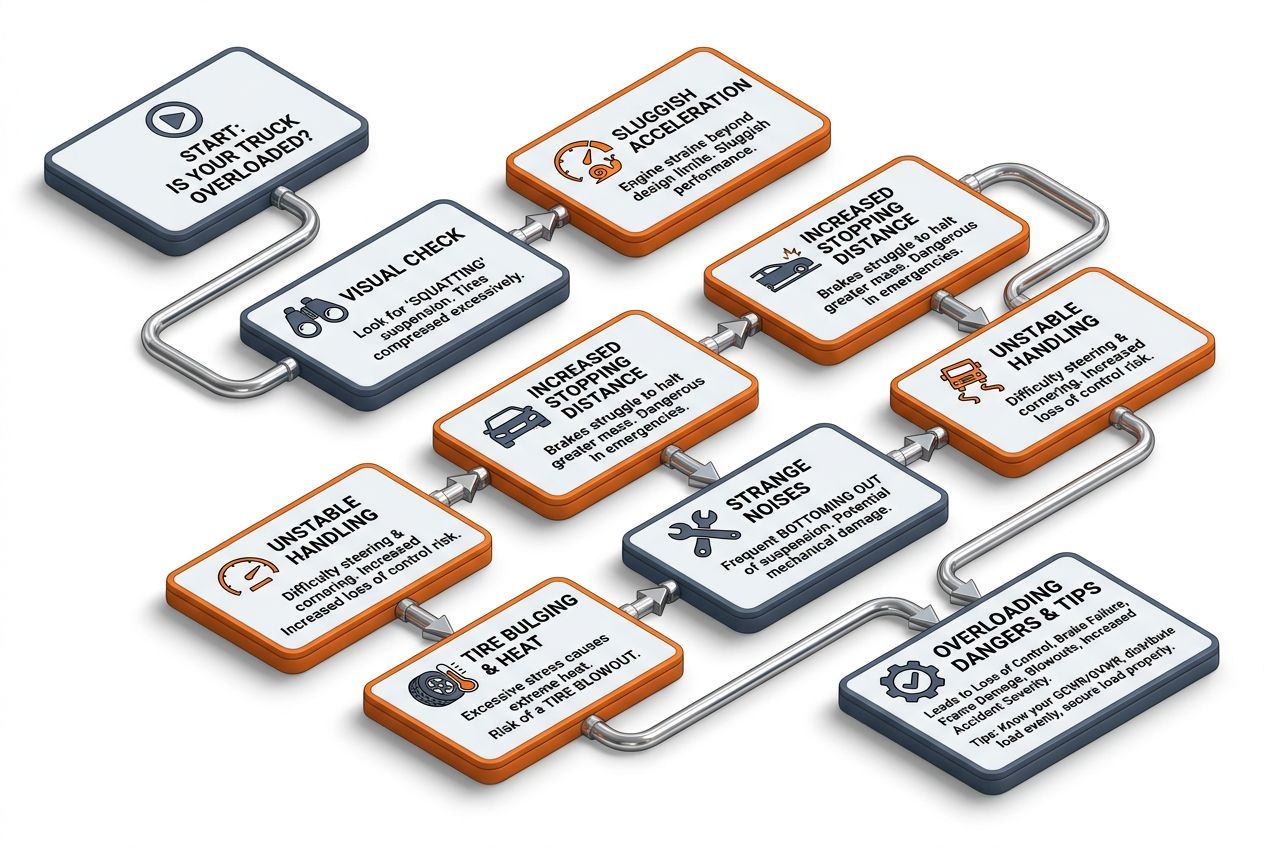
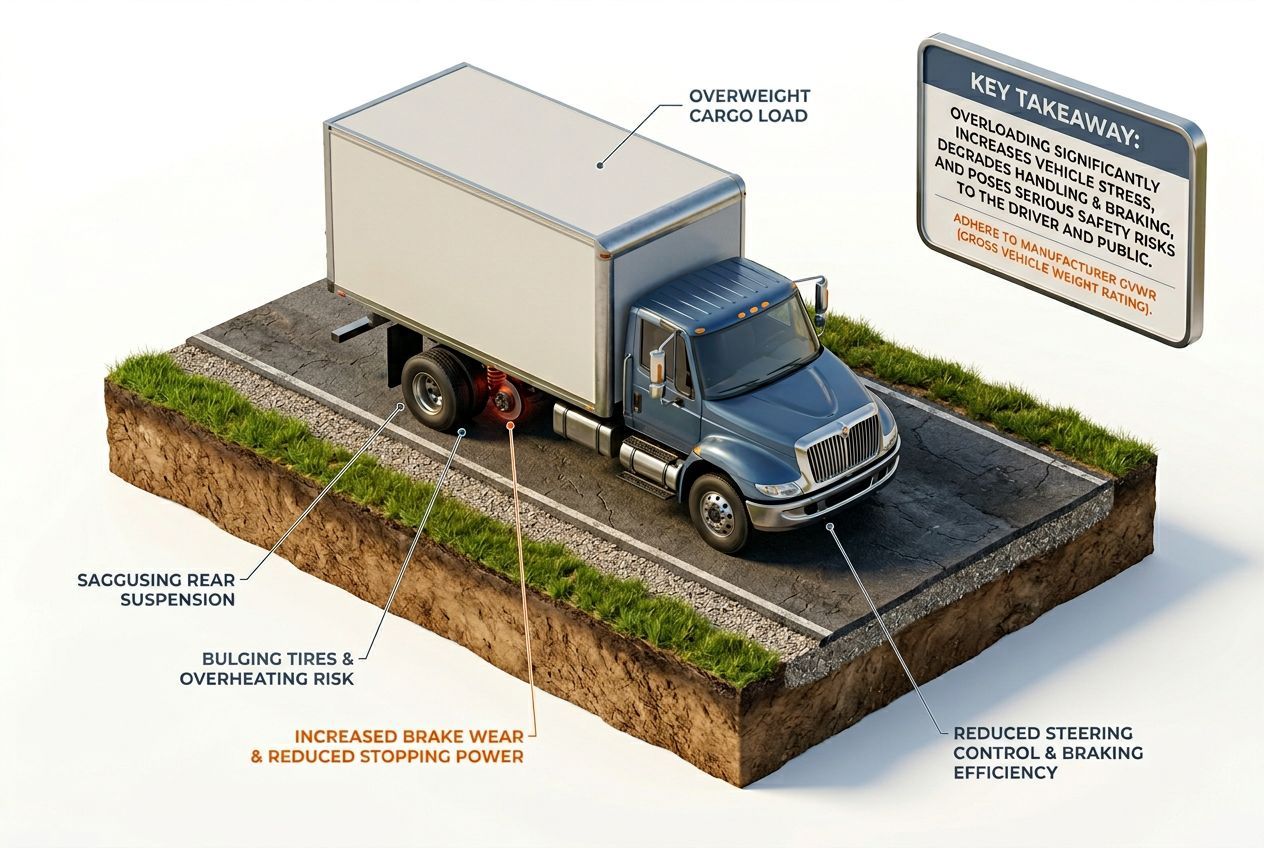
Understanding the consequences of overloading is critical, as it triggers a cascade of mechanical failures — brake fade, transmission overheating, accelerated suspension wear, and tire blowout — while simultaneously reducing your ability to steer and stop. Overloaded truck dangers compound each other: once your brakes overheat on a descent, you're relying on a truck that also has compromised steering and stressed tires.
Let's run through the failure chain:
Breakdown of Overload Risks
-
Brakes overheat. Rotors and pads are engineered to absorb kinetic energy within a defined weight range. Push past that, and heat builds faster than the system can dissipate it. On a long mountain descent in Colorado or Utah — where grades run 6–8% for miles — brake fade can transition to total brake failure.
⚠️ Warning:
The NHTSA fatal crash database (FARS) records roughly 5,000 truck-involved fatalities per year in the U.S., and runaway loads on descents are a recurring factor. Overloaded brakes are a direct contributor to these tragedies.
-
Transmission cooks. Towing or hauling at the limit keeps the torque converter locked up longer, generating heat in the ATF. If you're running a Ford 6R80 transmission, it takes Mercon LV fluid — and that fluid degrades faster under sustained heat loads. Change it before any heavy hauling season, not after. A transmission that's overheated once will fail sooner.
-
Frame and suspension fatigue. Steel fatigues under cyclic loading. Running your truck at 110% of GVWR repeatedly isn't just a one-trip problem — it's shortening the service life of your leaf springs, shackles, and frame rails. See our breakdown of truck bed weight capacity for axle-specific limits that often matter more than GVWR alone.
-
Insurance denial. Here's the one people miss: if you're involved in an accident while exceeding manufacturer-rated capacity, your insurer may deny the claim. Deliberately exceeding a published safety rating is grounds for a coverage dispute. That's a financial consequence on top of the physical ones.
🔧
TRAILER & PAYLOAD
How Much Weight Can a Truck Carry Legally?
Your truck's legal weight limit is set by the manufacturer's GVWR, and your payload capacity is GVWR minus curb weight. For half-ton pickups — your F-150, RAM 1500, Silverado 1500 — payload typically runs 1,000 to 2,300 lbs. Three-quarter-ton trucks like the F-250 and RAM 2500 handle 2,500 to 4,000 lbs. One-ton dually configurations can exceed 6,000 lbs of payload.
Here's a realistic look at current model figures, per manufacturer-published data:
How Much Weight Can a Truck Carry Legally? — data table
| Truck Model |
Payload Capacity |
GVWR |
Max Tow Rating |
Body Style |
| 2025 Ford F-150 (3.5L EcoBoost) |
Up to 2,238 lbs |
7,050 lbs |
13,000 lbs |
Regular Cab, 6.5' bed |
| 2025 RAM 1500 (5.7L Hemi) |
Up to 2,300 lbs |
7,100 lbs |
12,750 lbs |
Regular Cab |
| 2025 Chevy Silverado 1500 (6.2L V8) |
Up to 2,280 lbs |
7,100 lbs |
13,300 lbs |
Regular Cab |
| 2025 Ford F-250 Super Duty (6.7L Diesel) |
Up to 4,260 lbs |
10,000 lbs |
22,800 lbs |
Regular Cab |
| 2025 RAM 3500 Dually (6.7L Cummins) |
Up to 6,010 lbs |
14,000 lbs |
37,100 lbs |
Regular Cab |
Sources: Ford, RAM, Chevrolet published towing guides, 2025 model year.
📊 Quick Fact:
Beyond GVWR, federal bridge formula law caps gross vehicle weight at 80,000 lbs for commercial rigs — enforced by FHWA. For private pickup owners, the bigger legal trap is the axle weight limit. Many states post bridge weight restrictions independently, and you can be cited even if your overall GVWR is legal.
One common trap: confusing towing capacity vs. payload capacity. Your truck might tow 13,000 lbs, but that doesn't mean you can carry 2,000 lbs in the bed and tow 13,000 lbs simultaneously. Tongue weight eats directly into payload.
🛡️
TRAILER & PAYLOAD
What Are the Penalties for Driving an Overloaded Truck?
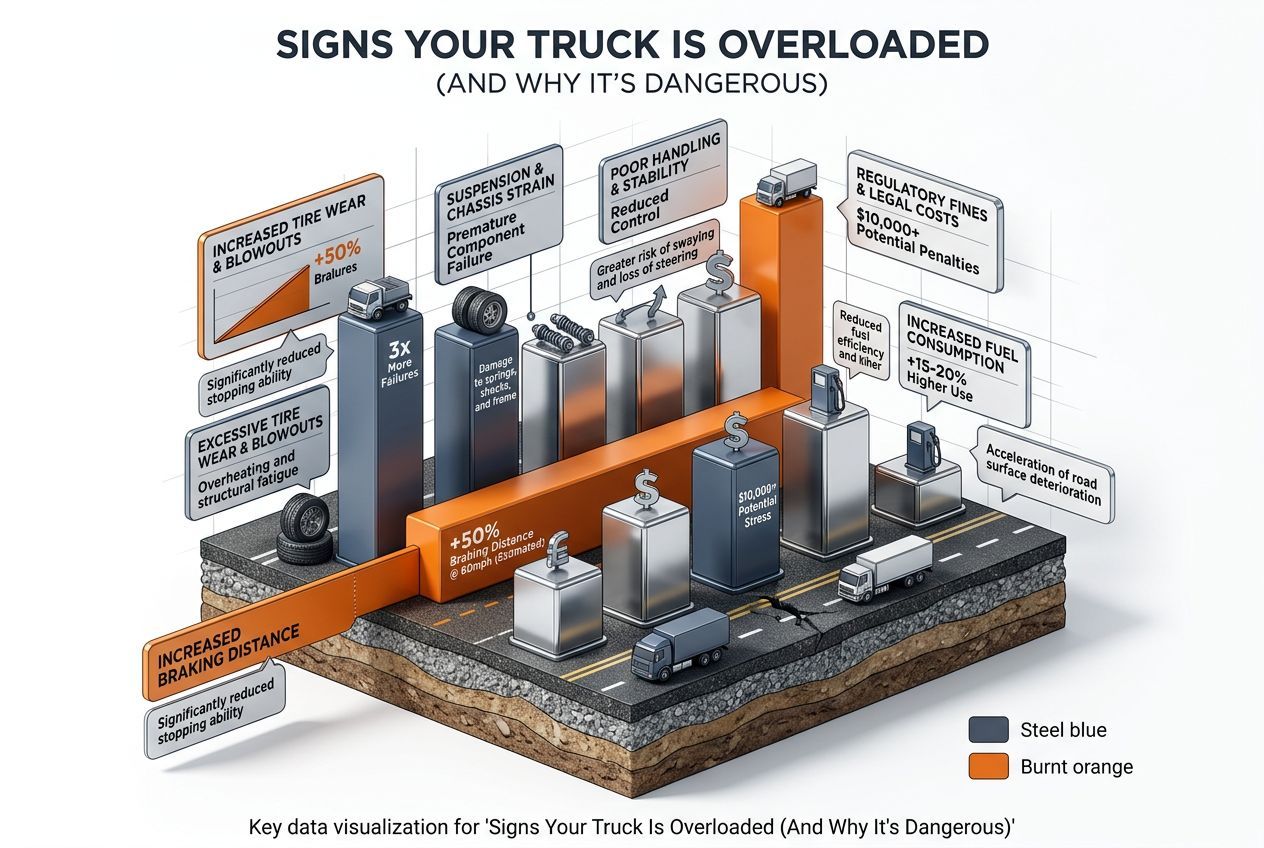
Overweight penalties for trucks range from $100 fines for minor overages to $16,000+ citations for severe violations, with many states using escalating per-pound rate structures. California charges approximately $1 per pound for the first 2,500 lbs over the axle limit, then escalates to $5 per pound beyond that threshold. Texas can issue fines up to $5,000. New York's base penalty runs $150–$575 per violation.
Beyond the fine itself, other consequences include:
- License points in most states accumulate toward suspension.
- Vehicle impoundment if the load poses an immediate public safety risk.
- Out-of-service orders for commercial drivers — meaning you don't move until the load is redistributed or offloaded.
- CSA score damage for CDL holders, which directly raises carrier insurance premiums.
⚠️ Warning:
For private pickup owners, a DOT scale inspection isn't common, but it does happen, especially on major interstates. More critically, if you're involved in a crash, officers will weigh the vehicle as part of the investigation, potentially leading to severe legal and financial repercussions.
Check towing laws by state for the specific penalty schedule in your region before your next heavy haul.
📋
TRAILER & PAYLOAD
Can an Overloaded Truck Cause a Tire Blowout?
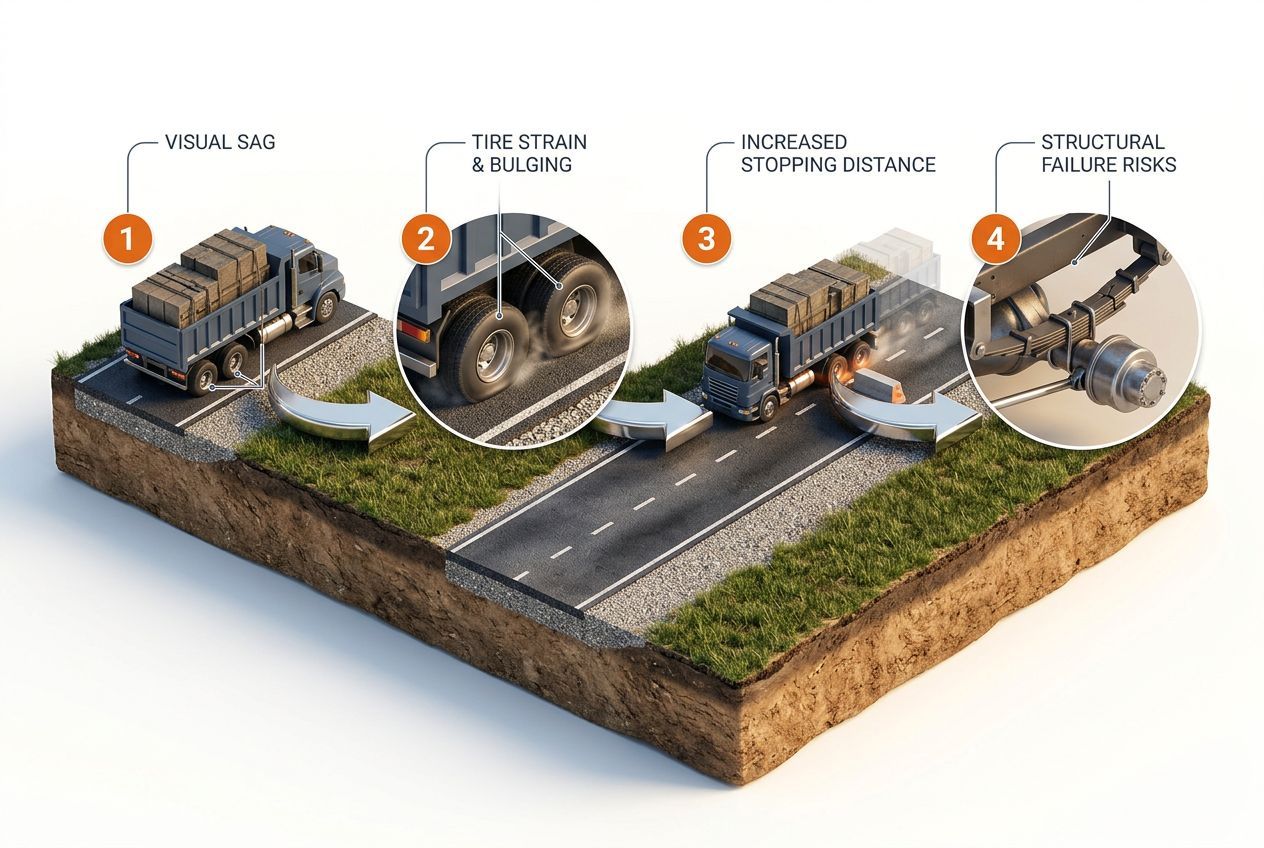
Yes — overloading is one of the leading contributors to tire blowouts, particularly at highway speeds where heat buildup is rapid and catastrophic failure is sudden. Tires carry a maximum load index rating, and exceeding it generates heat in the sidewall that weakens the rubber structure from the inside out. According to NHTSA, tire-related crashes cause more than 600 fatalities per year in the United States.
📊 Quick Fact:
Tire industry data shows load capacity drops roughly 2% for every 10°F above the tire's rated operating temperature. This means hot weather combined with an overloaded vehicle significantly amplifies blowout risk.
The blowout risk connects directly to trailer sway causes and fixes — a rear tire failure while towing is one of the fastest ways to trigger uncontrollable trailer oscillation. By the time you feel the pull, you have fractions of a second to respond correctly.
The IIHS reports overloaded trucks are approximately 3× more likely to experience rollover in emergency maneuvers than properly loaded vehicles. A blowout forces exactly that kind of maneuver.
⚙️
TRAILER & PAYLOAD
How Does Overloading Affect Truck Braking Distance?
An overloaded truck requires 25–50% more stopping distance than the same vehicle at its rated payload — at 60 mph, that's an additional 50 to 100 feet, or roughly four to seven car lengths. Per FMCSA and SAE studies on heavy vehicle dynamics, this gap grows non-linearly: the heavier you go past GVWR, the worse the return on each pound of excess weight.
⚠️ Warning:
Brake fade on mountain descents is the most dangerous expression of this problem. Sustained hard braking superheats brake fluid past its boiling point, introducing vapor into the hydraulic lines. At that point, pedal pressure compresses vapor instead of moving caliper pistons, leading to a long, soft pedal and almost no braking force.
If you're heading into the Rockies or the Sierra Nevada with a loaded trailer, check our weight distribution hitch guide. Redistributing tongue weight forward improves front axle braking contribution significantly and reduces the rear-brake overload that causes fade first.
Altitude adds another layer: at 7,000 feet in Colorado, naturally aspirated engines lose roughly 15–18% of their sea-level power output. Your engine brake — compression braking in lower gears — is already compromised before you touch the service brakes.
🚛
TRAILER & PAYLOAD
How Do You Calculate Your Truck's Payload Capacity?
Calculating your truck's payload capacity involves a simple subtraction: subtract your truck's curb weight from its GVWR. Both figures appear on the driver-side door-jamb sticker or in the Trailer Towing Supplement, which Ford and GM publish separately from the standard owner's manual. Everything you add to the truck counts: passengers, fuel, cargo, aftermarket accessories, and tongue weight from any attached trailer.
Payload Calculation Example
Let's walk through a worked example with real numbers:
Say you're driving a 2025 F-150 with a 1,800-lb payload rating.
- You've got two adults (375 lbs combined).
- 150 lbs of gear in the cab.
- You're towing a 7,000-lb travel trailer with 12% tongue weight (840 lbs on the hitch).
That's 375 + 150 + 840 = 1,365 lbs already consumed against an 1,800-lb budget — and you haven't added a full fuel tank (~120 lbs) or anything in the bed. You're at 1,485 lbs with only 315 lbs of margin remaining. One cooler, a toolbox, and a spare tire, and you're over.
This is exactly why towing capacity and payload capacity explained are two separate conversations. A truck rated to tow 12,000 lbs isn't necessarily able to tow 12,000 lbs and carry a cab full of passengers with gear. The math catches up fast.
For a complete breakdown of how tongue weight flows through this calculation, see our tongue weight guide. For fifth-wheel and gooseneck setups, pin weight replaces tongue weight in the equation — and pin weight is typically 15–25% of trailer gross weight, which hits payload budgets even harder.
💡 Key Takeaway:
No aftermarket suspension upgrade changes your truck's legal GVWR. Airbags and helper springs can make an overloaded truck feel more level and stable, but they don't increase the legal or structural weight limit. Manufacturers set GVWR based on frame, axle, brake, and tire engineering. Adding springs addresses symptoms, not the root problem.
For the full picture on how payload connects to safe trailer selection, our trailer weight guide walks you through matching trailer gross weight to your specific truck configuration — including how curb weight vs. gross weight affects every number in this calculation.