Skip to content
🔧 TOW TRUCK TYPES & METHODS

Flatbed Tow Trucks: When You Need One & What It Costs

Published · Updated · 12 min read
MarkUpdated Mar 2, 2026AAA
Key Takeaways
  • AWD and 4WD vehicles must use a flatbed — wheel-lift or dolly towing can destroy the transfer case and differential ($2,000–$5,000 in repairs)
  • Local flatbed tows run $95–$300 base; long-distance transport drops to $1.00–$3.50 per mile for trips over 100 miles
  • AAA Premier members get one tow of up to 200 miles a year (other tows up to 100 miles); AAA Classic caps out at 3–7 miles, depending on the club
  • After-hours and holiday surcharges add 15–50% to any base rate
  • Electric vehicles — including all Tesla models — require flatbed towing per manufacturer specs

💰
TOW TRUCK TYPES & METHODS

What Is a Flatbed Tow Truck and How Does It Work?

Understanding the Flatbed Mechanism: A flatbed tow truck — often called a rollback or slide carrier — uses a full-length hydraulic bed, typically 19–21 feet long per Jerr-Dan and Miller Industries manufacturing specs, that tilts and slides to ground level.

How Your Vehicle is Loaded:

  • Your vehicle gets winched onto the deck using a cable system.
  • It's then secured with wheel straps and safety chains at four anchor points.
  • Because all four tires sit flat on the platform with zero road contact, there's no drivetrain wear, no tire scrub, and no exposure to road debris.

💡 Key Takeaway: The key difference from other tow truck types is the hydraulic tilt mechanism. The operator controls the bed angle using cab-mounted switches, dropping the rear edge to within a few inches of the pavement. This is crucial for lowered vehicles and exotic cars, as it eliminates the risk of scraping that a wheel-lift tow truck might cause.

Capacity and Types: Standard flatbed trucks handle 10,000–17,000 lbs, which covers most passenger cars, SUVs, and light trucks. Specialized heavy-duty flatbeds, known as lowboys, are designed for larger loads. You can see how these fit into the broader lineup in our complete guide to tow truck types.


3D comparison of flatbed, wheel-lift, and integrated wrecker tow truck types
📊
TOW TRUCK TYPES & METHODS

When Do You Need a Flatbed Instead of a Regular Tow Truck?

Flatbed towing is often non-negotiable when your vehicle's drivetrain, frame, or ride height makes wheel-lift or dolly towing unsafe or physically impossible. This isn't a preference — in many cases, it's the only method that won't cause secondary damage.

Here's when flatbed is mandatory for safe transport:

  • All-Wheel-Drive (AWD) and Four-Wheel-Drive (4WD) Vehicles:

    • If a wheel-lift operator picks up the rear of your Subaru Outback, for example, and drags the front wheels on the pavement, torque flows back through the open front differential and into the AWD coupling—even with the ignition off.
    • This can lead to transfer case damage costing $2,000–$5,000 at a dealership. Your owner's manual will always confirm this requirement in the towing section.
  • Accident-Damaged Vehicles:

    • If your vehicle has a compromised frame, bent axle, or locked-up steering, it cannot track straight even when only two wheels are rolling.
    • A flatbed is the only safe option after a collision to prevent further damage.
  • Low-Clearance and Modified Vehicles:

    • Vehicles like a lowered Camaro or a widebody with an aftermarket front bumper cannot safely accept a wheel-lift cradle without risking contact damage.
    • The adjustable tilt angle on a flatbed solves this by allowing for a much shallower loading angle.
  • Luxury and Exotic Cars:

    • Manufacturers and dealerships for high-end brands like Porsche, Ferrari, and BMW explicitly specify flatbed transport.
    • Some luxury cars have delicate plastic undertray panels that a hook-and-chain rig would likely crack on contact.
  • Electric Vehicles (EVs):

    • Tesla, Rivian, and Lucid, along with most other EV manufacturers, require flatbed towing.
    • EVs use regenerative braking through the motor; towing an EV with its wheels rolling can back-feed voltage through the motor controller in ways the system wasn't designed to handle, potentially causing severe electrical damage. Tesla's owner's manual (available at tesla.com) states this directly.

For a side-by-side comparison of methods, see our flatbed vs. wheel-lift breakdown.


🔧
TOW TRUCK TYPES & METHODS

How Much Does a Flatbed Tow Truck Cost?

Local flatbed tow truck costs typically range from $95–$300 as a base or hook-up fee. Beyond the included distance (usually the first 5–10 miles), you can expect per-mile rates of $3–$7. The national average for a standard sedan tow within city limits usually falls between $125–$175, according to AAA data.

📊 Quick Fact: For long-distance flatbed transport (trips over 100 miles), the per-mile rates often drop to $1.00–$3.50. This is because the operator is committing to a dedicated haul, making longer distances more cost-efficient per mile.

Use our towing cost calculator below to get a fast estimate based on your vehicle type, distance, and location.

Try Our Free Towing Cost Calculator

3D cutaway diagram of a flatbed tow truck showing mechanical components

Flatbed Towing Cost by Vehicle Type

Flatbed Towing Cost by Vehicle Type — data table
Vehicle Type Base/Hook-Up Fee Per-Mile Rate Notes
Standard sedan / compact $95–$150 $3–$5/mile Most common scenario
SUV / pickup truck $120–$225 $4–$6/mile Weight premium applies
Luxury / exotic car $175–$300+ $5–$7/mile Specialty handling; enclosed option 2–3×
Motorcycle $50–$150 $2–$4/mile Needs flatbed or specialty trailer
Electric vehicle (Tesla, Rivian) $150–$250 $4–$7/mile Flatbed mandatory per manufacturer

Source: AAA (aaa.com); TowingServiceHub editorial estimates.

Surcharges That Add Up Fast

Beyond the base and per-mile rates, several factors can increase your final towing cost:

  • After-hours (nights/weekends): +15–30%
  • Major holidays: +25–50%
  • Rural or long-drive dispatch: +$25–$75 trip fee
  • Winter demand surge in northern states: +10–20% on top of base rate

A Real-World Example: Imagine you're in Minneapolis in January, and your AWD Subaru Forester breaks down 8 miles from home on a Saturday night.

  • Base rate: $165
  • After-hours surcharge at 25%: +$41
  • Three extra miles at $5/mile (8 miles - 5 included miles): +$15
  • Total: $221 — before tip.

✅ Pro Tip: This example highlights why checking your roadside assistance coverage before you need it is crucial. Our roadside assistance comparison tool can show you what plans cover flatbed service.

For a broader look at what towing services cost across all truck types, see our full towing cost guide.


🛡️
TOW TRUCK TYPES & METHODS

Is Flatbed Towing Safer for Your Vehicle?

Flatbed towing is the safest transport method available for passenger vehicles — full stop. With all four wheels secured on the deck, your car isn't subject to tire wear, road debris impact, or the uneven stress a wheel-lift cradle puts on one axle at a time.

Comparing Towing Methods: Hook-and-chain towing, the method you've seen in old movies, contacts the frame or bumper directly and often causes cosmetic damage. Wheel-lift improved on that, but it still leaves two wheels rolling on the pavement. For any vehicle where the drivetrain connects front to rear (AWD, 4WD, many FWD vehicles with traction control systems), that rolling contact creates real mechanical risk.

⚠️ Warning: Auto manufacturers and dealerships overwhelmingly recommend flatbed transport. According to NHTSA (nhtsa.gov), improper towing method is a documented contributor to post-accident secondary damage claims. If you're ever choosing between a wheel-lift truck that's available now and a flatbed that's 20 minutes out — wait for the flatbed if your vehicle has AWD or if it's a newer car still under warranty.

One honest caveat: flatbed towing isn't perfect for every scenario. On very steep, narrow mountain roads or in tight parking structures, a long rollback truck physically can't maneuver to load your car. In those situations, a wheel-lift or dolly towing setup may be the only option that fits.


📋
TOW TRUCK TYPES & METHODS

Can You Flatbed Tow an AWD or 4WD Vehicle?

Yes — and for AWD and 4WD vehicles, flatbed is the only method you should use. When any wheel rolls on an AWD or 4WD vehicle, the transfer case and differentials turn. With the engine off, there's no pump circulating fluid through those components.

⚠️ Warning: Dry-running a transfer case, even for a few miles, generates heat and metal debris that degrades seals and bearings. Repair costs range from $2,000 to $5,000 depending on the vehicle.

Prevalence of AWD/4WD: According to Edmunds (edmunds.com), roughly 55% of new vehicles sold in the U.S. in 2023 were AWD or 4WD-equipped. This means the majority of cars on the road right now need a flatbed if they require a tow. Brands with strict flatbed-only policies include Subaru (all Symmetrical AWD models), Audi (Quattro-equipped vehicles), and most crossover SUVs from Toyota, Honda, and Ford.

If you're unsure about your specific vehicle's towing requirement, our towing capacity lookup tool can pull up factory specs and towing method guidance by make, model, and year.
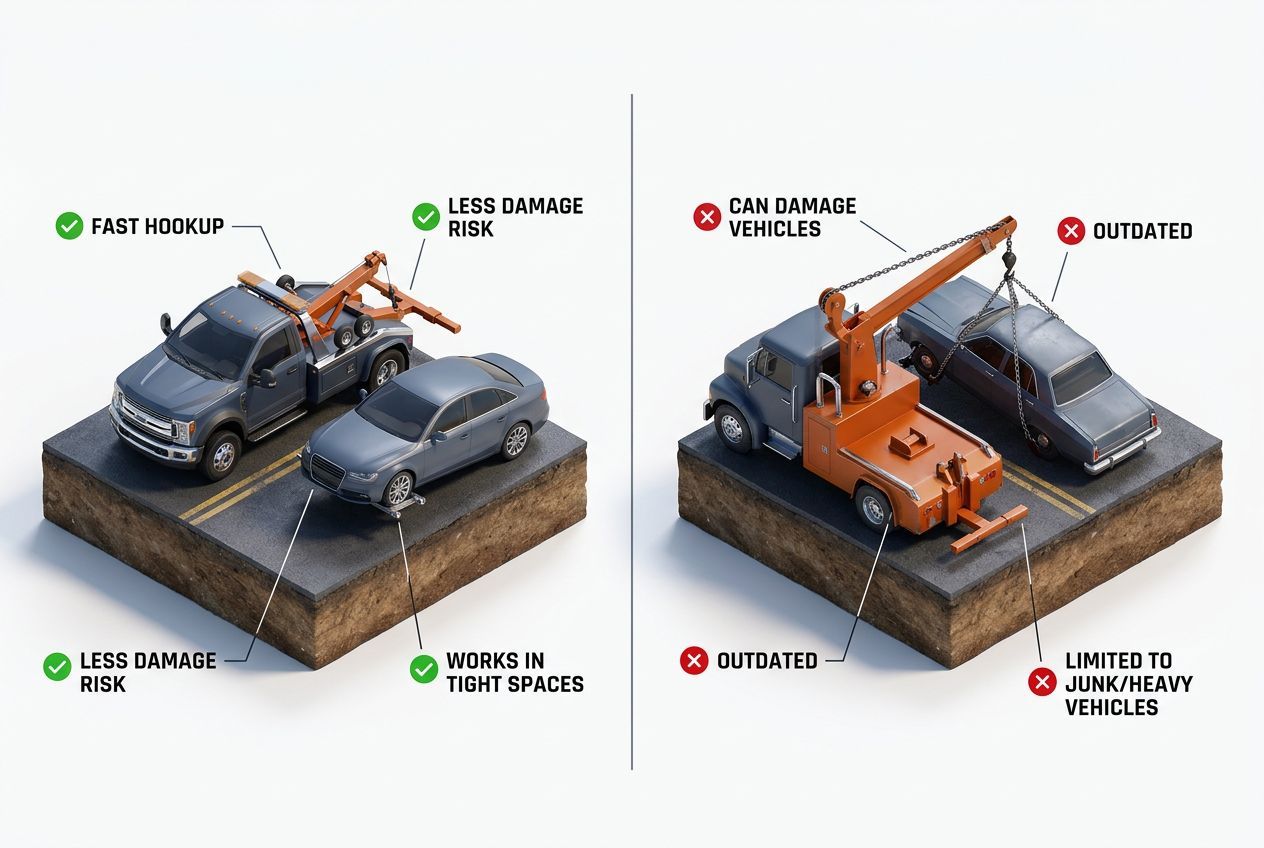

3D comparison of modern wheel-lift versus traditional hook-and-chain towing methods
⚙️
TOW TRUCK TYPES & METHODS

How Far Can a Flatbed Tow Truck Transport a Vehicle?

Flatbed tow trucks can technically transport a vehicle any distance, but most local operators work within a 50–200 mile radius. Beyond that range, specialized long-distance vehicle transport carriers — often using enclosed multi-car carriers or dedicated single-car flatbeds — handle the logistics.

Long-Distance Rates: For trips over 100 miles, per-mile rates drop significantly. While a local tow might run $3–$7/mile, a 500-mile dedicated flatbed haul could cost $1.50–$2.50/mile all-in. A cross-country transport (1,500–2,500 miles) typically costs $900–$1,800 for a standard vehicle through an auto transport broker.

Vehicle Weight Considerations: Standard flatbed trucks carry up to 17,000 lbs, which is enough for most passenger vehicles and light trucks. If you're moving a dually pickup or a large commercial van, always confirm the operator's gross vehicle weight rating before booking. Our RV and boat tow estimator can help you calculate load weights for larger vehicles.

For context on how flatbed compares to other specialized services like rotator trucks for complex recoveries, see our rotator tow truck guide.


🚛
TOW TRUCK TYPES & METHODS

Does Insurance or Roadside Assistance Cover Flatbed Towing?

Towing reimbursement from most comprehensive auto insurance policies rarely keeps pace with flatbed rates. Standard reimbursement caps typically run $50–$100 per tow, which might cover a basic wheel-lift job but falls short of a $175–$225 flatbed tow in most markets.

AAA Membership Tiers for Flatbed Coverage:

  • AAA Classic covers towing up to 3–7 miles depending on the club, then charges a per-mile rate ($4–$7 at the clubs we checked).
  • AAA Plus extends coverage to 100 miles.
  • AAA Premier covers one tow of up to 200 miles per membership year (other tows up to 100 miles) and explicitly includes flatbed service for eligible vehicles, per AAA's published membership terms (aaa.com).
  • If you drive an AWD vehicle and carry only Classic membership, you're likely paying out-of-pocket for most of the tow.

Credit Card Benefits: Many credit cards (particularly Visa Signature and Amex Platinum) include roadside assistance with flatbed coverage. Always check your card benefits before assuming you're uncovered. Our breakdown of whether AAA is worth it walks through the math for different driver profiles.

⚠️ Warning: State regulations that cap towing rates — such as those in California, Florida, Texas, and Virginia — generally apply only to police-ordered tows. If you call a tow truck yourself, those caps typically don't apply, and operators can charge market rates. The FMCSA regulates commercial towing across state lines but does not set retail pricing for local tows.

For a full picture of how towing method affects your overall transport decision, see our guide to choosing the right tow method.
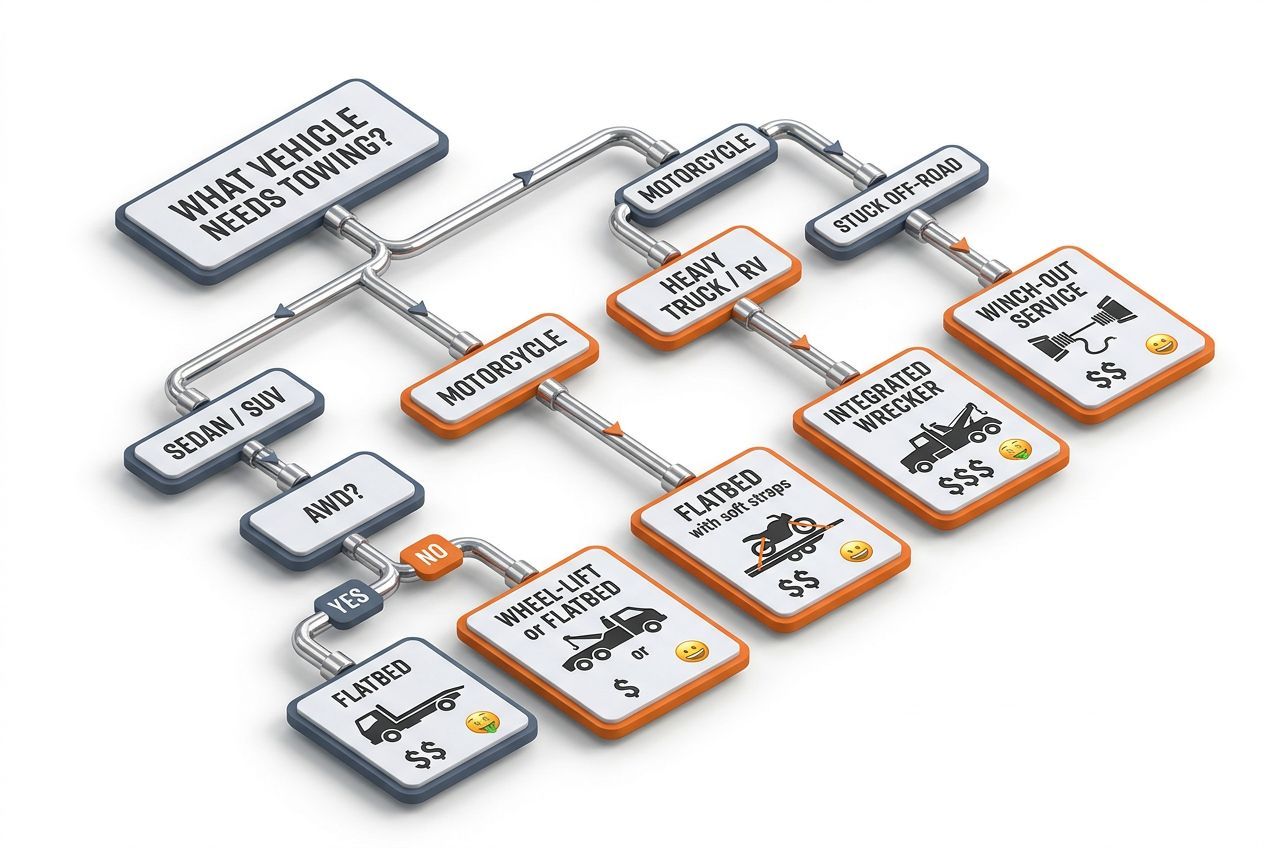

3D decision flowchart for selecting the appropriate tow truck type

Sources & Methodology

  1. 1.
    AAA (aaa.com) — Membership tier towing distance limits, national average tow cost data (~$109 all-type average), and roadside assistance coverage terms.
  2. 2.
    NHTSA (nhtsa.gov) — Vehicle safety data, improper towing as a contributor to secondary damage claims, and AWD/4WD market share figures used in conjunction with Edmunds data.
  3. 3.
    Edmunds (edmunds.com) — 2023 U.S. new vehicle sales data showing approximately 55% AWD/4WD penetration among new cars sold.
  4. 4.
    FMCSA (fmcsa.dot.gov) — Commercial towing regulations, interstate transport rules, and cargo securement standards referenced in insurance and regulatory context.

Rate ranges were compiled from publicly available operator pricing, transport marketplace listings, and industry surveys conducted 2024–2025. Costs vary by region, vehicle weight, and operator. Always confirm pricing directly with your tow provider before authorizing service.

TowingServiceHub is reader-supported: we may earn money from ads and from some links on this page. See our editorial policy.

Mark — Founder & Editor

Mark

Founder & Editor

Mark is the founder and editor of TowingServiceHub, which he launched in 2026 after struggling to find clearly sourced towing costs and truck specs. He works in enterprise technology and tows his own boats, trailers, and equipment, so he knows the questions drivers actually ask.

Read full bio →

Need a tow truck right now?

Browse vetted local providers in your area. Real Google ratings, verified business info, free to use.

Or browse all 50 states from our directory

Frequently Asked Questions

They're the same truck. "Rollback" refers to the sliding bed action — the deck rolls backward and tilts to ground level for loading. "Flatbed" describes the platform style. Both terms describe the same hydraulic tilt-bed carrier used for damage-free vehicle transport.

In urban areas, average response time runs 30–60 minutes. Rural areas can push 60–90 minutes or longer. Winter storms and peak accident hours extend those windows. Calling your roadside provider immediately after a breakdown gives dispatchers the best chance of minimizing your wait.

Yes — this is one of the primary use cases for flatbed towing. The winch cable pulls non-running vehicles onto the deck without requiring any wheel movement. Vehicles with locked steering, dead brakes, or seized wheels load via winch rather than driving up the ramp.

Yes. Tesla, Rivian, Lucid, and most other EV manufacturers specify flatbed-only towing in their owner's manuals. Rolling the wheels on an EV can back-drive the motor and damage the inverter or motor controller. Never allow a wheel-lift operator to tow your EV.

Rarely, but you can ask for a written estimate before authorizing the tow. Under consumer protection rules in most states, the operator must provide pricing upfront. You can also call a second provider for a competing quote — just confirm response time before declining the first truck on scene.

Related Articles

Explore More Towing Guides

Browse all 157 expert guides and 10 free tools.