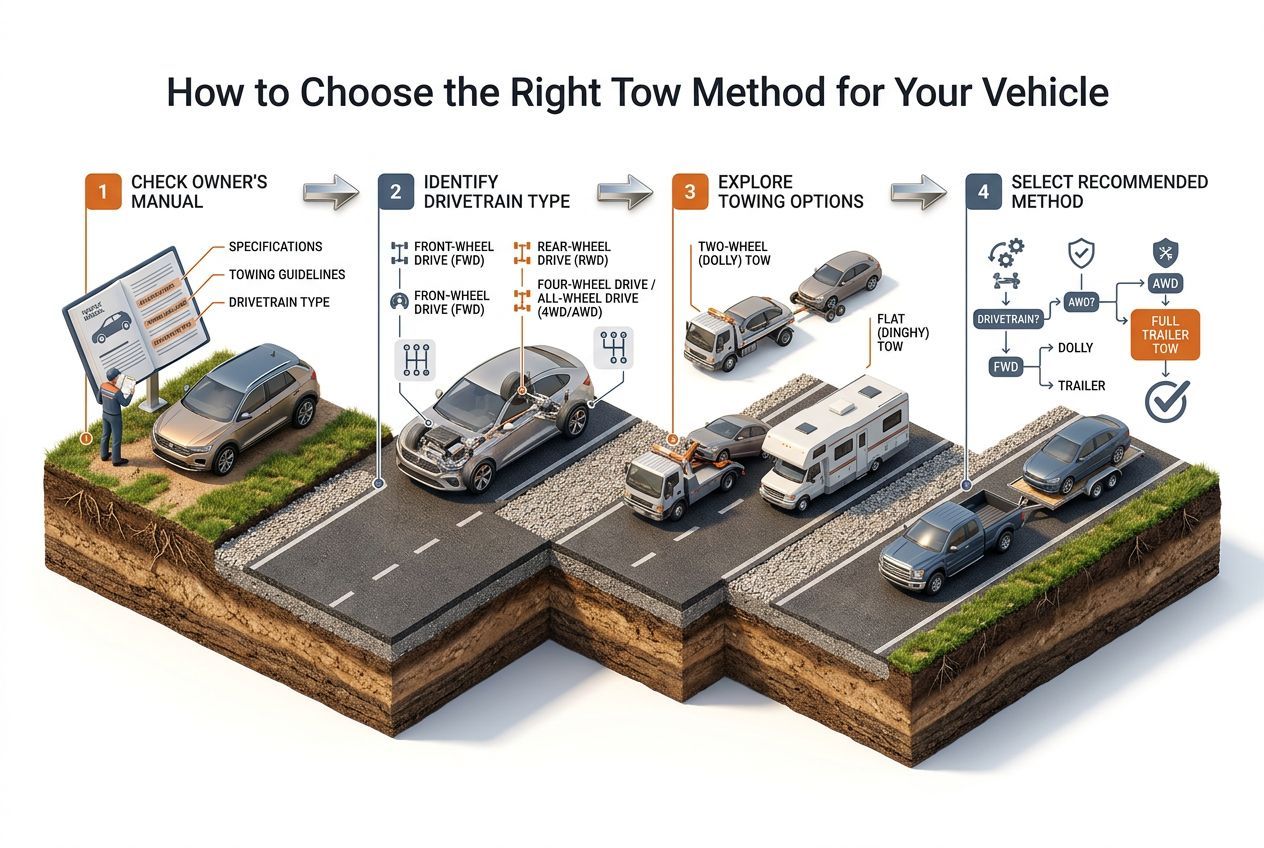
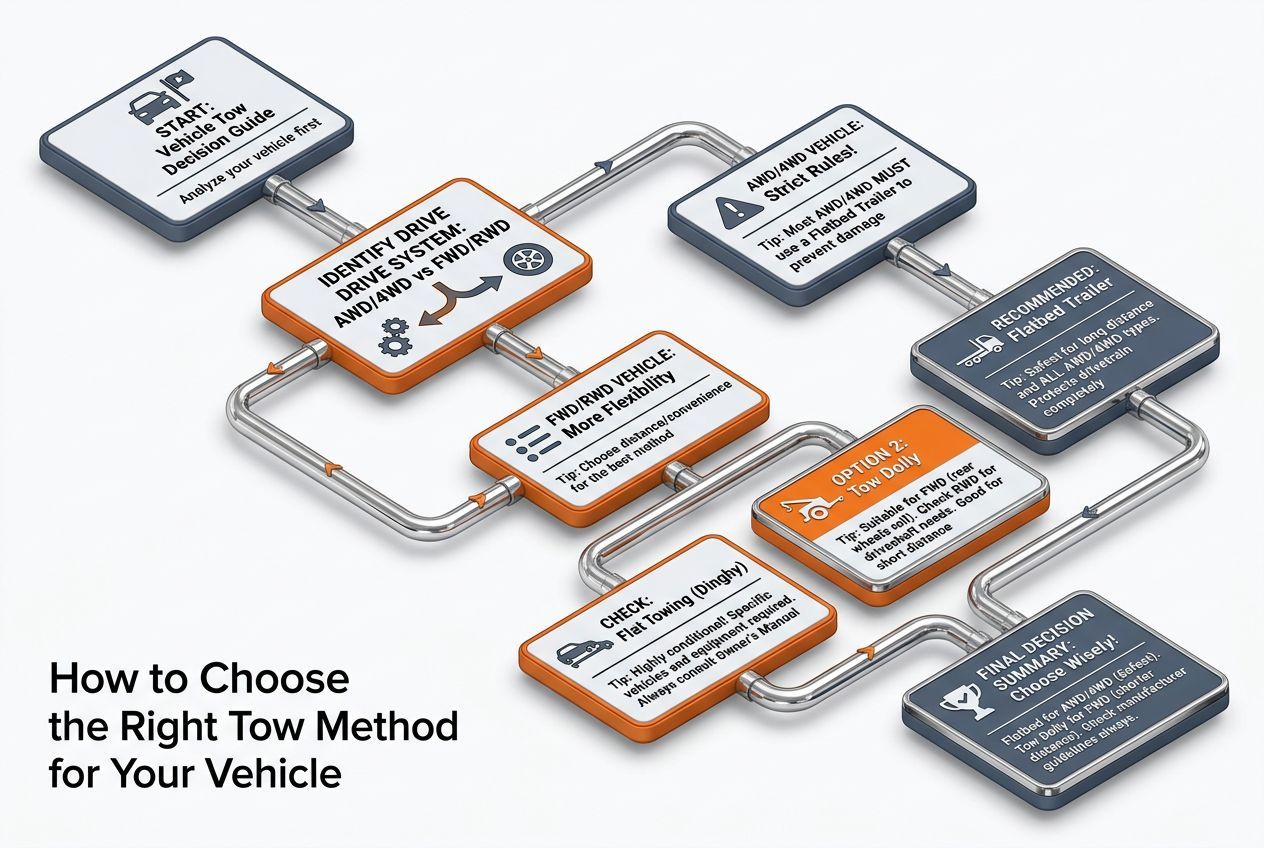
💡 Key Takeaway: Your vehicle's drivetrain is the single most important factor. AWD, 4WD, and EVs must be towed on a flatbed without exception to prevent costly damage.
📊 Quick Fact: Flatbed towing costs generally range from $95–$350 locally, while wheel-lift towing is typically $75–$250 for the same distance.
Choosing the wrong tow method isn't merely inconvenient; it carries the significant risk of destroying your vehicle's transmission or other vital components. For instance, a $150 wheel-lift tow on an AWD crossover could easily lead to a $5,000 transfer case replacement before you even get your car home. This comprehensive guide will walk you through every major tow method, detail which vehicles each one suits, and highlight the exact questions you need to ask before a tow truck arrives.
You can also browse our full types of tow trucks guide for a broader look at every service category in the industry.
What Are the Main Types of Tow Methods Available?
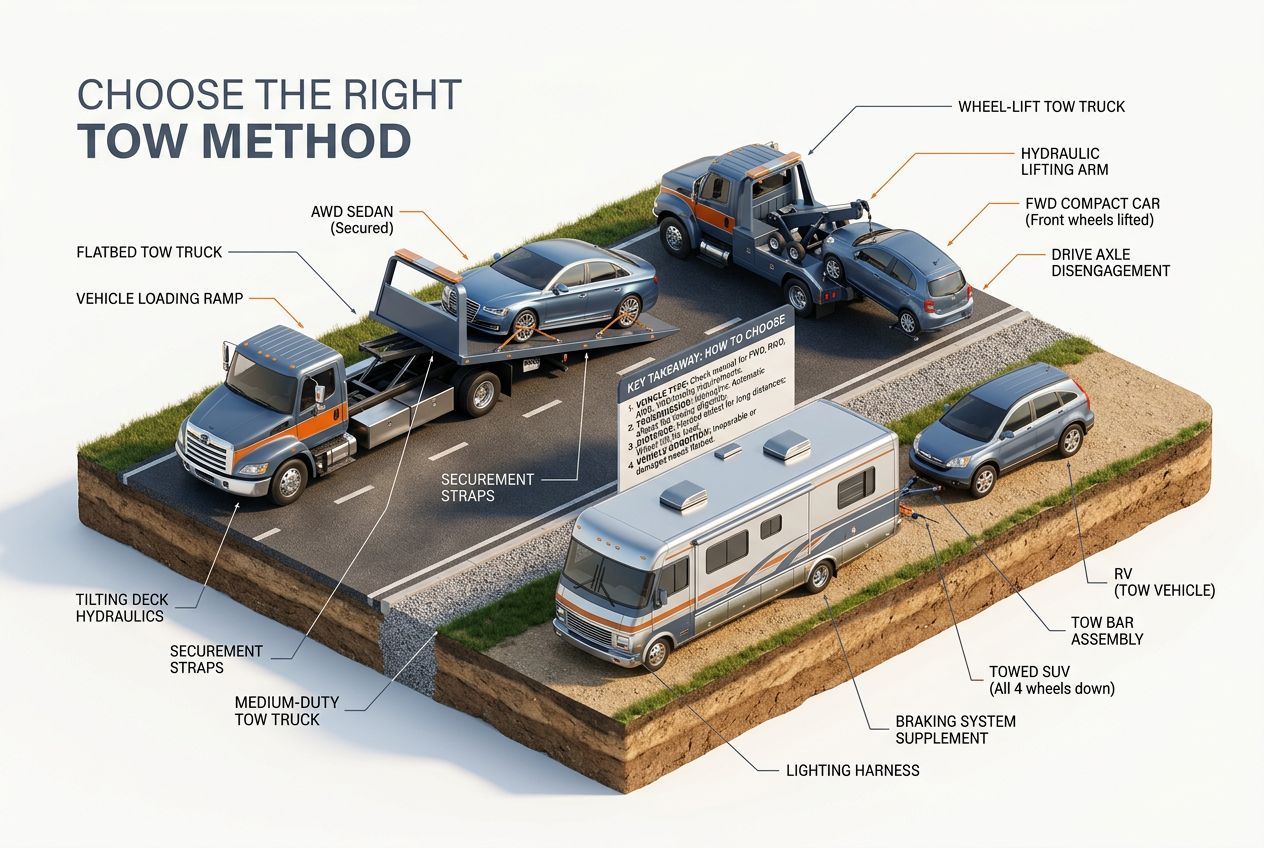
Four primary tow methods are commonly available: flatbed (rollback) towing, wheel-lift towing, tow dolly towing, and hook-and-chain towing. Each method differs in how many of your vehicle's wheels remain in contact with the road during transport. Today, flatbed and wheel-lift methods dominate professional towing services.
Hook-and-chain towing has largely become obsolete among reputable fleets. This method uses chains that can easily gouge bumpers, frame rails, and exhaust components on modern unibody vehicles, making it unsuitable for most passenger cars.
Here's a quick comparison of each method:
| Tow Method | Wheels on Road | Best For | Avg. Local Cost | Capacity |
|---|---|---|---|---|
| Flatbed (Rollback) | 0 | All vehicles, AWD, EV, luxury | $95–$350 | 8,000–12,000 lbs |
| Wheel-Lift | 2 | FWD sedans, RWD trucks | $75–$250 | 3,500–7,000 lbs |
| Tow Dolly | 2 (rear) | FWD vehicles, DIY moves | $45–$100/day rental | ~5,000 lbs |
| Hook-and-Chain | 2 | Salvage/junk vehicles only | $75–$175 | Varies |
Sources: Industry cost surveys; AAA average tow distance data (aaa.com)
For a detailed breakdown of flatbed versus wheel-lift trade-offs, see our flatbed vs wheel-lift comparison.
Which Tow Method Is Best for an AWD or 4WD Vehicle?
Flatbed towing is the only recommended tow method for AWD and 4WD vehicles — no exceptions. When any of the driven wheels roll on pavement, the drivetrain transfers that rotation directly to the transfer case and transmission.
Risk of Drivetrain Damage: On a 4WD truck, for instance, dragging the rear wheels even a few miles can severely score the transfer case internals and overheat the gear oil, which lacks a running pump for circulation. This type of damage can be permanent and extremely costly to repair.
⚠️ Warning: Do NOT allow an AWD or 4WD vehicle to be towed with any driven wheels on the ground. This can lead to catastrophic transfer case or transmission failure.
Manufacturer and Expert Consensus:
- AAA Protocol: According to AAA, which handles approximately 33 million roadside assistance calls annually, their dispatchers are specifically trained to send flatbeds for any all-wheel-drive vehicle by default.
- Owner's Manuals: Most manufacturers echo this guidance in their owner's manuals. For example, Ford's Trailer Towing Supplement for the Explorer explicitly states: "Do not tow with any wheels on the ground unless the driveshaft is disconnected." This advice holds true whether you're moving a Subaru Outback or a RAM 1500 with a sophisticated Quadra-Trac II transfer case.
Driveshaft Disconnection as a Workaround: Disconnecting the driveshaft is a legitimate alternative, but it requires specific tools (like a floor jack), knowledge of the correct torque specs, and about 30 minutes of roadside work. Unless you carry these tools and are familiar with the procedure for your specific vehicle, it's far safer and simpler to just request a flatbed.
📊 Quick Fact: With roughly 55% of new U.S. vehicles sold in 2024 being AWD or 4WD, flatbed towing has transitioned from a premium option to the essential standard for a vast segment of the market.
Is Flatbed Towing Safer Than Wheel-Lift Towing?
Flatbed towing is generally considered the safest tow method because all wheels are completely off the ground and secured to the deck. This eliminates drivetrain wear, prevents tire scrub, and protects your undercarriage from road debris during long highway tows.
When Wheel-Lift Towing is Safe: That said, wheel-lift towing is perfectly safe for the right vehicles when performed correctly. A competent operator using a modern rubber-cradle wheel-lift (as opposed to older steel hook styles) will cause zero damage on a standard FWD sedan. The wheel-lift method only becomes problematic when used on an incompatible drivetrain or if the operator misjudges ground clearance.
Practical Considerations:
- Loading Time: Flatbeds typically take longer to load (3–5 minutes) compared to wheel-lifts.
- Accessibility: Flatbeds may struggle to access tight parking garages or urban streets with low overhead clearance.
- Urban Towing: In dense cities, a wheel-lift unit can often reach you faster and works perfectly well for short hauls to a nearby shop, provided your vehicle's drivetrain is suitable.
See our full flatbed tow truck guide if you want to understand exactly how the rollback deck and winch system works together.
How Do I Choose the Right Tow Method Based on My Vehicle's Drivetrain?
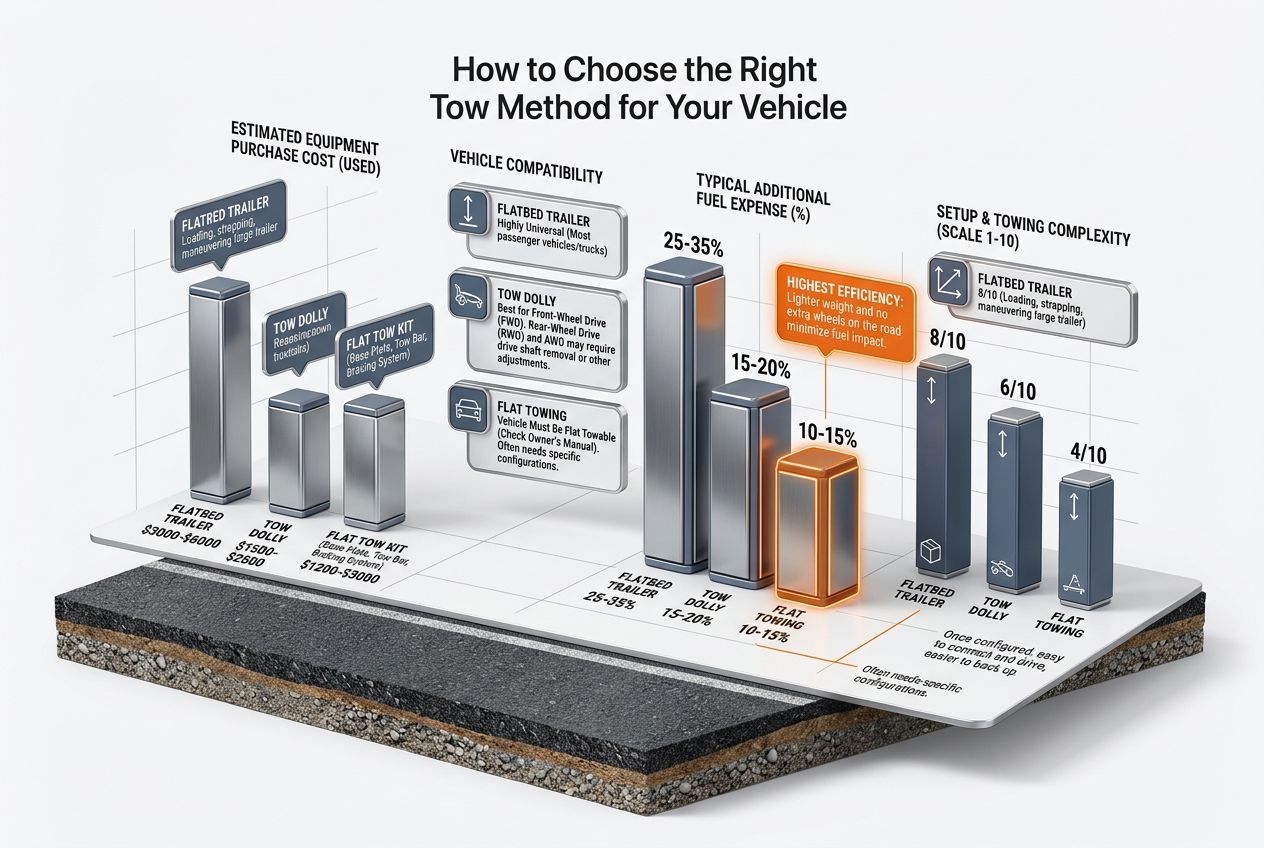
Your vehicle's drivetrain is the single most critical factor when deciding on a tow method. Adhering to these rules can prevent thousands of dollars in repairs:
- FWD (Front-Wheel Drive):
- Recommendation: Wheel-lift with the front axle elevated, allowing the rear wheels to roll freely.
- Alternative: A tow dolly (with front wheels on the dolly and rear wheels rolling) is also suitable. See the dolly towing guide for full setup instructions.
- RWD (Rear-Wheel Drive):
- Recommendation: The rear axle must be elevated (e.g., wheel-lift with rear lift) or the driveshaft disconnected.
- Alternative: Flatbed towing is always a safe option.
- AWD/4WD (All-Wheel Drive / 4-Wheel Drive):
- Recommendation: Flatbed towing only, or the driveshaft must be removed. No driven wheels should ever contact the ground.
- EVs (Electric Vehicles):
- Recommendation: Flatbed towing only (more details below). Towing with wheels on the ground can severely damage the electric motors.