For a broader look at how the Lightning stacks up across all electric trucks, see our electric truck towing capacity comparison.

📊
TRUCK TOWING CAPACITY
How Much Range Does the F-150 Lightning Lose When Towing?
Significant Range Reduction: Towing drastically cuts F-150 Lightning range by 40–65% in real-world conditions, representing one of the most significant trade-offs for any EV truck. An extended-range Lightning rated at 320 EPA miles may deliver only 120–180 miles pulling a 5,000–7,000 lb trailer at highway speeds. Independent testing by outlets including Edmunds and Out of Spec Motoring consistently confirms this range impact, making lightning towing range loss the single most important variable for trip planning.
Understanding Energy Consumption:
- Unloaded: The Lightning's energy consumption typically runs roughly 0.38–0.45 kWh per mile.
- Moderate Load: Towing a moderately aerodynamic 5,000-lb trailer at 65 mph pushes that figure to 0.80–0.95 kWh/mile.
- Heavy Load: Tow a tall, boxy 7,000-lb travel trailer at 70 mph, and you're looking at 1.0–1.1 kWh/mile — more than double the unloaded rate.
📊 Quick Fact: The Lightning's extended-range pack holds approximately 131 kWh usable. At a consumption rate of 1.0 kWh/mile, your effective range is roughly 130 miles before hitting the reserve.
The Impact of Speed: According to real-world test data compiled by TFL Truck and Out of Spec Motoring, dropping your towing speed from 70 mph to 55 mph recovers 15–25% of lost range. On a 300-mile towing trip, that difference can eliminate one full charging stop.
✅ Pro Tip: Reducing your highway speed while towing is the most effective way to conserve battery range and extend your charging intervals.
🔧
TRUCK TOWING CAPACITY
F-150 Lightning Towing Range: Load vs. Real-World Miles
F-150 Lightning Towing Range: Load vs. Real-World Miles — data table
| Configuration |
Trailer Weight |
Approx. kWh/Mile |
Real-World Range |
Range vs. EPA |
| Extended range, unloaded |
0 lbs |
0.38–0.45 |
280–320 mi |
Baseline |
| Extended range, utility trailer |
~3,000 lbs |
0.55–0.65 |
200–240 mi |
−25–35% |
| Extended range, mid-size camper |
~5,000 lbs |
0.80–0.95 |
138–165 mi |
−45–55% |
| Extended range, large travel trailer |
~7,000 lbs |
1.0–1.1 |
119–131 mi |
−55–65% |
| Standard range, mid-size camper |
~5,000 lbs |
0.80–0.95 |
103–123 mi |
−55–65% |
Sources: Edmunds real-world EV towing tests; Out of Spec Motoring YouTube testing; Ford F-150 Lightning Trailer Towing Guide. kWh/mile figures are estimates and vary with speed, terrain, and temperature.
🛡️
TRUCK TOWING CAPACITY
Can the F-150 Lightning Tow a Travel Trailer or Camper?
Towing Capabilities: Yes, the Lightning can tow most mid-size travel trailers, but meticulous range planning is absolutely non-negotiable. Trailers like the Airstream Basecamp (around 3,500 lbs loaded) or a Jayco Jay Flight SLX in the 5,500–6,500 lb range fall comfortably within the ford lightning towing capacity envelope. Larger trailers, such as a 30-ft fifth wheel at 12,000+ lbs, are completely out of scope. The Lightning is a half-ton platform with a half-ton ceiling.
Payload Considerations - A Worked Example:
Let's consider towing a 6,500-lb Jayco White Hawk travel trailer.
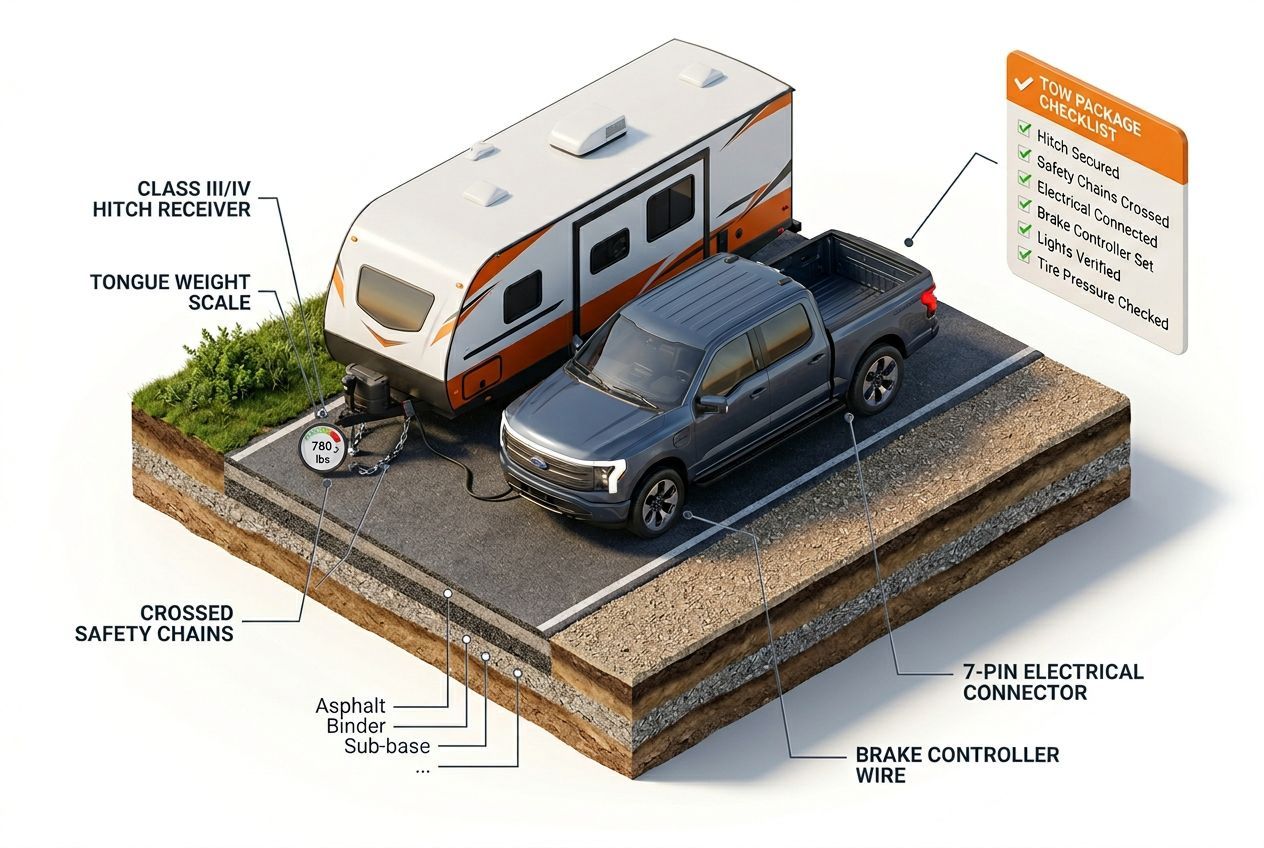
- Tongue Weight: At 12% of trailer weight, this is 780 lbs.
- Occupants & Gear: Add the driver (200 lbs), a passenger (160 lbs), and 80 lbs of gear in the cab.
- Total Payload Used: This sums to 1,220 lbs.
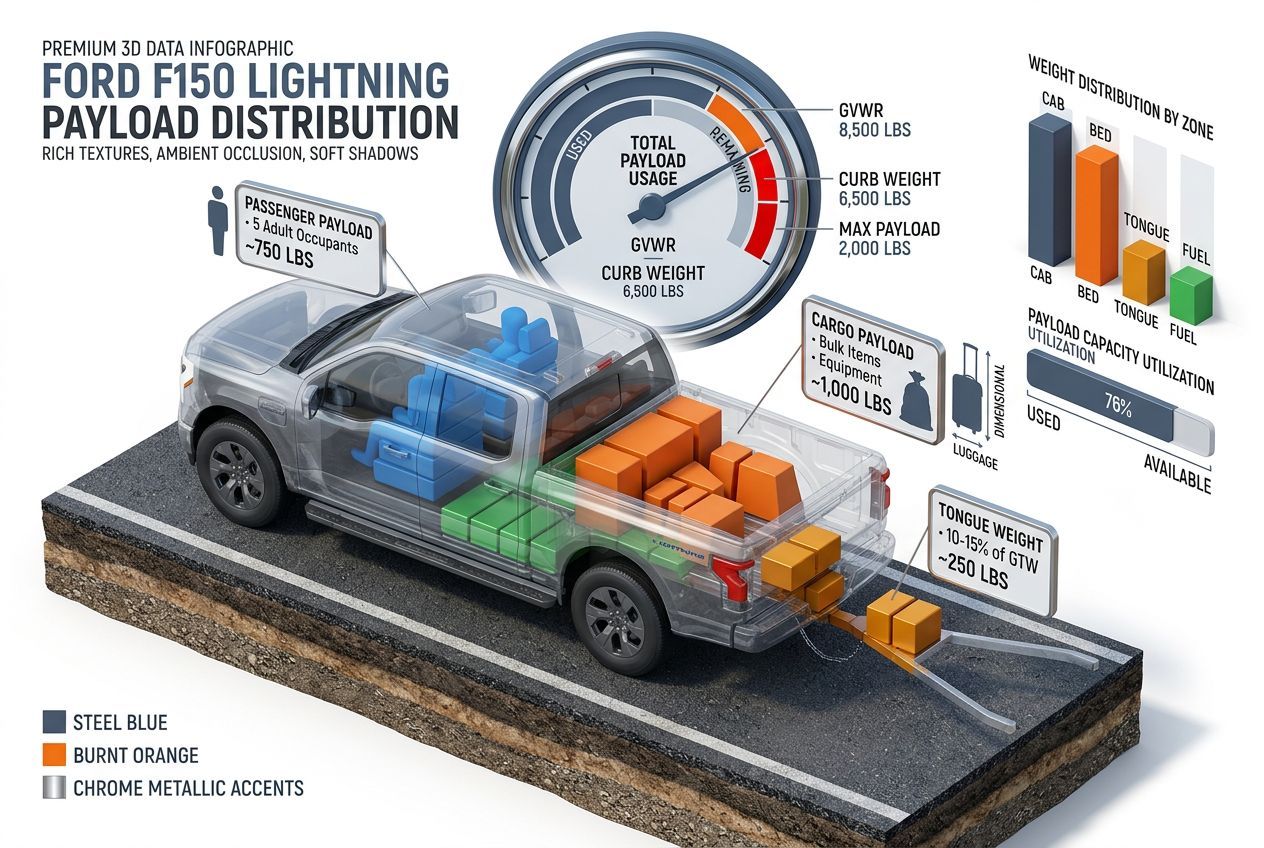
- Remaining Capacity: Against a roughly 1,800-lb payload rating on an extended-range SuperCrew, you're at 68% payload capacity before a full water tank or anything in the truck bed. This is workable but tight.
⚠️ Warning: Always check your specific payload capacity on the B-pillar sticker before loading up your truck for towing. Exceeding payload limits is dangerous and can void warranties.
Charging While Towing: Expect to stop every 100–140 miles at a DC fast charger when pulling that trailer at highway speeds.
- Charge Rate: Ford specs the Lightning's peak DC fast charge rate at 150 kW.
- Charge Time: A 15–80% charge takes approximately 41 minutes.
- Overall Stop Time: Add 15 minutes to unhitch if needed at a busy station, and you're looking at roughly one hour of added stop time per charging interval.
For context on how this compares to a gas-powered half-ton, our F-150 towing capacity guide covers the full ICE lineup.
📋
TRUCK TOWING CAPACITY
Standard Range vs. Extended Range Battery: Which for Towing?
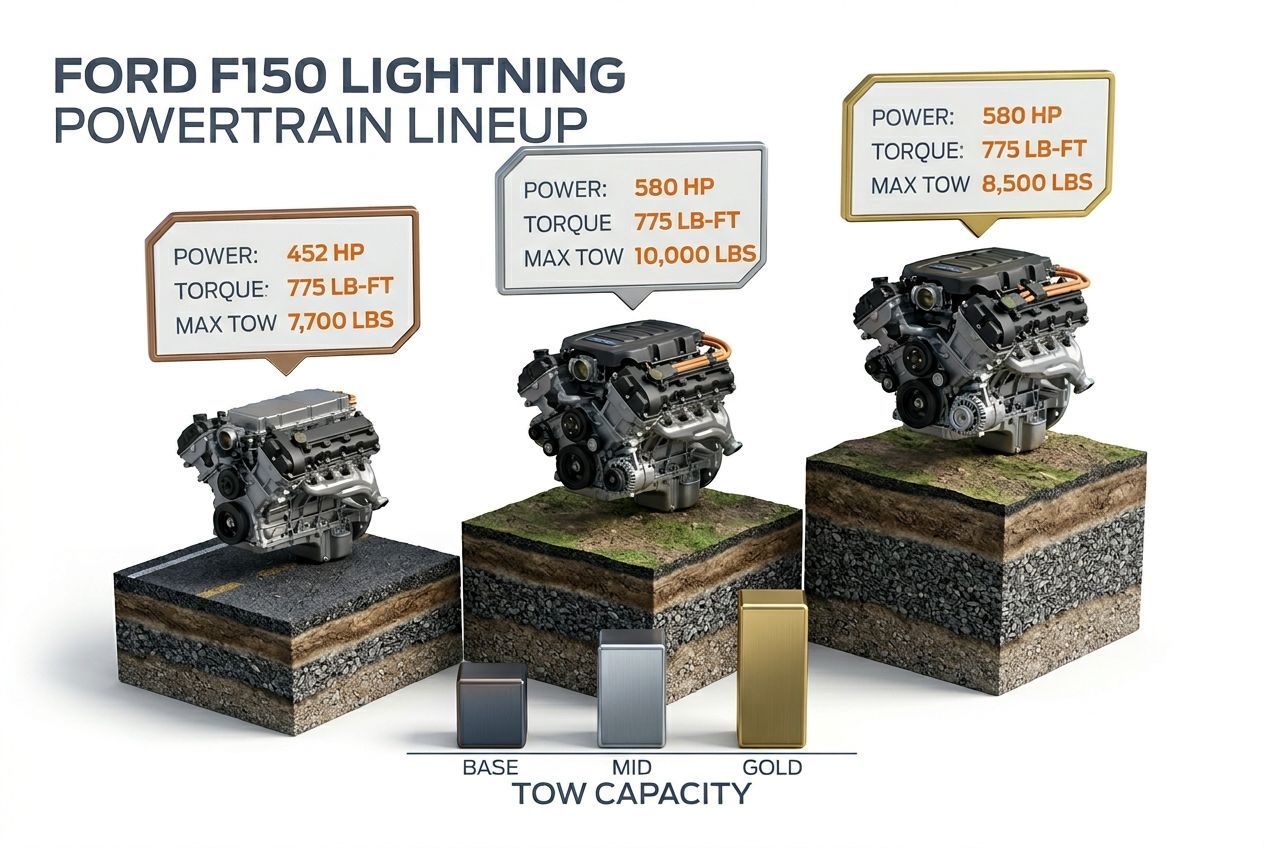
The Clear Choice for Towing: The extended-range battery (approximately 131 kWh usable) is the correct choice for any regular towing. Standard-range Lightning models (approximately 98 kWh usable) top out at roughly 7,700 lbs tow capacity and leave you with as few as 100–120 miles of real range pulling a mid-size camper — which makes anything beyond a 50-mile one-way trip genuinely stressful.
💡 Key Takeaway: The extended battery pack adds roughly 40–60 usable miles under towing load compared to the standard battery. This margin can be critical for reaching the next charging station.
Real-World Data: According to Edmunds, real-world towing tests of the extended-range Lightning confirm usable towing range in the 130–165-mile band for moderate loads — still demanding of planning, but manageable.
Cold Weather Impact: Cold weather further tightens these numbers.
- Range Reduction: Below 30°F, you can expect an additional 10–20% range reduction on top of towing losses, per NHTSA cold-weather EV testing data at nhtsa.gov.
- Practical Example: A winter towing run in Minnesota with a 5,000-lb trailer on an extended-range Lightning might net you 110–130 miles between stops, significantly less than the 150+ miles you'd get in mild conditions.
⚠️ Warning: Cold temperatures significantly reduce battery efficiency and overall towing range. Factor in an additional 10-20% range loss below 30°F.
Battery Preconditioning: Preconditioning the battery before arriving at a DC fast charger is essential in winter. The Lightning supports scheduled preconditioning through the FordPass app — use it. Charging into a cold, unpreconditioned pack can reduce charge speed significantly and add time to every stop.
✅ Pro Tip: Always use the FordPass app to precondition your battery before arriving at a DC fast charger, especially in cold weather, to ensure optimal charging speeds and efficiency.
Our towing capacity vs. payload guide explains how these two specs interact if you want to dig into the math.
⚙️
TRUCK TOWING CAPACITY
How Does the F-150 Lightning Compare to Other Electric Trucks for Towing?
Towing Capacity Ranking: The F-150 Lightning's 10,000-lb tow rating places it in the middle of the current EV truck pack.
- It trails the Rivian R1T (11,000 lbs) and Tesla Cybertruck (11,000 lbs).
- It is well behind some configurations of the Chevrolet Silverado EV Work Truck (10,000–12,500 lbs).
Universal Range Penalty: All four EVs experience broadly similar 40–60% range penalties under towing load. This is a fundamental physics problem, not a brand-specific issue.
Infrastructure and Service Advantage: Where the Lightning pulls ahead is in its established infrastructure and service network.
- Dealer Network: Ford boasts one of the broadest dealer networks in North America.
- Charging Compatibility: The Lightning is compatible with both the Ford Charging Network and third-party CCS chargers. This is crucial on a towing road trip where charger reliability and spacing are critical.
- Network Comparison: The Cybertruck's proprietary NACS network, while growing, still has fewer high-power CCS options in rural areas where many towing destinations are located.
💡 Key Takeaway: While other EV trucks may offer higher tow ratings, the F-150 Lightning benefits from Ford's extensive dealer network and broad charging compatibility (Ford Charging Network & CCS), offering a critical advantage for reliability on towing road trips.
For a full side-by-side breakdown of EV towing ratings, see our electric truck towing capacity comparison. If you're cross-shopping against the Silverado EV or RAM 1500 REV, our half-ton truck towing capacity guide puts all current platforms in context.
🚛
TRUCK TOWING CAPACITY
What Factors Affect the F-150 Lightning's Towing Range Most?
Primary Factors: Aerodynamics and Weight: Trailer aerodynamics and weight are the two biggest variables impacting F-150 Lightning tow range under load, by a wide margin.
- Aerodynamics: A flat, low-profile utility trailer at 3,000 lbs may trim range by only 30–35%. However, a tall, boxy Class C motorhome-style box trailer of the same weight could cut range by closer to 50% due to increased frontal area and turbulence drag. Shape matters as much as pounds.
Speed Amplification: Speed significantly amplifies the effect of aerodynamic drag.
- Drag Increase: Aerodynamic drag increases with the square of velocity. Going from 55 mph to 70 mph doesn't just add 27% drag; it roughly doubles it.
- High-Yield Adjustment: This is why slowing down is the single highest-yield adjustment a Lightning owner can make while towing.
📊 Quick Fact: Aerodynamic drag, which dramatically increases with speed, is a primary reason for significant range reduction when towing.
Other Meaningful Variables:
-
Elevation
Mountain passes and sustained grades increase energy consumption sharply. Regenerative braking on descents recovers some energy, but net elevation gain always results in a net range loss. At altitude (5,000+ ft), the Lightning's electric motors do not lose power the way a naturally aspirated gas engine does, which is a genuine EV advantage over a conventional F-150 in mountainous regions.
-
Ambient Temperature
Both temperature extremes hurt. Cold reduces battery chemistry efficiency, while heat triggers thermal management systems that draw power from the pack.
-
Tire Pressure
Under-inflated tires increase rolling resistance. It's crucial to check tire pressure on both the truck and trailer before every towing trip.
✅ Pro Tip: Regularly check and maintain proper tire pressure on both your F-150 Lightning and your trailer to minimize rolling resistance and maximize towing efficiency.
-
HVAC Load
Running the cab at full heat or full A/C adds a modest 3–5% range drain. While small relative to towing losses, this can add up over a 300-mile trip.
You can model your specific trip using our towing capacity lookup tool and cross-check with the can I tow this calculator for a full payload and tongue weight check.
📝
TRUCK TOWING CAPACITY
Is the F-150 Lightning Practical for Long-Distance Towing?
Defining Practicality: The F-150 Lightning is a practical towing truck for trips under 200 miles one-way with the extended-range battery, provided you're routing through areas with DC fast chargers spaced every 80–130 miles. Beyond that distance threshold, the dynamics change significantly.
The Time Trade-Off: For longer trips, you're adding 30–45-minute charging stops roughly every 100–150 miles. This can stretch a 400-mile towing trip into a 6–7-hour day versus the 4.5 hours a gas F-150 would typically take.
💡 Key Takeaway: For long-distance towing (over 200 miles one-way), the additional charging stops required by the F-150 Lightning can significantly extend travel time compared to a gas-powered truck, a crucial factor in trip planning.
Rural Infrastructure Gap: This is a real trade-off, not one that is easily solvable with planning. If your regular towing use case involves 400+ mile hauls to remote campgrounds, the Lightning will likely frustrate you. Charging infrastructure in rural areas — where boat launches, campgrounds, and job sites tend to be located — remains the biggest gap in the EV towing proposition in 2025–2026.
⚠️ Warning: The lack of robust DC fast charging infrastructure in many rural areas is currently the biggest practical limitation for long-distance F-150 Lightning towing, especially to remote destinations like campgrounds or job sites.
Where the Lightning Excels: The Lightning genuinely shines in specific scenarios:
- Regional towing.
- Job sites with reliable charging access.
- Predictable weekly routes.
- Overnight charging between hauls.
If you're a contractor towing equipment within a 150-mile radius and charging at your shop overnight, the Lightning's operational costs are compelling. If you're a snowbird dragging a 28-ft fifth-wheel from Minnesota to Texas twice a year, you likely need a gas or diesel three-quarter ton — consider the F-250 or check our RAM 1500 towing capacity if you want to stay half-ton but need more real-world range flexibility.
The FMCSA's guidance on cargo securement also applies to EV towing — securing your load correctly doesn't change based on what powers the tow vehicle. Don't skip that step.

