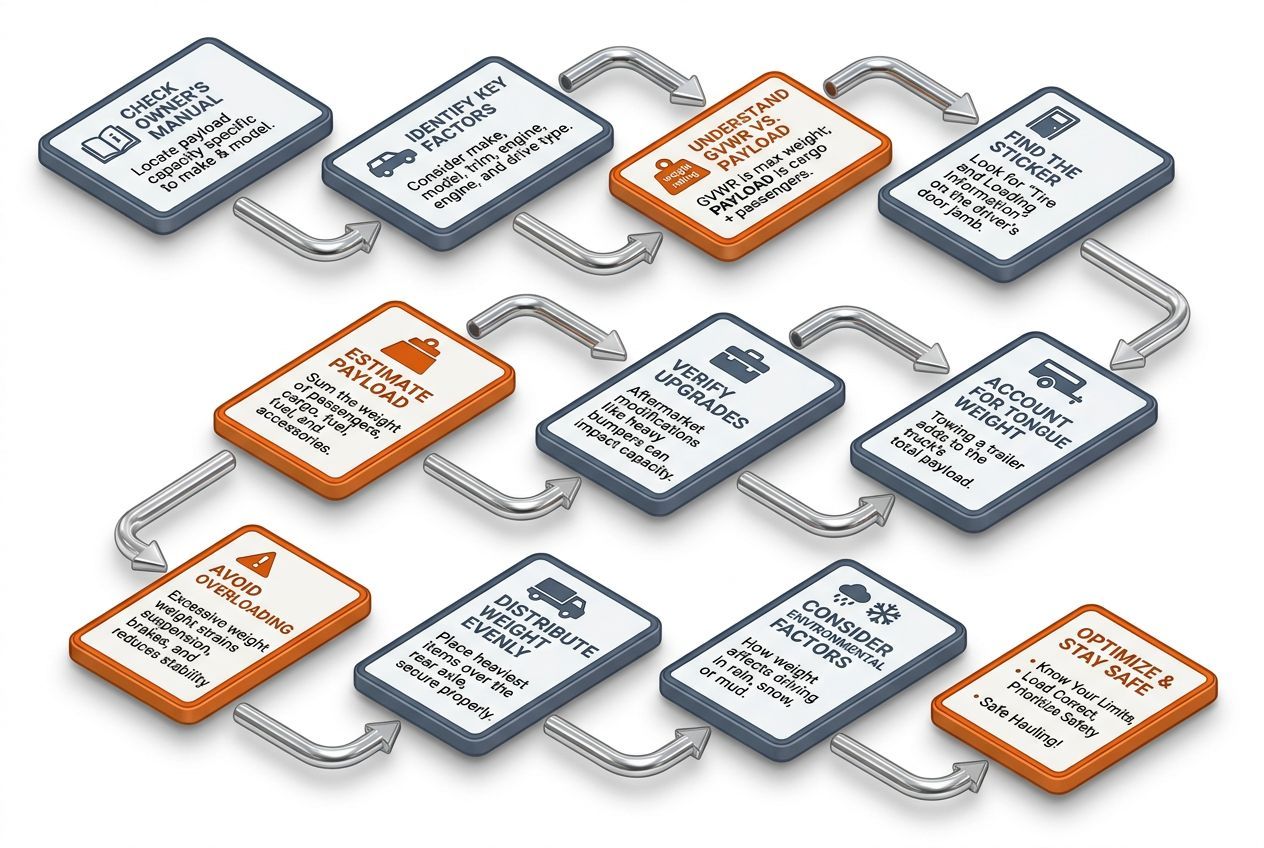
💡 Key Takeaway: Your real payload rating is on the yellow-and-white sticker inside the driver-side door jamb — not the marketing brochure maximum. 💡 Key Takeaway: Cab size, drivetrain, and engine choice can cut payload by 300–900 lbs compared to a base configuration. 💡 Key Takeaway: Tongue weight from a trailer (typically 10–15% of trailer weight) counts directly against your payload budget. ⚠️ Warning: Overloading increases stopping distance by 25–40% and can void your insurance claim if an accident occurs. 💡 Key Takeaway: HD trucks (F-250/350, Silverado 2500/3500, RAM 2500/3500) offer payload ratings up to 7,680 lbs — necessary if your half-ton's limit doesn't work for your load.
What Is Truck Bed Weight Capacity and Why Does It Matter?
Payload capacity is fundamental to vehicle safety. Truck bed weight capacity is the total weight a pickup can safely carry across its cab and bed, derived by subtracting curb weight from the vehicle's GVWR. It governs braking performance, suspension integrity, and tire safety. Exceed it and you're not just risking mechanical damage — you're creating a vehicle that doesn't handle, stop, or steer the way its engineers designed.
The payload formula is straightforward: Payload = GVWR − Curb Weight. However, "curb weight" includes a full fuel tank, all factory-installed fluids, and every option your specific truck came with from the factory.
💡 Key Takeaway: A truck with a sunroof, spray-in bedliner, running boards, and the towing package already installed weighs more than the base model. That extra weight comes directly out of your payload budget before you've put a single item in the bed.
For a full breakdown of how payload capacity is defined and measured, see our payload capacity explained guide.
How Much Weight Can a Truck Bed Hold by Make and Model?
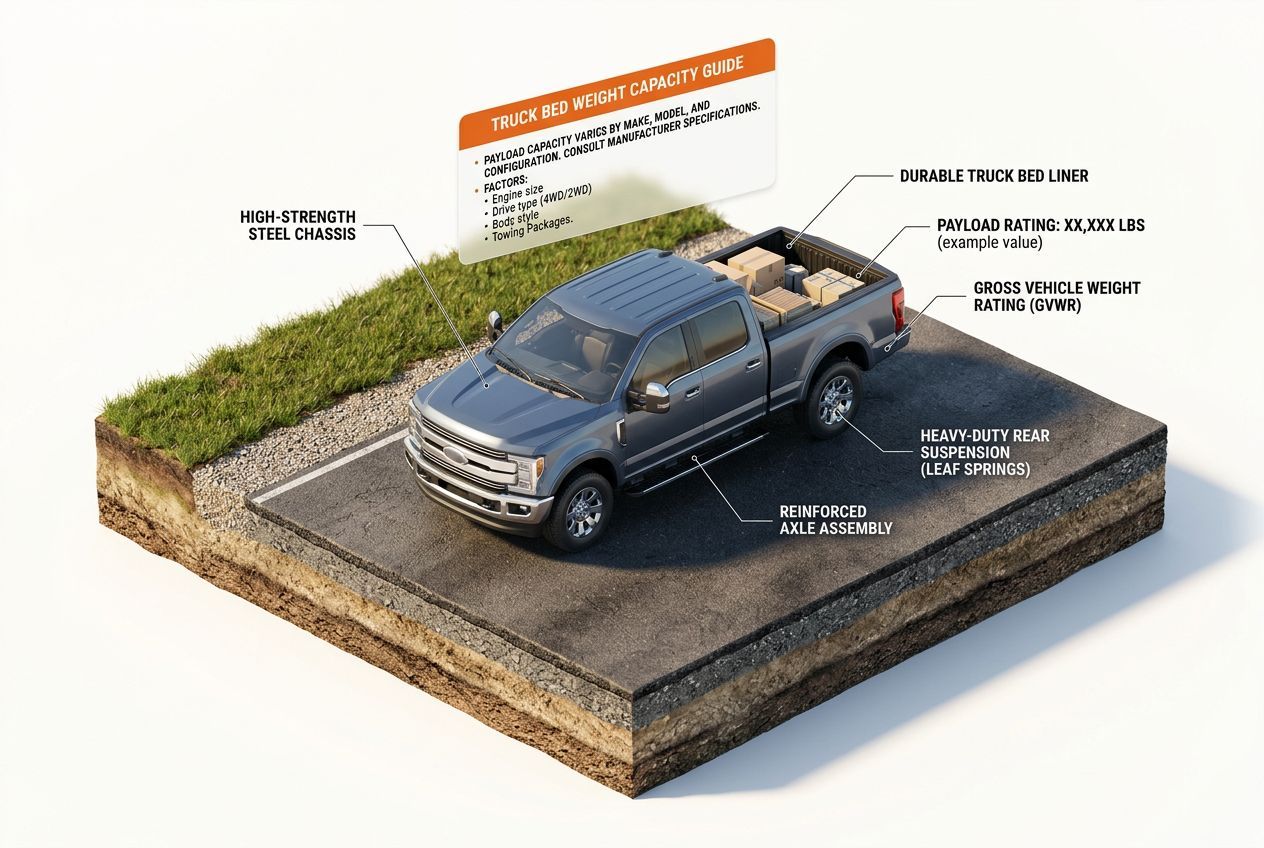
Maximum payload ratings vary significantly by segment and configuration. Most half-ton pickups carry between 1,300 and 2,325 pounds, while heavy-duty trucks stretch from 2,500 to over 7,600 pounds. The exact number varies by configuration — the same F-150 in Regular Cab 2WD form holds hundreds of pounds more than its Crew Cab 4WD sibling. The table below reflects maximum published payload ratings for top configurations as of the 2024–2025 model years.
2024–2025 Pickup Truck Bed Weight Capacity — Max Payload by Segment
Click any make/model for the full year-by-year tow chart and payload breakdown.
| Truck | Segment | Max Payload (lbs) | Notes |
|---|---|---|---|
| Ford F-150 | Half-ton | 2,325 | Regular Cab, 2WD, 3.3L V6; payload varies widely by trim |
| RAM 1500 | Half-ton | 2,300 | Classic trim, V8, specific axle ratio required |
| Chevrolet Silverado 1500 | Half-ton | 2,280 | Work Truck, 2WD, 4.3L V6 |
| Toyota Tundra | Half-ton | 1,940 | SR5, 3.5L twin-turbo V6 |
| Nissan Titan | Half-ton | 1,800 | King Cab, 2WD |
| Toyota Tacoma | Midsize | 1,440 | TRD Off-Road, 2.4L turbo |
| Ford Ranger | Midsize | 1,905 | XL, 2WD, 2.3L EcoBoost |
| Chevrolet Colorado | Midsize | 1,647 | WT, 2WD |
| Jeep Gladiator | Midsize | 1,700 | Sport, 2WD |
| Ford Maverick | Compact | 1,500 | Hybrid, FWD |
| Ford F-250 Super Duty | 3/4-ton | 4,340 | Regular Cab, 2WD, 6.2L V8, gas |
| RAM 2500 | 3/4-ton | 4,010 | Regular Cab, 2WD, 6.4L HEMI |
| Chevrolet Silverado 2500HD | 3/4-ton | 3,979 | Regular Cab, 2WD, 6.6L V8 |
| Ford F-350 DRW | 1-ton | 7,680 | Chassis cab configuration, 6.7L Power Stroke diesel |
| RAM 3500 DRW | 1-ton | 7,680 | 6.7L Cummins diesel, specific bed/axle |
Sources: Ford.com, Chevrolet.com, RamTrucks.com, Toyota.com, NissanUSA.com — 2024–2025 model year towing and payload guides. Ratings apply to specific configurations only; verify with the door-jamb sticker on your unit.
⚠️ Warning: These are ceiling figures. Your specific truck almost certainly rates lower. Use our payload calculator to plug in your truck's actual door-jamb number and remaining capacity.
Why Your Truck's Real-World Payload Is 30-40% Lower Than the Brochure Number
The published payload ceiling almost never matches the truck on a dealer lot. Manufacturers advertise the highest possible payload — and that figure belongs to the lightest possible configuration: Regular Cab, 2WD, base engine, no options. The truck most buyers actually drive home — a Crew Cab 4WD with a tow package, leather, and a larger engine — sits 600–1,000 lbs heavier at the curb, and every pound of that curb-weight gain comes directly off payload.
The gap between brochure and reality is consistent across half-tons:
| Truck | Advertised Max Payload | Typical Buyer Build | Real Payload | Delta |
|---|---|---|---|---|
| Ford F-150 | 2,325 lbs (Reg Cab 2WD, 3.3L V6) | SuperCrew 4WD, 3.5L EcoBoost | ~1,650 lbs | −29% |
| Chevrolet Silverado 1500 | 2,280 lbs (Reg Cab 2WD, 4.3L V6) | Crew Cab 4WD Z71, 6.2L V8 | ~1,520 lbs | −33% |
| RAM 1500 | 2,300 lbs (Classic, V8 + axle code) | Crew Cab 4WD Laramie, 5.7L HEMI | ~1,290 lbs | −44% |
| Toyota Tundra | 1,940 lbs (SR5, 3.5L V6) | CrewMax 4WD Limited | ~1,400 lbs | −28% |
Sources: Manufacturer Trailer Towing Supplements (ford.com, chevrolet.com, ramtrucks.com, toyota.com) cross-referenced with Edmunds and Car and Driver instrumented-test door-jamb readings on press-fleet trucks.
Why the RAM 1500 shows the biggest gap: The Crew Cab 4WD Laramie's higher trim adds 250–350 lbs in leather, larger wheels, sunroof, and air suspension — plus the 5.7L HEMI is heavier than the base V6. Stack those onto the same GVWR ceiling, and payload absorbs the full curb-weight increase. The same trim-level effect applies to every truck in the table, just less aggressively.
💡 Key Takeaway: Treat the brochure number as a ceiling that exists only in marketing material. Your actual payload is whatever's printed on the yellow-and-white sticker inside your specific truck's door jamb — and on a popular Crew Cab 4WD configuration, that number will be 28–44% lower than the advertised max. Run yours through the calculator at the top of this page before you commit to a trailer or load.
What Is the Difference Between Payload Capacity and Towing Capacity?
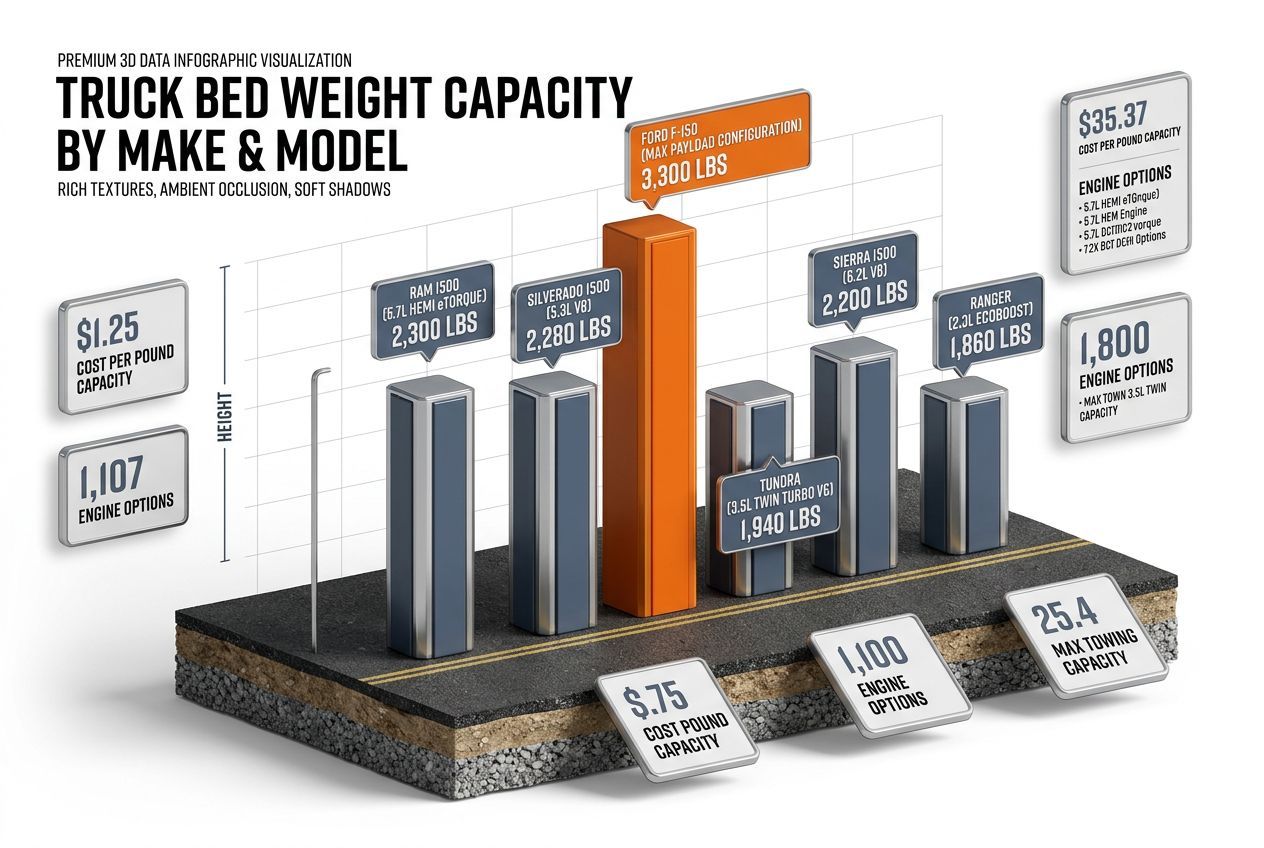
Payload and towing capacity are intertwined. They are two separate ratings that share the same GVWR ceiling — and that relationship is exactly where most truck owners run into trouble. Payload is what you carry inside and on the truck (cab + bed). Towing capacity is what you pull behind it. They're not independent budgets you can max out simultaneously.
Consider this real-numbers scenario: You're towing a 7,000-lb travel trailer with your RAM 1500 (rated at 2,100 lbs payload for your specific build). Tongue weight at 13% is 910 lbs. You've got a driver (210 lbs), a passenger (160 lbs), 60 lbs of gear in the cab, and 80 lbs of tools in the bed.
📊 Quick Fact: That's 1,420 lbs against a 2,100-lb ceiling — meaning you've burned 68% of your payload before touching the tow rating. Toss a cooler and some camping gear in the bed, and you're looking at a very thin margin.
Tongue weight directly impacts payload. This is why tongue weight and payload aren't separate concerns. According to NHTSA guidance, tongue weight must be factored into payload calculations, and ignoring it is one of the most common causes of overloaded half-ton trucks. For a deeper look at this relationship, our tongue weight guide walks through the math step by step.
If you're also comparing towing numbers across makes, the towing capacity guide covers those figures by model.
How Do I Find the Exact Payload Rating for My Truck?
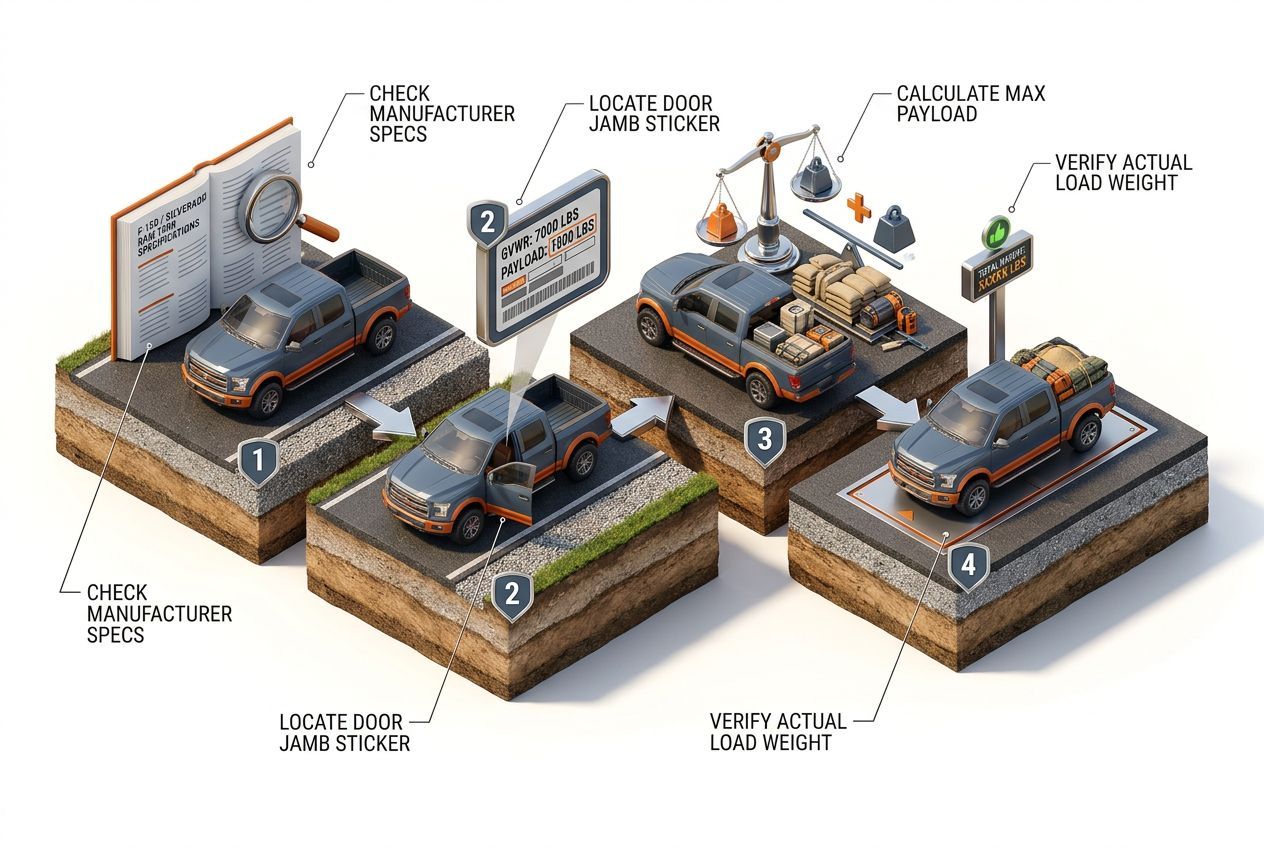
Your truck's specific payload is on its door jamb sticker. The exact payload rating for your truck is printed on the yellow-and-white Tire and Loading Information sticker on the driver-side B-pillar door jamb. This number is specific to your vehicle's actual build — not the segment maximum published in ads. It accounts for every factory-installed option, your cab configuration, drivetrain, and bed size.
✅ Pro Tip: Look for a line that reads "The combined weight of occupants and cargo should never exceed XXX kg / XXX lbs." That's your number. Write it down. It lives on the jamb because it's that important.
Cross-reference it with your truck's window sticker or build sheet if you still have it — the GVWR and curb weight are listed there too, and you can verify the math yourself. Ford publishes a separate Trailer Towing Supplement (available at ford.com) that breaks payload and tow ratings down by cab, bed, engine, and axle ratio — far more useful than the single max number in the brochure. GM and RAM offer similar configuration-specific charts on their respective sites (chevrolet.com, ramtrucks.com).
⚠️ Warning: Aftermarket accessories added post-sale — bed covers, toolboxes, lift kits, roof racks — are not reflected in that door-jamb sticker. Every pound of aftermarket gear you've added comes off your payload rating. A steel toolbox alone can run 80–150 lbs. A loaded spare in the bed is another 50 lbs. Do the subtraction before you load up.
What Happens If You Exceed Your Truck Bed Weight Limit?
Overloading your pickup truck creates significant mechanical, safety, and legal risks. Exceeding your truck bed weight limit creates cascading mechanical and legal consequences that aren't worth the risk. Overloaded suspension compresses beyond design limits, reducing ground clearance and forcing tires into wheel-well contact. Stopping distance increases 25–40% — a truck that stops in 150 feet at legal capacity may need 200+ feet when overloaded, according to NHTSA vehicle dynamics data at nhtsa.gov.