Skip to content
πŸ”— DIY TOWING & FLAT TOWING

How to Back Up a Trailer: Step-by-Step Guide for Beginners

Published Β· Updated Β· 11 min read
MarkUpdated Apr 15, 2026FMCSA Safe Driving Tips

Key Takeaways

  • βœ“Place your hand at the **bottom of the wheel** β€” move it the direction you want the trailer to go
  • βœ“Short trailers are **harder to back** than long ones β€” they react faster to steering input
  • βœ“Use **small corrections** and slow speed β€” overcorrecting is the #1 beginner mistake
  • βœ“A spotter at the trailer's **rear corner** communicates better than one behind the trailer
  • βœ“**30-60 minutes** of parking lot practice builds basic competence for most drivers

Key Takeaways

  • Place your hand at the bottom of the wheel β€” move it the direction you want the trailer
  • Short trailers are harder to back than long ones β€” they jackknife faster
  • Use small corrections at slow speed β€” overcorrecting is the #1 beginner mistake
  • A spotter at the trailer's rear corner provides the best visual guidance
  • 30-60 minutes of practice in an empty lot builds solid basic competence

Backing up a trailer intimidates even experienced drivers the first few times. The reversed steering logic β€” turn right to go left β€” fights every instinct your brain developed from years of forward driving. But the skill is learnable in a single afternoon with the right technique and practice method. This guide breaks down the hand-on-bottom steering method, mirror setup, spotter communication, and practice drills that CDL schools use to train professional truck drivers, adapted for recreational towers.


πŸ’°
DIY TOWING & FLAT TOWING

Why Is Backing Up a Trailer Different from Regular Driving?

When you drive forward, the front wheels steer and the rear follows in the same arc. When you reverse with a trailer, the hitch point creates a pivot between the tow vehicle and the trailer. The trailer moves in the opposite direction of your steering input until the tow vehicle's angle pushes it the other way.

This pivot effect means the trailer responds to steering inputs with a delay β€” and the shorter the trailer, the faster and more dramatically it reacts. A 25-foot travel trailer gives you time to see the turn developing and correct. A 10-foot utility trailer jackknifes before most beginners can react.

The key mental shift: stop thinking about steering the tow vehicle and start thinking about steering the trailer. Your vehicle is just a tool pushing the trailer where it needs to go. Once you internalize that the trailer is the thing you're placing β€” not the truck β€” backing becomes much more intuitive.

Key Insight: Professional truck drivers in CDL training spend more time on backing skills than any other single maneuver. It's not natural for anyone β€” even experienced drivers develop the skill through deliberate practice, not instinct.
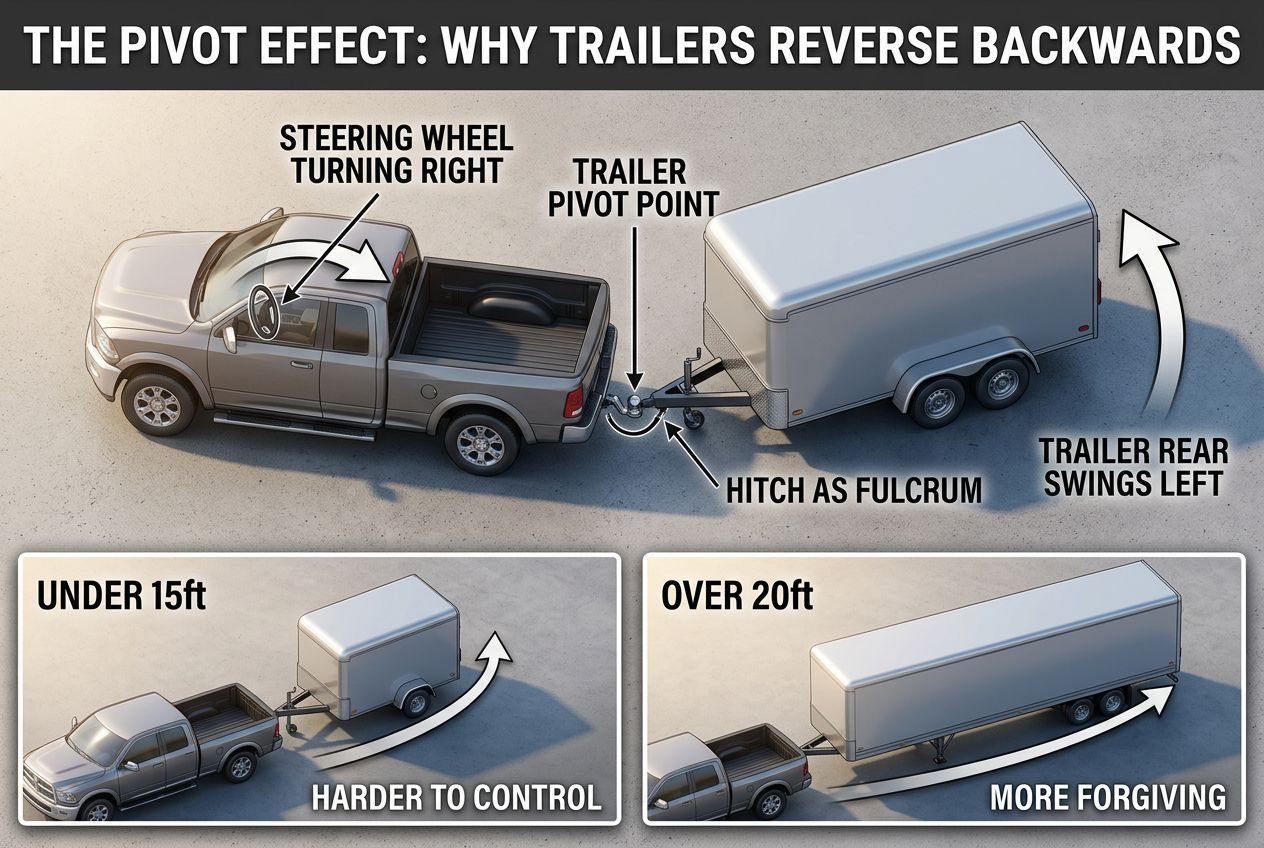

Trailer pivot point diagram showing how steering input reverses direction at the hitch
πŸ“Š
DIY TOWING & FLAT TOWING

What Is the Hand-on-Bottom Steering Method?

The hand-on-bottom method is the simplest mental model for trailer backing. It eliminates the "opposite direction" confusion by giving you a physical reference.

How it works:

  1. Place one hand at the 6 o'clock position (bottom) of the steering wheel
  2. Move your hand in the direction you want the trailer to go
  3. Hand goes left β†’ trailer goes left
  4. Hand goes right β†’ trailer goes right
  5. That's it β€” no reverse-logic thinking required

This works because when your hand is at the bottom of the wheel, moving it left physically turns the wheel right (which sends the trailer left). The reversed steering logic is still happening mechanically, but your brain only needs to process "hand goes where trailer goes."

Use this method with small, gradual movements. The biggest beginner mistake is making aggressive steering corrections. A 2-inch movement of your hand at the wheel bottom translates to a gentle arc that you can monitor and adjust. A 6-inch movement starts a sharp turn that quickly leads to jackknifing.

Pro Tip: Keep your hand at the bottom of the wheel for the entire backing maneuver. Don't switch back to the top. The moment you move your hand to the 12 o'clock position, the direction logic reverses again and your brain gets confused. Bottom hand = intuitive direction. Top hand = reversed direction. Stay at the bottom.
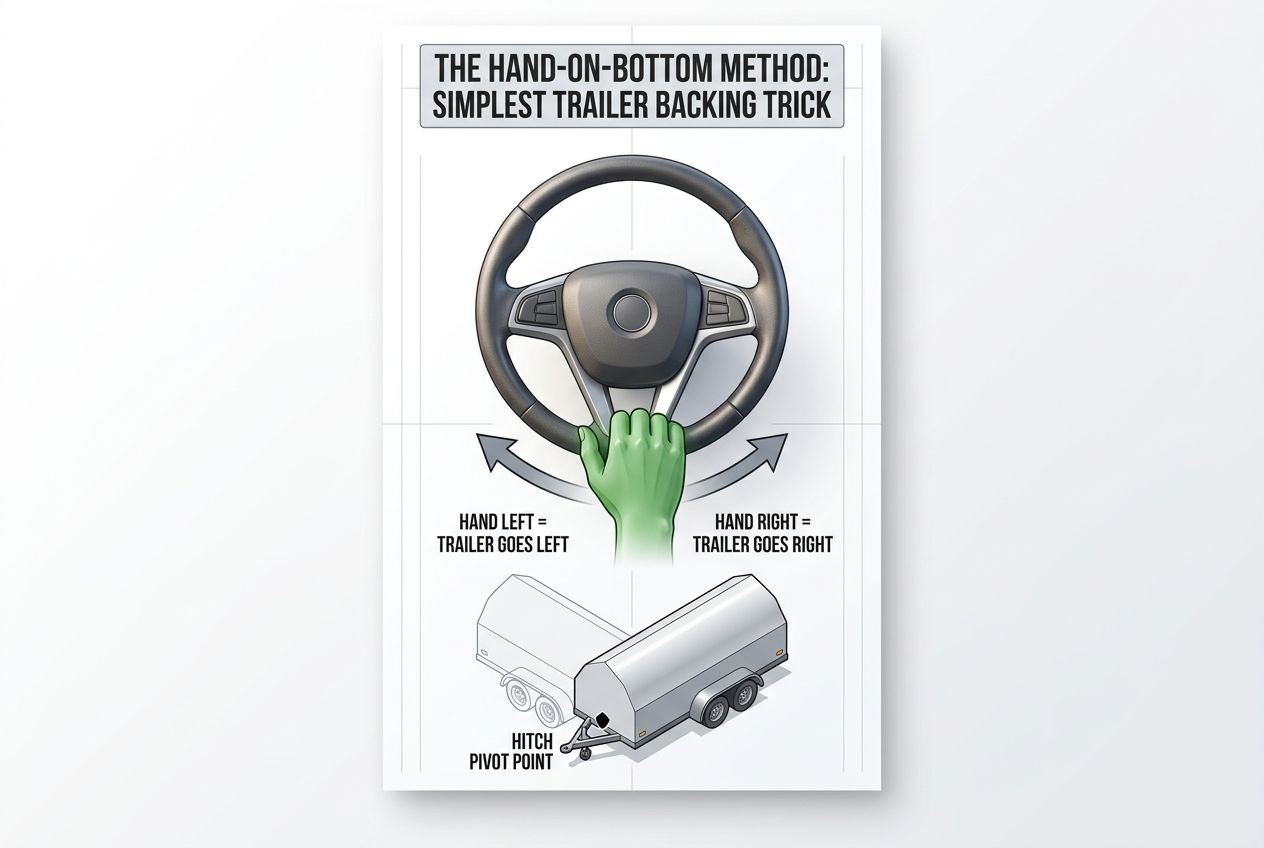
Hand-on-bottom steering method for trailer backing showing hand position and trailer direction

Need a tow truck?

Use our free tools to estimate costs and find help near you.

Try Free Tools
πŸ”§
DIY TOWING & FLAT TOWING

How Do You Back Up a Trailer Step by Step?

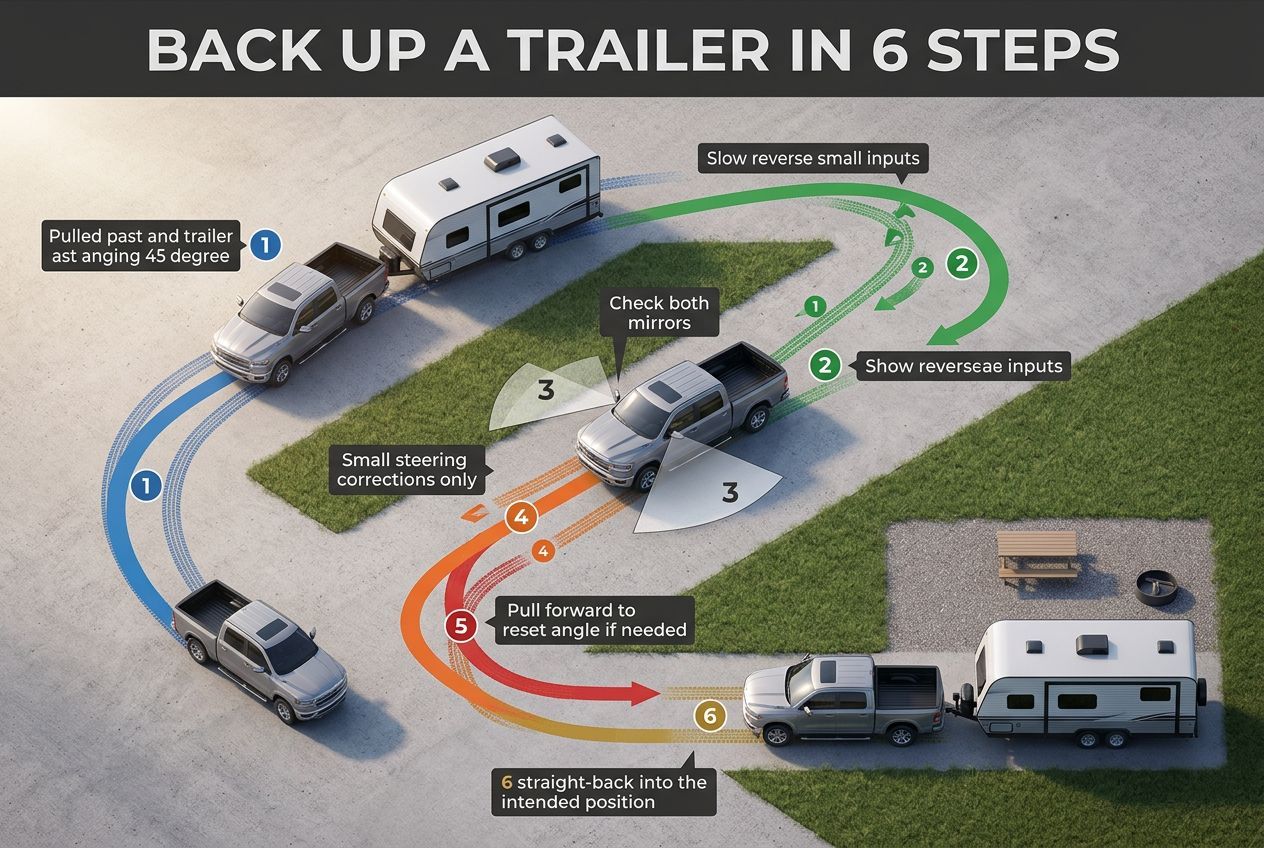
Here's the complete process from approach to parked, using the technique taught in CDL schools and adapted for recreational trailers.

Step 1: Set up your approach. Pull past your target spot (campsite, boat ramp, driveway) and position your tow vehicle at roughly a 45-degree angle away from the side the trailer needs to enter. If the spot is on your left, pull past and angle your vehicle to the right. This gives the trailer room to swing into position.

Step 2: Shift into reverse and go slow. Idle speed or barely above it. You want the trailer moving slowly enough that you have time to see where it's heading and make corrections. Speed is the enemy of controlled backing.

Step 3: Watch the trailer in your mirrors. Both side mirrors should show the trailer's sides. The trailer will begin to angle as you start backing. Use the hand-on-bottom method to guide the trailer toward your target.

Step 4: Make small corrections early. When you see the trailer drifting off course, make a small steering adjustment immediately. Small corrections early are far easier than large corrections late. If the trailer starts angling too sharply, pull forward 5-10 feet to straighten out and try again.

Step 5: Pull forward and reset if needed. There is zero shame in pulling forward to reset. Professional drivers do it constantly. If the trailer angle is getting away from you, stop, pull forward until the trailer straightens behind the vehicle, and start the backing attempt again from a better angle.

Step 6: Final positioning. As the trailer approaches the target position, straighten the steering wheel to align the tow vehicle with the trailer. Make final small adjustments to center the trailer. Set the parking brake and chock the trailer wheels.

Common Mistake: Trying to complete the backing in one continuous reverse motion. The best approach is multiple short reversing segments with pull-forward corrections between them. Even a 3-point backing maneuver is more accurate and less stressful than one long, gradually-worsening attempt.


Six step trailer backing process showing approach angle reversing corrections and final positioning

πŸ›‘οΈ
DIY TOWING & FLAT TOWING

How Should You Set Up Mirrors and Use a Spotter?

Good mirror setup and spotter communication eliminate most backing anxiety. You need to see where the trailer is going β€” either through mirrors, cameras, or a spotter's guidance.

Mirror setup:

Adjust both side mirrors so you can see the full length of the trailer sides without moving your head. The bottom half of each mirror should show the trailer. The top half shows the road behind. If your tow vehicle has towing mirrors that extend outward, use them β€” they provide a wider field of view past the trailer.

For enclosed trailers and travel trailers, the vehicle's rearview mirror is useless because the trailer blocks the view. You're 100% dependent on side mirrors and any backup camera system.

Using a spotter:

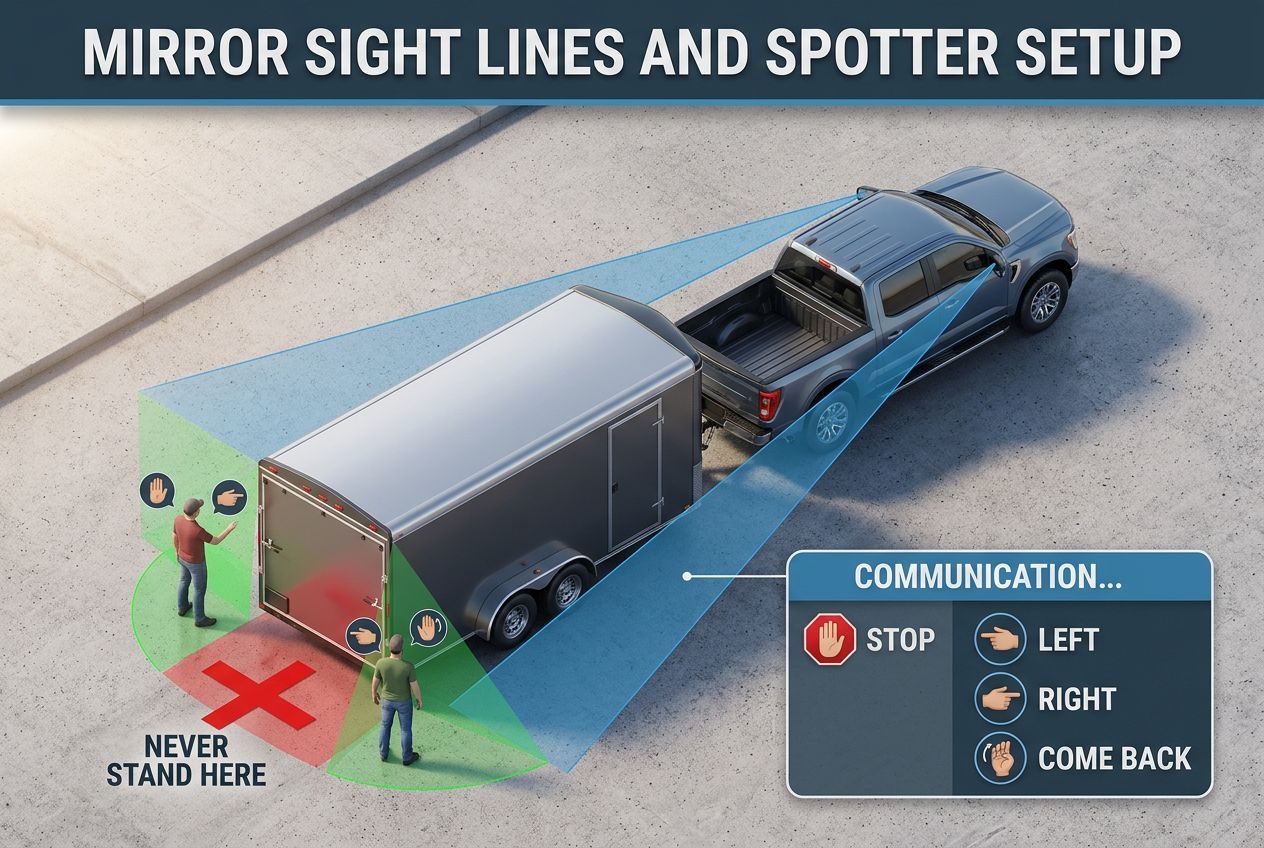
A spotter stands outside and guides the driver with hand signals or verbal commands. The most effective spotter position is at the trailer's rear corner on the driver's side β€” visible in the driver's side mirror while also seeing where the trailer is heading.

Spotter communication rules:

  • Agree on signals before starting β€” left, right, straight, stop
  • The spotter should never stand directly behind the trailer
  • "Stop" means stop immediately, not "finish your current movement"
  • If the driver loses sight of the spotter, stop and don't move until visual contact is re-established
  • Hand signals work better than shouting, especially in noisy environments like boat ramps

Pro Tip: Wireless trailer backup cameras ($100-$300) mount to the trailer's license plate bracket and display on your phone or a dedicated screen. They're a worthwhile investment for any trailer you back up regularly β€” especially boat trailers at busy ramps where a spotter may not be available.


Mirror sight lines and spotter positioning diagram for safe trailer backing
πŸ“‹
DIY TOWING & FLAT TOWING

What Are the Best Practice Drills for Trailer Backing?

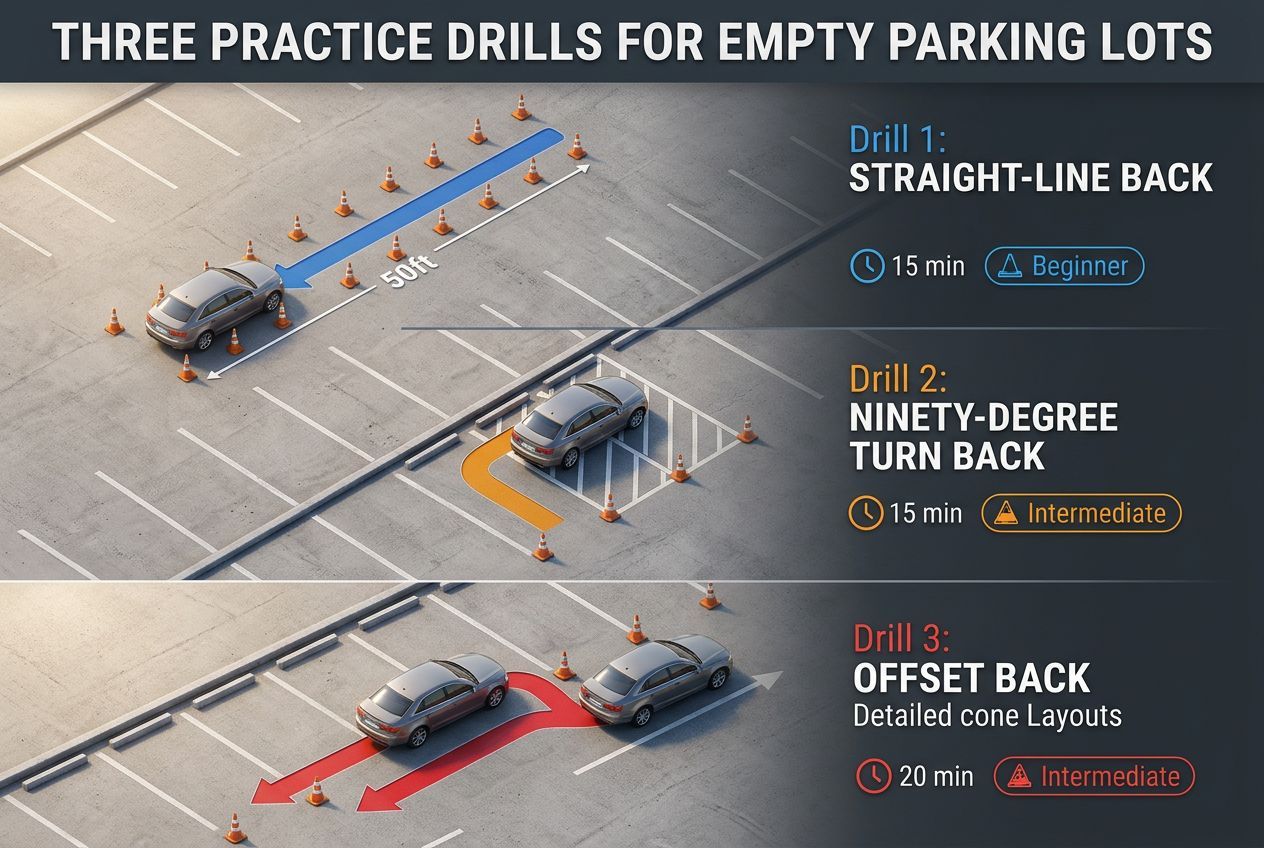
Practice in an empty parking lot transforms trailer backing from terrifying to routine. Here are three drills that CDL schools use, scaled for consumer trailers.

Drill 1: Straight-Line Back (15 minutes)

Set up two lines of cones (or water bottles) 12 feet apart in a 50-foot lane. Practice backing the trailer straight between them. Focus on keeping the trailer centered using tiny steering corrections. This teaches you to maintain a straight line, which is actually harder than backing in a curve.

Drill 2: 90-Degree Turn Back (20 minutes)

Set up a target parking spot perpendicular to your starting position. Practice the approach angle, the backing turn, and the pull-forward corrections to get the trailer into the spot. This simulates backing into a campsite, driveway, or dock.

Drill 3: Offset Back (15 minutes)

Start in a lane and back the trailer into an adjacent lane β€” like backing into a parking space that's one lane over from where you're driving. This is the hardest common maneuver and teaches you to manage the S-curve that the tow vehicle and trailer create during an offset approach.

Key practice principles:

  • Practice with the trailer you'll actually be towing β€” every trailer length handles differently
  • Start with longer backing distances and work toward tighter spots
  • Do NOT practice on public roads β€” find an empty lot on a weekend morning
  • Practice both left and right backing (driver side is easier because of mirror visibility)
  • Record yourself with a phone propped on the dashboard β€” watching the replay reveals patterns you can't see in real time

For travel trailer towing, invest the practice time before your first campground trip. Nothing ruins a camping weekend faster than a 30-minute spectacle at the campsite while your family watches.

Key Insight: Shorter trailers are harder to back than longer ones. A 6-foot utility trailer jackknifes in half the distance a 24-foot travel trailer does. If you learn to back a short trailer competently, a longer one will feel easy by comparison. Start with whatever trailer you own β€” but know that short trailers demand more precision.


Three trailer backing practice drills straight line 90-degree turn and offset in parking lot

Sources & Methodology

  1. 1.
    FMCSA Safe Driving Tips β€” Federal motor carrier recommendations for trailer maneuvering and backing safety.
  2. 2.
    AAA Foundation for Traffic Safety β€” Research on recreational towing safety practices and driver education.
  3. 3.
    National Safety Council β€” Backing accident prevention statistics and recommended techniques.
  4. 4.
    RVIA β€” RV and travel trailer maneuvering best practices for recreational towers.
  5. 5.
    FMCSA CDL Training Resources β€” Commercial driver training backing techniques adapted for consumer application.

TowingServiceHub is reader-supported: we may earn money from ads and from some links on this page. See our editorial policy.

Mark β€” Founder & Editor

Mark

Founder & Editor

Mark is the founder and editor of TowingServiceHub, which he launched in 2026 after struggling to find clearly sourced towing costs and truck specs. He works in enterprise technology and tows his own boats, trailers, and equipment, so he knows the questions drivers actually ask.

Read full bio β†’

Need a tow truck right now?

Browse vetted local providers in your area. Real Google ratings, verified business info, free to use.

Or browse all 50 states from our directory

Frequently Asked Questions

Turn the steering wheel in the opposite direction you want the trailer to go. If you want the trailer to go left, turn the wheel right. The easiest method is to place your hand at the bottom of the steering wheel β€” then move your hand in the direction you want the trailer to go. Hand goes left, trailer goes left.

Backing a trailer is difficult because the trailer pivots at the hitch point and moves opposite to your steering input. Your brain is wired for forward driving where left means left. With a trailer, the reversed relationship creates a mental conflict. Practice in an empty parking lot for 30 minutes and the reversed logic starts feeling natural.

Pull past the spot and angle the tow vehicle away from it at about 45 degrees. Start backing slowly with small steering corrections. Use a spotter positioned at the rear corner of the trailer. Make several pull-forward corrections rather than trying to nail it in one attempt. Folding mirrors or a backup camera on the trailer greatly help in tight spaces.

Backup cameras mounted on the trailer's rear help tremendously by showing exactly where the trailer is heading. Wireless trailer backup cameras cost $100-$300 and mount to the license plate bracket. They're especially useful for enclosed trailers and travel trailers where you can't see past the trailer through your vehicle's rearview mirror.

Most people develop basic competence in 30-60 minutes of focused practice in an empty parking lot. Confident, precise backing into tight spots takes 3-5 real-world sessions. Short trailers like boat trailers are harder to back than longer travel trailers because they react faster to steering inputs, giving you less time to correct.

Related Articles

Explore More Towing Guides

Browse all 157 expert guides and 10 free tools.