🔧
DIY TOWING & FLAT TOWING
How Does a Supplemental Braking System Work?
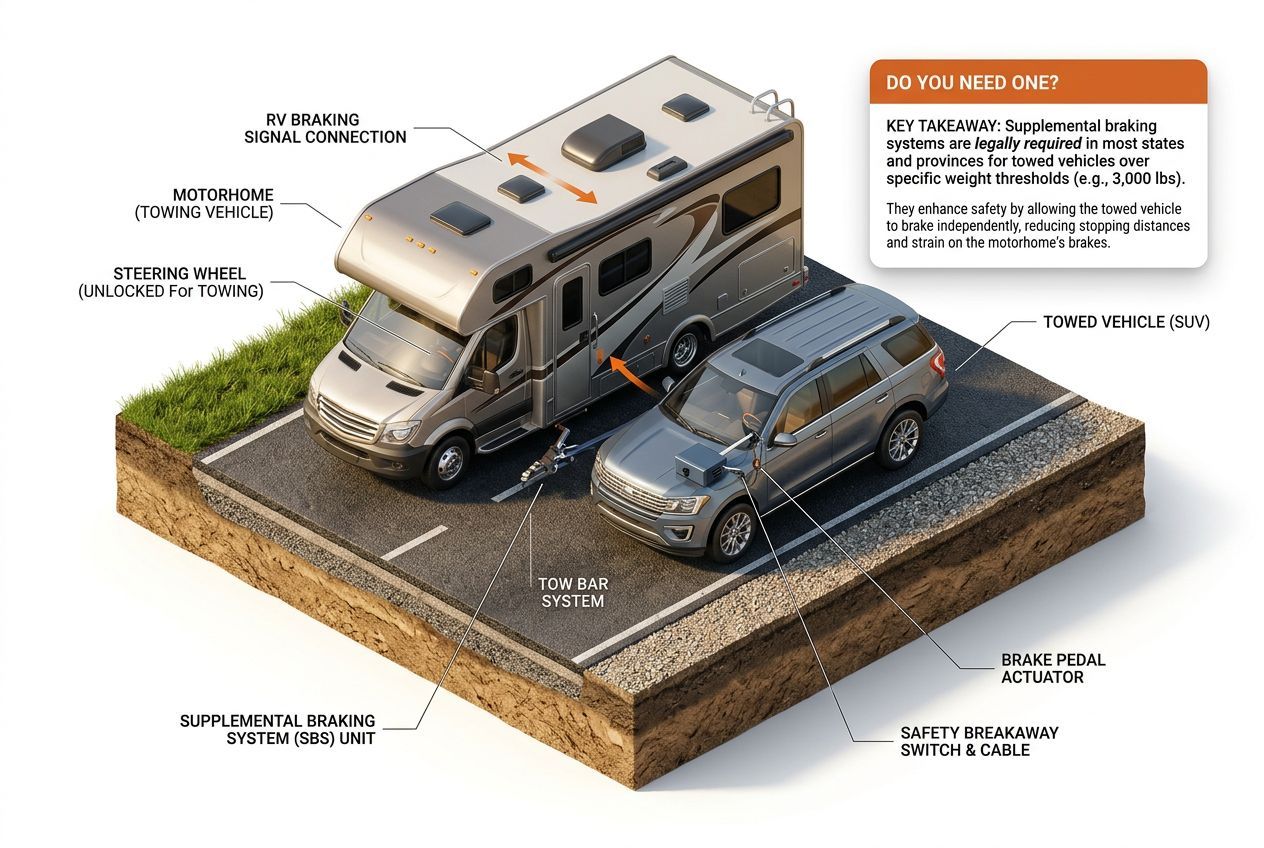
Detecting Deceleration: A supplemental braking system detects deceleration in the tow vehicle — either through an inertia sensor inside the towed vehicle or an electronic signal from the motorhome's brake controller — then applies proportional or preset force to the towed vehicle's brake pedal or brake line.
Proportional vs. Fixed-Force Systems
Proportional Systems: These systems read the motorhome's actual deceleration rate and apply matching brake pressure to the toad. Brake gently, and the system brakes gently. Brake hard, and it brakes hard. This produces smoother stops, less brake pad wear, and a more natural feel for the motorhome driver.
Fixed-Force (Time-Actuated) Systems: These systems apply a pre-set amount of braking force regardless of how hard the tow vehicle is stopping. They're simpler and less expensive but can cause jerky stops or insufficient braking in emergency situations.
The Role of a Breakaway Switch
Essential Safety Feature: Both types incorporate a breakaway switch — a cable-connected failsafe that triggers full brake application if the toad separates from the motorhome. Most systems activate the breakaway function in under one second. That's the difference between a runaway 4,000-lb Jeep and a stopped one.
💡 Key Takeaway: A breakaway switch is a separate but mandatory safety device that applies full braking if the towed vehicle detaches, preventing a potentially catastrophic runaway vehicle.
For a broader look at how towing dynamics affect safety, see our flat towing guide.
🛡️
DIY TOWING & FLAT TOWING
What Are the Different Types of Supplemental Braking Systems?
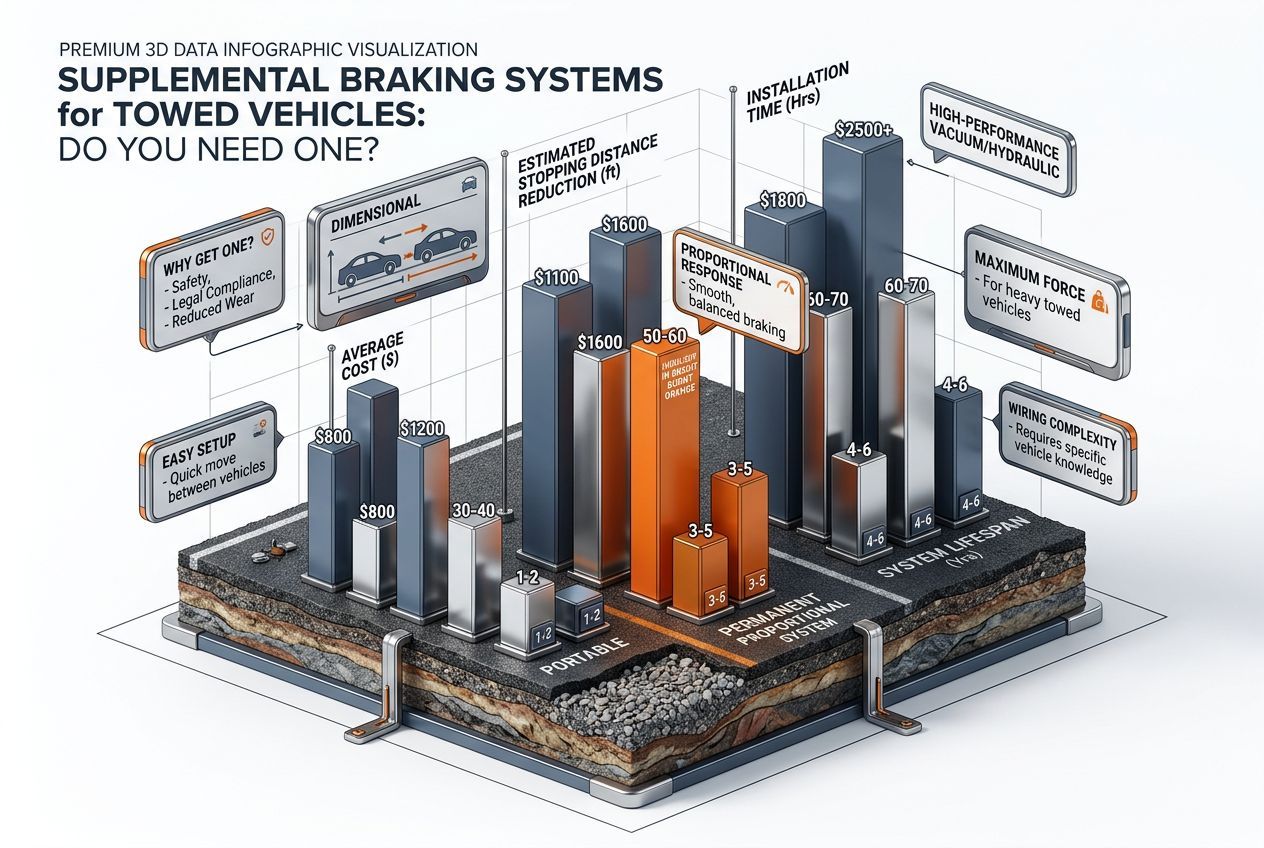
Supplemental braking systems fall into three main categories, each with distinct trade-offs in cost, convenience, and installation complexity.
Portable (Self-Contained) Systems
Flexible & Movable: These systems sit on the towed vehicle's driver-side floorboard, with an actuating arm attached to the brake pedal. The RVibrake 3 and Roadmaster's Even Brake are common examples.
- Setup: Takes 15–30 minutes per trip.
- Advantages: You can easily move the unit between multiple tow vehicles.
- Disadvantages: Requires setup every time, and precise placement is crucial for optimal performance.
Permanent/Fixed-Mount Systems
Set-and-Forget Convenience: These systems are hardwired into the towed vehicle and stay there. The Blue Ox InvisiBrake is the category standard.
- Operation: Mounts out of sight, activates automatically when you connect the tow bar, and requires zero driver interaction at setup. These are typically proportional systems.
- Installation: Takes 2–4 hours and involves wiring a control module, mounting a brake actuator, and integrating with the vehicle's brake pedal assembly.
- Benefit: Once installed, it's essentially invisible and always ready.
Direct-Connect (Electronic) Systems
Advanced Integration: These systems interface with the motorhome's brake controller via a dedicated wiring harness, giving the motorhome driver real-time brake status of the toad on a dashboard display. These systems offer the tightest integration but require compatible brake controllers on the motorhome side.
Choosing the Right Type: Selecting the best system depends on how many vehicles you tow, how often you swap toads, and whether you want a set-and-forget solution. Review our tow bar vs. tow dolly comparison for context on the full flat-towing setup.
📋
DIY TOWING & FLAT TOWING
How Much Does a Supplemental Braking System Cost?
How Much Does a Supplemental Braking System Cost? — data table
| System Type |
Unit Cost |
Installation Cost |
Best For |
| Portable (e.g., RVibrake 3) |
$900–$1,200 |
$0–$100 (DIY setup) |
Multi-vehicle households |
| Permanent proportional (e.g., InvisiBrake) |
$1,100–$1,500 |
$200–$500 (professional) |
Dedicated toad vehicles |
| Direct-connect electronic |
$1,400–$2,000 |
$300–$500 (professional) |
Premium Class A setups |
| Budget fixed-force portable |
$800–$950 |
$0–$75 |
Occasional towers |
Pricing based on manufacturer MSRP and installer averages as of early 2026. Confirm current pricing at point of purchase.
Professional Installation Considerations: Professional installation at an RV service center or towing shop typically runs $200–$500 for permanent systems. If you're handy with automotive wiring and have a basic socket set, the permanent systems are DIY-manageable — Blue Ox publishes detailed vehicle-specific installation guides.
✅ Pro Tip: While DIY installation can save money, if you're not confident with electrical work, pay for professional installation. A mis-wired system that doesn't activate in an emergency isn't a system at all.
Cost Savings vs. Brake Wear: Compare these costs to motorhome brake pad replacement: $500–$1,200 per axle at a shop, according to service industry averages. A Class A motorhome doing repeated hard stops from 65 mph with a 4,000-lb Jeep in tow will chew through pads significantly faster than one with a functioning supplemental braking system sharing the load.
💡 Key Takeaway: Investing in a supplemental braking system can extend the life of your motorhome's brake pads, potentially saving hundreds of dollars in replacement costs over time.
For a full picture of what flat towing costs, use our towing cost calculator.
⚙️
DIY TOWING & FLAT TOWING
Can You Flat Tow Without a Braking System?
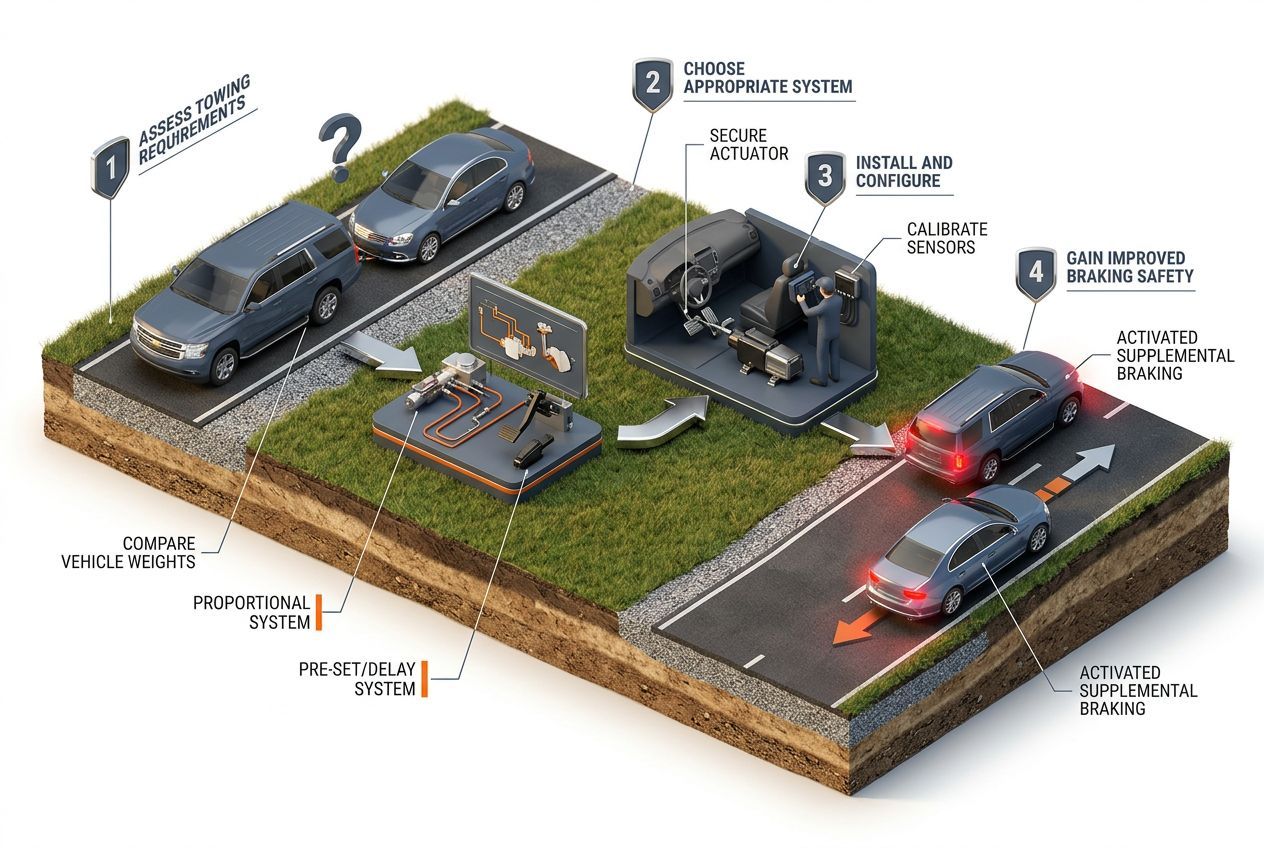
You can physically flat tow without a braking system, but it's illegal in most states, measurably dangerous, and a serious insurance liability. Here's the physics: a Class A motorhome at 30,000 lbs towing a 4,000-lb Jeep Wrangler has a combined weight of 34,000 lbs. At 60 mph, that rig's stopping distance increases by up to 40% compared to the motorhome alone — that's roughly 50–80 additional feet before you stop. On a mountain grade in Colorado or in stop-and-go traffic on I-95, those extra feet are the difference between a close call and a collision.
Insurance Liability: The insurance exposure is real and documented. Most liability policies contain language excluding coverage for illegal vehicle operation. If you're towing a 3,900-lb Jeep in Connecticut (where the threshold is 1,000 lbs) without supplemental brakes and you rear-end another vehicle, your insurer has grounds to deny the claim. You'd be personally liable for damages.
⚠️ Warning: Towing illegally without a supplemental braking system can void your liability insurance, leaving you personally responsible for all damages in an accident.
System Limitations: What a supplemental braking system won't do: It won't compensate for an improperly rated tow bar, a worn breakaway cable, or a towed vehicle with deferred brake maintenance. The NHTSA consistently notes that supplemental braking effectiveness depends on the towed vehicle's base braking system being in serviceable condition. If the Jeep's rotors are warped or the calipers are seized, the supplemental system has nothing good to work with.
✅ Pro Tip: Before flat towing, ensure your towed vehicle's brakes are in excellent working order. A supplemental system is only as effective as the underlying braking components.
For more on the mechanical side of safe flat towing, see our guide on towing with an automatic transmission.
🚛
DIY TOWING & FLAT TOWING
How Do You Install a Supplemental Braking System?
Portable System Installation
Simple Setup: Installing a portable system is straightforward.
- Place the unit on the driver-side floorboard with the actuating arm contacting the brake pedal at the correct angle (typically 90 degrees to the pedal face).
- Run the breakaway switch cable to the tow bar connection point.
- Sync the unit to the motorhome via Bluetooth or the provided wiring harness.
Most portable systems self-calibrate on the first tow. The whole process runs 15–30 minutes once you've done it once.
Permanent System Installation Workflow
More Involved Process: Permanent systems are more involved. Here's the general workflow for something like the InvisiBrake:
- Mount Control Module: Secure the control module under the dash (typically using two bolts and a pre-drilled bracket).
- Install Brake Pedal Actuator: Connect this component to the brake pedal arm mechanically or via a cable.
- Route Wiring Harness: Route and connect the 7-pin wiring harness to the tow bar umbilical.
- Set Sensitivity: Adjust the system's sensitivity (usually via a dial or app-based calibration).
- Test Activation: Test-activate the system by pressing the tow vehicle's brakes while stationary.
Vehicle-Specific Details: The full process takes 2–4 hours. Vehicle-specific quirks matter here. A Jeep Wrangler JL has more underdash space than a Chevy Equinox, so actuator bracket placement varies.
✅ Pro Tip: Blue Ox and Roadmaster both publish detailed vehicle-specific installation PDFs. Always pull the one for your exact toad before you start a permanent system installation.
If you're building out a full flat-tow setup from scratch, our DIY car trailer tips and tow hitch types guide cover the rest of the equipment chain. And once everything's installed, double-check your complete rig against our towing capacity guide to make sure your GCWR is in bounds.