🔧
RV & BOAT TOWING
What Equipment Do You Actually Need to Tow a Travel Trailer?
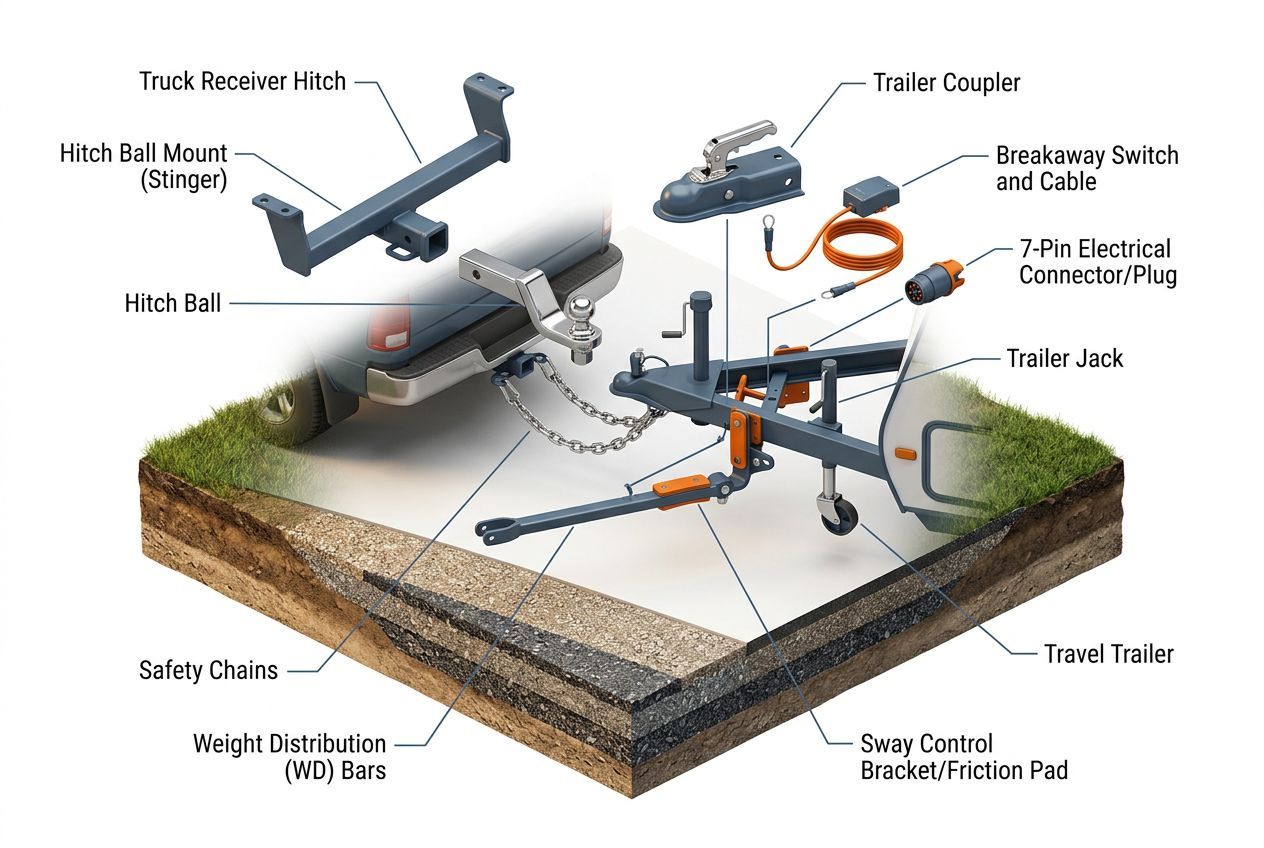
The essential towing equipment list includes several key components to ensure safety and stability:
- A properly rated hitch receiver.
- A weight distribution hitch (WDH) with integrated sway control.
- A trailer brake controller.
- Extended towing mirrors.
- Safety chains rated to the trailer's gross weight.
What Equipment Do You Actually Need to Tow a Travel Trailer? — data table
| Equipment |
What to Look For |
When It's Required |
| Hitch Receiver |
Class III (5,000 lb GTW) or Class IV (10,000 lb GTW) — rating stamped on receiver tube |
Always |
| Weight Distribution Hitch |
Andersen No-Sway or Equal-i-zer; rated to loaded trailer weight |
Trailers >50% of tow vehicle weight |
| Trailer Brake Controller |
Proportional type (Reese Towpower Pro, Tekonsha P3) preferred over time-delay |
Trailers with brakes (typically >3,000 lbs) |
| Towing Mirrors |
Clamp-on extenders (CIPA 11000 series) or factory tow mirrors |
Anytime trailer is wider than tow vehicle |
| Safety Chains |
Cross-connected, rated to full trailer GVWR |
All states — federal law |
Sources: FMCSA cargo securement regulations (49 CFR Part 393); hitch manufacturer specifications from Andersen Hitches and Equal-i-zer
The Class rating is stamped directly on the receiver tube near the pin hole — "Class IV" or "GTW 10,000." If you can't find it, the hitch receiver needs to be replaced before you tow anything.
✅ Pro Tip: Opt for a proportional trailer brake controller (e.g., Tekonsha Prodigy P3) over a time-delay unit. Proportional controllers sense your actual deceleration and apply trailer brakes accordingly, leading to smoother, safer stops and less wear.
Most first-timers skip the proportional brake controller and go with a basic time-delay unit to save $50. Don't. A proportional controller like the Tekonsha Prodigy P3 senses actual deceleration and applies trailer brakes in proportion — resulting in shorter, smoother stops and less wear on both axles. Our RV towing guide covers brake controller installation in detail.
🛡️
RV & BOAT TOWING
How Do You Prevent Travel Trailer Sway?
Trailer sway is the number-one fear for first-time towers, and it's preventable with proper setup. The root cause is almost always incorrect tongue weight — too light, and the trailer pivots freely; too heavy, and your tow vehicle's rear axle is overloaded. Tongue weight should sit between 10–15% of the trailer's total loaded weight, measured on a tongue weight scale after you've packed everything.
⚠️ Warning: Incorrect tongue weight is the leading cause of trailer sway. Too little tongue weight (under 10%) can make your trailer unstable and prone to dangerous fishtailing.
Prevention Checklist
- Tongue weight: Aim for 10–15% of the loaded trailer weight. Measure it accurately, don't estimate.
- Weight distribution hitch (WDH): This system levels both vehicles and transfers load back to the front axle, significantly reducing sway potential.
- Speed: NHTSA crash data links wind gusts over 30 mph with significant sway incidents; sustained speeds above 65 mph amplify the risk.
- Loading: Always place heavier items forward of the trailer axle and lighter items towards the rear.
If sway starts: ease off the accelerator. Don't brake. Don't counter-steer. Let the rig decelerate through engine drag, and the sway will typically dampen within 2–3 oscillations. Many modern brake controllers (and some trucks) have an integrated Trailer Sway Control (TSC) function that applies individual wheel brakes automatically — check whether your vehicle's stability system includes it.
✅ Pro Tip: If trailer sway begins, resist the urge to brake or counter-steer sharply. Instead, gently ease off the accelerator and allow the vehicle and trailer to slow down naturally, which often helps the sway to self-correct.
One honest caveat: no amount of equipment fully compensates for overloading or a tongue weight that's badly out of spec. A WDH with sway control is a tool, not a license to push the limits. Our travel trailer towing tips page has a full gear-selection walkthrough.
📋
RV & BOAT TOWING
What Speed Should You Drive When Towing a Travel Trailer?
Drive between 55–65 mph when towing a travel trailer. Most Special Trailer (ST) tires carry a maximum speed rating of 65 mph at their full load rating — exceed that and heat buildup accelerates dramatically, raising blowout risk. According to the California Vehicle Code (§22406), vehicles towing trailers are limited to 55 mph regardless of posted freeway speeds. Oregon and Indiana enforce similar limits. Texas, by contrast, allows towing at the posted speed limit — but that doesn't mean you should.
⚠️ Warning: Most ST (Special Trailer) tires are rated for a maximum speed of 65 mph. Exceeding this limit can cause dangerous heat buildup, leading to premature tire failure and blowouts. Always check state-specific towing speed limits.
📊 Quick Fact: Dropping your towing speed from 70 mph to 60 mph can improve your fuel economy by 8–12% due to significantly reduced aerodynamic drag.
Fuel economy drops 25–50% when towing, per Department of Energy estimates. Dropping from 70 mph to 60 mph can recover 8–12% of that loss just from reduced aerodynamic drag. Over a 500-mile trip with a 40-gallon diesel, that's real money.
Check towing-specific speed laws for every state on your route with our towing laws by state tool before departure. State rules vary more than most people expect. For a look at the full MPG impact, see our RV towing MPG breakdown.
⚙️
RV & BOAT TOWING
How Do You Back Up a Travel Trailer for the First Time?
Backing up a travel trailer requires counter-intuitive steering. Place your hand at the bottom of the steering wheel and move it in the direction you want the trailer's rear to go. Left hand movement sends the trailer left; right sends it right. This is the opposite of normal driving — and your brain will fight it until muscle memory kicks in.
Use the smallest steering inputs possible. A half-inch of hand movement translates to significant trailer arc over 30 feet. The moment the trailer starts jackknifing, pull forward and reset — there's no shame in it, and professionals do it too.
Practical Setup for Your First Attempt:
- Empty parking lot: Practice in a large, empty area with traffic cones marking a simulated campsite.
- Spotter: Have a spotter standing at the trailer's driver-rear corner, clearly visible in your mirror.
- Communication: Keep windows down so you can hear verbal cues from your spotter.
- Backup camera: Use a backup camera if equipped, but as a supplement, not a replacement for mirrors.
One thing backing up can't fix: a poorly set site. If the campsite requires a 90-degree precision back-in with trees on both sides, ask the camp host for a pull-through spot on your first trip. There's no pride in saving a back-in spot and losing a fender.
✅ Pro Tip: For your first few trips, prioritize ease of parking. Ask for pull-through campsites or wide, unobstructed back-in spots to build confidence before attempting complex maneuvers.
🚛
RV & BOAT TOWING
What Is a Pre-Trip Towing Checklist?
A pre-trip towing checklist is your last line of defense before the wheels roll. Run it in writing — not from memory — before every single departure. Experienced RV owners report a written checklist reduces forgotten steps by more than 80%.
💡 Key Takeaway: A written pre-trip checklist isn't optional; it's essential. Relying on memory significantly increases the risk of overlooking a critical safety step before departure.
Pre-Trip Checklist – Minimum Standard:
- Coupler: Ensure it's latched, locked, and the pin is securely inserted.
- Safety Chains: Verify they are cross-connected in an X-pattern under the coupler.
- Breakaway Cable: Confirm it's clipped to the tow vehicle (not the hitch ball).
- WDH Setup: Check that the WDH head is torqued and spring bars are properly seated.
- Trailer Tire Pressure: Inflate all trailer tires (including the spare) to the manufacturer's recommended cold PSI.
- Tow Vehicle Tire Pressure: Verify tow vehicle tires are inflated to the recommended PSI for towing.
- Trailer Brake Controller: Confirm it's verified and the gain is correctly set.
- All Lights: Test running lights, brake lights, turn signals, and reverse lights.
- Towing Mirrors: Adjust both sides for maximum visibility around the trailer.
- Interior Cargo: Ensure all interior cargo is secured, slides are retracted, and the refrigerator is latched.
- Tongue Jack: Fully retract and pin the tongue jack.
- Chocks & Blocks: Confirm wheel chocks are stored and leveling blocks are stowed.
Tire pressure deserves its own mention. ST trailer tires are often inflated to 50–80 PSI — significantly higher than passenger tires. Cold inflation matters: check them before the trailer has been in the sun for two hours, not after a 45-minute drive. Under-inflated ST tires overheat and fail catastrophically at highway speeds.
⚠️ Warning: Always check trailer tire pressure when tires are cold. Under-inflated ST (Special Trailer) tires can overheat rapidly at highway speeds, leading to catastrophic blowouts.
For pre-season trips after winter storage, a thorough inspection is crucial:
- Tire Sidewalls: Inspect for any signs of cracking or dry rot, even if the tread looks fine.
- Wheel Bearings: Grab each tire at 3 and 9 o'clock and push laterally; any movement means the bearings need professional attention before towing.
For cost planning on your first rig, see how much towing costs and use our RV boat tow estimator to budget the full trip. Our camper towing capacity guide covers specific vehicle-trailer matchups if you're still vehicle shopping. And if you're comparing tow vehicles, the best trucks for RV towing roundup is worth a read before you commit.