📊
RV & BOAT TOWING
What Type of Hitch Do You Need for a Boat Trailer?
For most recreational boats, you will need a Class III or Class IV receiver hitch with a 2-inch ball mount. The appropriate hitch class is determined by your trailer's Gross Trailer Weight (GTW), not solely by the truck's overall towing capacity.
What Type of Hitch Do You Need for a Boat Trailer? — data table
| Hitch Class |
Max GTW |
Max Tongue Weight |
Typical Use Case |
| Class II |
3,500 lbs |
350 lbs |
Small jon boats, kayak trailers |
| Class III |
8,000 lbs |
800 lbs |
Bass boats, small pontoons, ski boats |
| Class IV |
12,000 lbs |
1,200 lbs |
Large pontoons, center consoles, twin-engine rigs |
| Class V |
20,000 lbs |
2,000 lbs |
Heavy cabin cruisers, commercial rigs |
Source: CURT Manufacturing hitch classification standards; Draw-Tite product specifications.
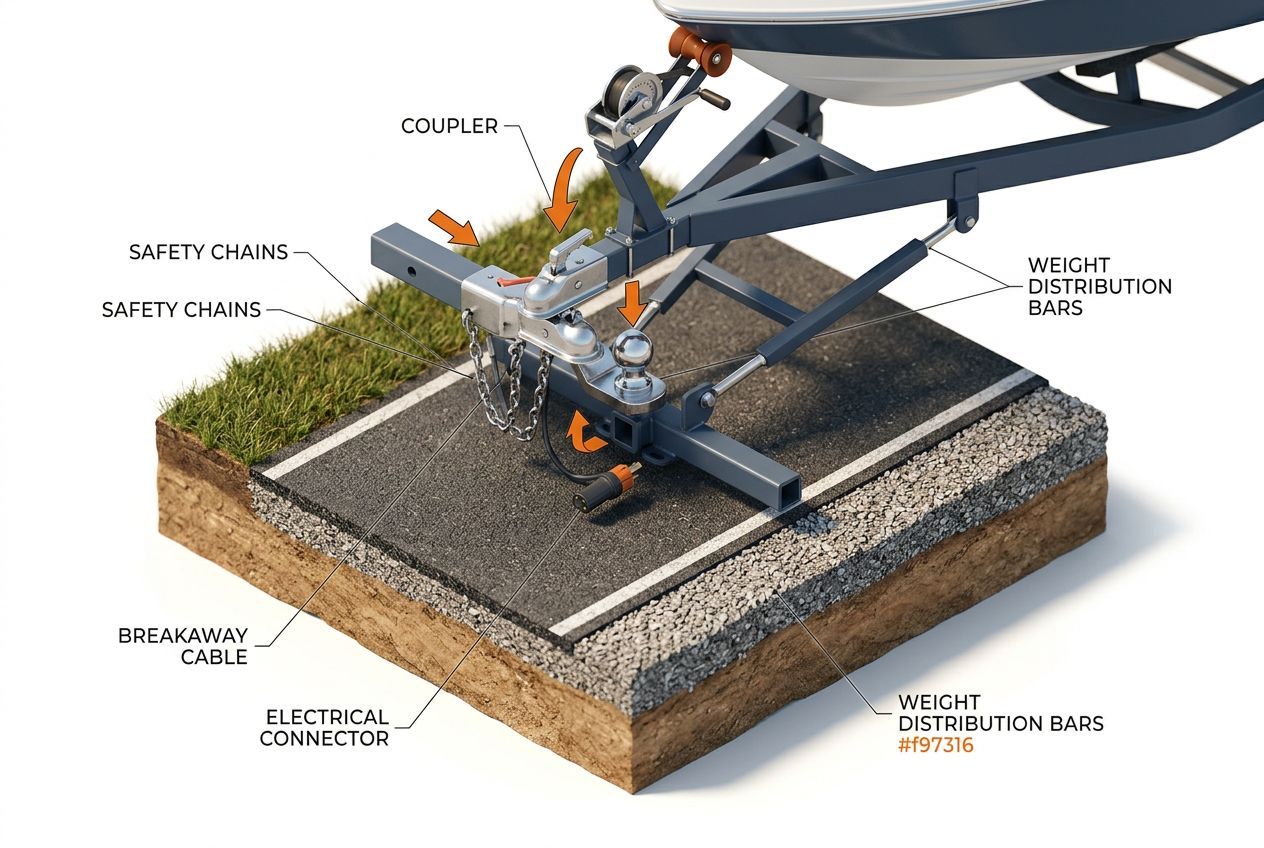
Verify your hitch rating. The rating is usually stamped directly on the receiver tube — look for "Class IV" or "GTW 10,000" near the pin hole. If that stamp is missing or illegible, it's crucial to replace the hitch before towing for safety.
Correct ball size is critical. Most boat trailers use a 1-7/8" or 2" ball. The correct size is always stamped on the coupler jaw. Using a mismatched ball is not only illegal but can cause the trailer to decouple at highway speeds, leading to extremely dangerous situations.
⚠️ Warning: A mismatched hitch ball and coupler can lead to catastrophic trailer detachment. Always verify the sizes are identical before connecting.
Weight distribution hitches (WDH) add a spring-arm system that redistributes tongue weight across all four axles of the tow vehicle. They're recommended when your loaded trailer exceeds 50% of the tow vehicle's curb weight, or when you notice the truck's rear squatting significantly and headlights tilting skyward. That said, most boat trailers don't require a WDH unless you're in the heavy center-console or large cabin cruiser category. Check our full boat towing guide for hitch setup photos and adjustment steps.
Understanding trailer brakes. Trailers over 3,000 lbs are required to have trailer brakes in most states. Boat trailers commonly use surge brakes — a hydraulic system that activates automatically when the trailer pushes against the hitch ball during deceleration. No separate controller is needed in the cab. Electric brakes, on the other hand, require a brake controller mounted in the cab (Tekonsha P3 or Redarc Tow-Pro are popular picks) to modulate braking force. Verify which system your trailer uses before wiring.
🔧
RV & BOAT TOWING
How Do You Tow a Boat for the First Time?
For first-time boat towers, your two biggest challenges will likely be wide turns and backing. Both are skills that can be mastered with 20 minutes of practice in an empty parking lot before you ever get near a boat ramp.
A Worked First-Timer Scenario
Let's consider a practical example:
- You're towing a 19-foot bass boat on a 22-foot single-axle trailer.
- Total loaded weight: 4,800 lbs.
- Tongue weight at 12%: 576 lbs.
- You're driving a Ram 1500 with a 1,760-lb payload capacity.
- Add the driver (195 lbs), a passenger (160 lbs), and tackle/coolers in the cab (120 lbs).
- That's 1,051 lbs of cargo against 1,760 lbs of payload capacity — you're at 60%, which is fine.
- Now, add the 576-lb tongue weight: 1,051 lbs (cargo) + 576 lbs (tongue weight) = 1,627 lbs total against your 1,760-lb payload.
- You have 133 lbs of margin. That's tight — so don't add a full-size spare in the truck bed, and you're good.
✅ Pro Tip: Use our payload calculator to run your own numbers before loading up. Never guess your payload!
Key First-Trip Habits
- Adjust your mirrors: You need to see the full length of your trailer. Towing mirrors that extend 3–4 inches past your standard glass are required in most states for trailers wider than the tow vehicle.
⚠️ Warning: According to AAA, inadequate mirror coverage is a leading cause of lane-change incidents while towing.
- Increase following distance: Extend your following distance to 4–6 seconds.
📊 Quick Fact: Per AAA data, braking distance increases 20–40% when towing a loaded trailer versus driving unladen.
- Make wide turns: Always make turns wider than you think necessary. The trailer's wheels track inside your truck's path — clip a curb, and you can pop a trailer tire or bend the tongue.
- Pre-plan fuel stops: Choose stations with pull-through lanes. Backing out of a standard pump island with a 22-foot trailer behind you is a stressful way to end your first trip.
For a deeper look at trailer handling fundamentals, our travel trailer towing tips article covers the same physics in more detail.
🛡️
RV & BOAT TOWING
How Fast Can You Drive While Towing a Boat?
Maintain a conservative speed. Stay at or below 60 mph, regardless of posted limits, unless you know your state's specific towing speed law. Most states cap towing speeds for vehicles with trailers at 55–65 mph, and several enforce separate limits even on 70+ mph interstates.
State-specific speed limits:
- Per the California Vehicle Code (§22406), vehicles towing trailers are limited to 55 mph on freeways regardless of the posted limit.
- Texas imposes no separate towing speed restriction — you can tow at the posted limit.
- Washington caps trailer towing at 60 mph.
✅ Pro Tip: Check our towing laws by state tool before any multi-state haul to avoid unexpected fines.
Mitigate trailer sway. Beyond legal limits, trailer sway becomes exponentially harder to control above 60 mph. Boat trailers are particularly sway-prone because the load is often heavy at the stern (motor) and relatively light at the bow — the opposite of ideal weight distribution. If sway starts, do not brake hard. Instead, ease off the throttle and let the truck slow naturally.
Monitor tire heat. Tire heat is another limiting factor. ST-rated trailer tires (marked "ST" on the sidewall) are typically designed for sustained loads at 65 mph. Running them at 75+ mph for hours degrades the sidewall and can void the tire manufacturer's warranty. Most ST trailer tires specify 50–65 PSI — always check cold pressure before departure, not after 30 miles of highway driving.
📋
RV & BOAT TOWING
Do You Need a Special License to Tow a Boat?
For most recreational boat trailer towing, no special license is required in the U.S. This holds true provided your Gross Combined Weight Rating (GCWR) stays under 26,001 lbs.
📊 Quick Fact: Per FMCSA regulations, the 26,001-lb GCWR threshold is the federal line that triggers commercial driver's license (CDL) requirements. For personal towing, a standard Class C driver's license covers you in the vast majority of situations.
Exceptions to Standard Licensing
- California: Trailers with a GVWR (Gross Vehicle Weight Rating) over 10,000 lbs require a Class A or B non-commercial license.
- Maryland and New York: These states have specific endorsement and trailer registration rules based on weight thresholds — always verify current requirements with your state DMV.
Always carry your documentation. Ensure you have your trailer's registration, the boat's registration or title, and proof of insurance for both. Some states require the boat's registration to be onboard the vessel, not in the glove box of the tow vehicle.
⚙️
RV & BOAT TOWING
How Do You Launch and Retrieve a Boat at a Ramp?
Efficient launch preparation happens entirely in the staging area, not at the water's edge. Every minute you spend at the top of the ramp with other boaters waiting creates friction and is easily avoidable with proper pre-planning.
Before You Back Down the Ramp
- Remove tie-down straps: Take off all tie-down straps. Leave the bow winch strap on until the boat is floating.
- Install the drain plug: This is a non-negotiable step; forgetting it will quickly ruin your day.
- Load essentials: Place coolers, fishing rods, safety equipment, and life jackets onto the boat.
- Attach dock lines: Connect dock lines to both the bow and stern of the boat.
- Perform pre-launch checks: Power on the bilge, electronics, and confirm the engine starts before you block the ramp.
Backing Down and Launching
- Submerge the trailer: Back until the lower third of the bunks or rollers is submerged. This typically occurs when the trailer tongue is at the waterline.
- Release the boat: Release the winch strap, then gently push or motor the boat off the trailer.
- Clear the ramp: Pull your tow vehicle and trailer forward immediately and move to the courtesy dock or parking area.
Retrieval Process
- Straighten the trailer: Pull forward enough to straighten the trailer before reversing into the water.
- Submerge bunks: Back the trailer until the bunks are fully submerged.
- Drive onto trailer: Drive the boat onto the trailer at idle speed — avoid using excessive momentum.
- Secure bow strap: Attach the bow winch strap before pulling forward.
- Post-retrieval staging: Pull completely clear of the ramp, then secure all straps, kill electronics, and re-check the drain plug in the staging area.
⚠️ Warning: Wet ramps with algae growth are more slippery than they look. Per NHTSA, steep ramp angles combined with wet surfaces create extraction loads up to 30% higher than flat dry-weight figures suggest. Use 4WD or AWD for retrieval if your truck has it — even a light truck can lose traction on a 15% grade with a soaked ramp surface.
🚛
RV & BOAT TOWING
What Safety Checks Should You Do Before Towing a Boat?
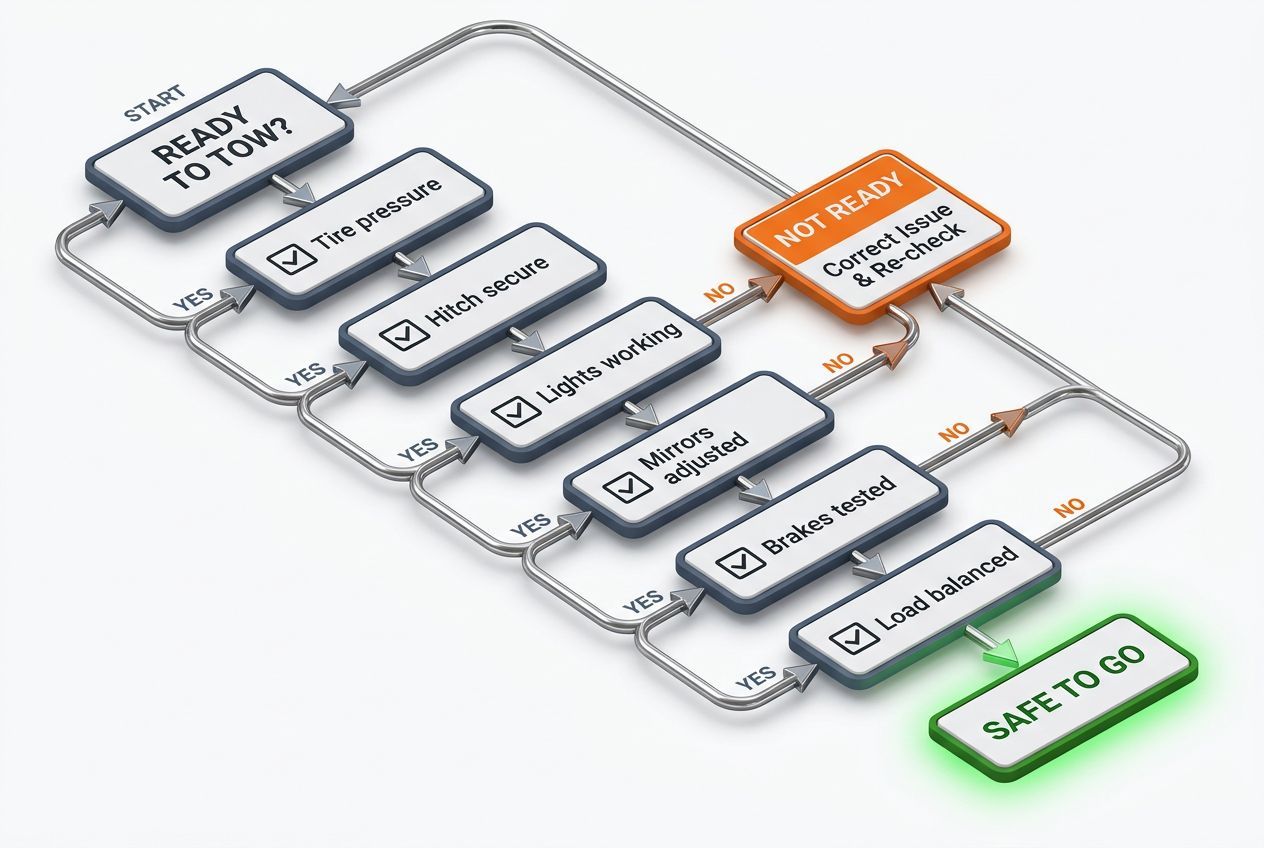
Always run a thorough safety checklist before every single trip. Vibration during transit can loosen connections that were perfectly tight when you initially hooked up, making these checks critical for safe travel.
7-Point Pre-Tow Checklist
- Coupler lock: Verify the hitch ball is fully seated, and the coupler latch is closed and securely locked with a hitch pin or padlock.
- Safety chains: Ensure safety chains are crossed in an X pattern beneath the trailer tongue — crossed chains will cradle the tongue if the coupler separates.
- Trailer lights: Plug in the 4-pin or 7-pin connector and, with a helper, verify running lights, brake lights, and turn signals are all functional.
- Tire pressure: Check all trailer tires cold using a gauge — ST trailer tires typically run 50–65 PSI per their sidewall specification. Do not eyeball it.
- Lug nuts: Torque lug nuts to spec after the first 50 miles on a new trailer and after any tire change. Standard trailer lug nuts typically spec at 90–120 ft-lbs.
- Bow and transom straps: Confirm the boat has at least two points of securement beyond the winch strap (e.g., transom tie-downs).
- Mirror visibility: From the driver's seat, you should clearly see the rear corners of the trailer. Adjust mirrors or add extenders as needed.
Don't forget the brakes. Also verify your trailer brake lights activate when you press the brake pedal — not just your truck's lights. If you have electric brakes, confirm the brake controller display shows a valid reading before the tow vehicle moves.
Our complete RV towing guide covers the same pre-trip logic for larger trailer setups, and the tow vehicle matchmaker tool can cross-check your full rig configuration.