Key Takeaways
- Tow bars require a manufacturer-approved flat-tow vehicle and base plate installation, but they're lighter and cheaper to maintain long-term.
- Tow dollies work with most front-wheel-drive cars but add 400–600 lbs, require ongoing tire and bearing maintenance, and need separate registration in many states.
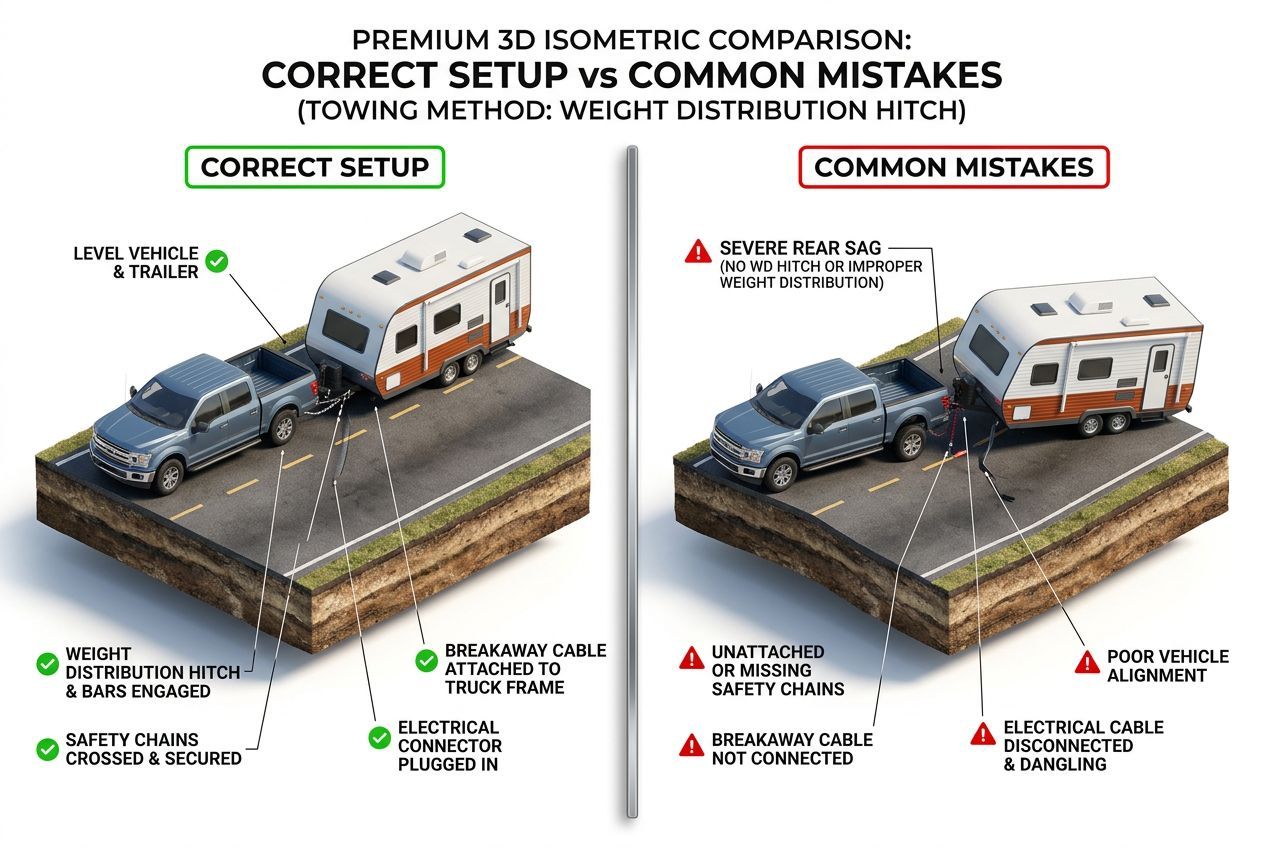
- Neither method is inherently safer — proper setup, tongue weight, safety cables, and a supplemental braking system matter far more than which method you choose.
- Most U.S. states legally require a supplemental braking system once the towed load exceeds 1,500–3,000 lbs, so budget for one regardless of which option you pick.
- For long trips in mountain states, tow bars are generally preferred for their weight savings and shorter overall rig length.
💰
DIY TOWING & FLAT TOWING
What Is the Difference Between a Tow Bar and a Tow Dolly?
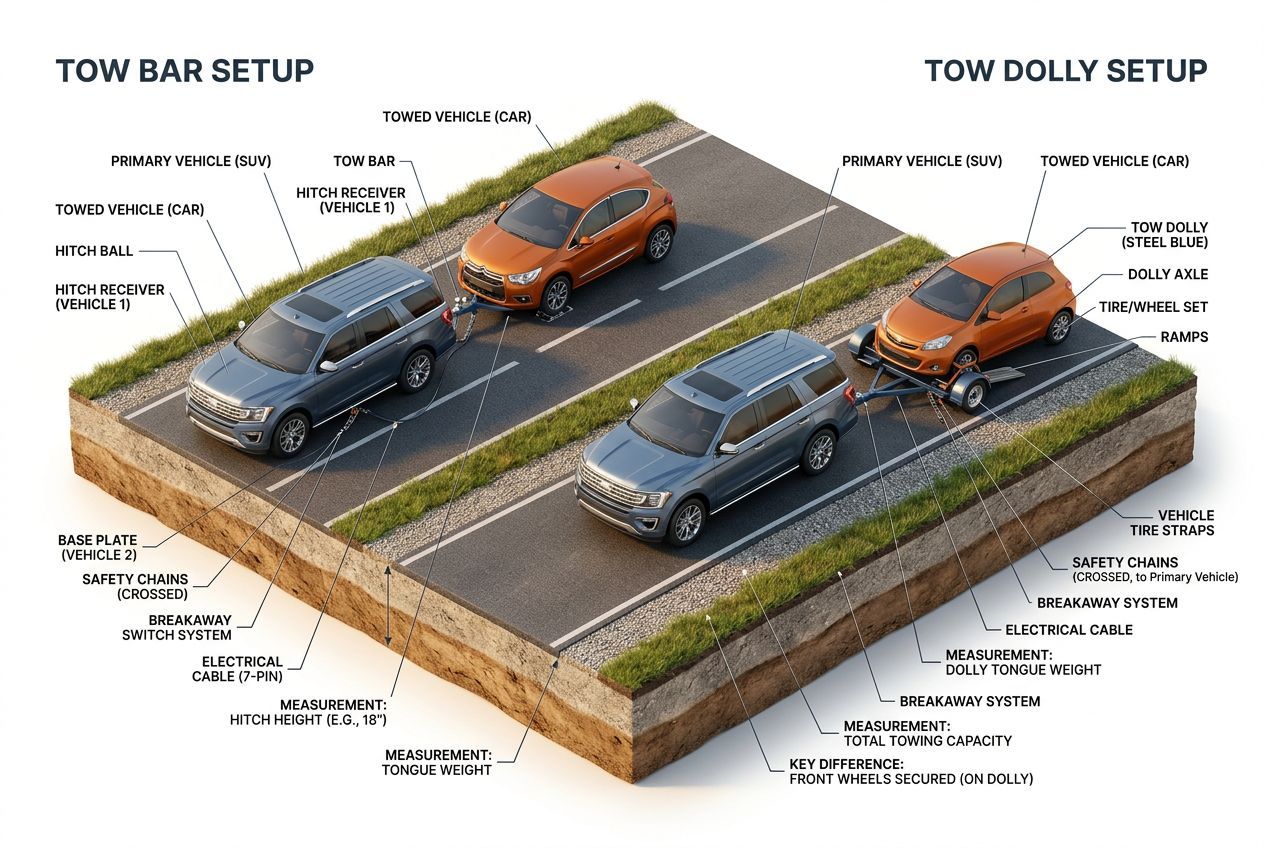
Understanding the Core Distinction: A tow bar is a rigid or self-aligning hitch that connects a towed vehicle — commonly called a "toad" or dinghy — directly to the rear hitch of a motorhome so all four wheels stay on the road. A tow dolly is a small two-wheeled trailer that cradles the front wheels of the towed car while the rear wheels roll on the pavement. The fundamental difference is ground contact and what it demands from your vehicle's drivetrain.
Tow bars typically use a self-aligning A-frame design (like the Blue Ox Aventa LX or Roadmaster Falcon) that locks rigid once the rig straightens out. They weigh just 30–60 lbs and connect to steel base plates that bolt directly to the towed vehicle's frame. Tow dollies — with brands like Demco and Master Tow dominating the market — weigh 400–600 lbs on their own and have their own tires, lights, and sometimes integrated braking.
The method you pick here cascades into every other decision: vehicle compatibility, storage, registration costs, and long-term maintenance. If you're still figuring out which vehicles even qualify for each method, our flat tow compatible vehicles guide breaks down the current manufacturer-approved list.
What Is the Difference Between a Tow Bar and a Tow Dolly? — data table
| Feature |
Tow Bar |
Tow Dolly |
| Ground Contact |
All four wheels on pavement |
Front wheels lifted, rear wheels on pavement |
| Equipment Weight |
30–60 lbs (bar only) |
400–600 lbs (dolly itself) |
| Vehicle Type |
Manufacturer-approved flat-tow vehicles |
Most FWD cars < 4,500 lbs (some exceptions) |
| Drivetrain Compatibility |
Specific configurations (often MT, or AT with pump/disconnect) |
FWD only; generally NOT for AWD/4WD/RWD |
| Setup Hardware |
Base plates, wiring harness, safety cables |
Straps, chains, safety cables (dolly provides lights) |
| Overall Length |
Shorter rig length |
Longer rig length |
| Storage |
Compact, often folds/stores on motorhome |
Bulky, needs separate storage or towing |
| Registration |
Usually none for towed vehicle |
Required in many states (dolly is a separate trailer) |
| Maintenance |
Minimal (cables, base plates) |
Tires, wheel bearings, lights (for dolly) |
📊
DIY TOWING & FLAT TOWING
Is a Tow Bar or Tow Dolly Better for Long-Distance RV Travel?
For extended journeys, a tow bar generally offers superior advantages. It reduces the overall weight of your rig, significantly shortens its total length compared to a dolly setup, and eliminates the logistical hassle of finding a place to store or tow a bulky dolly once you've reached your campsite. Additionally, tow dollies can sometimes lead to uneven front tire wear on the towed vehicle because those tires are spinning on a static platform, an issue that is entirely avoided when all four wheels roll normally under a tow bar.
💡 Key Takeaway: Tow bars typically offer advantages for long-distance travel due to less added weight, shorter overall rig length, and easier storage at camp.
That said, a tow dolly remains the right call when your vehicle isn't rated for four-wheels-down towing and a full car trailer isn't practical for your trip. If you're a snowbird doing a straight shot from Ohio to Florida every November, a well-maintained dolly setup gets the job done reliably.
When tackling mountainous terrain, tow bars further demonstrate their superiority. At altitudes above 5,000 feet, naturally aspirated engines lose roughly 3% power per 1,000 feet of elevation gain. The last thing you want is an extra 500 lbs of dolly dragging behind you on a 7% grade outside Vail, further straining your motorhome's capabilities.
📊 Quick Fact: Naturally aspirated engines lose approximately 3% of their power for every 1,000 feet of elevation gained above 5,000 feet.
🔧
DIY TOWING & FLAT TOWING
Can You Use a Tow Dolly with Any Vehicle?
Tow dollies are not universally compatible with all vehicles. While they work with most front-wheel-drive vehicles under approximately 4,500 lbs, all-wheel-drive (AWD) and four-wheel-drive (4WD) vehicles are typically incompatible. When the rear wheels remain on the ground without engine power flowing through the drivetrain, you risk severe damage to transfer cases and rear differentials. Some newer AWD systems can sustain damage in under 50 miles of dolly towing.
⚠️ Warning: Never tow AWD or 4WD vehicles on a standard tow dolly without explicit manufacturer approval. Doing so can cause irreparable damage to the drivetrain in a very short distance.
Rear-wheel-drive vehicles also generally cannot use a standard tow dolly. Lifting only the drive wheels leaves the rear differential spinning without proper lubrication, leading to potential damage. Always check the door-jamb sticker on the driver-side B-pillar for your vehicle's Gross Vehicle Weight Rating (GVWR), then cross-reference your owner's manual towing supplement specifically — not just the main manual — for dolly approval and any speed or distance caps.
✅ Pro Tip: Always consult your vehicle's specific towing supplement, not just the general owner's manual, for definitive guidance on tow dolly compatibility, especially for AWD, 4WD, or RWD models.
A real-world scenario: Say you own a 2023 Honda CR-V with the standard AWD system. The owner's manual explicitly prohibits dolly towing. Your options are a flat-tow setup (if Honda approves it for that trim), a full trailer with all four wheels on the deck, or swapping to a front-wheel-drive vehicle that's dolly-compatible. There's no workaround. Use the flat tow checker tool to confirm your specific model before purchasing anything.
🛡️
DIY TOWING & FLAT TOWING
Do You Need a Special Vehicle to Use a Tow Bar?
Yes, flat towing with a tow bar requires a vehicle that the manufacturer has explicitly approved for four-wheels-down towing. Roughly 80–100 models make the approved list each model year, according to annual compilations published by outlets like MotorHome Magazine, but many popular vehicles are absent entirely. Manual transmission vehicles are typically easier to approve; automatics are trickier because most require a lubrication pump or driveshaft disconnect to protect the transmission while the engine isn't running.
💡 Key Takeaway: Tow bars can only be used with vehicles specifically approved by their manufacturer for "four-wheels-down" or "flat" towing.
Our guide to towing with an automatic transmission covers exactly which systems need extra hardware and which are genuinely dinghy-ready from the factory.
Essential Components for a Tow Bar Setup
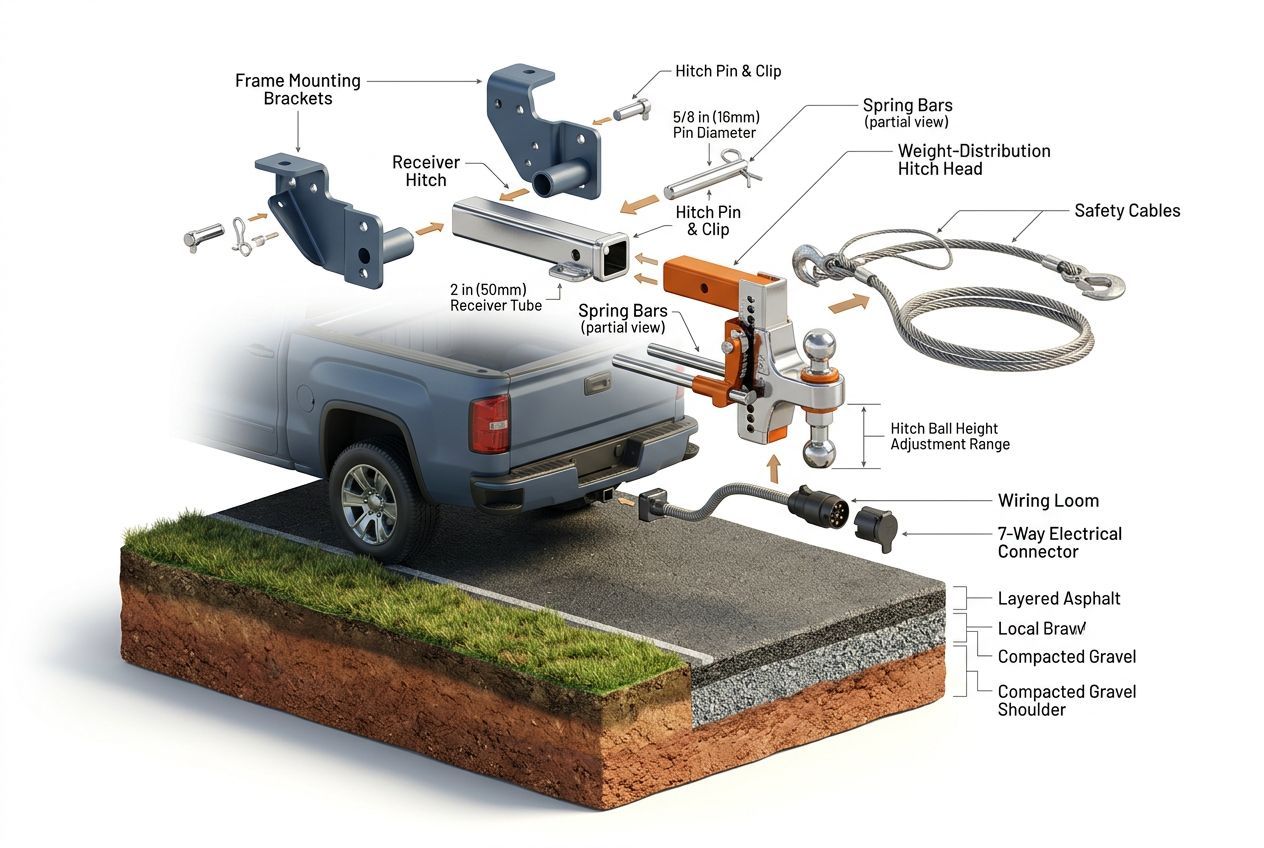
Beyond vehicle approval, a tow bar setup requires several key components:
- Base plates bolted to the towed vehicle's frame (not the bumper) — budget $300–$500 for parts, plus 2–4 hours of professional installation time.
- A wiring harness to run brake lights and turn signals to the toad.
- Safety cables rated to hold the full weight of the towed vehicle.
- A supplemental braking system (legally required in most states above 1,500–3,000 lbs).
If you're new to base plate installation, read through our complete flat towing guide before booking a shop appointment — knowing what to ask saves money.
📋
DIY TOWING & FLAT TOWING
How Much Does a Tow Bar Cost Compared to a Tow Dolly?
Here's a side-by-side cost breakdown based on current manufacturer MSRP and installer estimates:
How Much Does a Tow Bar Cost Compared to a Tow Dolly? — data table
| Cost Category |
Tow Bar Setup |
Tow Dolly Setup |
| Equipment purchase |
$800–$2,500 |
$1,000–$3,500 |
| Vehicle modification (base plates + wiring) |
$400–$1,300 |
None required |
| Professional installation |
$200–$500 |
$0–$150 (lights check) |
| Total upfront cost |
$1,400–$4,300 |
$1,000–$3,650 |
| Annual registration (varies by state) |
Usually none |
$30–$150 (FL, TX, CA, PA) |
| Tire replacement interval |
N/A (toad's existing tires) |
Every 15,000–25,000 miles |
| Supplemental braking (both) |
$800–$1,500 |
$800–$1,500 |
Sources: Blue Ox, Roadmaster, Demco manufacturer MSRP; state DOT registration schedules
While tow dollies may appear cheaper initially, the long-term math often shifts. States like Florida, Texas, California, and Pennsylvania require separate registration for tow dollies — adding $30–$150 per year. Dolly tires also need replacement every 15,000–25,000 miles (roughly $150–$250 per set), and wheel bearings require annual greasing or replacement. A tow bar, once installed, has minimal recurring costs beyond routine safety cable inspection.
📊 Quick Fact: Several states, including Florida, Texas, California, and Pennsylvania, require separate annual registration for tow dollies, adding $30–$150 to your yearly towing expenses.
Use our towing cost calculator to run a five-year total cost comparison specific to your state and usage habits.
⚙️
DIY TOWING & FLAT TOWING
Should You Use a Tow Bar or Tow Dolly for Your Setup?
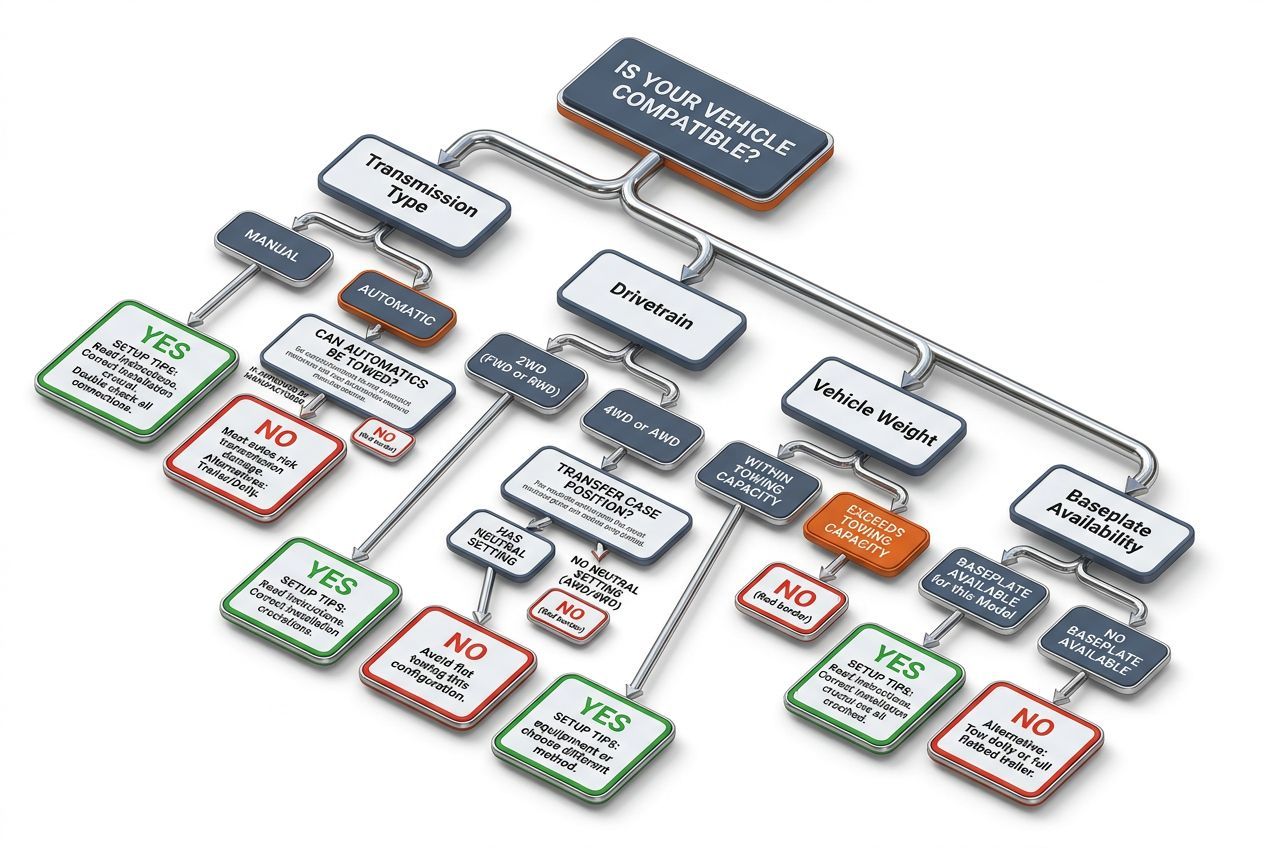
The honest answer is: it depends on your toad vehicle's specifications, not merely your preference. Run through this decision tree to determine the best option for your setup:
- Is your vehicle manufacturer-approved for flat towing? If yes, a tow bar is almost always the better long-term investment. If no, skip to step 2.
- Is your vehicle front-wheel-drive under 4,500 lbs? If yes, a tow dolly is a practical option. If no — AWD, RWD, or too heavy — you likely need a full trailer setup.
- How far are you traveling? For weekend trips under 500 miles, either can work. For cross-country seasons, tow bars generally win on simplicity and rig manageability.
Use the tool below to get a personalized recommendation based on your motorhome, toad vehicle, and travel style.
Choosing the right tow vehicle pairing takes more than a gut check — the tool below factors in your specific setup details to give you a clear match.