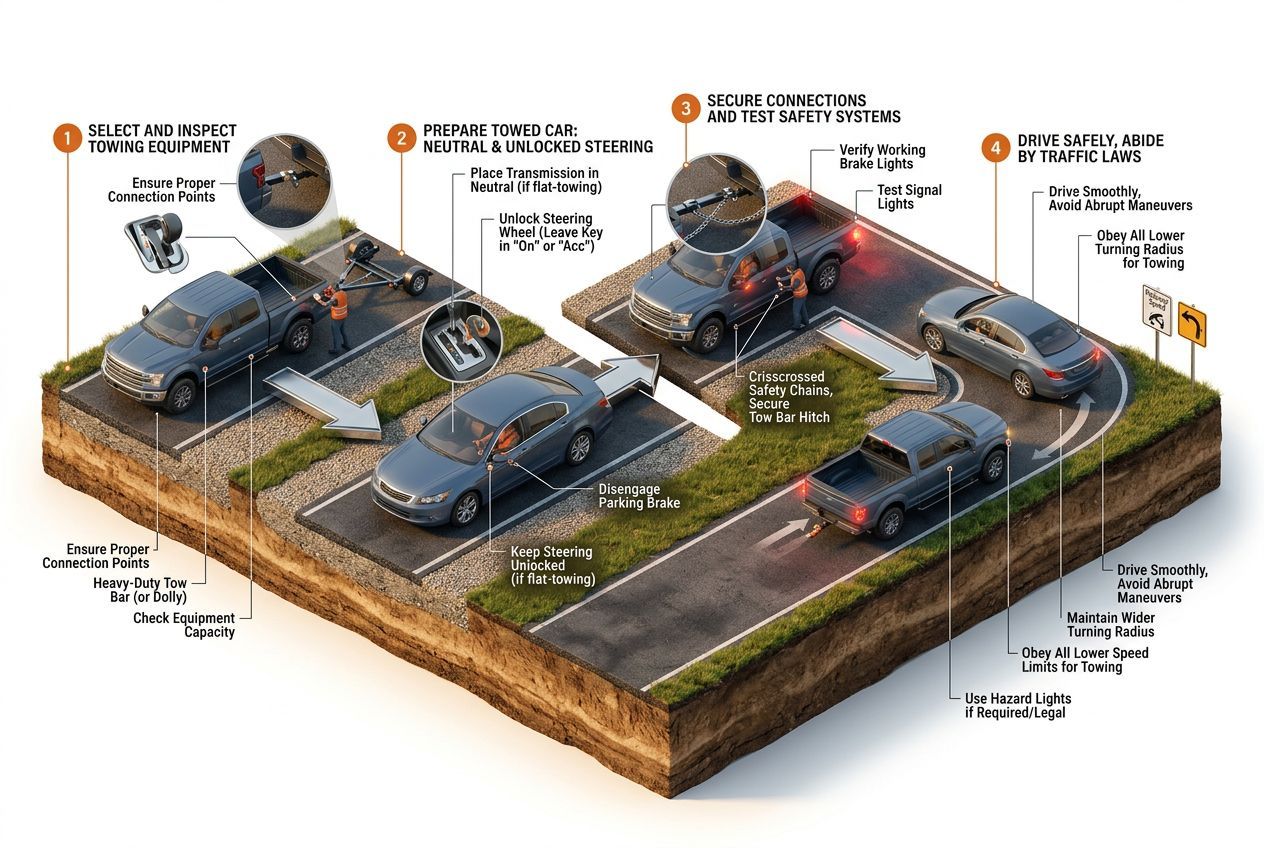
Key Takeaways
- A Class III or IV hitch receiver, ball mount, safety chains, trailer lights, and ratchet straps are the minimum equipment required before you tow anything
- Flatbed trailers are the safest method for any drivetrain; tow dollies work for FWD vehicles; flat towing requires explicit manufacturer approval for the towed car
- Never rely on the sticker number alone — subtract your truck's actual curb weight, passengers, and cargo from its GCWR to find your real remaining tow budget
- Supplemental braking systems are legally required in most states when the towed vehicle exceeds 1,500–3,000 lbs
- DIY towing typically saves $300–$800 over professional transport on moves longer than 100 miles
💰
DIY TOWING & FLAT TOWING
What Do You Need to Tow a Car with a Truck?
Towing a car with a truck requires a compatible hitch receiver (Class III or IV), a ball mount matched to your trailer coupler, safety chains rated at 2× the gross trailer weight, a tow dolly or flatbed trailer, a 4- or 7-pin wiring harness for trailer lights, and ratchet straps or wheel nets to secure all four tires. In most states, a supplemental braking system is also legally required once the towed load crosses 1,500–3,000 lbs.

The Equipment Checklist in Detail
Hitch Receiver: Check the rating stamped directly on the receiver tube near the pin hole — look for "Class III" (5,000-lb GTW) or "Class IV" (10,000-lb GTW). The class rating must meet or exceed the combined weight of the towed car and trailer.
⚠️ Warning: Never assume your truck has the correct hitch class; verify the rating stamped directly on the receiver tube, as many come from the factory with a Class II receiver unless a tow package was ordered.
Ball Mount and Coupler: The three common hitch ball sizes are 1-7/8", 2", and 2-5/16". Tow dollies almost universally use a 2" ball, while flatbed car trailers often use 2-5/16".
⚠️ Warning: Mismatching the ball to the coupler is one of the most common pre-trip errors. The coupler may latch but won't seat correctly, creating a serious risk of trailer separation at speed.
Safety Chains: Cross them under the coupler in an X pattern with enough slack to turn but not enough to drag. Per standard hitch manufacturer guidelines, chains must be rated at a minimum of 2× the gross trailer weight. For example, if you're towing a 3,500-lb car on a 1,000-lb trailer, your chains need to be rated for at least 9,000 lbs combined.
✅ Pro Tip: Crossing safety chains in an "X" pattern under the coupler provides an extra layer of security, catching the trailer tongue if it accidentally detaches from the hitch.
Trailer Lighting: All 50 states require functioning brake lights and tail lights on the towed unit, per federal FMCSA cargo and trailer regulations at fmcsa.dot.gov. A 4-pin flat connector covers basic stop/turn/tail functions. If your trailer has electric brakes, you'll need a 7-pin round connector and a brake controller mounted in the cab.
Tie-Down Straps and Wheel Nets: Ratchet straps should run from the trailer's D-rings to the towed vehicle's frame or designated tie-down points.
⚠️ Warning: Never hook tie-down straps to a suspension component or plastic body panel, as this can cause damage or lead to an insecure load.
For flatbed trailers, a four-point tie-down system with straps rated at 3,300 lbs each is the baseline. Wheel nets, which grip the tire sidewall, are often easier for DIYers to attach correctly.
📊
DIY TOWING & FLAT TOWING
Can You Tow a Car with a Pickup Truck?
Most half-ton and larger pickup trucks can tow a standard passenger car when properly equipped. A typical midsize sedan weighs 3,000–3,500 lbs. Add a tow dolly (750–1,200 lbs) or a flatbed car trailer (1,800–2,900 lbs), and your combined load lands between 4,200 and 6,400 lbs — well within the rated capacity of most half-ton trucks. The crucial caveat is that the max tow rating printed in the brochure only applies when the truck was ordered with the factory tow package.
On Ford trucks, for instance, that's the Class IV Trailer Tow Package (option code 53B on recent F-150s), which adds a transmission oil cooler, upgraded radiator, 7-pin wiring harness, and heavy-duty flasher relay. Without it, that advertised ceiling doesn't apply to your truck.
💡 Key Takeaway: The advertised max tow rating is often only valid if your truck was equipped with a factory tow package. Always verify your specific configuration using the window sticker or the door-jamb label.
When a Half-Ton Hits Its Ceiling
Half-Ton Limitations: While a half-ton truck like an F-150 can tow many passenger cars, its capabilities have a ceiling. The F-150 tops out at 9,900 lbs in its highest-rated configuration, which is sufficient for most passenger vehicles.
📊 Quick Fact: A typical midsize sedan weighs 3,000–3,500 lbs, while larger SUVs can range from 5,500–6,000 lbs.
When to Upgrade: If you're moving a larger SUV weighing 5,500 lbs on a 2,500-lb flatbed, your combined load is 8,000 lbs — and that's before accounting for tongue weight eating into payload. This pushes many half-ton trucks to their absolute limit. For a heavier tow setup (e.g., a loaded Suburban on a gooseneck), you will step outside half-ton territory entirely and need a 3/4-ton truck like an F-250, Silverado 2500HD, or RAM 2500 at minimum.
🔧
DIY TOWING & FLAT TOWING
What Are the Different Methods to Tow a Car with a Truck?
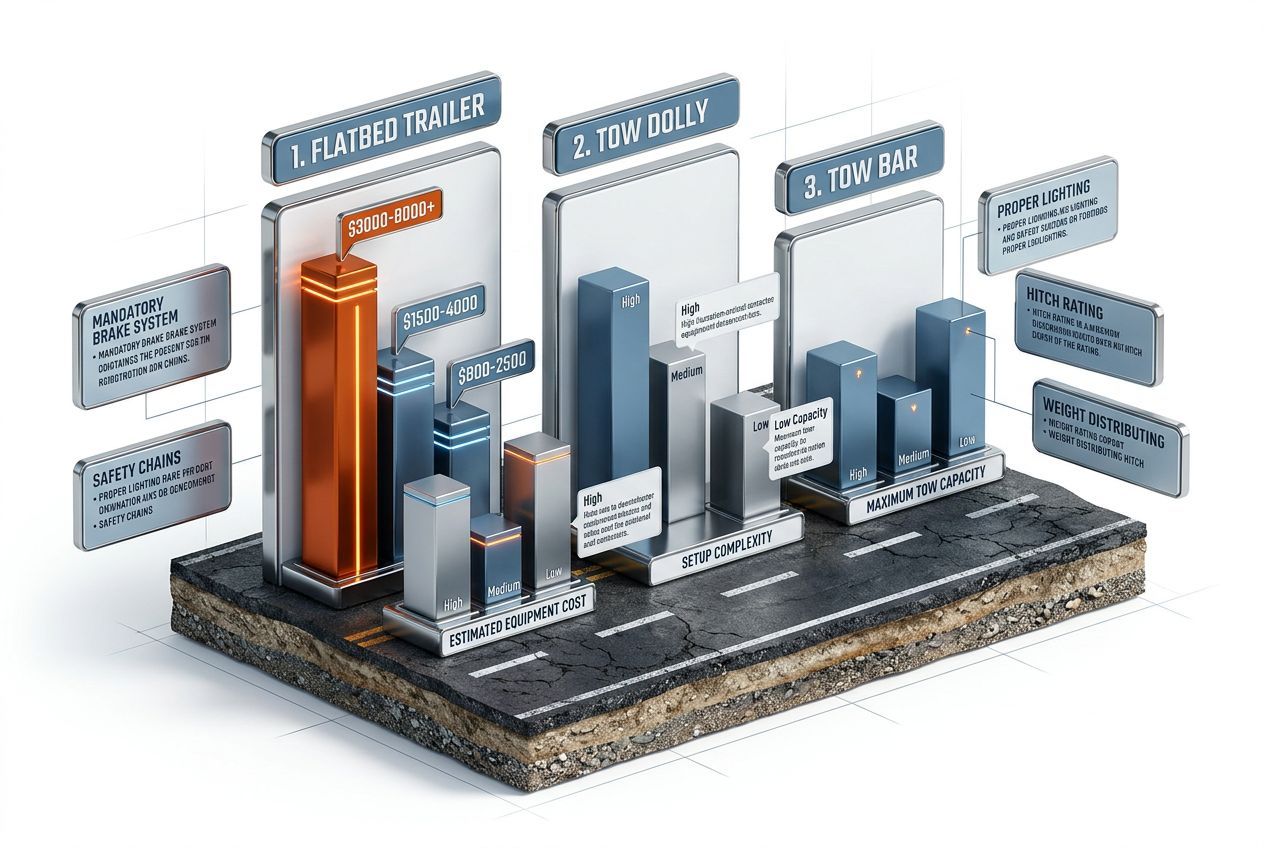
The four methods for towing a car with a truck are flatbed trailers, tow dollies, flat towing with a tow bar, and tow straps for very short distances. Each method suits different drivetrains, distances, and budgets. Choosing the wrong method for your towed vehicle's drivetrain is how transmissions get destroyed.
What Are the Different Methods to Tow a Car with a Truck? — data table
| Method |
Best For |
Weight Added |
Drivetrain Requirement |
Avg. Rental Cost |
| Flatbed trailer |
Any drivetrain |
1,800–2,900 lbs |
None — all 4 wheels off ground |
$70–$200/day |
| Tow dolly |
FWD vehicles |
750–1,200 lbs |
Front wheels lifted; rear must not drive |
$50–$120/day |
| Flat tow (tow bar) |
Mfr-approved vehicles |
~100 lbs (bar only) |
Must be rated by manufacturer |
$0–$50/day (owned bar) |
| Tow strap |
Emergency/very short |
Negligible |
Any, but high risk — avoid on roads |
N/A |
Sources: U-Haul rental pricing, manufacturer product specs, NHTSA vehicle weight data
Flatbed Trailer Towing
Flatbed trailer is the gold standard for car transport. With every wheel off the ground, drivetrain damage to the towed vehicle is impossible. For a DIY car trailer setup, load the vehicle as far forward as possible.
✅ Pro Tip: For stable towing with a flatbed trailer, ensure your tongue weight lands between 10–15% of the total trailer load by positioning the towed vehicle correctly.
Tow Dolly Towing
A tow dolly lifts the front wheels and allows the rear wheels to roll on the road. This method works cleanly for front-wheel-drive vehicles like a Honda Civic or Toyota Camry.
⚠️ Warning: If your towed car is rear-wheel-drive or all-wheel-drive, the driven rear wheels spinning on the road can pump transmission fluid into parts designed to be stationary, leading to severe damage in under 50 miles. Our full tow bar vs. tow dolly comparison breaks this down in more detail.
Flat Towing (Tow Bar)
Flat towing requires the towed vehicle to be explicitly rated for four-down towing by its manufacturer. The Jeep Wrangler is one of the most common flat-tow candidates; many other vehicles are not approved at all.
💡 Key Takeaway: Always check our flat tow compatible vehicles list or your car's owner's manual before assuming your vehicle qualifies. For flat towing, you'll also need a tow bar, safety cables, and a supplemental braking setup.
Tow Straps (Emergency Use Only)
Tow straps are emergency recovery tools, not transport methods.
⚠️ Warning: Using a strap to pull a vehicle down a public road at highway speed — without functioning lights and without a rigid connection — is illegal in most states and extremely dangerous in all of them. See our tow strap guide for what they're actually rated to do.
🛡️
DIY TOWING & FLAT TOWING
Is It Legal to Tow a Car with a Truck Yourself?
DIY car towing is legal in all 50 states, but the requirements vary enough that you should check your specific jurisdiction before loading up. Functioning tail lights and brake lights on the towed unit or trailer are mandatory everywhere, per federal FMCSA standards. Beyond that, state law diverges significantly.
State-Specific Towing Laws:
- California: Vehicle Code §22406 restricts vehicles towing trailers to 55 mph, irrespective of the posted freeway speeds.
- Texas: Has no equivalent speed restriction; you may tow at the posted limit.
- Florida: Requires a breakaway safety switch on trailers over 3,000 lbs but has no vehicle inspection program, so enforcement is inconsistent.
- Colorado: Mandates supplemental braking on any towed vehicle over 3,000 lbs and strongly enforces it on mountain corridors like I-70, where grade pressure on long descents can overwhelm a tow vehicle's brakes alone.
Use the towing laws by state tool to pull the specific rules for your route — especially if you're crossing state lines, where you're subject to the stricter of the two states' laws for the segment you're driving.
📋
DIY TOWING & FLAT TOWING
Can Your Truck Safely Tow This Car?
Before you hook anything up, run the math using your truck's actual numbers — not the brochure ceiling. Enter your truck's year, make, model, and configuration below to get a personalized capacity check.