Skip to content
🚐 RV & BOAT TOWING

Towing a 5th Wheel: Truck Requirements & Setup Guide

Published · Updated · 11 min read
MarkUpdated Mar 2, 2026Ford Motor Company
Key Takeaways
  • Most 5th wheels need a ¾-ton (2500-series) or 1-ton (3500-series) truck — half-tons work only for lightweight sub-10,000-lb trailers
  • Pin weight (15–25% of trailer GVWR) eats directly into your truck's payload — this is the number most buyers ignore until it's too late
  • Your truck must satisfy three ratings simultaneously: max tow rating, payload capacity, and GCWR
  • Short beds under 6.5 ft require a slider hitch or auto-slide hitch to prevent cab contact during turns
  • CDL is not required in most states for personal RV use, but California, Pennsylvania, and Hawaii have added requirements above 26,000 lbs GCWR

💰
RV & BOAT TOWING

What Size Truck Do You Need to Tow a 5th Wheel?

Choosing the right truck for towing a 5th wheel involves understanding its core capabilities. Most 5th wheel trailers require a ¾-ton or 1-ton pickup with a tow rating between 12,000 and 20,000+ lbs. Critically, the truck must also carry the trailer's pin weight — typically 15–25% of gross weight — within its payload limit. Engine choice, rear axle ratio, and bed length all determine which trailers a given truck can legally and safely handle.

💡 Key Takeaway: Most 5th wheels require a ¾-ton or 1-ton truck. Half-tons are only suitable for lightweight 5th wheels under 10,000 lbs due to strict payload limitations.

Understanding Truck Classes

The three mainstream truck choices break down as follows, each suited for different trailer sizes and weights:

  • ¾-ton (F-250, RAM 2500, Silverado 2500HD): This class handles most family 5th wheels in the 10,000–18,000-lb range when properly optioned.
  • 1-ton Single Rear Wheel (F-350 SRW, RAM 3500 SRW): These trucks bump capacity and payload another notch, making them suitable for larger luxury 5th wheels.
  • 1-ton Dually (F-350 DRW, RAM 3500 DRW): This is the right call for anything over 16,000 lbs or when you need maximum stability in crosswinds, especially for heavy toy haulers.

Engine & Axle Ratio Considerations

Axle ratio matters more than most buyers realize for heavy towing. For instance, Ford recommends a 3.73 or 4.10 axle ratio for heavy 5th wheel towing on the F-250 and F-350. While a lower numerical ratio (like 3.31) can save fuel on the highway, it noticeably reduces pulling power on grades.

✅ Pro Tip: If you're towing in the Mountain West (Colorado, Utah, Montana), a 4.10 axle paired with a diesel engine is highly recommended. It's not overkill; it's the minimum you'll want on a 7% grade with 15,000 lbs behind you.

For a broader comparison of the best-rated trucks across every category, see our best trucks for RV towing roundup.

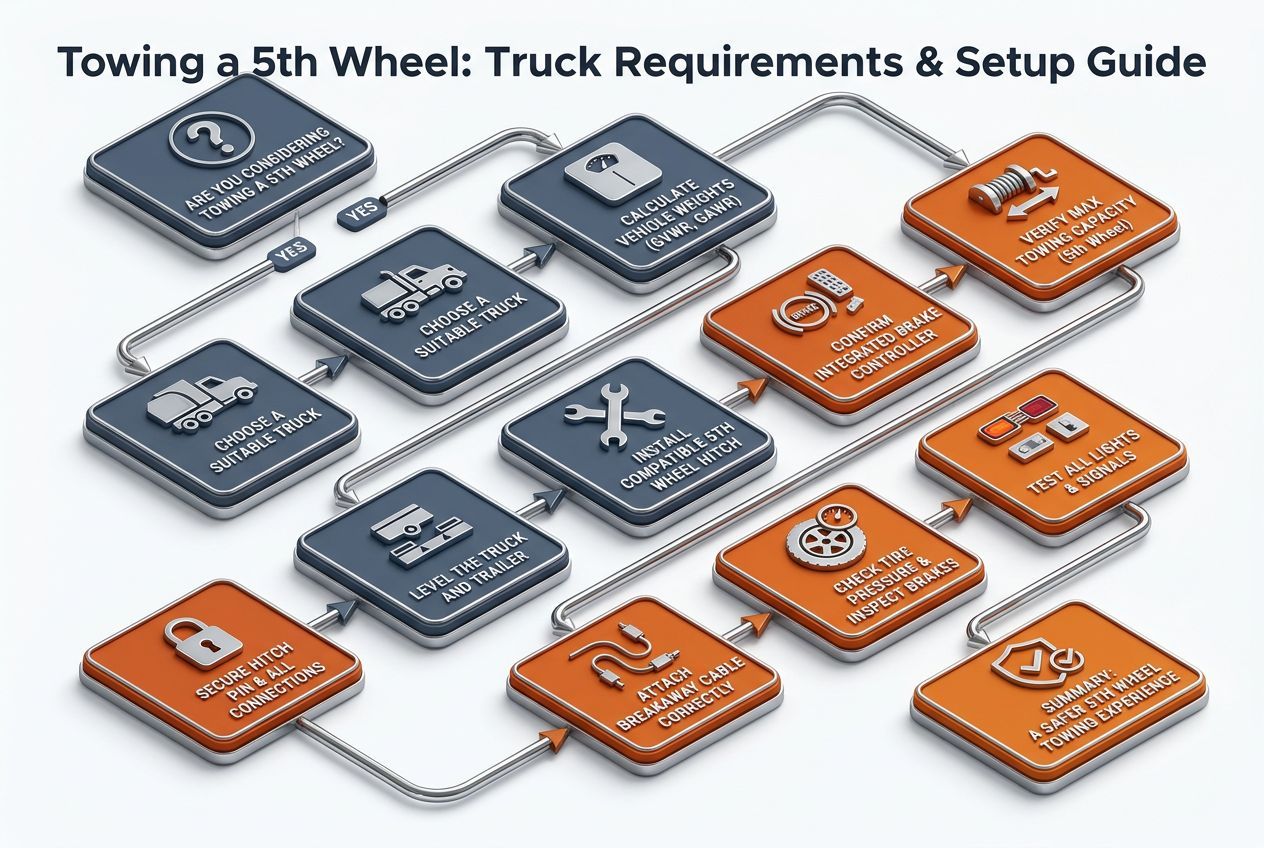
3D isometric overview diagram for towing a 5th wheel: truck requirements & setup guide
📊
RV & BOAT TOWING

What Are the Minimum Towing Requirements for a 5th Wheel?

Fifth wheel towing requirements center on three ratings that must all be satisfied simultaneously:

  1. Max Tow Rating: Must exceed the trailer's Gross Vehicle Weight Rating (GVWR).
  2. Payload Capacity: Must exceed the trailer's pin weight plus the weight of passengers and cargo in the truck.
  3. Gross Combined Weight Rating (GCWR): Must cover the fully loaded combined weight of both the truck and the trailer.

Passing only one or two of these tests isn't enough to ensure safe and legal towing.

⚠️ Warning: Here's where most buyers go wrong: they find a truck whose tow rating beats the trailer's GVWR and stop there. Payload is a separate and independent limit stamped on the door-jamb sticker on the driver-side B-pillar. Always cross-reference your door-jamb sticker with the Trailer Towing Supplement (often published separately from the owner's manual) to get the full picture.

The Payload Predicament: A Worked Example

Understanding payload is crucial. That door-jamb sticker lists your truck's GVWR, GAWR, and max payload. Let's consider a practical scenario.

Worked example: Say your 5th wheel has a GVWR of 14,000 lbs.

  • Pin weight at 20% is 2,800 lbs.
  • Add yourself (200 lbs), a passenger (160 lbs), 100 lbs of food and gear in the cab, and the hitch head itself (100–150 lbs).
  • Your total payload requirement is 3,260–3,310 lbs — and that's before you've put a drop of fuel in the tank.
  • A ¾-ton SRW with a typical 2,900-lb payload would already be over its limit in this scenario. You'd need a truck with at least 3,400 lbs of payload, which typically means a 1-ton or a heavy-payload ¾-ton with the right options.

The payload calculator lets you run these numbers for your exact truck configuration before you buy anything.

The Payload Predicament: A Worked Example — data table
Truck Class Max Tow Rating (5th Wheel) Typical Payload Best For
Half-ton (F-150, RAM 1500) 8,000–11,500 lbs 1,500–2,000 lbs Sub-10,000-lb lightweight 5th wheels only
¾-ton SRW (F-250, RAM 2500) 15,000–22,000 lbs 2,200–3,500 lbs Most family 5th wheels 10,000–18,000 lbs
1-ton SRW (F-350, RAM 3500 SRW) 22,000–26,000 lbs 3,200–4,200 lbs Large luxury 5th wheels
1-ton Dually (F-350 DRW, RAM 3500 DRW) 26,000–37,090 lbs 5,500–7,000 lbs Heavy/toy hauler 5th wheels 16,000+ lbs

Sources: Ford Towing Guide 2025 (ford.com), RAM Towing & Payload Guide 2025 (ramtrucks.com), Edmunds vehicle specs (edmunds.com)

Our full towing capacity guide breaks down how to read every rating on your door-jamb sticker.


🔧
RV & BOAT TOWING

What Truck Do You Need to Tow a 5th Wheel Specifically?

The right truck for towing a 5th wheel depends on your trailer's fully loaded weight, not just its dry weight advertised on the dealer lot. A 13,500-lb dry-weight 5th wheel loaded to its 16,000-lb GVWR completely changes your truck equation.

Use our towing vehicle matchmaker to find trucks rated for your specific trailer weight and axle configuration.
Try Our Free Can I Tow This? Calculator

The gas vs. diesel debate is a practical decision here, not merely a preference. While a diesel engine adds $8,000–$12,000 upfront, it delivers 30–50% more torque at lower RPM — precisely what you need at altitude or on a sustained mountain grade.

📊 Quick Fact: According to Edmunds, a RAM 2500 with the 6.7L Cummins produces 1,075 lb-ft of torque versus 430 lb-ft for the 6.4L HEMI gas engine. This difference is most pronounced at 5,000+ feet of elevation where naturally aspirated gas engines lose roughly 3% of power per 1,000 feet of altitude gain. At 8,000 feet in the Rockies, a gas engine towing at its rated limit is effectively 24% down on power compared to sea level.

If you tow routinely in mountain terrain, see towing in mountains for grade-by-grade planning.


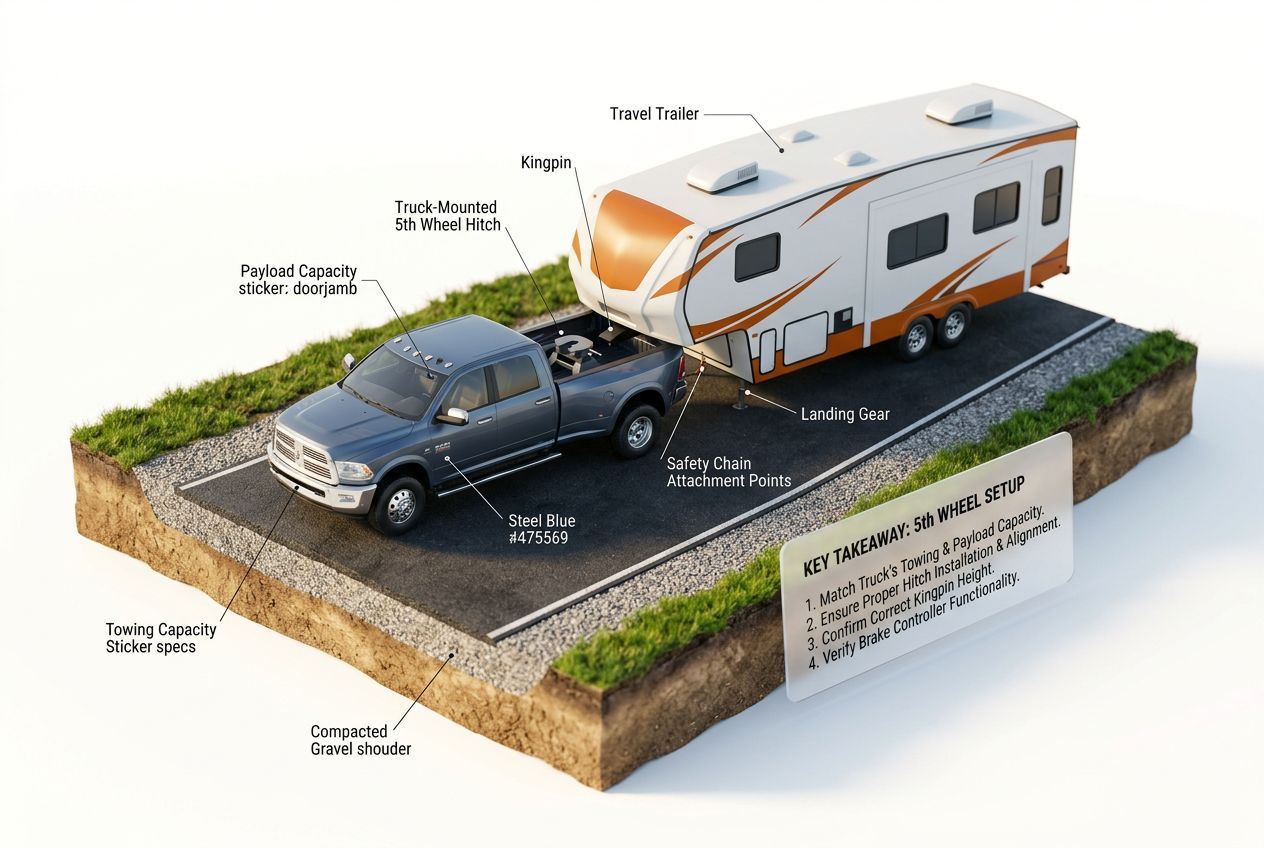
3D data visualization showing key figures for towing a 5th wheel: truck requirements & setup guide
🛡️
RV & BOAT TOWING

How Do You Set Up a 5th Wheel Hitch in Your Truck Bed?

Properly setting up a 5th wheel hitch is paramount for safe towing. This involves mounting base rails or a factory puck system to the truck bed, positioning the hitch head over the rear axle at the correct height, and verifying jaw lock engagement on the kingpin before every departure. Centering the kingpin connection and attaching safety chains and a breakaway cable are non-negotiable steps.

Step-by-Step Hitch Installation

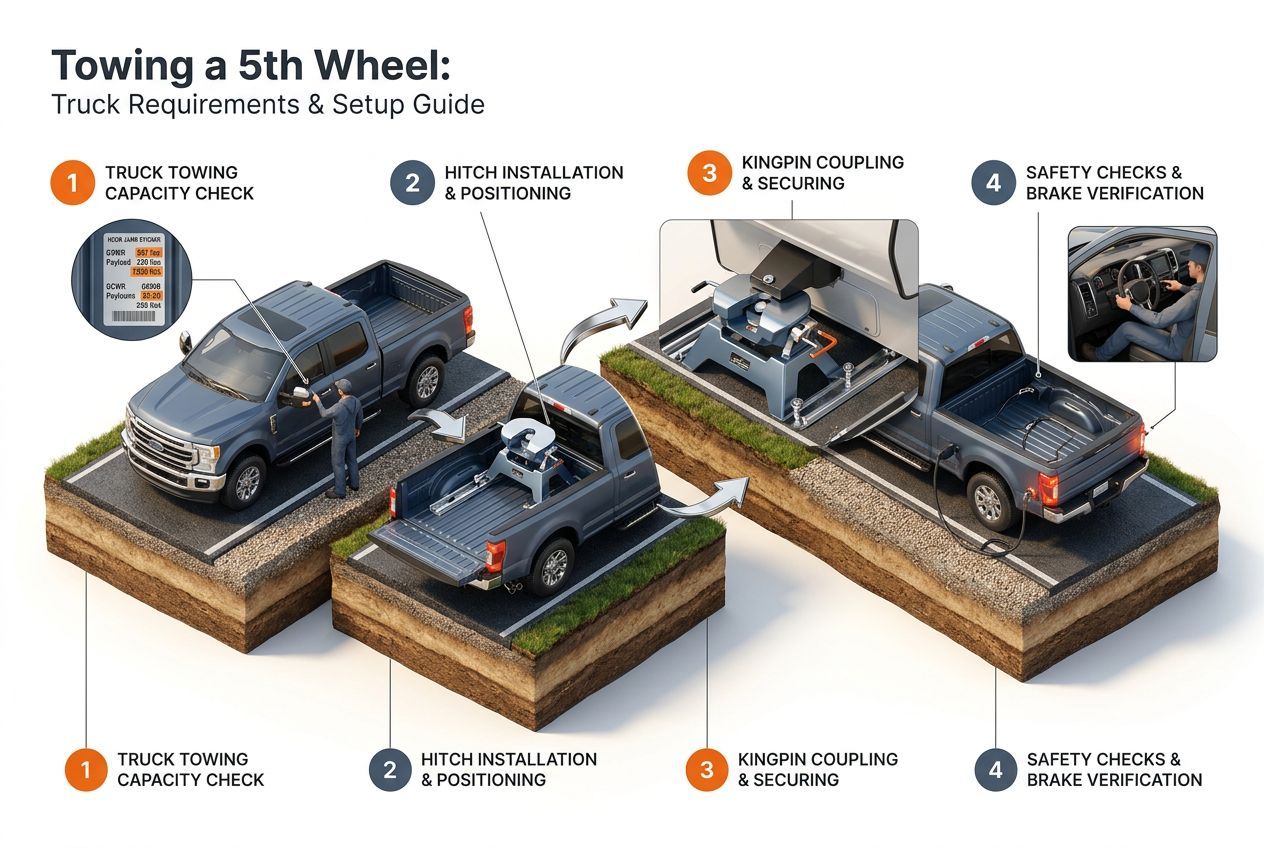
Follow these crucial steps to ensure your 5th wheel hitch is correctly installed and secured:

  1. Mount the base rails. Traditional rail systems bolt to the truck bed using factory-drilled holes or supplemental brackets. Ford, GM, and RAM now offer factory puck systems on many trims — for example, the Ford Gooseneck/5th Wheel Prep Package (option 52R) installs four under-bed attachment points that accept a compatible hitch head directly, no rail drilling required.
  2. Set hitch height. The hitch head should sit 3–5 inches above the top of the truck bed rails. If it's too low, you risk binding on turns; if it's too high, the trailer nose pitches down, shifting pin weight rearward.
  3. Position over the rear axle. The kingpin connection point should sit 2–4 inches in front of the center of the rear axle. This placement helps balance pin weight distribution and prevents rear-axle overload.
  4. Engage and verify the jaw. After coupling, insert the provided test bar (or a length of 2×4) to confirm the kingpin is fully seated. Then, tug the truck forward about 6 inches with the trailer brake set — if the trailer moves with you, the jaw is not locked, and you must re-engage.
  5. Connect electrical and safety cables. The 7-pin trailer connector handles the brake controller signal, running lights, and reverse lights. Connect the breakaway cable to a fixed point on the truck — not the hitch head itself.

Addressing Short Bed Challenges

If your truck bed is under 6.5 feet, a fixed hitch can create cab contact during sharp turns, potentially damaging both your truck and trailer. A slider hitch or auto-slide hitch, which moves the coupling point rearward during turns, effectively solves this issue. The kingpin standard size is 2-1/16 inches in diameter per SAE J2638 — always verify your hitch jaw matches this specification.

The average installed cost for a quality 5th wheel hitch typically runs $800–$2,500, depending on the brand and whether you're using a rail system or a factory puck system. Our full 5th wheel towing guide covers hitch brand comparisons and bed protection options.


📋
RV & BOAT TOWING

Can You Tow a 5th Wheel With a Half-Ton Truck?

Some half-ton trucks can tow lighter 5th wheels under 10,000 lbs GVWR when equipped with a max-tow package. However, their payload constraints, typically 1,500–2,000 lbs, make this marginal for most full-size 5th wheels. Exceeding payload is the most dangerous and most common mistake made when towing a 5th wheel with a half-ton.

⚠️ Warning: The Ford F-150 tops out at 9,900 lbs in 5th wheel configuration — and that ceiling is firm. If your loaded 5th wheel hits 12,000 lbs, the F-150 is not your truck. Per NHTSA vehicle loading guidelines, operating a truck over its GVWR compromises braking distance, suspension geometry, and tire load rating simultaneously.

The RAM 1500 also offers a factory 5th wheel/gooseneck prep option and can manage similar weight ranges with the max-tow package. But it is imperative to run the payload math first (refer to the worked example above). By the time you account for pin weight, passengers, and cab cargo, most half-tons are at or over their payload limit before you've even loaded the trailer's storage bays.

Half-tons make sense for a narrow category of RVs: lightweight aluminum-frame 5th wheels like smaller Keystone Montana models in the 9,000–10,000-lb GVWR range, typically for a solo driver with minimal cab cargo. Any heavier, and you need to step up to a ¾-ton or 1-ton truck.


3D step-by-step process visualization for towing a 5th wheel: truck requirements & setup guide
⚙️
RV & BOAT TOWING

Do You Need a Dually to Tow a 5th Wheel?

A dually isn't always required, but it becomes the smart choice for 5th wheels over 14,000 lbs GVWR and a near-necessity above 16,000 lbs. Dually trucks provide 20–40% more payload capacity than their single rear wheel equivalents and offer measurably better crosswind stability due to their wider rear stance.

The physics are straightforward: a dually's four rear tires distribute pin weight across more contact patches, reducing individual tire load and lowering the truck's effective center of gravity under side loading. This makes a significant difference at highway speeds, especially in windy conditions. If you're regularly towing a toy hauler or large luxury coach in the 18,000–20,000-lb range, a RAM 3500 DRW with the 6.7L Cummins High Output (rated to 37,090 lbs by RAM) is built for exactly that duty cycle.

The tradeoff for a dually includes being harder to park, getting worse fuel economy when unloaded, and costing more upfront. For part-time towing of a mid-size 5th wheel, a well-optioned ¾-ton SRW is often the better all-around truck.


🚛
RV & BOAT TOWING

What Is Pin Weight and Why Does It Matter?

Pin weight is the downward force the trailer's front section exerts on the truck bed at the kingpin, typically equal to roughly 15–25% of the trailer's total loaded weight. It counts directly against the truck's payload capacity — and it's the number that most buyers miss until they're dangerously overloaded on the highway.

💡 Key Takeaway: Pin weight is a critical factor often overlooked. It's the direct downward pressure your trailer puts on your truck and must be accounted for within your truck's payload capacity.

The Dynamic Nature of Pin Weight

Critically, pin weight is a moving target. It changes every time you load or unload the trailer. For example, adding 400 lbs of camping gear toward the front of the trailer will increase pin weight. Conversely, moving a 200-lb ATV to the rear of a toy hauler will decrease it.

✅ Pro Tip: Weigh your rig at a certified CAT scale (available at many Pilot and Love's truck stops) with everything loaded as it would be for travel. The rear axle reading minus the truck's unloaded rear axle weight gives you your actual pin weight in the field.

For a deeper breakdown of how all these weight ratings interact, the RV towing guide covers GVWR, GCWR, and payload in full detail.


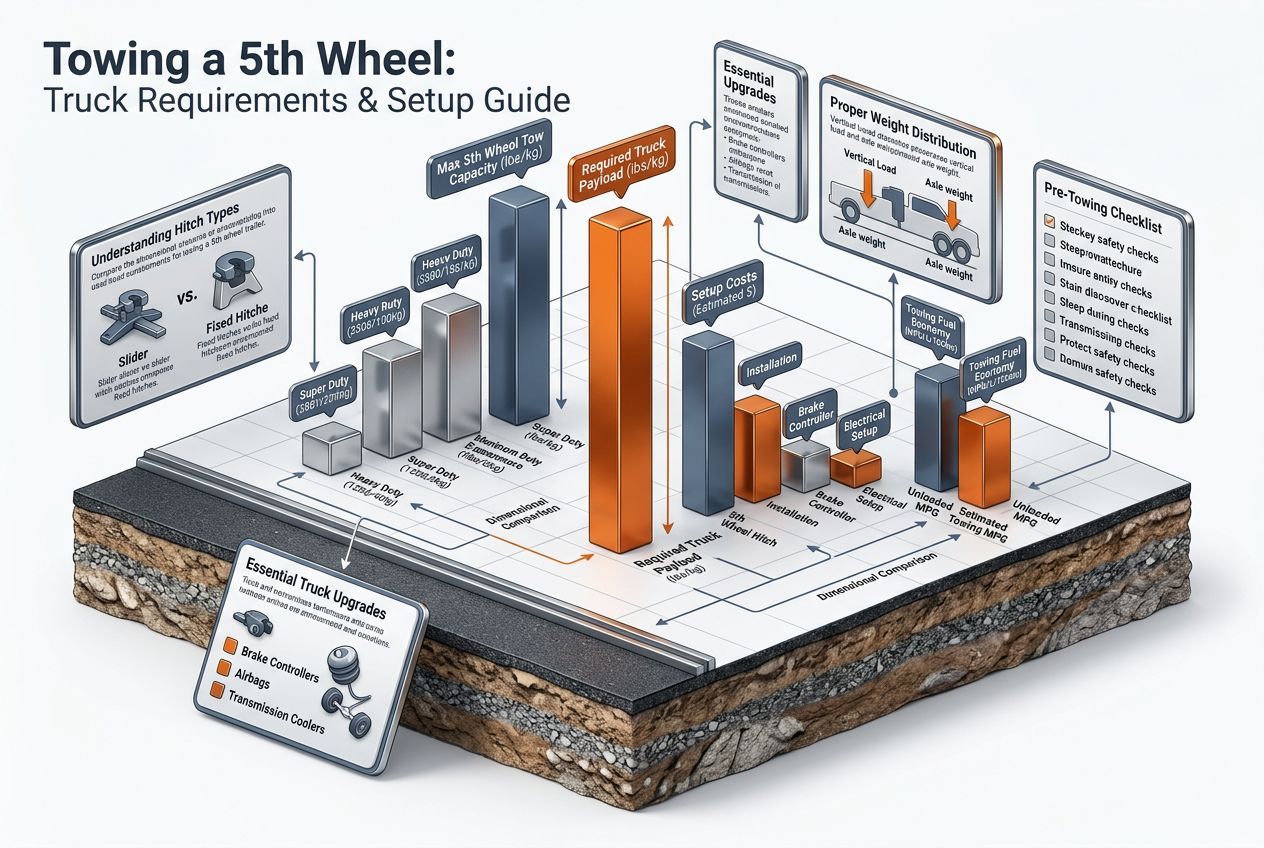
3D flowchart of practical tips and decisions for towing a 5th wheel: truck requirements & setup guide
📝
RV & BOAT TOWING

Do You Need a CDL to Tow a 5th Wheel RV?

In most U.S. states, a Commercial Driver's License (CDL) is not required to tow a 5th wheel RV for personal recreational use, regardless of combined weight. Federal FMCSA regulations generally exempt vehicles used exclusively for personal use from CDL requirements.

⚠️ Warning: While a federal CDL isn't typically required for personal RV use, California, Pennsylvania, and Hawaii impose non-commercial endorsement requirements when the Gross Combined Weight Rating (GCWR) exceeds 26,000 lbs. Always check state-specific regulations.

According to FMCSA, the commercial CDL threshold of 26,001 lbs GCWR applies to vehicles operated in commerce — not private RV towing. That said, "personal use" has legal nuance. Renting your 5th wheel through a peer-to-peer platform, for example, could potentially shift it out of private-use classification in some states.

Check your specific state requirements with our towing laws by state tool before towing across state lines, especially if your combined weight approaches or exceeds 26,000 lbs.

Sources & Methodology

  1. 1.
    Ford Motor Company — 2025 Ford Towing Guide and F-Series Trailer Towing Supplement, covering max tow ratings, payload, and puck system options. ford.com
  2. 2.
    RAM Trucks — 2025 RAM Towing & Payload Guide, including RAM 3500 Cummins HO ratings and dually vs. SRW payload comparisons. ramtrucks.com
  3. 3.
    NHTSA (National Highway Traffic Safety Administration) — Vehicle loading standards, GVWR definitions, and overloading safety data. nhtsa.gov
  4. 4.
    FMCSA (Federal Motor Carrier Safety Administration) — CDL regulations and exemptions for personal use vehicles. fmcsa.dot.gov

TowingServiceHub is reader-supported: we may earn money from ads and from some links on this page. See our editorial policy.

Mark — Founder & Editor

Mark

Founder & Editor

Mark is the founder and editor of TowingServiceHub, which he launched in 2026 after struggling to find clearly sourced towing costs and truck specs. He works in enterprise technology and tows his own boats, trailers, and equipment, so he knows the questions drivers actually ask.

Read full bio →

Need a tow truck right now?

Browse vetted local providers in your area. Real Google ratings, verified business info, free to use.

Or browse all 50 states from our directory

Frequently Asked Questions

A 3/4-ton or 1-ton pickup is recommended. Pin weight (18–25% of trailer weight) counts against payload, and most half-ton trucks run out of payload before hitting their tow rating with a typical fifth-wheel.

A 5th wheel hitch mounts in the truck bed with a kingpin receiver plate. Conventional hitches use a ball on a receiver at the rear bumper. The 5th wheel design improves stability with heavy RVs.

Generally no for private/recreational use. Most states exempt personal RV towing from CDL requirements even at high weights. Check your state's specific rules — a few states require a Class A non-commercial license over certain thresholds.

Keep pin weight at 18–25% of gross trailer weight. Below 18% causes poor handling and sway; above 25% overloads the rear axle and exceeds payload capacity on most trucks.

Yes, with a slider hitch. A short-bed truck (5.5–6.5 ft) doesn't have enough clearance for a standard 5th wheel hitch during tight turns. A slider hitch moves the pivot point back during low-speed maneuvers.

Related Articles

Explore More Towing Guides

Browse all 157 expert guides and 10 free tools.