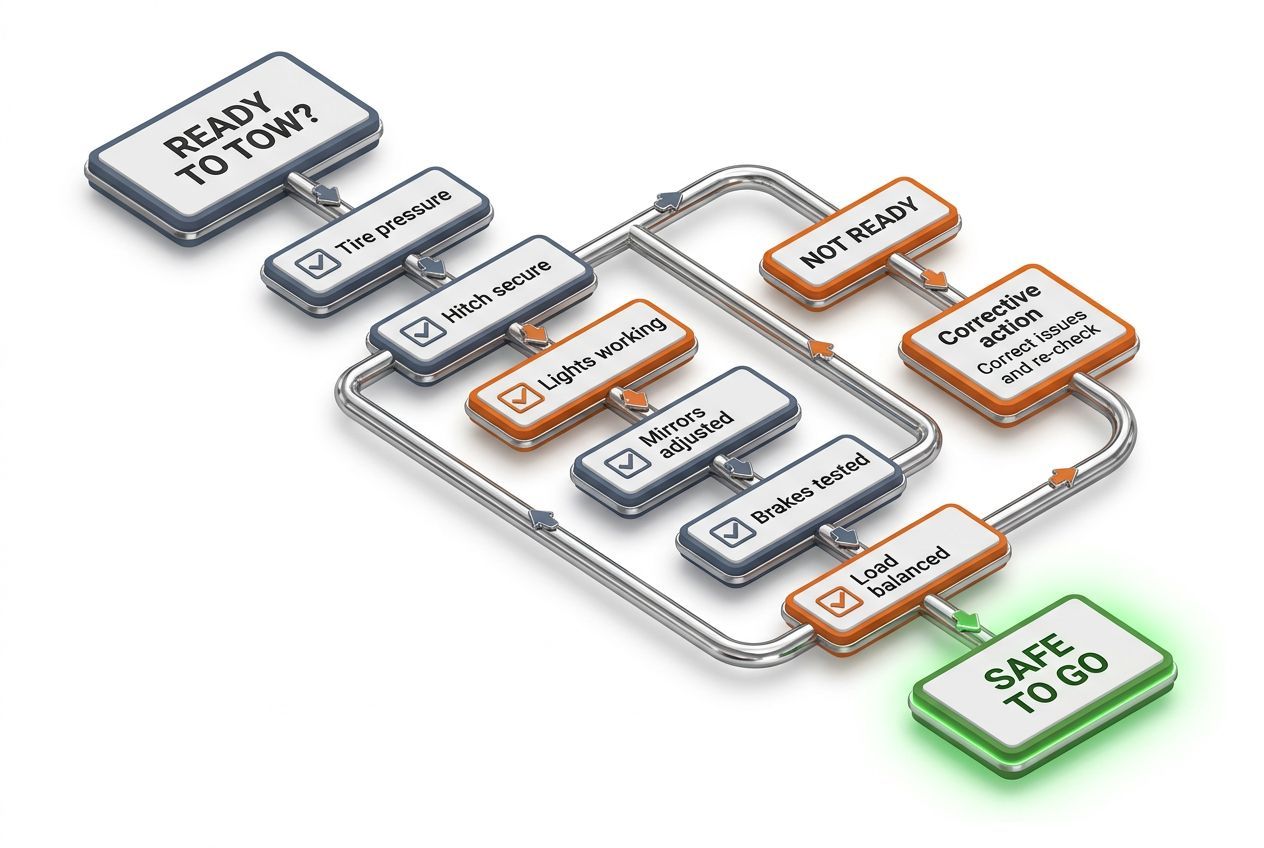
- Tow rating alone doesn't tell the full story — payload capacity is often the limiting factor, especially on half-ton trucks.
- Tongue weight must be 10–15% of loaded trailer weight for conventional hitches; exceeding it causes dangerous front-axle overload.
- A 10–20% safety buffer below your truck's max tow rating is the industry-standard cushion for real-world conditions.
- Fifth wheels and trailers above 12,000 lbs require a 3/4-ton or 1-ton truck — no exceptions.
- Always check your specific state's trailer brake and licensing laws before crossing state lines.
What Size Truck Do You Need to Tow an RV?
Understanding Trailer Weight and Truck Capability: The right truck size depends entirely on your trailer's loaded weight — not its dry weight from the brochure. Light travel trailers under 5,000 lbs work fine behind a midsize truck like the Toyota Tacoma or Ford Ranger. Trailers between 8,000–16,000 lbs need a 3/4-ton or 1-ton truck — think Ford F-250, Ram 2500, or Chevy Silverado 2500HD.
The Half-Ton Payload Dilemma: Here's a practical breakdown. The 2024 Ford F-150 with the 3.5L EcoBoost and Max Trailer Tow Package tops out at 13,500 lbs. Impressive — but that number assumes you're towing with minimal cab weight. Add a passenger (170 lbs), a driver (200 lbs), gear in the bed (300 lbs), and tongue weight from a 10,000-lb trailer at 12% (1,200 lbs), and you've burned through 1,870 lbs of a payload rating that might only be 2,000 lbs to start. You're operating at the absolute limit with no margin left.
If your loaded fifth wheel hits 14,000 lbs, the F-150 simply isn't your truck. The 2024 Ram 3500 with the 6.7L Cummins diesel is rated to 37,100 lbs on a fifth wheel — built for exactly that duty cycle. Our best trucks for RV towing page breaks down specific model recommendations by trailer class.
⚠️ Warning: Midsize trucks — even the most capable ones — cannot handle fifth wheels. The 2024 Tacoma with its 3.5L V6 (2GR-FKS engine) is rated to just 6,500 lbs. A loaded fifth wheel would be double that. Don't let "max tow" marketing language blur that line.
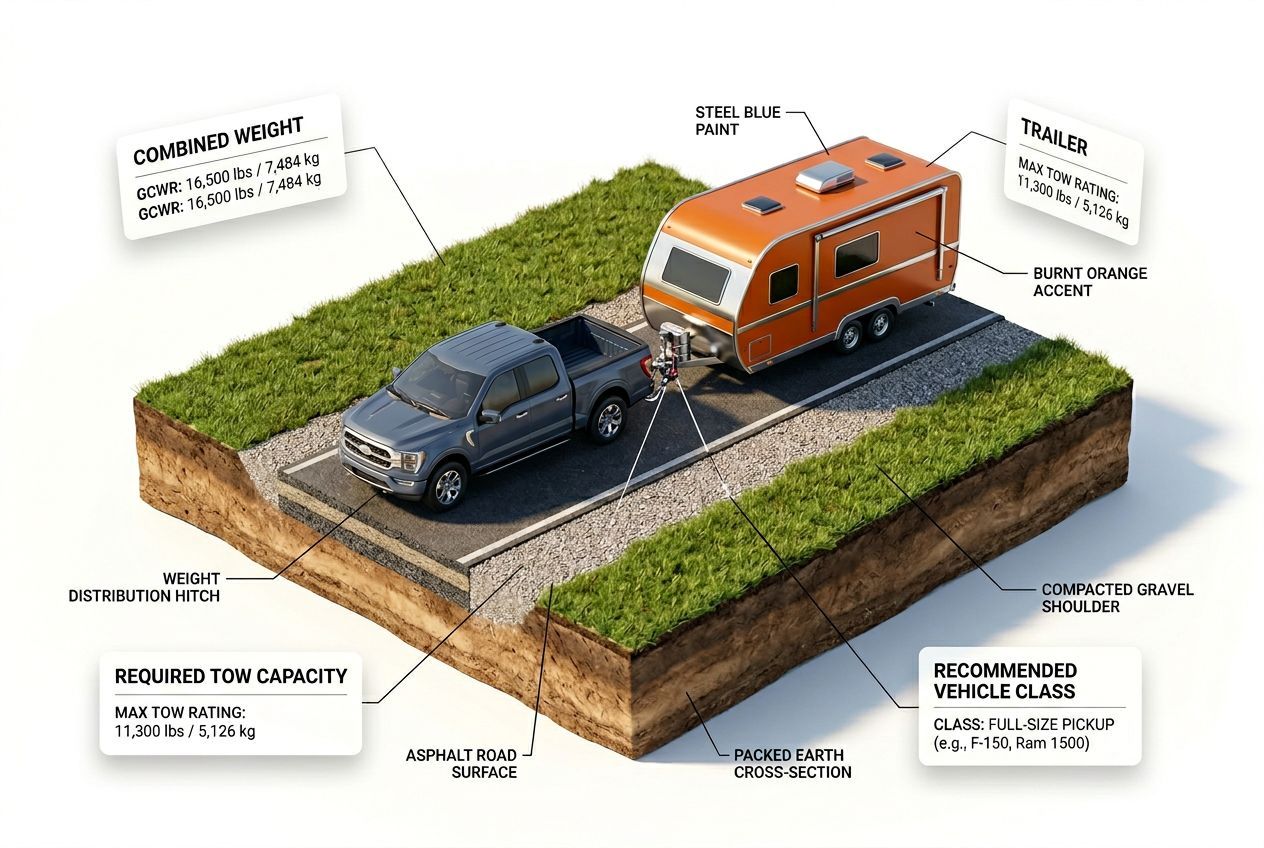
How Do You Calculate the Towing Capacity You Need?
Determine Your Gross Trailer Weight (GTW): Start with your trailer's dry weight, then add every pound you'll actually load. This includes:
- Water (8.34 lbs per gallon — a full 40-gallon tank is 334 lbs)
- Propane tanks
- Food, clothes, and personal items
- Bikes, kayaks, and other gear
- Any aftermarket additions to the trailer
That final number is your Gross Trailer Weight (GTW). Add a 10–20% safety buffer, and you have your minimum required tow rating.
Worked Example for GTW Calculation: You're buying a travel trailer with a 5,800-lb dry weight.
- Add 40 gallons of water (334 lbs)
- Two bikes (60 lbs each = 120 lbs)
- A week of food and gear (200 lbs)
- A full 30-lb propane tank (adds roughly 24 lbs of propane weight)
Your real GTW is roughly 5,800 + 334 + 120 + 200 + 24 = 6,478 lbs. Add a 15% buffer: 6,478 lbs * 1.15 = 7,450 lbs. That's the minimum tow rating you need — not 5,800 lbs.
✅ Pro Tip: The number on the window sticker is a ceiling, not a target. According to NHTSA, improper weight distribution and overloading are among the leading causes of towing-related accidents. Use our towing capacity lookup tool to cross-reference your specific truck's numbers, or try the payload calculator to verify you're not burying your truck's payload rating before you leave the driveway.
📊 Quick Fact: Factor in altitude when planning. At 7,000 feet in Colorado or Utah, a naturally aspirated engine loses roughly 3% of its power per 1,000 feet of elevation — about 21% total power reduction from sea level ratings. That published tow ceiling was tested at sea level. Plan accordingly if you're hitting mountain passes. Our towing in mountains guide covers this in depth.
What Is the Difference Between GVWR, GCWR, and Payload?
Understanding Key Weight Ratings: These three ratings work as a system, and confusing them is one of the most common — and costly — RV towing mistakes beginners make.
- GVWR (Gross Vehicle Weight Rating): This is the maximum your truck can weigh fully loaded, including fuel, passengers, and cargo.
- GCWR (Gross Combined Weight Rating): This is the maximum total weight of the truck plus the trailer combined.
- Payload: This is how much weight your truck can carry on itself — in the cab and bed.
✅ Pro Tip: Always check the door-jamb sticker on the driver's side B-pillar. It lists your truck's GVWR and GAWR (Gross Axle Weight Ratings). Then look at the Trailer Towing Supplement — Ford, RAM, and GM all publish these as separate documents from the owner's manual — for GCWR and official max tow ratings by engine and axle code.
Common Mistakes: Here's where people go wrong: they see a 12,000-lb tow rating and assume they're safe towing a 12,000-lb trailer. But if their truck's GCWR is only 19,000 lbs, and the truck itself weighs 7,500 lbs loaded, they're already at 19,500 lbs combined — 500 lbs over the legal and structural limit.
For a full breakdown of every weight term you'll encounter, our towing capacity guide covers all the definitions with real examples.
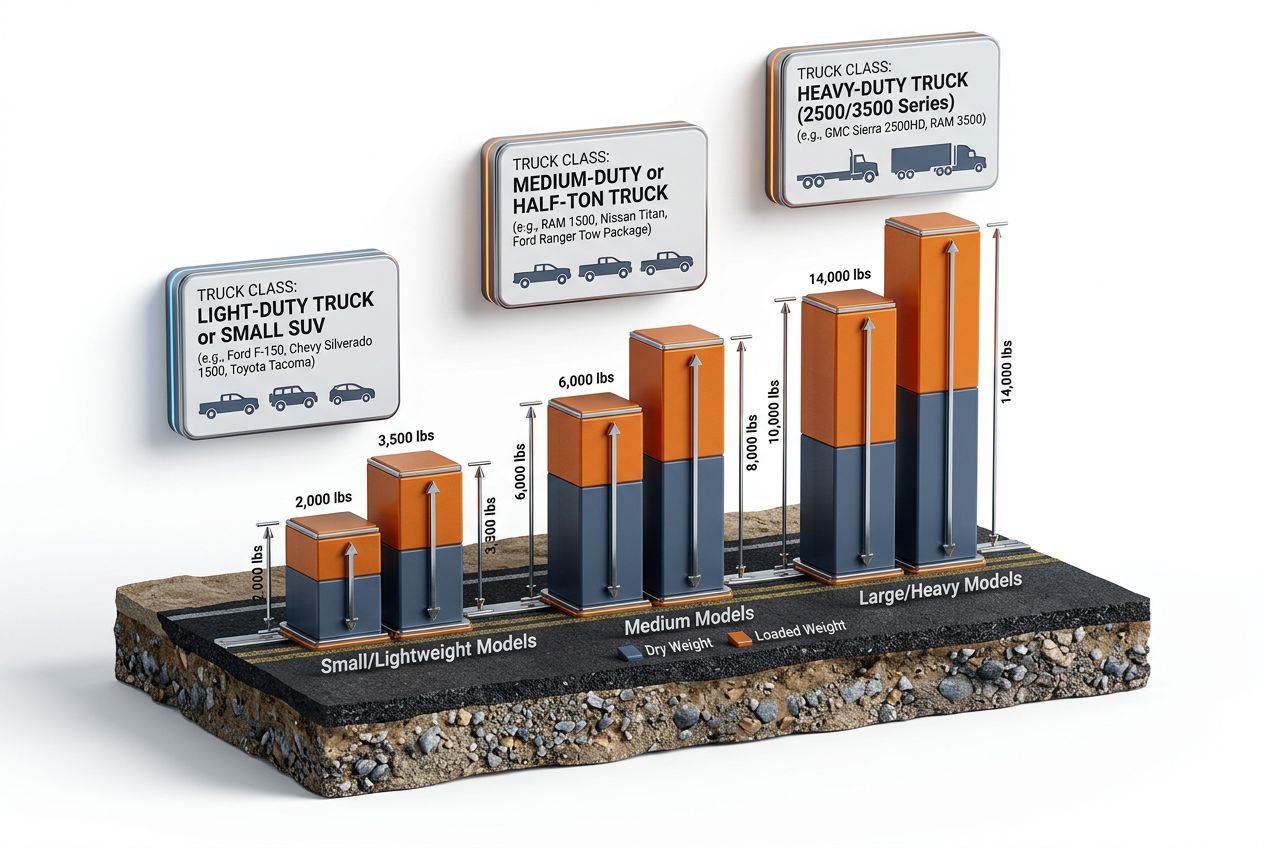
Tow Capacity by Truck Class — Quick Reference
| Truck Class | Example Models | Max Tow Rating | Best Trailer Match |
|---|---|---|---|
| Midsize | Tacoma, Ranger, Colorado | 3,500–7,700 lbs | Teardrop, pop-up, small travel trailer |
| Half-Ton | F-150, Ram 1500, Silverado 1500 | Up to 13,500 lbs | Mid-size travel trailers |
| 3/4-Ton | F-250, Ram 2500, Silverado 2500HD | Up to 22,000 lbs | Large travel trailers, light fifth wheels |
| 1-Ton SRW | F-350, Ram 3500, Silverado 3500HD | Up to 26,000 lbs (conv.) | Heavy fifth wheels, large toy haulers |
| 1-Ton DRW | F-350/450 DRW, Ram 3500 DRW | Up to 37,100 lbs | Max-weight fifth wheels, goosenecks |
Sources: Ford.com, Chevrolet.com, RAMTrucks.com 2024 Towing Guides
Can a Half-Ton Truck Handle Towing a Travel Trailer?
Conditional Capability: Yes — with conditions. A properly configured half-ton with the right engine and tow package can pull many travel trailers comfortably. The real constraint is usually payload capacity, not the tow rating itself. Half-tons often carry surprisingly tight payload budgets.
💡 Key Takeaway: The factory Class IV Trailer Tow Package — option code 53B on Ford, Z82 on GM — adds a transmission oil cooler, 7-pin wiring harness, heavy-duty flasher relay, and upgraded radiator. Without it, the published max tow rating doesn't apply to your truck. Always verify your specific truck's option codes before hitching anything heavy.
Weight Distribution Hitches: For anything over 5,000 lbs, you'll need a weight distribution hitch. These redistribute tongue weight across all axles, keeping the truck level and stable. Popular options include the Equal-i-zer and Andersen No-Sway hitches. Check out our travel trailer towing tips for setup walkthroughs.
What Is Tongue Weight and Why Does It Matter?
Defining Tongue Weight: Tongue weight is the downward force your trailer pushes onto the hitch ball. For conventional hitches, it must stay between 10–15% of your total loaded trailer weight. Go too low and the trailer wags dangerously. Go too high and your front wheels lift, killing steering and braking response. Both are dangerous.
💡 Key Takeaway: Say you're towing a 7,000-lb loaded travel trailer. Your target tongue weight range is 700–1,050 lbs. At 12%, that's 840 lbs. That 840 lbs counts directly against your truck's payload rating. Add it to your driver, passenger, and cab gear, and you'll see why half-ton payload budgets disappear fast.
✅ Pro Tip: You can measure tongue weight precisely with a Sherline tongue weight scale or a portable ball mount scale at most truck stops and RV dealers. Don't guess — the wrong number in either direction creates trailer sway, which NHTSA links directly to rollover risk in towing accidents.
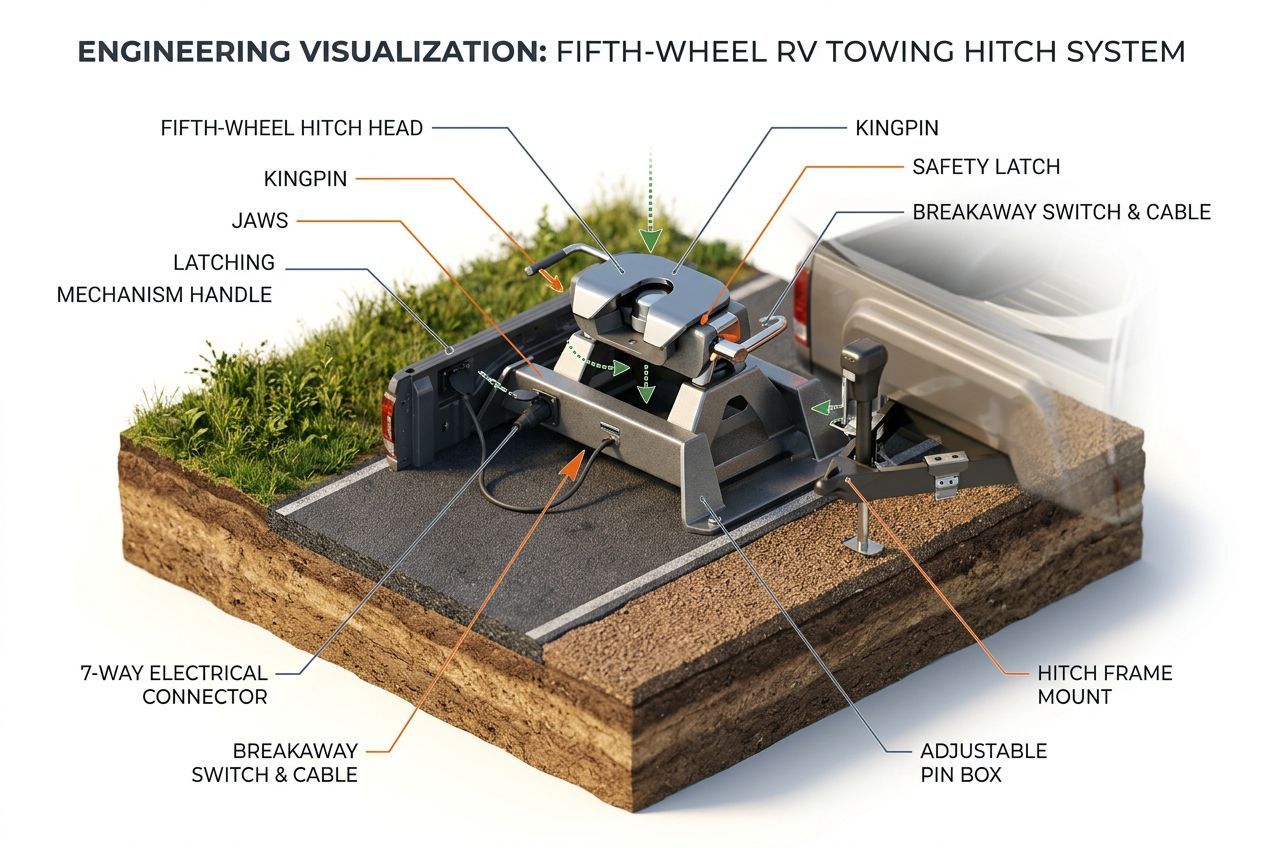
What Truck Do You Need to Tow Your RV?
Every trailer-truck combination has unique requirements based on loaded weight, hitch type, and your driving terrain. Use the tool below to get a personalized match based on your actual trailer specs.
Enter your RV type, loaded weight estimate, and truck you're considering — the estimator will flag any payload, tow rating, or tongue weight conflicts instantly.