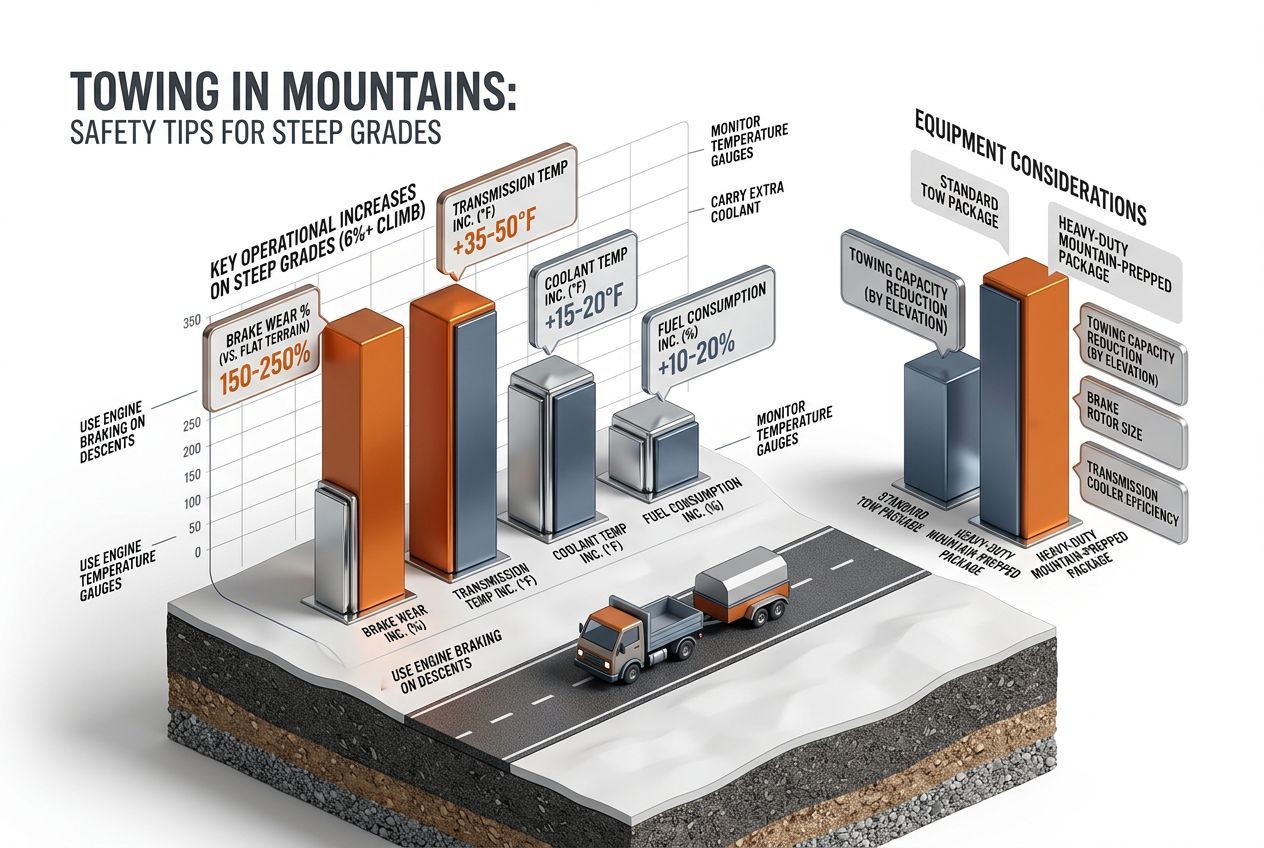
Power loss at elevation: According to SAE testing standards, naturally aspirated engines typically lose 3–4% of their horsepower for every 1,000 feet above sea level. This isn't a minor factor; at 8,000 feet—a common elevation for many Rocky Mountain passes—a non-turbo V8 engine can experience a power reduction of 25–30% from its rated output. If your truck's maximum tow rating is 9,900 lbs and you're already towing 9,500 lbs, you are effectively exceeding your usable capacity at that elevation.
Turbocharged engines offer better compensation: Turbocharged engines are designed to compensate better for thinner air by forcing more air into the combustion chamber, irrespective of ambient atmospheric pressure. Diesel engines, which are almost universally turbocharged, generally perform best at altitude among common tow vehicles. However, even turbo engines aren't entirely immune; fuel mapping and boost limits still adapt to changes in air density, which may result in slower throttle response and longer times to reach cruising speed on grades.
Real-world impact: Consider this scenario: You're towing a 7,200-lb fifth wheel with a half-ton gas truck rated for 9,900 lbs. On I-70 in Colorado, you're already operating at 73% of your rated capacity before factoring in any altitude penalty. Add a 25% power deficit at 9,000 feet, and you're effectively asking your truck to perform as if it needed 120% of its sea-level power. This is a common situation that leads to transmission overheating and spiked coolant temperatures.
✅ Pro Tip:
Plan more frequent rest stops on long climbs—at least every 30–40 miles when grades are sustained at 6% or more. Pull into a truck turnout, shift to park, and allow your cooling system to recover and normalize temperatures.
Our towing in mountains companion content covers fuel economy impacts at altitude in detail, and our RV towing MPG guide shows how grade and elevation hit your range calculations.
🛡️
RV & BOAT TOWING
What Speed Should You Maintain While Towing on Mountain Passes?
Adhere to posted limits: Most state Departments of Transportation (DOTs) recommend a speed range of 45–55 mph on mountain passes with grades of 6% or more when towing. It's critical to note that posted truck speed limits on mountain grades are frequently 10–15 mph below the general limit. Always prioritize the black-and-white regulatory signs over yellow advisory signs.
Examples of specific limits:
- On Vail Pass, the posted speed for trucks and trailers heading westbound is 45 mph.
- On the Grapevine (I-5, California), truck speeds are limited to 35 mph in some sections.
- California Vehicle Code §22406 legally restricts vehicles towing trailers to a maximum of 55 mph on freeways statewide, regardless of the higher posted freeway limit for other vehicles.
⚠️ Warning:
These speed limits are not suggestions; they are legally enforced regulations designed for safety. Ignoring them can lead to dangerous situations and costly citations.
Prioritize safety over speed: Your speed selection should always consider curve geometry and grade percentage in combination. Approaching a blind curve at 50 mph on a 7% downgrade with a 6,500-lb trailer presents a vastly different challenge than 50 mph on a straight, flat road. Give yourself significantly more stopping and reaction distance than you think you need. When on multi-lane mountain highways, always use the right lane; allow faster traffic to pass you. Your ultimate objective is to arrive safely.
Check your state's specific towing speed rules at our towing laws by state tool.
📋
RV & BOAT TOWING
How Do You Prevent Trailer Sway on Mountain Roads?
Understanding sway triggers: Trailer sway on mountain roads can be triggered by a combination of factors, including sudden crosswinds at exposed ridgelines, uneven pavement on switchbacks, and, most commonly, improper weight distribution within the trailer. Effective prevention begins long before you hit the road, specifically when loading your trailer.
Preventing sway through proper loading:
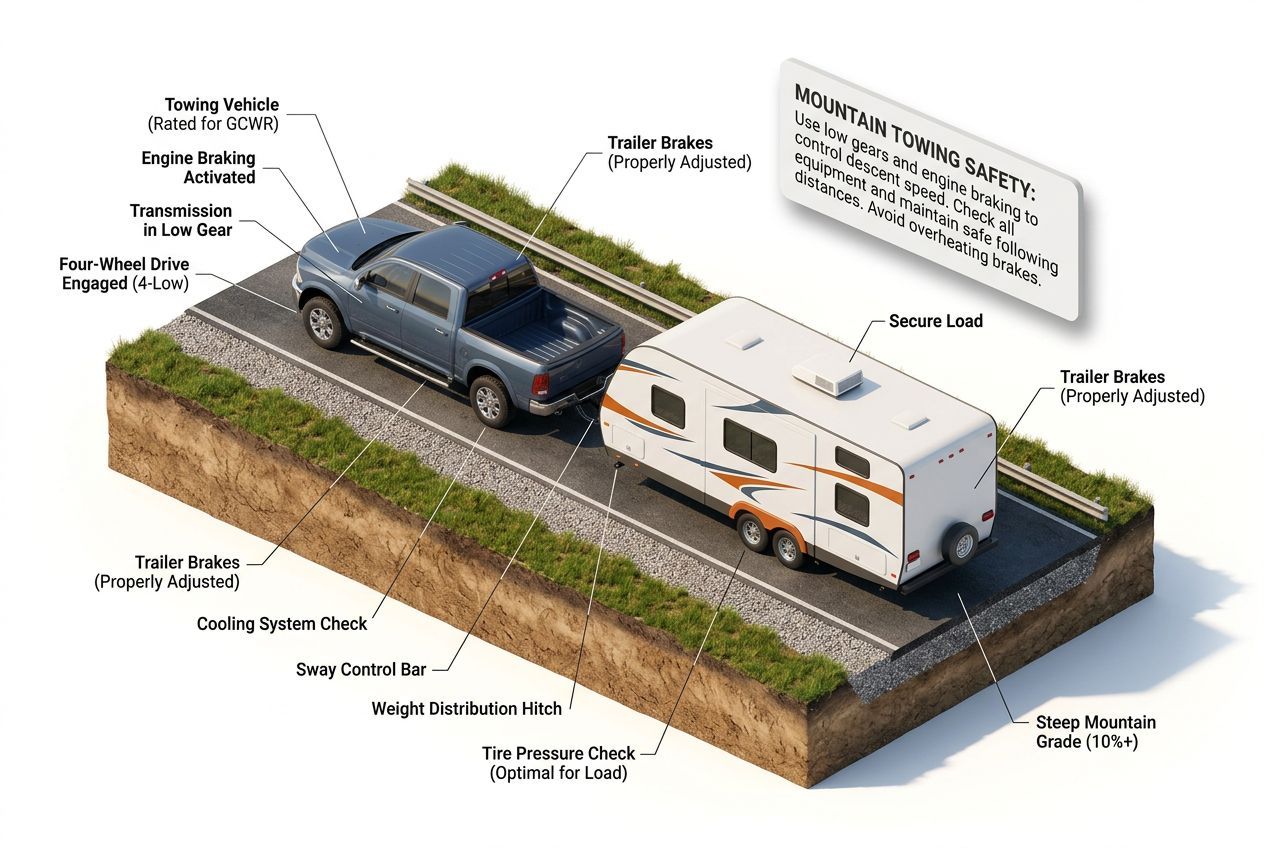
- Weight Distribution: Place approximately 60% of your cargo weight in the front half of the trailer, ensuring it's forward of the axle.
- Tongue Weight: Maintain a tongue weight that is 10–15% of the total trailer weight. For a 6,500-lb trailer, this translates to 650–975 lbs on the hitch ball.
- Weight-Distribution Hitch: If achieving the ideal tongue weight proves difficult with cargo placement alone, or if your trailer is heavy, a weight-distribution hitch is essential. Systems like a Reese Sway Control bar or an Equal-i-zer 4-point hitch effectively address both tongue weight management and enhance lateral stability.
What to do if sway starts:
If you experience trailer sway while moving, follow these steps:
- Ease off the accelerator gradually: Do NOT brake sharply, as this can worsen the sway.
- Allow the system to react: If your truck is equipped with a Trailer Sway Control system (standard on Ford trucks since 2016, and available on GM trucks as part of the Integrated Trailer Brake Controller system), the vehicle will automatically apply individual wheel brakes to help stabilize the trailer.
- Manual trailer brake application: If you have a manual trailer brake controller (e.g., a Tekonsha Prodigy P3), apply it independently. This action helps to straighten the trailer without directly affecting the tow vehicle's momentum.
💡 Key Takeaway:
Reducing your speed before every curve is the single most effective strategy for preventing trailer sway. No sway control device can fully compensate for excessive speed.
For a complete breakdown of weight-distribution setups, see our RV towing guide.
⚙️
RV & BOAT TOWING
What Equipment Do You Need for Mountain Towing?
Essential Gear for Safe Mountain Towing:
-
Brake controller: Required by law in most states for trailers over 3,000 lbs, a brake controller is an absolute necessity for any loaded trailer on a mountain grade. Proportional controllers, such as the Tekonsha Prodigy P3 and Reese Towpower Brake-Evac, are recommended. These units modulate trailer brake force based on the actual deceleration rate of your tow vehicle, providing smooth and effective stopping power crucial for mountain conditions.
-
Weight-distribution hitch: You need a weight-distribution hitch if your trailer's tongue weight exceeds 10% of your tow vehicle's curb weight. Ensure you select a system rated for at least the tongue weight you'll be carrying; never undersize your hitch (e.g., don't use a 600-lb-rated WD hitch for an 800-lb tongue weight).
-
Transmission cooler: If your truck didn't come equipped with the factory tow package (e.g., Ford F-150 option code 53A or 53C, GM option code Z82), it might lack an auxiliary transmission oil cooler. Sustained uphill grades with a heavy trailer are the quickest way to overheat and damage a transmission. Installing an aftermarket unit like a Hayden 679 or B&M SuperCooler provides meaningful protection.
-
Tire Pressure Monitoring System (TPMS): A TPMS for both your truck and trailer is highly recommended. Cold-inflation pressure at sea level will read differently at altitude and will increase significantly as tires heat up on long descents. A TPMS with a per-axle display allows you to detect a developing blowout or underinflation issue before it escalates into a dangerous trailer separation event.
-
Emergency equipment in the cab or truck bed: Always carry essential emergency gear. This includes wheel chocks (like Camco Olympian), at least one gallon of extra coolant, an accurate tire pressure gauge, and emergency triangles or LED road flares. Mountain shoulders are often narrow and roadside stops can be extremely dangerous—the faster you can establish a visible safety perimeter, the better.
For help matching equipment to your specific rig, use our towing capacity lookup tool and payload calculator.
🚛
RV & BOAT TOWING
How Do You Avoid Brake Fade When Towing Downhill?
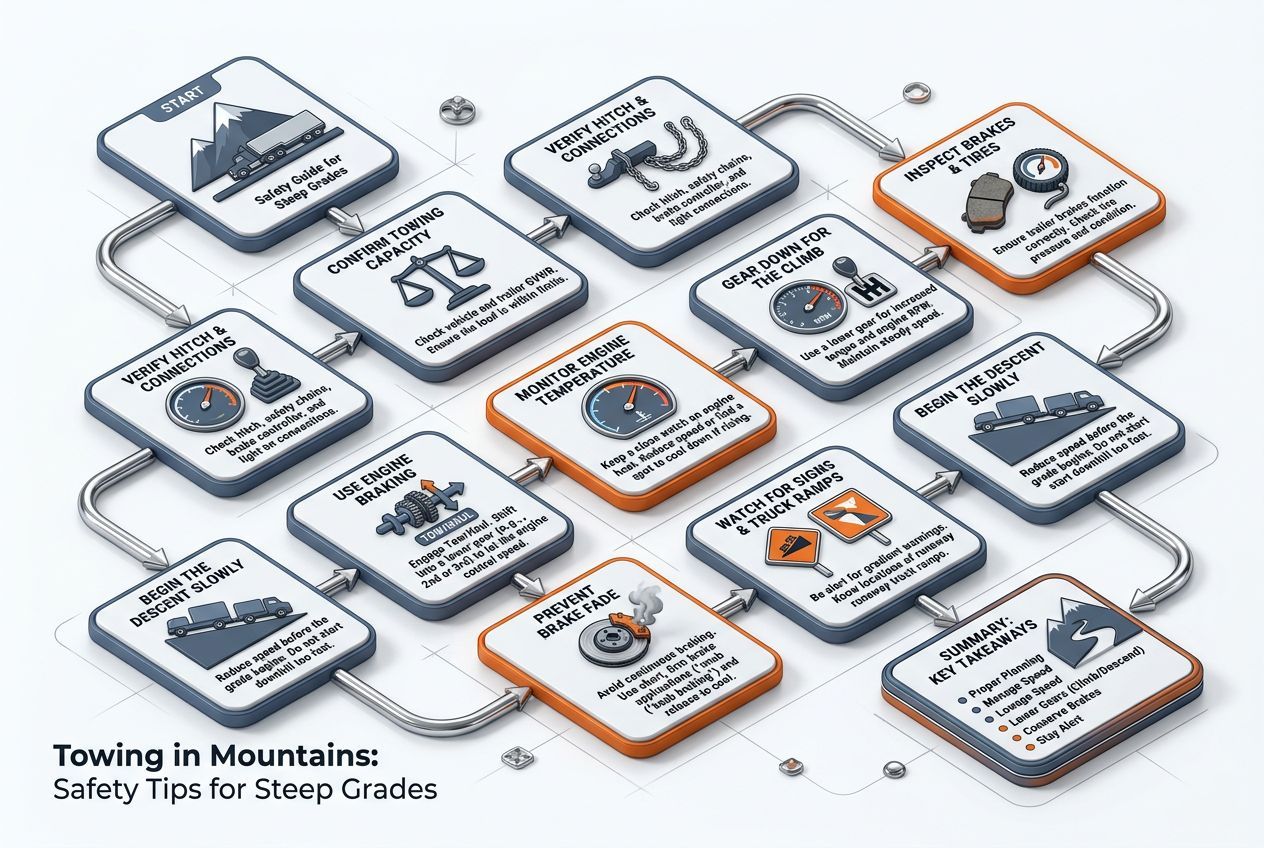
Understanding brake fade: Brake fade occurs when sustained friction causes your brake components—rotors, drums, and pads—to overheat past their thermal limits. These limits are typically around 450°F for drum brakes and 600°F for disc brakes, according to brake manufacturer specifications. Once these temperatures are exceeded, the friction material degrades, leading to a sharp and dangerous drop in stopping power. On a loaded trailer on a 7% grade, you can experience brake fade in under two miles of continuous, improper braking.
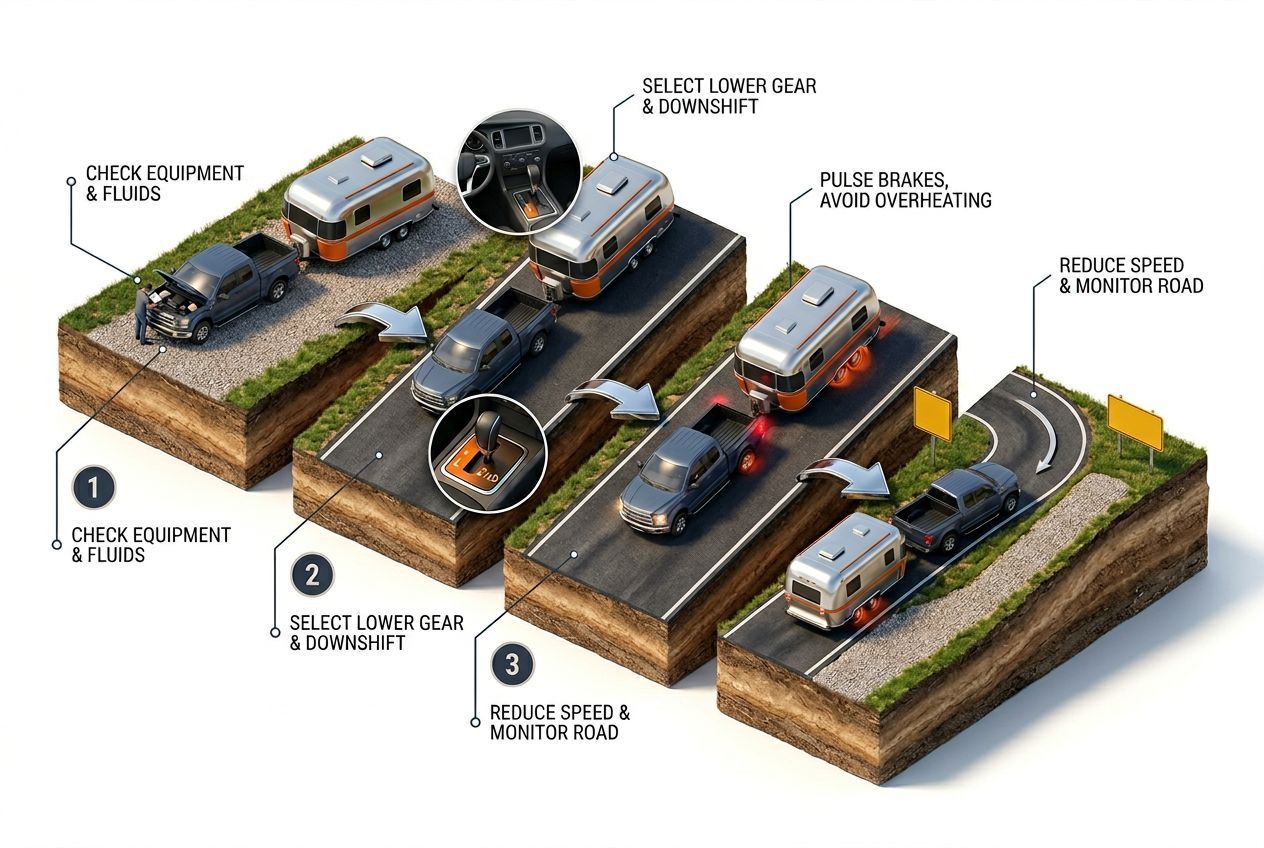
The correct technique: The primary solution is to prioritize engine braking, using your wheel brakes only as a secondary measure. Utilize your transmission to hold your speed, as detailed in the gear selection tips above. When you do apply the wheel brakes, use short, firm applications (3–5 seconds of definitive pedal pressure) rather than prolonged, light pressure. Light, sustained pressure is the primary culprit behind brake fade, as it prevents the rotors and drums from effectively dissipating heat between applications.
⚠️ Warning:
If you're running a diesel with an exhaust brake, engage it. If you're in a gas truck, pay close attention to your brake pedal feel. If it begins to feel soft or spongy before you reach the bottom of the grade, immediately pull into the next truck turnout and allow your brakes 10–15 minutes to cool down. Never attempt to push through brake fade.
Heed the warnings: NHTSA data indicates that approximately 18% of towing-related crashes involve grades steeper than 5%. Brake failure is a significant contributing factor in many of these incidents, most of which are preventable with proper technique. Familiarize yourself with the locations of runaway truck ramps on your route. For example, on westbound I-70 in Colorado, several ramps are strategically placed on the descent from the Eisenhower Tunnel. They are there for a reason, used by real trucks in real emergencies.
Our downhill towing and mountain driving resource has additional route-specific guidance. If you're heading to a boat ramp after the descent, our boat towing guide covers wet-ramp and trailering specifics that apply after you get off the mountain.