Key Takeaways
- Never shop by max tow rating alone — payload capacity is almost always the binding constraint for RV towing
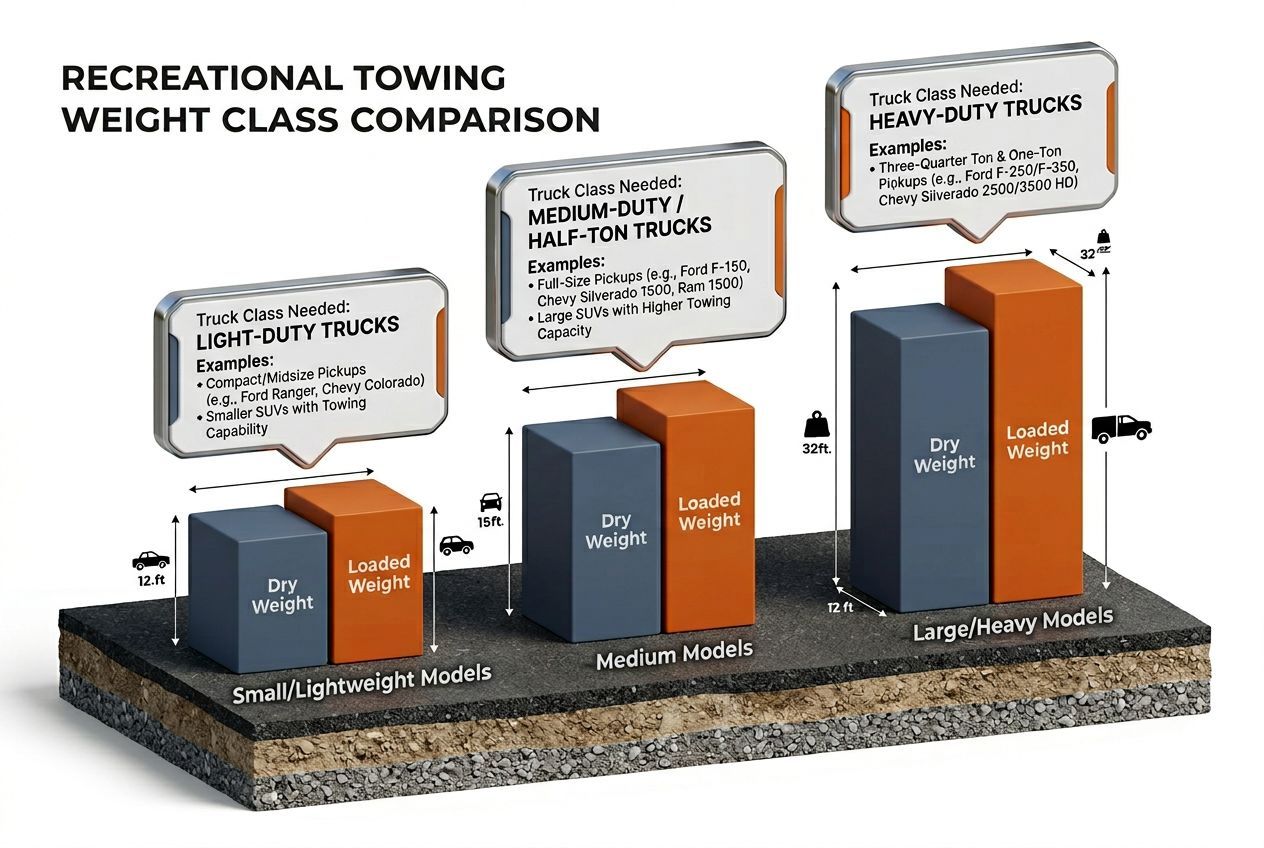
- Half-tons handle travel trailers up to ~8,000 lb GVWR; anything heavier needs a 3/4-ton or 1-ton
- The Ram 3500 with the 6.7L Cummins diesel leads all 2026 pickups at 37,100 lb conventional tow rating
- Tongue weight eats into payload fast — a 7,000-lb trailer at 12% tongue weight burns 840 lb of your payload budget before you add a single passenger
- Factory tow packages are not optional — without the factory tow package (on recent Ford F-150s, option 53A Trailer Tow or 53C Max Trailer Tow; Z82 on GM), the published max tow rating does not apply to your truck
💰
RV & BOAT TOWING
What Is the Best Truck for Towing an RV in 2026?
The best truck for towing an RV in 2026 is subjective, depending entirely on your RV's weight class. However, the Ford F-350 Super Duty consistently dominates heavy-duty fifth-wheel towing, while the Ram 1500 often leads the half-ton segment for travel trailers. No single truck wins across every category; the right pick is the one with sufficient towing capacity and enough payload margin after accounting for passengers, gear, and tongue or pin weight.
Here's how the major 2026 contenders stack up across all three weight classes. Specs are sourced directly from Ford, Ram, and Chevrolet manufacturer towing guides, assuming maximum tow packages and optimal configurations.
What Is the Best Truck for Towing an RV in 2026? — data table
| Truck |
Segment |
Max Tow Rating |
Max Payload |
Best For |
| Ram 1500 (5.7L eTorque) |
Half-ton |
12,750 lb |
2,300 lb |
Travel trailers to 8,000 lb |
| Ford F-150 (3.5L PowerBoost) |
Half-ton |
12,700 lb |
2,238 lb |
Travel trailers to 8,000 lb |
| Chevy Silverado 1500 (6.2L) |
Half-ton |
13,300 lb |
2,280 lb |
Travel trailers to 8,000 lb |
| Ford F-250 (6.7L Power Stroke) |
3/4-ton |
22,800 lb |
4,210 lb |
Fifth wheels to 16,000 lb |
| Ram 2500 (6.7L Cummins) |
3/4-ton |
23,000 lb |
4,010 lb |
Fifth wheels to 16,000 lb |
| Chevy Silverado 2500 HD (6.6L Duramax) |
3/4-ton |
22,100 lb |
3,979 lb |
Fifth wheels to 15,000 lb |
| Ford F-350 (6.7L Power Stroke) |
1-ton |
26,500 lb |
7,850 lb |
Heavy fifth wheels & toy haulers |
| Ram 3500 (6.7L Cummins, SRW) |
1-ton |
37,100 lb |
7,680 lb |
Maximum fifth-wheel capacity |
Sources: Ford Truck Towing Guide 2026 (ford.com), Ram Truck Towing & Payload Guide 2026 (ramtrucks.com), Chevrolet Silverado Towing Guide 2026 (chevrolet.com)
For a full breakdown of tow ratings beyond RV use, see our towing capacity guide.
📊
RV & BOAT TOWING
How Much Towing Capacity Do I Need for an RV?
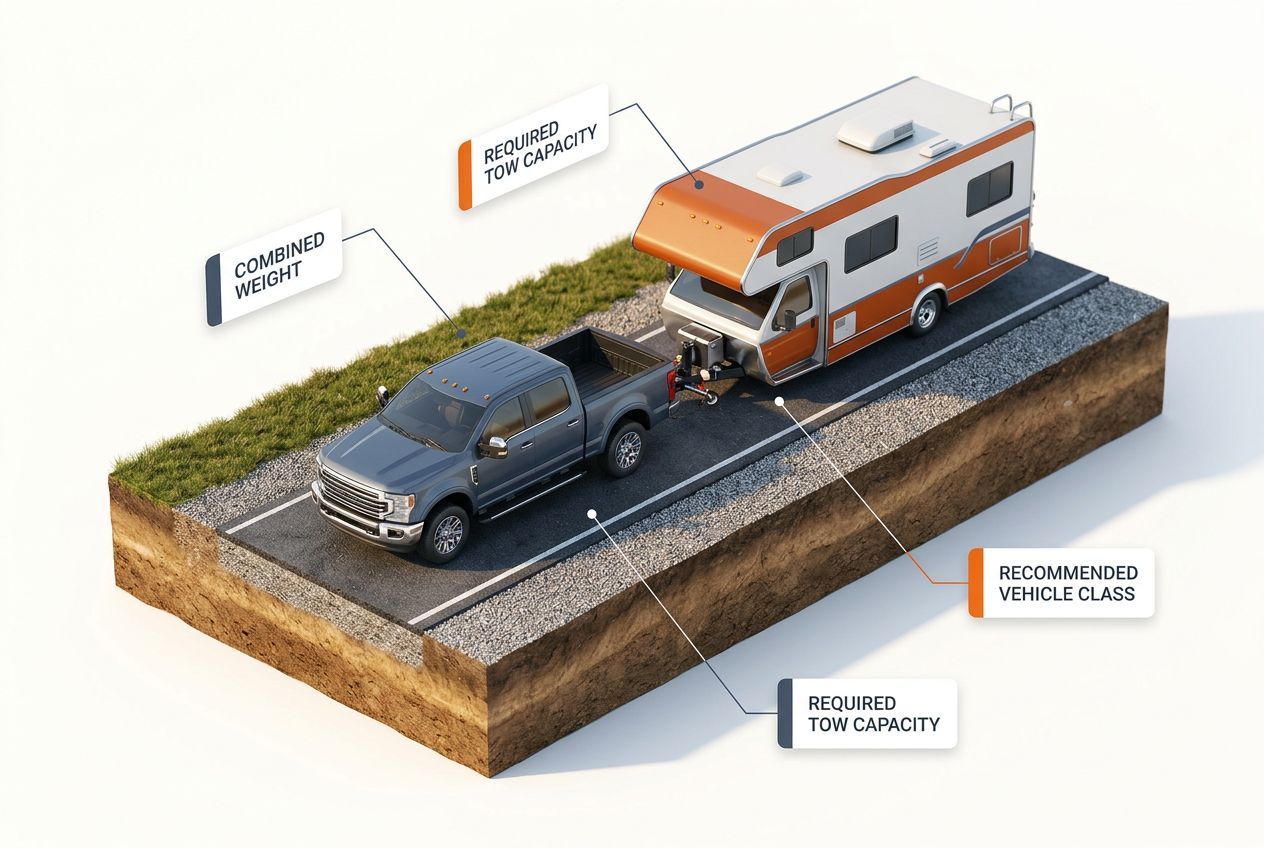
Your towing capacity should exceed your RV's fully loaded GVWR by at least 15–20%, per AAA towing safety guidelines. For example, a 7,000-lb travel trailer needs a truck rated for at least 8,500 lb — and that's before accounting for payload. Most buyers fixate on the tow rating and often overlook the payload ceiling, which is typically what limits a half-ton truck in real-world RV towing scenarios.
Here's a worked example that frequently trips up buyers:
- Trailer GVWR: 7,200 lb (28-foot travel trailer)
- Tongue Weight (12%): 864 lb
- Driver: 200 lb
- Passenger: 160 lb
- Gear in bed: 120 lb
- Total Payload Consumed: 864 lb + 200 lb + 160 lb + 120 lb = 1,344 lb
If you have a Ram 1500 with an 1,800-lb payload rating, you're already at 75% capacity with a light load of fuel, sweating the margin. In contrast, a Silverado 1500 with 2,280 lb of payload has real margin to spare.
⚠️ Warning: Don't assume any half-ton truck can handle any travel trailer just because its max tow rating looks comfortable. RVIA industry data indicates the average travel trailer GVWR is between 4,500 and 9,000 lb. Rigs at the upper end of that range can easily overwhelm a lightly optioned half-ton's payload, even if the tow rating technically clears. Use our payload calculator to run your own numbers before you buy.
📊 Quick Fact: At elevations above 5,000 feet, a naturally aspirated gas engine loses roughly 3% of its power per 1,000 feet. A truck's published max tow rating is typically tested at sea level. If you're pulling through the Colorado Rockies at 8,000 feet, your gas engine could be working with about 20% less output than advertised. Turbodiesel engines handle altitude significantly better, which is a key reason HD diesel trucks are preferred by the western mountain RV crowd. Our towing in mountains guide goes deeper on this.
🔧
RV & BOAT TOWING
Is a Half-Ton Truck Enough to Tow a Travel Trailer?
A half-ton is a solid choice for towing a travel trailer with a GVWR under 8,000 lb, provided you select the right configuration.
- Chevy Silverado 1500: The 2026 Chevy Silverado 1500 with the 6.2L V8 and Max Trailering Package edges out the F-150 and Ram 1500 with a 13,300-lb max tow rating. This makes it the top half-ton pick for best truck to tow a travel trailer at the upper end of the weight range.
- Ram 1500: The 2026 Ram 1500 with the 5.7L HEMI eTorque mild-hybrid earns recognition for its ride comfort. It's often considered the smoothest half-ton on the highway and handles trailer sway recovery well thanks to its standard Trailer Sway Damping system. If you're logging 5,000+ miles per year towing a mid-size trailer, the Ram 1500's ride quality can make a real difference on long driving days.
- Ford F-150: The 2026 Ford F-150 with the 3.5L PowerBoost full-hybrid system is the fuel-efficiency leader in the half-ton class. It returns about 24 MPG city unloaded and roughly 13–15 MPG towing a 7,000-lb trailer, which is best in class for that scenario. Ford's Pro Trailer Backup Assist also comes standard on most trim levels, offering a genuine advantage if you're new to backing a trailer into a campsite. For detailed tips on exactly how to handle travel trailer towing, check out our travel trailer towing tips guide.
⚠️ Warning: Half-tons realistically top out around 9,000–9,900 lb in real-world, fully-loaded RV scenarios once payload is factored in. If your loaded fifth-wheel hits 12,000 lb, no half-ton is the right truck. You absolutely need a 3/4-ton at minimum for that kind of weight.
🛡️
RV & BOAT TOWING
What Are the Best 3/4-Ton and 1-Ton Trucks for Fifth Wheels?
For RVs over 12,000 lb, the Ram 2500 and Ram 3500 with the 6.7L Cummins turbodiesel are top contenders, leading their respective segments in max tow rating and payload. The Ford F-250/F-350 with the 6.7L Power Stroke and the Chevy Silverado 2500 HD/3500 HD with the 6.6L Duramax are both formidable alternatives, supported by strong dealer networks and broad trim availability.
- Ram Heavy-Duty (2500/3500): Often leads in maximum conventional and fifth-wheel tow ratings, particularly with the High Output Cummins diesel engine. Excellent for heavy fifth wheels and toy haulers.
- Ford Super Duty (F-250/F-350): Offers strong payload capacity and the powerful Power Stroke diesel. The F-350 with its high payload is ideal for large fifth wheels and can sometimes rival dual-rear-wheel trucks for certain applications.
- Chevy Silverado HD (2500 HD/3500 HD): Known for its comfortable ride and competitive Duramax diesel engine, offering robust towing capabilities for large RVs.
💡 Key Takeaway: For fifth wheels specifically, pin weight capacity is as critical as the overall tow rating. RVIA data shows most fifth-wheel GVWRs between 12,000 and 20,000 lb, with pin weights typically running 18–25% of the trailer's loaded weight. A 16,000-lb fifth wheel can generate 2,880–4,000 lb of pin weight, which counts directly against your truck's payload. A Ram 3500 with 7,680 lb of max payload handles that comfortably, while a 3/4-ton with 3,800–4,200 lb of payload will be tighter but workable for rigs in the 14,000–16,000-lb range.
The 2026 F-350 Super Duty introduced Ford's latest-generation trailer sway mitigation, which uses steering input—not just braking—to correct a swaying trailer. It's considered the most sophisticated factory sway control system in the 1-ton segment for this model year. For in-depth guidance on fifth-wheel towing setups, our 5th wheel towing guide covers hitch selection, weight distribution, and brake controller setup. You can also compare truck options by RV type using our RV towing guide.
📋
RV & BOAT TOWING
Diesel vs Gas: Which Is Better for RV Towing?
Diesel engines generally win for RV towing above 10,000 lb due to their superior low-RPM torque, better fuel economy under load, and stronger engine braking on descents. Gas trucks, on the other hand, typically cost $8,000–$12,000 less upfront and are simpler to maintain, making them ideal for lighter-duty towing under 8,000 lb. The break-even point on fuel savings for diesel typically hits around 10,000–15,000 towing miles per year.
- Diesel Advantages:
- Torque: More low-RPM torque for easier climbing and less transmission strain.
- Fuel Economy: Generally better MPG while towing heavy loads.
- Engine Braking: Superior control on descents, reducing brake wear.
- Durability: Often designed for higher mileage and heavier workloads.
- Gas Advantages:
- Cost: Lower upfront purchase price.
- Maintenance: Generally simpler and less expensive to maintain.
- Fuel Availability: Gasoline is more widely available than diesel.
📊 Quick Fact: According to DOE fuel economy data, gas trucks typically cost $0.22–$0.32 per mile when towing at moderate loads. Diesel trucks running the same loads can run $0.18–$0.25 per mile. Over 15,000 towing miles annually, that $0.05–$0.07/mile difference translates to savings of $750–$1,050 per year. While meaningful, it still takes several years to offset the initial diesel price premium.
For RV towing specifically, diesel's torque advantage matters most on grades. The 6.7L Cummins in the 2026 Ram 2500, for example, produces 1,000 lb-ft of torque starting at just 1,500 RPM. This means it pulls strongly without needing to rev high, significantly reducing transmission heat and wear during sustained mountain grades. Gas engines in half-tons typically produce 400–500 lb-ft and need to work considerably harder to maintain highway speed on a 6% grade with a heavy trailer in tow.
For more detail on how towing affects your fuel costs, our RV towing MPG guide breaks down real-world economy figures for each major model. If you're a motorhome owner instead — looking for a vehicle to tow behind your coach — see our flat tow compatible vehicles list for 2026 dinghy-approved models.

⚙️
RV & BOAT TOWING
How Do I Match My Truck to My RV?
Matching a truck to your RV requires checking four numbers simultaneously: the trailer's GVWR, tongue/pin weight, the truck's GCWR (Gross Combined Weight Rating), and the truck's available payload. Max tow rating alone tells you almost nothing useful if any of the other three numbers aren't in range.
Use our Tow Vehicle Matchmaker tool to enter your RV's specs and instantly see which 2026 trucks clear every threshold — with payload buffer shown so you can account for passengers and gear.