Skip to content
⚙️ TRAILER & PAYLOAD

Trailer Tongue Jack: Types, Weight Ratings, and How to Choose the Right One

Published · Updated · 12 min read
MarkUpdated Apr 15, 2026Bulldog by Cequent

Key Takeaways

  • ✓Size your jack to **at least 125%** of your trailer tongue weight
  • ✓A-frame jacks are the most common type — bolt-on installation in **30 minutes**
  • ✓Electric jacks cost **$150-$400** but eliminate manual cranking on heavy trailers
  • ✓Swivel jacks fold horizontal to prevent ground strikes while towing
  • ✓Grease the inner tube every **3-6 months** to prevent rust seizure

Key Takeaways

  • Size your jack to at least 125% of your trailer's tongue weight
  • A-frame jacks bolt on in 30 minutes — the most common type for bumper-pull trailers
  • Electric jacks cost $150-$400 but eliminate manual cranking
  • Swivel jacks fold horizontal while towing to prevent ground strikes
  • Grease the inner tube every 3-6 months — rust seizure is the #1 failure mode

The tongue jack does one job — raise and lower the front of your trailer for hitching and unhitching — but it's one of the most-used components on any trailer. A jack that's undersized, seized from rust, or poorly mounted turns a 5-minute hitch-up into a 30-minute ordeal. Understanding tongue weight, jack types, and weight ratings helps you pick the right jack the first time and maintain it so it works every time you need it.

Before choosing a jack, know your trailer's tongue weight — it determines the minimum weight rating you need.


💰
TRAILER & PAYLOAD

What Are the Different Types of Trailer Tongue Jacks?

Tongue jacks come in four main types, each designed for different trailer sizes and use cases. The mounting style and trailer design dictate which type fits.

What Are the Different Types of Trailer Tongue Jacks? — data table
Jack Type Weight Rating Range Price Range Best For
A-Frame Manual 1,000-5,000 lbs $30-$80 Utility trailers, small boat trailers
A-Frame Electric 2,000-5,000 lbs $150-$400 Travel trailers, frequent hitching
Swivel (Bolt-On) 1,000-3,500 lbs $40-$100 Boat trailers, low-clearance trailers
Side-Wind (Pipe Mount) 1,000-10,000 lbs $25-$60 Heavy utility trailers, car haulers

Source: Bulldog, Lippert Components, Curt Manufacturing specifications

A-Frame jacks mount to the trailer's A-frame tongue with two bolts. The tube extends straight down and cranks with a top-mounted handle. This is the most common type on travel trailers, enclosed cargo trailers, and larger boat trailers. They're simple, strong, and the easiest to replace.

Swivel jacks pivot at the mounting point. When hitched, you swing the jack up and horizontal so it rides above the ground. When unhitched, swing it down and crank to support the tongue. Swivel jacks prevent the jack foot from dragging on the ground or catching on obstacles while towing — a common problem with fixed A-frame jacks that don't retract high enough.

Side-wind jacks mount to a vertical pipe welded to the trailer tongue rather than bolting to an A-frame. The crank handle sits on the side rather than the top. These are common on heavy-duty utility trailers and car haulers that use a pipe-style tongue instead of an A-frame.

Pro Tip: If your A-frame jack drags on driveways or speed bumps while towing, switch to a swivel jack or add a removable caster wheel to the foot pad. A dragging jack wears down the foot, damages driveways, and can catch on road imperfections at speed.
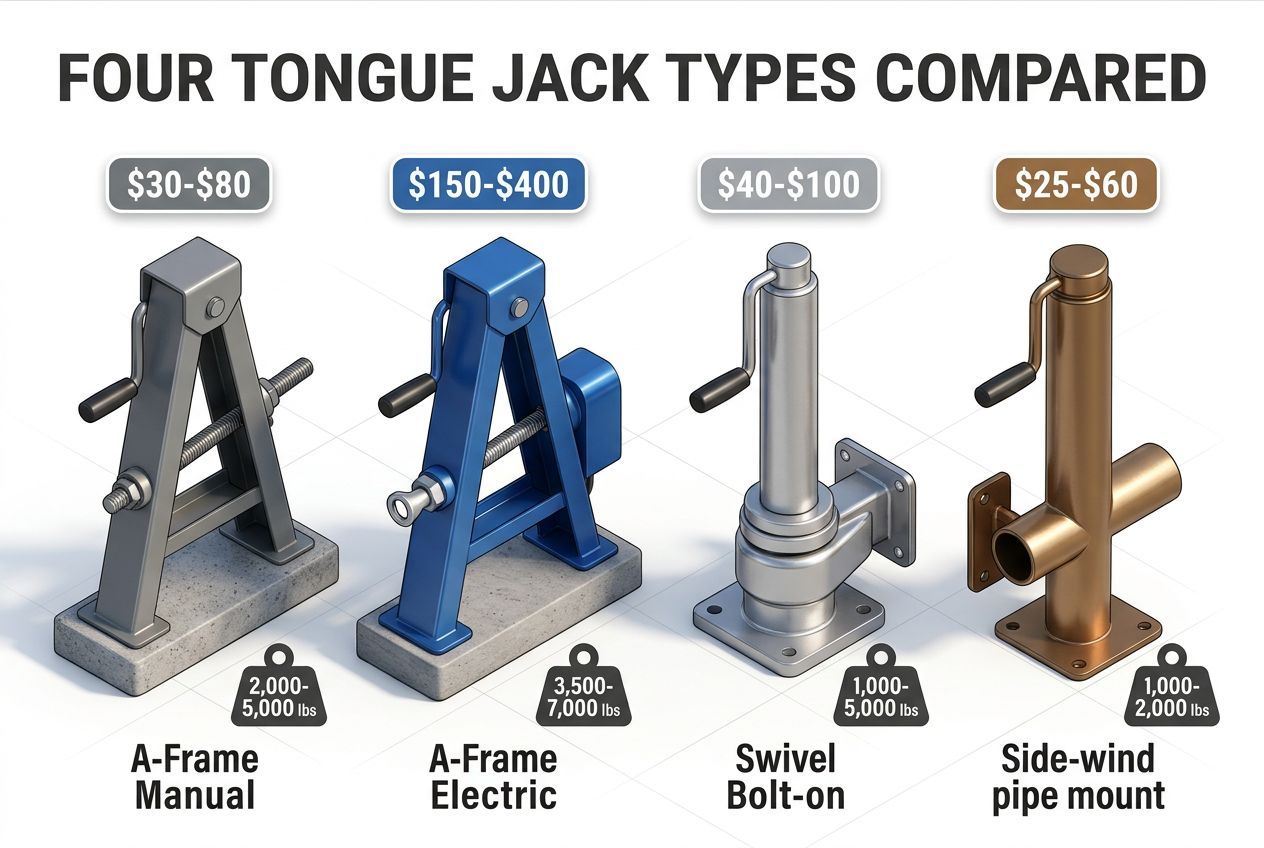

Four trailer tongue jack types compared A-frame electric swivel and side-wind with ratings
📊
TRAILER & PAYLOAD

How Do You Size a Tongue Jack for Your Trailer?

Undersizing a tongue jack is the most common mistake trailer owners make. A jack rated at exactly your tongue weight is already at 100% capacity — one soft spot in the ground and the jack fails or bends.

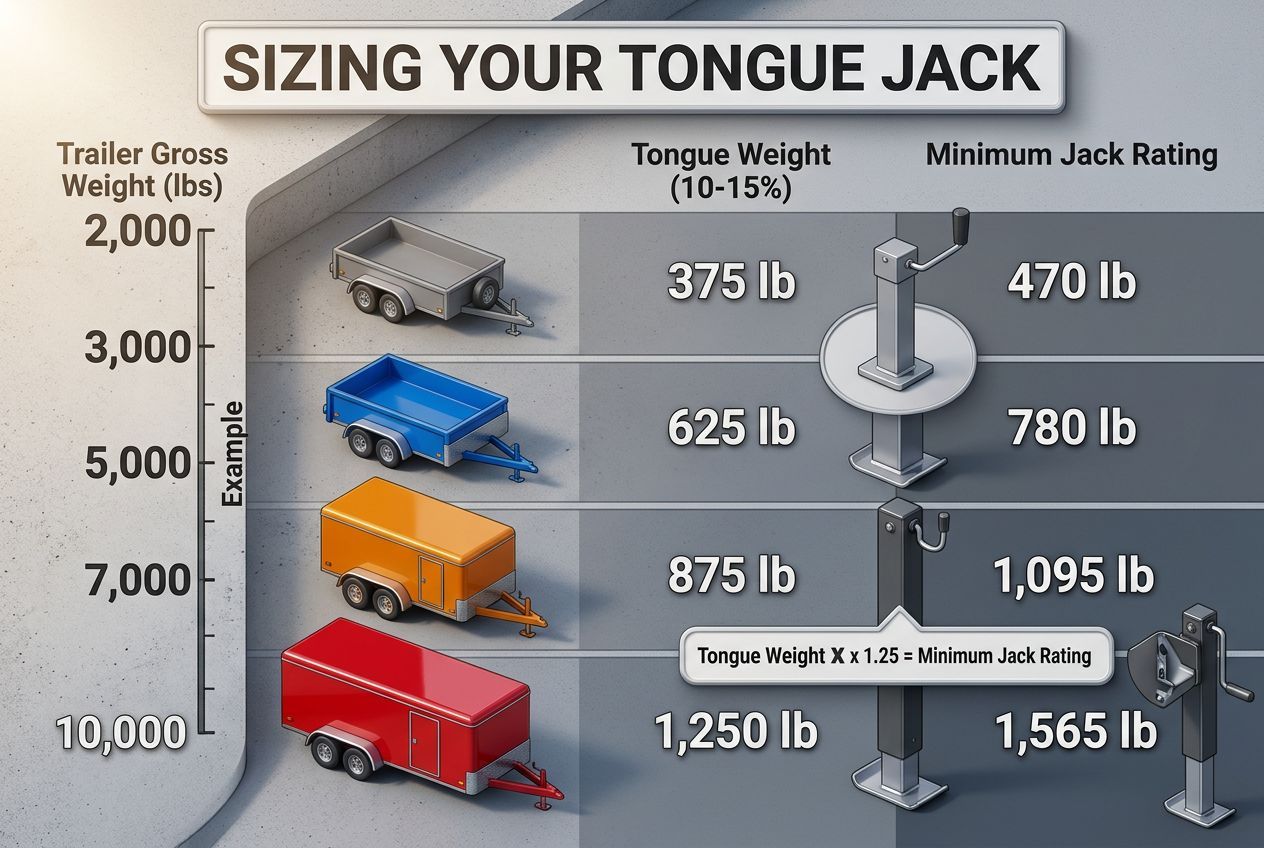
The formula: Tongue Weight × 1.25 = Minimum Jack Rating

Your trailer's tongue weight is typically 10-15% of the Gross Trailer Weight (GTW). Here's how that scales:

How Do You Size a Tongue Jack for Your Trailer? — data table
Trailer GTW Est. Tongue Weight Min Jack Rating Recommended Jack
2,000 lbs 200-300 lbs 375 lbs 1,000 lb A-frame
3,500 lbs 350-525 lbs 650 lbs 1,000 lb A-frame
5,000 lbs 500-750 lbs 940 lbs 1,500 lb A-frame
7,000 lbs 700-1,050 lbs 1,310 lbs 2,000 lb A-frame or electric
10,000 lbs 1,000-1,500 lbs 1,875 lbs 2,500 lb electric

Source: Industry standard tongue weight calculations, RVIA guidelines

The pin weight for fifth-wheel trailers is different — it's 15-25% of GTW and requires a much heavier landing gear system rather than a tongue jack. This guide covers conventional bumper-pull trailers only.

Measure, don't estimate. Tongue weight changes based on how you load the trailer. A trailer loaded with heavy items at the rear can shift from 12% tongue weight to 7% — or vice versa with forward-heavy loading. Use a tongue weight scale or take your loaded trailer to a truck scale for an accurate number.

Common Mistake: Using a 1,000 lb jack on a 7,000 lb travel trailer because "it came with the trailer." Factory jacks are often undersized to save costs. A loaded travel trailer can easily exceed 1,000 lbs of tongue weight when water tanks, propane, and gear are added. Upgrade to at least a 2,000 lb rated jack.
Try Our Free Truck Towing Capacity Lookup


Trailer tongue jack sizing guide showing GTW to tongue weight to minimum jack rating formula
🔧
TRAILER & PAYLOAD

Should You Upgrade to an Electric Tongue Jack?

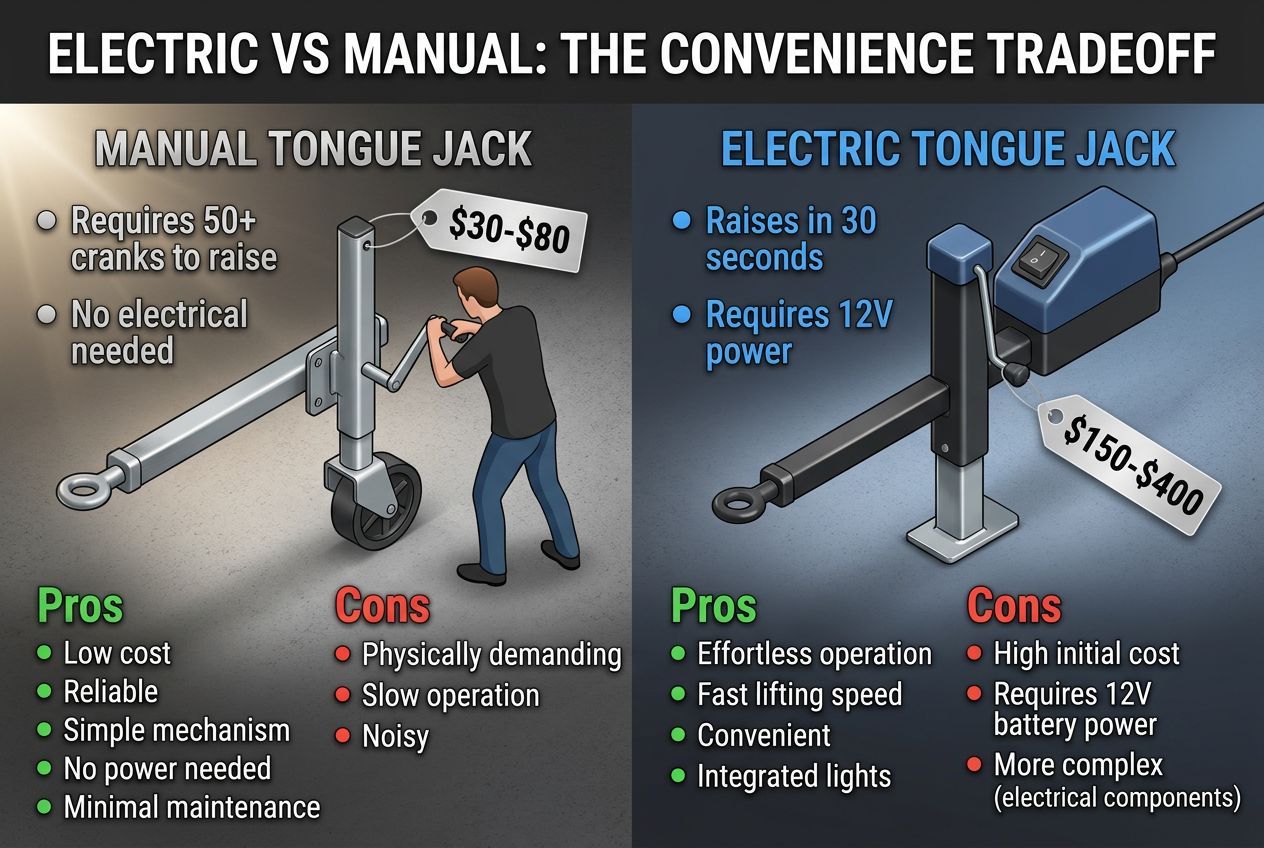
Electric tongue jacks use a 12V DC motor to extend and retract the jack tube at the push of a button or flip of a switch. No cranking, no effort, no sore arms after lifting 800 lbs of tongue weight.

When electric is worth it:

  • Tongue weight over 500 lbs (cranking gets old fast)
  • Frequent hitching and unhitching (weekend campers, boat launchers)
  • Physical limitations that make cranking difficult
  • Travel trailers with slide-outs that change tongue weight when deployed

When manual is fine:

  • Light trailers under 3,000 lbs with low tongue weight
  • Occasional use (a few times per year)
  • Budget-conscious builds where $150-$400 matters
  • Situations where 12V power isn't readily available

Electric jacks draw power from the trailer battery or the 7-pin connector's 12V auxiliary circuit. Most draw 25-35 amps during operation, so ensure your trailer battery can handle the load. A dead trailer battery means your electric jack won't work — always carry a manual backup crank or a small jump pack.

Top electric tongue jack brands include Bulldog (the industry standard), Lippert (common on new RVs), and Husky. Prices range from $150 for basic 2,000 lb models to $400 for 3,500 lb units with LED work lights and built-in level indicators.

Key Insight: Many electric jacks include an override handle socket that lets you crank manually if the motor dies. Check that your model has this feature before you buy — a motor failure at a remote campsite without manual override means you can't unhitch.


Electric versus manual trailer tongue jack comparison showing price effort and convenience trade-offs

🛡️
TRAILER & PAYLOAD

How Do You Install a Trailer Tongue Jack?

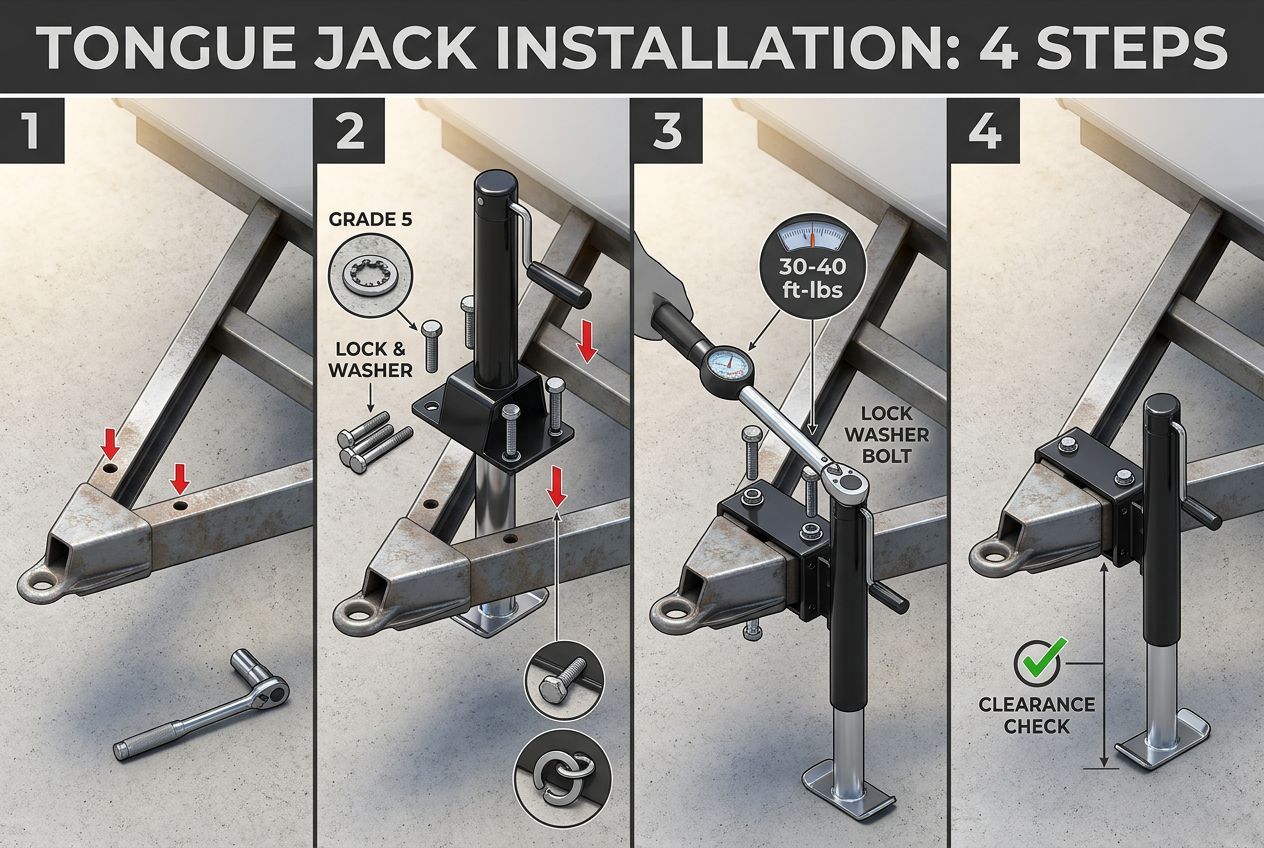
Installing or replacing an A-frame tongue jack takes about 30 minutes with basic hand tools. Electric jacks add another 15-30 minutes for wiring.

For A-Frame manual jacks:

  1. Remove the old jack. Support the trailer tongue on a stable block or jack stand. Remove the two mounting bolts securing the old jack to the A-frame. These are typically 1/2" or 9/16" bolts.

  2. Position the new jack. Slide the new jack's mounting bracket over the A-frame. Align the bolt holes. If the holes don't match (different brands use different patterns), drill new holes using the jack's bracket as a template. Use a step drill bit on thin A-frame walls.

  3. Install mounting hardware. Use Grade 5 or Grade 8 bolts with lock washers and nylock nuts. Torque to the manufacturer's specification — typically 30-40 ft-lbs for 1/2" bolts. Do not use standard nuts without lock washers — vibration will loosen them.

  4. Test the jack. Crank it fully extended and fully retracted. Check for smooth operation and any binding. Apply marine-grade grease to the inner tube before first use.

For electric jacks, add these steps:

  1. Mount the jack using the same A-frame bolt pattern as manual jacks.

  2. Run the power wires. Connect the positive (red) wire to the trailer battery or 12V auxiliary circuit through a 40-amp inline fuse. Connect the negative (black) wire to the trailer frame ground.

  3. Mount the switch or remote inside the tongue tool box or on the A-frame where it's accessible.

  4. Test both directions. Run the jack fully up and fully down. Listen for unusual motor sounds. Check current draw if possible — a healthy motor draws 25-35 amps under load.

Pro Tip: Before removing the old jack, mark its position on the A-frame with a paint pen. This gives you a reference point if the new jack has a slightly different footprint. Also measure the old jack's extended height — your new jack needs to lift the coupler at least to ball height on your tow vehicle.


Trailer tongue jack installation steps showing A-frame mounting bolts and torque specifications
📋
TRAILER & PAYLOAD

How Do You Maintain a Trailer Tongue Jack?

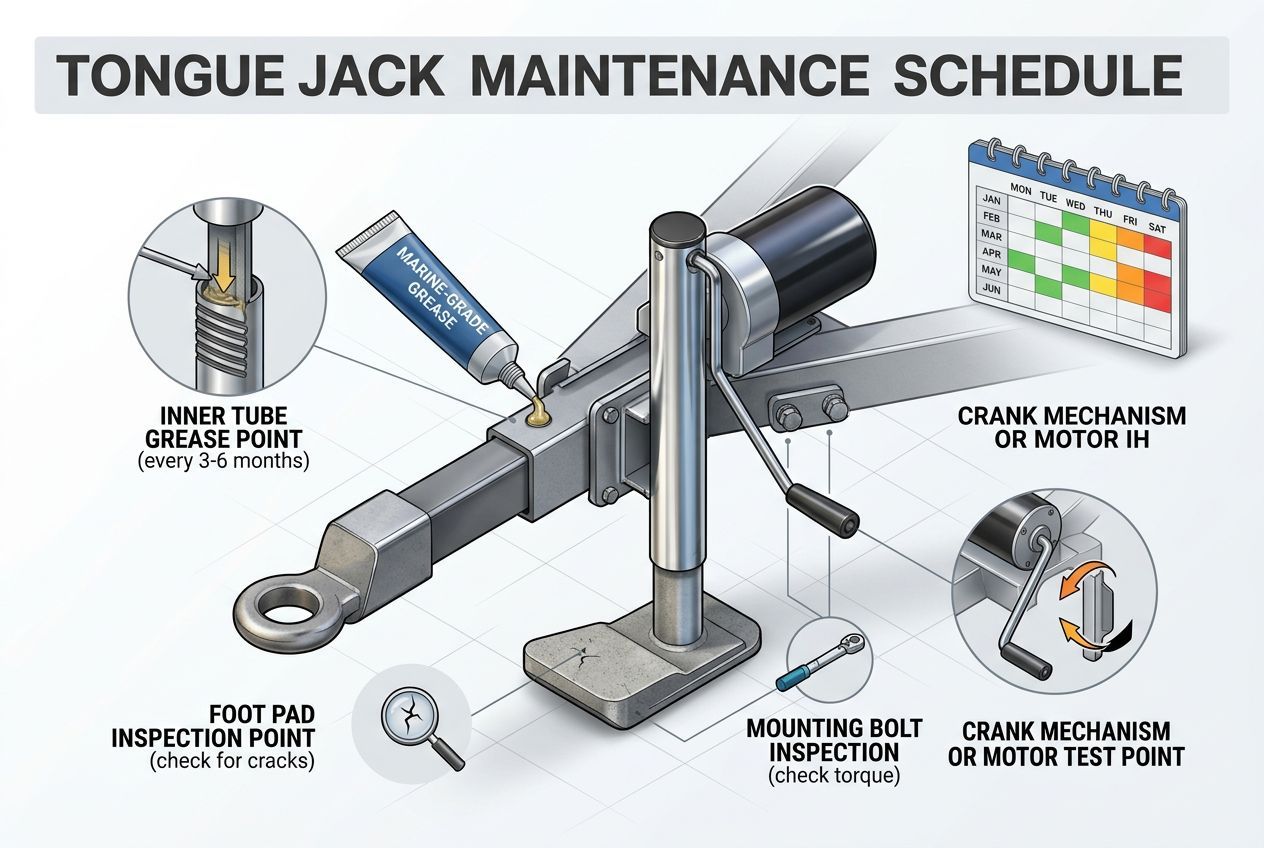
Tongue jacks fail from rust, not from mechanical wear. The inner tube slides inside the outer housing, and any moisture that gets between them starts corroding within weeks. Regular maintenance prevents the most common failure: a seized jack that won't crank up or down.

Every 3-6 months (or before each towing season):

  • Fully extend the jack and wipe down the inner tube
  • Apply a thin coat of marine-grade grease (not WD-40 — it's a solvent, not a lubricant)
  • Check the foot pad for cracks or missing rubber
  • Inspect mounting bolts for tightness — re-torque if loose
  • Test the crank handle for smooth operation through full range

For electric jacks, additionally:

  • Check all wiring connections for corrosion
  • Test the motor in both directions with no load
  • Inspect the motor housing for water intrusion
  • Clean battery terminals if connected to trailer battery
  • Verify the inline fuse hasn't corroded

Replace the jack if: the inner tube is visibly bent (common from hitting objects while towing), the gears strip and skip under load, the outer housing has structural cracks, or rust has seized the tube despite lubrication attempts.

Store your trailer with the tongue jack retracted and the coupler on a block. A fully extended jack sitting in standing water for months is the fastest path to a seized tube. If you must store with the jack extended, cover the tube with a jack cover or PVC pipe sleeve.

Common Mistake: Using WD-40 as a lubricant on the tongue jack tube. WD-40 displaces water initially but evaporates and leaves no lasting lubrication film. Marine-grade grease or white lithium grease stays in place and provides long-term protection against rust and binding. Apply it with a rag along the full length of the inner tube.


Trailer tongue jack maintenance checklist showing greasing inspection and 3-6 month schedule

Sources & Methodology

  1. 1.
    Bulldog by Cequent — Tongue jack specifications, weight ratings, and installation guides for A-frame and swivel models.
  2. 2.
    Lippert Components — Electric and manual tongue jack technical documentation for RV and travel trailer applications.
  3. 3.
    Curt Manufacturing — A-frame jack mounting standards, bolt patterns, and compatibility guides.
  4. 4.
    RV Industry Association — Trailer component standards, safety guidelines, and weight rating classifications.
  5. 5.
    SAE International — Engineering standards for trailer coupling and support equipment.

TowingServiceHub is reader-supported: we may earn money from ads and from some links on this page. See our editorial policy.

Mark — Founder & Editor

Mark

Founder & Editor

Mark is the founder and editor of TowingServiceHub, which he launched in 2026 after struggling to find clearly sourced towing costs and truck specs. He works in enterprise technology and tows his own boats, trailers, and equipment, so he knows the questions drivers actually ask.

Read full bio →

Need a tow truck right now?

Browse vetted local providers in your area. Real Google ratings, verified business info, free to use.

Or browse all 50 states from our directory

Frequently Asked Questions

Your tongue jack should be rated for at least your trailer's tongue weight plus a 25% safety margin. Most trailers have a tongue weight of 10-15% of their gross trailer weight. A 5,000 lb trailer typically has 500-750 lbs of tongue weight, so a 1,000 lb rated jack provides adequate margin. Check your trailer's tongue weight sticker or measure with a tongue weight scale.

An A-frame jack mounts to the trailer's A-frame tongue with two bolts and stays in a fixed vertical position. A swivel jack pivots to fold horizontally when the trailer is hitched, reducing the chance of ground strikes while towing. Swivel jacks are preferred for travel trailers and boat trailers that encounter uneven terrain.

Electric tongue jacks eliminate the manual cranking required to raise and lower the trailer tongue. They cost $150-$400 compared to $30-$80 for manual jacks, but they save significant effort — especially for heavier trailers with 800+ lbs of tongue weight. If you hitch and unhitch frequently, an electric jack pays for itself in convenience.

Grease the inner tube and gears every 3-6 months with marine-grade grease. Inspect the foot pad for cracks and the mounting bolts for looseness before each tow. For electric jacks, check the wiring connections for corrosion and test the motor in both directions. Replace the jack if the tube is bent or the gears strip.

Yes, most electric tongue jacks use the same A-frame bolt pattern as manual jacks. Installation takes 30-60 minutes with basic tools. You need to run a 12V power wire from the trailer battery or a direct connection to the 7-pin connector's auxiliary power circuit. Make sure the electric jack's weight rating matches or exceeds your manual jack's rating.

Related Articles

Explore More Towing Guides

Browse all 157 expert guides and 10 free tools.